Results by title
200 books match the query 'Sociology of Religion' and 22 start with s
Sacred Divorce
Religion, Therapeutic Culture, and Ending Life PartnershipsJenkins, Kathleen E
Rutgers University Press, 2014
For more than five years, Jenkins observed religious support groups and workshops for the divorced and interviewed religious practitioners in the midst of divorces, along with clergy members who advised them. Her findings appear here in the form of eloquent and revealing stories about individuals managing emotions in ways that make divorce a meaningful, even sacred process. Clergy from mainline Protestant denominations to Baptist churches, Jewish congregations, Unitarian fellowships, and Catholic parishes talk about the concealed nature of divorce in their congregations. Sacred Divorce describes their cautious attempts to overcome such barriers, and to assemble meaningful symbols and practices for members by becoming compassionate listeners, delivering careful sermons, refitting existing practices like Catholic annulments and Jewish divorce documents (gets), and constructing new rituals.
With attention to religious, ethnic, and class variations, covering age groups from early thirties to mid-sixties and separations of only a few months to up to twenty years, Sacred Divorce offers remarkable insight into individual and cultural responses to divorce and the social emotions and spiritual strategies that the clergy and the faithful employ to find meaning in the breach. At once a sociological document, an ethnographic analysis, and testament of personal experience, Sacred Divorce provides guidance, strategies and answers to readers looking for answers and those looking to heal.
Santeria Enthroned
Art, Ritual, and Innovation in an Afro-Cuban ReligionDavid H. Brown
University of Chicago Press, 2003
Focusing on the royal throne as a potent metaphor in Santería belief and practice, Brown shows how negotiation among ideologically competing interests have shaped the religion's symbols, rituals, and institutions from the nineteenth century to the present. Rich case studies of change in Cuba and the United States, including a New Jersey temple and South Carolina's Oyotunji Village, reveal patterns of innovation similar to those found among rival Yoruba kingdoms in Nigeria. Throughout, Brown argues for a theoretical perspective on culture as a field of potential strategies and "usable pasts" that actors draw upon to craft new forms and identities—a perspective that will be invaluable to all students of the African Diaspora.
American Acemy of Religion Award for Excellence in the Study of Religion (Analytical-Descriptive Category)
Secrecy
Silence, Power, and ReligionHugh B. Urban
University of Chicago Press, 2021
With Secrecy, Urban investigates several revealing instances of the power of secrecy in religion, including nineteenth-century Scottish Rite Freemasonry, the sexual magic of a Russian-born Parisian mystic; the white supremacist BrüderSchweigen or “Silent Brotherhood” movement of the 1980s, the Five Percenters, and the Church of Scientology. An electrifying read, Secrecy is the culmination of decades of Urban’s reflections on a vexed, ever-present subject.
Seeking the Straight and Narrow
Weight Loss and Sexual Reorientation in Evangelical AmericaLynne Gerber
University of Chicago Press, 2011
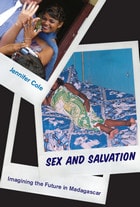
Sex and Salvation
Imagining the Future in MadagascarJennifer Cole
University of Chicago Press, 2010
Sex and Salvation chronicles the coming of age of a generation of women in Tamatave in the years that followed Madagascar’s economic liberalization. Eager to forge a viable future amid poverty and rising consumerism, many young women have entered the sexual economy in hope of finding a European husband. Just as many Westerners believe that young people break with the past as they enter adulthood, Malagasy citizens fear that these women have severed the connection to their history and culture.
Jennifer Cole’s elegant analysis shows how this notion of generational change is both wrong and consequential. It obscures the ways young people draw on long-standing ideas of gender and sexuality, it ignores how urbanites relate to their rural counterparts, and it neglects the relationship between these husband-seeking women and their elders who join Pentecostal churches. And yet, as talk about the women circulates through the city’s neighborhoods, bars, Internet cafes, and churches, it teaches others new ways of being.
Cole’s sophisticated depiction of how a generation’s coming of age contributes to social change eschews a narrow focus on crisis. Instead, she reveals how fantasies of rupture and conceptions of the changing life course shape the everyday ways that people create the future.
Shades of White Flight
Evangelical Congregations and Urban DepartureMark T. Mulder
Rutgers University Press, 2015
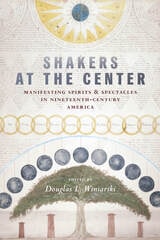
Shakers at the Center
Manifesting Spirits & Spectacles in Nineteenth-Century AmericaEdited by Douglas L. Winiarski
University of Massachusetts Press, 2026
Exploring the theological, social, and cultural dimensions of one of America’s most ambitious prophetic movements
The Shakers’ Era of Manifestations ranks among the most astounding events in American religious history. During the 1840s, members of the United Society of Believers in Christ’s Second Appearing embarked on an audacious project of receiving visions, revelations, and other manifestations from the spirit world and convincing both themselves and the world’s people of their reality. Gifted Shakers known as “instruments” surrendered their bodies to possessing spirits and celestial beings who, in turn, provided the Believers with an unimaginable number of revelatory communications that collapsed time and space, rewrote the Bible, and vastly expanded traditional Protestant beliefs and practices. The fruits of Shaker spiritualism would gain a permanent place in America’s public consciousness.
Hundreds of volumes and thousands of pages of inspired writings, music, and art from the New Era or period of Mother's Work, as the Shakers called it, crowd the shelves of a half dozen major research libraries. The archive is so vast, so extraordinary, so seemingly bizarre that few scholars have dared tackle it in its totality. The authors of this volume, specialists in nineteenth-century American religious studies, have collaborated to produce an extensive analysis of Mother Ann’s Work. They examine a fascinating range of topics: speaking with the dead; the spectacle of Shaker rituals; race, gender, and family life; and the material culture of physical and spiritual things; as well as manuscripts, books, songs, objects, and art produced during the New Era.
Shakers at the Center brings the sprawling elements of the Era of Manifestations together in a single volume. Written for students, scholars, and general readers alike, it will stand for years as the definitive history of the Shakers’ most fascinating and vexing historical period.
Contributors include the volume editor as well as Emily Suzanne Clark, Brett Malcolm Grainger, Sonia Hazard, Dana Logan, Carol Medlicott, Sally M. Promey, Erik R. Seeman, Ryan K. Smith, and David Walker.
Shaking the World for Jesus
Media and Conservative Evangelical CultureHeather Hendershot
University of Chicago Press, 2004
Thousands of products promoting the Christian faith are sold to millions of consumers each year through the Web, mail order catalogs, and even national chains such as Kmart and Wal-Mart. Heather Hendershot explores in this book the vast industry of film, video, magazines, and kitsch that evangelicals use to spread their message. Focusing on the center of conservative evangelical culture—the white, middle-class Americans who can afford to buy "Christian lifestyle" products—she examines the industrial history of evangelist media, the curious subtleties of the products themselves, and their success in the religious and secular marketplace.
To garner a wider audience, Hendershot argues, evangelicals have had to carefully temper their message. But in so doing, they have painted themselves into a corner. In the postwar years, evangelical media wore the message of salvation on its sleeve, but as the evangelical media industry has grown, many of its most popular products have been those with heavily diluted Christian messages. In the eyes of many followers, the evangelicals who purvey such products are sellouts—hucksters more interested in making money than spreading the word of God.
Working to understand evangelicalism rather than pass judgment on it, Shaking the World for Jesus offers a penetrating glimpse into a thriving religious phenomenon.
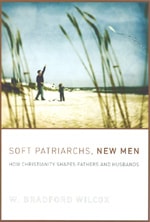
Soft Patriarchs, New Men
How Christianity Shapes Fathers and HusbandsW. Bradford Wilcox
University of Chicago Press, 2004
According to W. Bradford Wilcox, the divergent family ideologies of evangelical and mainline churches do not translate into large differences in family behavior between evangelical and mainline Protestant men who are married with children. Mainline Protestant men, he contends, are "new men" who take a more egalitarian approach to the division of household labor than their conservative peers and a more involved approach to parenting than men with no religious affiliation. Evangelical Protestant men, meanwhile, are "soft patriarchs"—not as authoritarian as some would expect, and given to being more emotional and dedicated to their wives and children than both their mainline and secular counterparts. Thus, Wilcox argues that religion domesticates men in ways that make them more responsive to the aspirations and needs of their immediate families.

Songs for the Spirits
Music and Mediums in Modern VietnamBarley Norton
University of Illinois Press, 2008
Spirit Wives and Church Mothers
Marriage, Survival, and Healing in Central MozambiqueChristy K. Schuetze
University of Wisconsin Press, 2023
Drawing on years of field research, Schuetze offers a richly drawn ethnographic analysis of these important religious transformations in the lives of female participants. Illustrating how economic and social context shapes the possibilities for—and forms of—women’s empowerment, Spirit Wives andChurch Mothers intervenes in scholarly debates about the nature of agency and challenges universalist Western feminist assumptions about the form of women’s liberation.
Spirited Things
The Work of "Possession" in Afro-Atlantic ReligionsEdited by Paul Christopher Johnson
University of Chicago Press, 2014
Spoils of the Kingdom
Clergy Misconduct and Religious CommunityAnson Shupe
University of Illinois Press, 2006
Drawing on case evidence, Shupe employs classical and modern social exchange theories to explain the institutional dynamics of clergy misconduct. He argues that there is an implicit contract of reciprocity and compliance between congregants and religious leaders that, when amplified by the charismatic awe often associated with religious authorities, can lead to misconduct.

Sports in Zion
Mormon Recreation, 1890-1940Richard Ian Kimball
University of Illinois Press, 2002
If a religion cannot attract and instruct young people, it will struggle to survive, which is why recreational programs were second only to theological questions in the development of twentieth-century Mormonism. In this book, Richard Ian Kimball explores how Mormon leaders used recreational programs to ameliorate the problems of urbanization and industrialization and to inculcate morals and values in LDS youth. As well as promoting sports as a means of physical and spiritual excellence, Progressive Era Mormons established a variety of institutions such as the Deseret Gymnasium and camps for girls and boys, all designed to compete with more "worldly" attractions and to socialize adolescents into the faith.
Kimball employs a wealth of source material including periodicals, diaries, journals, personal papers, and institutional records to illuminate this hitherto underexplored aspect of the LDS church. In addition to uncovering the historical roots of many Mormon institutions still visible today, Sports in Zion is a detailed look at the broader functions of recreation in society.

St. Augustine's Bones
A MicrohistoryHarold Samuel Stone
University of Massachusetts Press, 2002
In 1695, workers in Pavia, Italy, chanced upon a collection of bones in the crypt of the Cathedral of San Pietro in Ciel d'Oro. The workers later testified that they had seen the name of St. Augustine written in charcoal on the surface of the casket they had uncovered. Yet by the time of the official inquest, all traces of the writing had disappeared.
Rich with new insights into urban literacy and conceptions of reading, this book explores the controversy that ensued over the alleged discovery of Augustine's bones. Manuscripts, broadsides, pamphlets—even whole books—were devoted to proving or disproving the authenticity of the remains. Although these works were addressed to members of the clergy, they were also intended for the general reading public in Pavia, Milan, and Venice. Their dissemination helped create a temporary public sphere in which the merits of the case were examined in a spirit of free debate.
A reexamination of the dispute over St. Augustine's bones illuminates aspects of Catholic spirituality in Northern Italy during the late seventeenth and early eighteenth centuries. It also reveals the different ways in which Catholic scholars, local religious leaders, and the papal administration sought to influence and direct local popular religious belief and practices. Although the controversy was officially resolved by the papacy in 1728, the debate over the relics of San Pietro continued into the twentieth century.
By combining methods developed in the burgeoning field of the history of the book with the tools of cultural analysis, Harold Samuel Stone not only recovers the stories surrounding St. Augustine's bones, but also reconstructs the mental world of those who read or heard them.
Stained Glass Ceilings
How Evangelicals Do Gender and Practice PowerLisa Weaver Swartz
Rutgers University Press, 2023
State of Virginity
Gender, Religion, and Politics in an Early Modern Catholic StateUlrike Strasser
University of Michigan Press, 2006
Winner: 2005 Book Award from the Society for the Study of Early Modern Women; Selected by the German Studies Association as one of the top five books of 2004 in early modern history
"A fresh, original study of gender roles and religious ideology in the early modern Catholic state. . . . Using a rich array of archival sources, Strasser explores ways in which an increasingly centralized Bavarian government in Munich inaugurated marriage and convent reforms and a civil religion based on the veneration of the Virgin Mary. Her carefully selected case studies show how church and state collaborated to produce a shared discourse and consistent policies proscribing extramarital sex, and excluding those without property from marriage. "
Ulrike Strasser is Associate Professor of History, Affiliate Faculty in Women's Studies, and Core Faculty in Religious Studies at the University of California, Irvine.
Stepping Into Zion
Hatzaad Harishon, Black Jews, and the Remaking of Jewish IdentityJanice W. Fernheimer
University of Alabama Press, 2014
Considers the question “Who is a Jew?”— a critical rhetorical issue with far-reaching consequences for Jews and non-Jews alike
Hatzaad Harishon ("The First Step") was a New York-based, multiracial Jewish organization that worked to increase recognition and legitimacy for Black Jews in the sixties and seventies. In Stepping into Zion, Janice W. Fernheimer examines the history and archives of Hatzaad Harishon to illuminate the shifting definitions and borders of Jewish identity, which have critical relevance to Jews of all traditions as well as to non-Jews.
Fernheimer focuses on a period when Jewish identity was in flux and deeply influenced by the Civil Rights and Black Power movements. In 1964, white and Black Jews formed Hatzaad Harishon to foster interaction and unity between Black and white Jewish communities. They raised the question of who or what constitutes Jewishness or Jewish identity, and in searching for an answer succeeded—both historically and rhetorically—in gaining increased recognition for Black Jews. Fernheimer traces how, despite deep disagreement over definitions, members of Hatzaad Harishon were able to create common ground in a process she terms "interruptive invention": an incremental model for rhetorical success that allows different groups to begin and continue important but difficult discussions when they share little common ground or make unequal claims to institutional and discursive power, or when the nature of common ground is precisely what is at stake. Consequently, they provide a practical way out of the seemingly incommensurable stalemate incompatible worldviews present.
Through insightful interpretations of Hatzaad Harishon's archival materials, Fernheimer chronicles the group's successes and failures within the larger rhetorical history of conflicts that emerge when cultural identities shift or expand.
Streets of Glory
Church and Community in a Black Urban NeighborhoodOmar M. McRoberts
University of Chicago Press, 2003
McRoberts finds, for example, that most of the churches in Four Corners are attended and run by people who do not live in the neighborhood but who worship there because of the low overhead. These churches, McRoberts argues, are communities in and of themselves, with little or no attachment to the surrounding area. This disconnect makes the churches less inclined to cooperate with neighborhood revitalization campaigns and less likely to respond to the immediate needs of neighborhood residents. Thus, the faith invested in inner-city churches as beacons of local renewal might be misplaced, and the decision to count on them to administer welfare definitely should be revisited.
As the federal government increasingly moves toward delivering social services through faith-based organizations, Streets of Glory must be read for its trenchant revisionist view of how churches actually work in depressed urban areas.
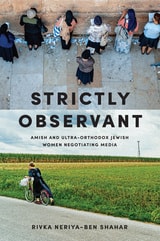
Strictly Observant
Amish and Ultra-Orthodox Jewish Women Negotiating MediaRivka Neriya-Ben Shahar
Rutgers University Press, 2024
The Amish and ultra-Orthodox Jewish communities have typically been associated with strict religious observance, a renunciation of worldly things, and an obedience of women to men. Women’s relationship to media in these communities, however, betrays a more nuanced picture of the boundaries at play and women’s roles in negotiating them.
Strictly Observant presents a compelling ethnographic study of the complex dynamic between women in both the Pennsylvanian Old Order Amish and Israeli ultra-Orthodox Jewish communities and contemporary media technologies. These women regularly establish valuable social, cultural, and religious capital through the countless decisions for use and nonuse of media that they make in their daily lives, and in ways that challenge the gender hierarchies of each community. By exhibiting a deep awareness of how media can be managed to increase their social and religious reputations, these women prompt us to reconsider our outmoded understanding of the Amish and ultra-Orthodox Jewish communities, the role that women play in these communities as agents of change, and our own relationship to media today.
Strong Religion
The Rise of Fundamentalisms around the WorldGabriel A. Almond, R. Scott Appleby, and Emmanuel Sivan
University of Chicago Press, 2003
To answer questions like these, Strong Religion draws on the results of the Fundamentalism Project, a decade-long interdisciplinary study of antimodernist, antisecular militant religious movements on five continents and within seven world religious traditions. The authors of this study analyze the various social structures, cultural contexts, and political environments in which fundamentalist movements have emerged around the world, from the Islamic Hamas and Hizbullah to the Catholic and Protestant paramilitaries of Northern Ireland, and from the Moral Majority and Christian Coalition of the United States to the Sikh radicals and Hindu nationalists of India. Offering a vividly detailed portrait of the cultures that nourish such movements, Strong Religion opens a much-needed window onto different modes of fundamentalism and identifies the kind of historical events that can trigger them.
Summoned
Identification and Religious Life in a Jewish NeighborhoodIddo Tavory
University of Chicago Press, 2016
In Summoned, Tavory takes readers to the heart of the exhilarating—at times exhausting—life of the Beverly-La Brea Orthodox community. Just blocks from West Hollywood’s nightlife, the Orthodox community thrives next to the impure sights, sounds, and smells they encounter every day. But to sustain this life, as Tavory shows, is not simply a moral decision they make. To be Orthodox is to be constantly called into being. People are reminded of who they are as they are called upon by organizations, prayer quorums, the nods of strangers, whiffs of unkosher food floating through the street, or the rarer Anti-Semitic remarks. Again and again, they find themselves summoned both into social life and into their identity as Orthodox Jews. At the close of Tavory’s fascinating ethnography, we come away with a better understanding of the dynamics of social worlds, identity, interaction and self—not only in Beverly-La Brea, but in society at large.