Results by title
51 books match the query 'Songs and music' and 5 start with s
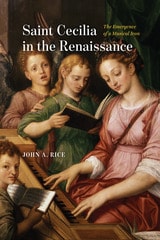
Saint Cecilia in the Renaissance
The Emergence of a Musical IconJohn A. Rice
University of Chicago Press, 2022
This study uncovers how Saint Cecilia came to be closely associated with music and musicians.
Until the fifteenth century, Saint Cecilia was not connected with music. She was perceived as one of many virgin martyrs, with no obvious musical skills or interests. During the next two centuries, however, she inspired many musical works written in her honor and a vast number of paintings that depicted her singing or playing an instrument.
In this book, John A. Rice argues that Cecilia’s association with music came about in several stages, involving Christian liturgy, visual arts, and music. It was fostered by interactions between artists, musicians, and their patrons and the transfer of visual and musical traditions from northern Europe to Italy. Saint Cecilia in the Renaissance explores the cult of the saint in Medieval times and through the sixteenth century when musicians’ guilds in the Low Countries and France first chose Cecilia as their patron. The book then turns to music and the explosion of polyphonic vocal works written in Cecilia’s honor by some of the most celebrated composers in Europe. Finally, the book examines the wealth of visual representations of Cecilia especially during the Italian Renaissance, among which Raphael’s 1515 painting, The Ecstasy of Saint Cecilia, is but the most famous example. Thoroughly researched and beautifully illustrated in color, Saint Cecilia in the Renaissance is the definitive portrait of Saint Cecilia as a figure of musical and artistic inspiration.
[more]
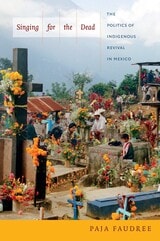
Singing for the Dead
The Politics of Indigenous Revival in MexicoPaja Faudree
Duke University Press, 2013
Singing for the Dead chronicles ethnic revival in Oaxaca, Mexico, where new forms of singing and writing in the local Mazatec indigenous language are producing powerful, transformative political effects. Paja Faudree argues for the inclusion of singing as a necessary component in the polarized debates about indigenous orality and literacy, and she considers how the coupling of literacy and song has allowed people from the region to create texts of enduring social resonance. She examines how local young people are learning to read and write in Mazatec as a result of the region's new Day of the Dead song contest. Faudree also studies how tourist interest in local psychedelic mushrooms has led to their commodification, producing both opportunities and challenges for songwriters and others who represent Mazatec culture. She situates these revival movements within the contexts of Mexico and Latin America, as well as the broad, hemisphere-wide movement to create indigenous literatures. Singing for the Dead provides a new way to think about the politics of ethnicity, the success of social movements, and the limits of national belonging.
[more]
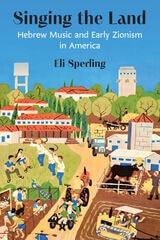
Singing the Land
Hebrew Music and Early Zionism in AmericaEli Sperling
University of Michigan Press, 2024
Singing the Land: Hebrew Music and Early Zionism in America examines the proliferation and use of popular Hebrew Zionist music amongst American Jewry during the first half of the twentieth century. This music—one part in a greater process of instilling diasporic Zionism in American Jewish communities—represents an early and underexplored means of fostering mainstream American Jewish engagement with the Jewish state and Hebrew national culture as they emerged after Israel declared its independence in 1948. This evolutionary process brought Zionism from being an often-polemical notion in American Judaism at the turn of the twentieth century to a mainstream component of American Jewish life by 1948. Hebrew music ultimately emerged as an important means through which many American Jews physically participated in or ‘performed’ aspects of Zionism and Hebrew national culture from afar.
Exploring the history, events, contexts, and tensions that comprised what may be termed the ‘Zionization’ of American Jewry during the first half of the twentieth century, Eli Sperling analyzes primary sources within the historical contexts of Zionist national development and American Jewish life. Singing the Land offers insights into how and why musical frameworks were central to catalyzing American Jewry’s support of the Zionist cause by the 1940s, parallel to firm commitments to their American locale and national identities. The proliferation of this widespread American Jewish-Zionist embrace was achieved through a variety of educational, religious, economic, and political efforts, and Hebrew music was a thread consistent among them all.
Exploring the history, events, contexts, and tensions that comprised what may be termed the ‘Zionization’ of American Jewry during the first half of the twentieth century, Eli Sperling analyzes primary sources within the historical contexts of Zionist national development and American Jewish life. Singing the Land offers insights into how and why musical frameworks were central to catalyzing American Jewry’s support of the Zionist cause by the 1940s, parallel to firm commitments to their American locale and national identities. The proliferation of this widespread American Jewish-Zionist embrace was achieved through a variety of educational, religious, economic, and political efforts, and Hebrew music was a thread consistent among them all.
[more]
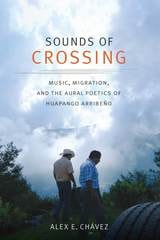
Sounds of Crossing
Music, Migration, and the Aural Poetics of Huapango ArribeñoAlex E. Chávez
Duke University Press, 2017
In Sounds of Crossing Alex E. Chávez explores the contemporary politics of Mexican migrant cultural expression manifest in the sounds and poetics of huapango arribeño, a musical genre originating from north-central Mexico. Following the resonance of huapango's improvisational performance within the lives of audiences, musicians, and himself—from New Year's festivities in the highlands of Guanajuato, Mexico, to backyard get-togethers along the back roads of central Texas—Chávez shows how Mexicans living on both sides of the border use expressive culture to construct meaningful communities amid the United States’ often vitriolic immigration politics. Through Chávez's writing, we gain an intimate look at the experience of migration and how huapango carries the voices of those in Mexico, those undertaking the dangerous trek across the border, and those living in the United States. Illuminating how huapango arribeño’s performance refigures the sociopolitical and economic terms of migration through aesthetic means, Chávez adds fresh and compelling insights into the ways transnational music-making is at the center of everyday Mexican migrant life.
[more]
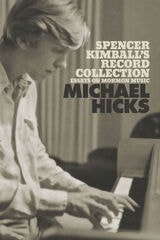
Spencer Kimball's Record Collection
Essays on Mormon MusicMichael Hicks
Signature Books, 2020
At times jubilant, at times elegiac, this set of ten essays by music historian Michael Hicks navigates topics that range from the inner musical life of Joseph Smith to the Mormon love of blackface musicals, from endless wrangling over hymnbooks to the compiling of Mormon folk and exotica albums in the 1960s. It also offers a brief memoir of what happened to LDS Church President Spencer Kimball’s record collection and a lengthy, brooding piece on the elegant strife it takes to write about Mormon musical history in the first place. There are surprises and provocations, of course, alongside judicious sifting of sources and weighing of evidence. The prose is fresh, the research smart, and the result a welcome mixture of the careful and the carefree from Mormonism’s best-known scholar of musical life.
[more]