Results by title
226 books match the query 'Southwest, New' and 17 start with s
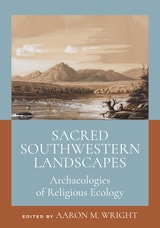
Sacred Southwestern Landscapes
Archaeologies of Religious EcologyEdited by Aaron M. Wright
University of Utah Press, 2024
Hailing from various academic and cultural backgrounds, contributors invoke a range of theoretical currents and methodological practices to examine how these relationships developed and evolved. Nearly all the places, people, and paradigms at play in contemporary southwestern scholarship find room among these pages, from the Sonoran and Chihuahuan Deserts to the Colorado Plateau; from diverse cultures, including Ancestral Pueblo, Mogollon, Hohokam, Pataya, Trincheras, Navajo (Diné), and Nuevomexicano; and from theoretical frameworks drawing upon phenomenology, materiality, bundling, and semiotics. This collective engagement showcases how religious ecologies can be studied from multiple perspectives and through sundry lines of evidence, leaving readers with appreciation and reverence for the rich and robust sacredness in southwestern landscapes.
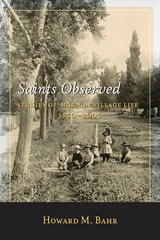
Saints Observed
Studies of Mormon Village Life, 1850-2005Howard M. Bahr
University of Utah Press, 2014
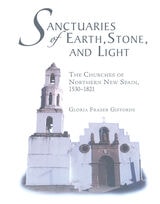
Sanctuaries of Earth, Stone, and Light
The Churches of Northern New Spain, 1530-1821Gloria Fraser Giffords
University of Arizona Press, 2007
Giffords has a remarkable eye for detail and for images both grand and diminutive. Because so many of the buildings she examines have been destroyed, she sleuthed through historical records in several countries, and she discovered that the architecture and material culture of northern New Spain reveal the influences of five continents. As she examines objects as large as churches or as small as ornamental ceramic tile she illuminates the sometimes subtle, sometimes striking influences of the religious, social, and artistic traditions of Europe (from the beginning of the Christian era through the nineteenth century), of the Muslim countries ringing the Mediterranean (from the seventh through the fifteenth centuries), and of Northern New Spain’s indigenous peoples (whose art influenced the designs of occupying Europeans).
Sanctuaries of Earth, Stone, and Light is a pathbreaking book, featuring 200 stunning photographs and over 300 illustrations ranging from ceremonial garments to detailed floor plans of the churches.
Sea la Luz
The Making of Mexican Protestantism in the American Southwest, 1829-1900Juan Francisco Martínez
University of North Texas Press, 2006
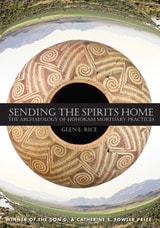
Sending the Spirits Home
The Archaeology of Hohokam Mortuary PracticesGlen E. Rice
University of Utah Press, 2015
This data-rich monograph provides new and stimulating perspectives on the Hohokam people and their mortuary practices. It breaks new ground by using the knowledge of descendent peoples to generate archaeologically testable hypotheses; demonstrating the need for mortuary analyses conducted at a regional scale; and synthesizing of the interaction of beliefs, ideology, social organization, and ecology in determining Hohokam mortuary practices. Various chapters discuss body treatment, mortuary furniture and goods, mortuary architecture, and cemeteries, and numerous figures help document the variability of Hohokam practices.
The study synthesizes data from various excavations, applied archaeology, and cultural resource management projects. With its review of past research and ethnographic accounts along with line drawings of mortuary features and artifacts, Sending the Spirits Home provides tools for the adoption of standardized protocols needed to facilitate cross-project comparisons on which future regional syntheses can be based. Although written for archaeologists, the book does not require a specialist’s knowledge to appreciate its insights into these early people of the Southwest.
Social Violence in the Prehispanic American Southwest
Edited by Deborah L. Nichols and Patricia L. Crown
University of Arizona Press, 2008
CONTENTS
1. Introduction
Patricia Crown and Deborah Nichols
2. Dismembering the Trope: Imagining Cannibalism in the Ancient Pueblo World
Randall H. McGuire and Ruth Van Dyke
3. An Outbreak of Violence and Raiding in the Central Mesa Verde Region in the 12th Century AD
Brian R. Billman
4. Chaco Horrificus?
Wendy Bustard
5. Inscribed in the Body, Written in Bones: The Consequences of Social Violence at La Plata
Debra L. Martin, Nancy Akins, Bradley Crenshaw, and Pamela K. Stone
6. Veneration or Violence: A Study of Variations in Patterns of Human Bone Modification at La Quemada
Ventura R. Pérez, Ben A. Nelson, and Debra L. Martin
7. Witches, Practice, and the Context of Pueblo Cannibalism
William H. Walker
8. Explanation vs. Sensation: The Discourse of Cannibalism at Awat’ovi
Peter Whiteley
9. Devouring Ourselves
George J. Armelagos
References Cited
About the Contributors
Index
Soldier-Artist of the Great Reconnaissance
John C. Tidball and the 35th Parallel Pacific Railroad SurveyEugene C. Tidball
University of Arizona Press, 2004
Some Strange Corners of Our Country
Charles F. Lummis; Foreword by Lawrence Clark Powell
University of Arizona Press, 1989
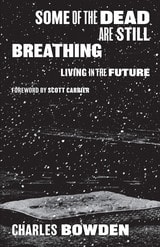
Some of the Dead Are Still Breathing
Living in the FutureBy Charles Bowden
University of Texas Press, 2018
The third book in Charles Bowden’s “accidental trilogy” that began with Blood Orchid and Blues for Cannibals, Some of the Dead Are Still Breathing attempts to resolve the overarching question: “How can a person live a moral life in a culture of death?” As humanity moves further into the twenty-first century, Bowden continues to interrogate our roles in creating the ravaged landscapes and accumulated death that still surround us, as well as his own childhood isolation, his lust for alcohol and women, and his waning hope for a future. We witness post-Katrina New Orleans and terrorist-bombed Bali; we encounter our shared actions with the animal world and the desirous need for consumption; we see the clash and erosion of our physical and figurative borders, the savagery of our own civilization. A man of his time and out of time, Bowden seeks acceptance and a will to endure what may lie ahead.
Soul Over Lightning
Ray Gonzalez
University of Arizona Press, 2014
Gonzalez shows his profound respect for other people, species, places, elements, and histories. Illusions to religious imagery knock against those of the natural world—feathers and rocks—creating a complex tableau of objects and feelings. Employing the image-driven approach for which he is renowned, in this collection Gonzalez is taut, using poetics that are fully formed. Even as the poems weave together highly intellectual, refined subject matter, the language remains accessible.
The book is divided into three parts. The first section offers Gonzalez’s most personal work yet, meditating on aging, forgetting, and the reader. The next section is more outward looking, as Gonzalez takes on great artists from both Old World and New World traditions. Finally, in the last section, Gonzalez opens himself up, reflecting in very personal ways on the everyday, such as a return from a hospital stay or a visit to the doctor.
Soul Over Lightning weaves together elements of Native American and Chicano/a narratives, inspired by the landscape of the desert Southwest and the experience of living on the border. It offers a new supernarrative that lifts spirits and yet remains grounded in a timeless search for home and truth.
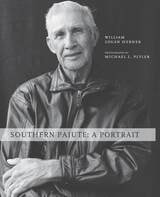
Southern Paiute
A PortraitLogan Hebner
Utah State University Press, 2010
Now little recognized by their neighbors, Southern Paiutes once had homelands that included much of the vast Colorado Plateau, Great Basin, and Mojave Desert. From the Four Corners’ San Juan River to California’s lower Colorado, from Death Valley to Canyonlands, from Capitol Reef to the Grand Canyon, Paiutes lived in many small, widespread communities. They still do, but the communities are fewer, smaller, and mostly deprived of the lands and resources that sustained traditional lives.
To portray a people and the individuals who comprise it, William Logan Hebner and Michael L. Plyler relay Paiute voices and reveal Paiute faces, creating a space for them to tell their stories and stake claim to who they once were and now are.
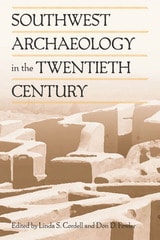
Southwest Archaeology in the Twentieth Century
Linda S Cordell
University of Utah Press, 2011
With contributions from well-known archaeologists, Southwest Archaeology in the Twentieth Century reviews the histories of major archaeological topics of the region during the twentieth century, with particular attention to the vast changes in southwestern archaeology during the later decades of the century. Included are the huge influence of field schools, the rise of cultural resource management (CRM), the uses and abuses of ethnographic analogy, the intellectual contexts of archaeology in Mexico, and current debates on agriculture, sedentism, and political complexity.
By looking back at the previous century of study, this book provides an authoritative retrospective of intellectual trends as well as a synthesis of current themes in the arena of the American Southwest.
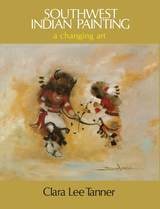
Southwest Indian Painting
A Changing ArtClara Lee Tanner
University of Arizona Press, 1972
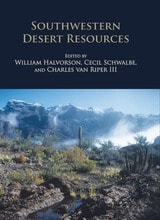
Southwestern Desert Resources
Edited by William Halvorson, Cecil Schwalbe, and Charles van Riper III
University of Arizona Press, 2010
This book puts a spotlight on individual research projects which are specific examples of work being done in the area and when they are all brought together, to shed a general light of understanding the biological and cultural resources of this vast region so that those same resources can be managed as effectively and efficiently as possible. The intent is to show that collaborative efforts among federal, state agency, university, and private sector researchers working with land managers, provides better science and better management than when scientists and land managers work independently.
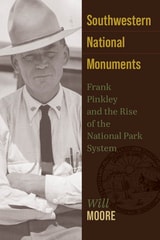
Southwestern National Monuments
Frank Pinkley and the Rise of the National Park SystemWill Moore
University of Utah Press, 2025
This volume uncovers the little-known legacy of Frank Pinkley, the first superintendent of the Southwestern National Monuments (SWNM)—a unique National Park Service unit established in 1923. Pinkley’s leadership and innovative approach helped protect and develop thirty diverse monuments, ranging from Montezuma Castle to White Sands, linked by miles of rough roads and united by their historical, archaeological, and natural significance.
Drawing on archived SWNM Monthly Reports, Will Moore reconstructs the stories behind these monuments and their contributions to the nascent national park system. From the pioneering all-Navajo Mobile Unit of the Civilian Conservation Corps to visionary work in visitor education, Pinkley and his team helped to set a course for the protection of American landscapes. Southwestern National Monuments is essential reading for anyone passionate about America's natural heritage and national parks.
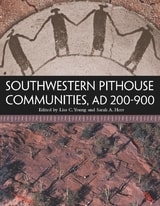
Southwestern Pithouse Communities, AD 200-900
Edited by Lisa C. Young and Sarah A. Herr
University of Arizona Press, 2012
Pithouses are the earliest identifiable domestic architecture in many areas of the world, and can provide insights into the origins of communities--a fundamental component of past and present societies. In this book, Lisa Young and Sarah Herr invite archaeologists to explore the development of communities using information from pithouse sites in the American Southwest.
Using regional and topical syntheses to investigate the formation of pithouse communities, contributors to this volume examine the complex relationship between the economic transition to agricultural dependence and the social changes associated with sedentism. They discover that during this transformation, peoples' relationship with the landscape changed in ways that affected their use of space, community organization, and cultural identity.
Employing various theoretical perspectives, these contributions analyze changes in pithouses, site layout, communal architecture, and settlement patterns to investigate the development of place-based communities. Chapters look at community formation strategies in populous regions like the northern San Juan Basin, the southern Colorado Plateau, Mimbres/southern Mogollon, and Hohokam Basin and Range and compare them with social structures in more sparsely populated regions like the northeast Hohokam peripheries, the Arizona Transition Zone, the Cibola region, southeast New Mexico, and the northern Rio Grande. The book also includes thematic discussions of panregional economic change, the complex relationship between house and household, and the demographic shifts accompanying the Neolithic Demographic Transition.
An essential book for students and archaeologists interested in the origins of communities, Southwestern Pithouse Communities is also an important comparative resource for scholars interested in social change during the transition to settled village life.
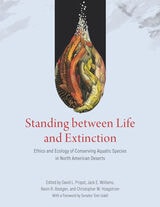
Standing between Life and Extinction
Ethics and Ecology of Conserving Aquatic Species in North American DesertsEdited by David L. Propst, Jack E. Williams, Kevin R. Bestgen, and Christopher W. Hoagstrom
University of Chicago Press, 2020
A precursor to this book, Battle Against Extinction, laid out the scope of the problem and related conservation activities through the late 1980s. Since then, many nascent conservation programs have matured, and researchers have developed new technologies, improved and refined methods, and greatly expanded our knowledge of the myriad influences on the ecology and dynamics of these species. Standing between Life and Extinction brings the story up to date. While the future for some species is more secure than thirty years ago, others are less fortunate. Calling attention not only to iconic species like the razorback sucker, Gila trout, and Devils Hole pupfish, but also to other fishes and obscure and fascinating invertebrates inhabiting intermittent aquatic habitats, this book explores the scientific, social, and political challenges of preserving these aquatic species and their habitats amid an increasingly charged political discourse and in desert regions characterized by a growing human population and rapidly changing climate.