Results by title
4154 books match the query 'State & Local' and 256 start with s

SUBURBAN STEEL
The Magnificent Failure of the Lustron Corporation, 1945–1951Douglas Knerr
The Ohio State University Press, 2004
Suburban Steel chronicles the rise and fall of the Lustron Corporation, once the largest and most completely industrialized housing company in U.S. history. Beginning in 1947, Lustron manufactured porcelain-enameled steel houses in a one-million-square-foot plant in Columbus, Ohio. With forty million dollars in federal funds and support from the highest levels of the Truman administration, the company planned to produce one hundred houses per day, each neatly arranged on specially designed tractor-trailers for delivery throughout the country. Lustron’s unprecedented size and scope of operations attracted intense scrutiny. The efficiencies of uninterrupted production, integrated manufacturing, and economies of scale promised to lead the American housing industry away from its decentralized, undercapitalized, and inefficient past toward a level of rationalization and organization found in other sectors of the industrial economy.
The company’s failure marked a watershed in the history of the American housing industry. Although people did not quit talking about industrialized housing, enthusiasm for its role in the transformation of the housing industry at large markedly waned. Suburban Steel considers Lustron’s magnificent failure in the context of historical approaches to the nation’s perpetual shortage of affordable housing, arguing that had Lustron’s path not been interrupted, affordable and desirable housing for America’s masses would be far more prevalent today.

Sabine Pass
The Confederacy's ThermopylaeBy Edward T. Cotham, Jr.
University of Texas Press, 2004
Winner, Dan and Marilyn Laney Prize, Austin Civil War Round Table, 2005
In an 1882 speech, former Confederate president Jefferson Davis made an exuberant claim: "That battle at Sabine Pass was more remarkable than the battle at Thermopylae." Indeed, Sabine Pass was the site of one of the most decisive Civil War battles fought in Texas. But unlike the Spartans, who succumbed to overwhelming Persian forces at Thermopylae more than two thousand years before, the Confederate underdogs triumphed in a battle that over time has become steeped in hyperbole. Providing a meticulously researched, scholarly account of this remarkable victory, Sabine Pass at last separates the legends from the evidence.
In arresting prose, Edward T. Cotham, Jr., recounts the momentous hours of September 8, 1863, during which a handful of Texans—almost all of Irish descent—under the leadership of Houston saloonkeeper Richard W. Dowling, prevented a Union military force of more than 5,000 men, 22 transport vessels, and 4 gunboats from occupying Sabine Pass, the starting place for a large invasion that would soon have given the Union control of Texas.
Sabine Pass sheds new light on previously overlooked details, such as the design and construction of the fort (Fort Griffin) that Dowling and his men defended, and includes the battle report prepared by Dowling himself. The result is a portrait of a mythic event that is even more provocative when stripped of embellishment.
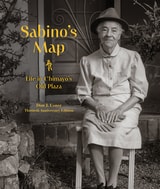
Sabino's Map
Life in Chimayó’s Old Plaza, Thirtieth Anniversary EditionDon J. Usner
Museum of New Mexico Press, 2024
“Brimming with voices, las voces de la gente…. the first-person narrator who returns again and again to the text like a knowing and trusted pariente inviting the reader to sit for a while in the Plaza del Cerro. —Jim Sagel
“Quite simply…the best history yet made of a northern New Mexico community. It is thorough, balanced, gracefully written, and blessed with an insider’s access and affection.”—William De Buys
Chimayó is renowned for its Hispano master weaving families, lowriders, and its storied church, El Santurio de Chimayó. The old Plaza del Cerro had once been the village’s center place, where locals gathered to pick up mail, socialize and celebrate religious and family events. Over the years after WWII, the plaza was neglected, but the memory of the once-vibrant place remained vivid in the stories of village elders.
The first edition of Sabino’s Map, published in 1995, documented oral histories of these elders. It would prove to be a critical turning point for many Chimayosos. At the Chimayó book launch, Usner recalls locals embraced the book, one cousin of his even declaring, “For the first time in my life I feel like I can be proud to be from Chimayó.” In the past thirty years since its publication, the community and its people have been revitalized with the help of the Chimayó Cultural Preservation Association and the establishment of a museum on the old plaza—in the home of Usner’s ancestors.
This landmark publication, read and passed on through generations, is considered a classic of New Mexico literature, alongside other treasured books including John Nichols’s Milagro Beanfield War, Rudolfo Anaya’s Bless Me Ultima, and Ruben Cobos’s Dictionary of New Mexico and Northern New Mexico Spanish.
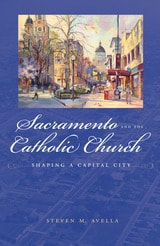
Sacramento and the Catholic Church
Shaping a Capital CitySteven Avella
University of Nevada Press, 2008
Besides the numerous institutions that the Church sponsored, it brought together a wide spectrum of the city’s diverse ethnic populations and offered them several routes to assimilation. Catholic Sacramentans have always played an active role in government and in the city’s economy, and Catholic institutions provided a matrix for the creation of new communities as the city spread into neighboring suburbs. At the same time, the Church was forced to adapt itself to the needs and demands of its various ethnic constituents, particularly the flood of Spanish-speaking newcomers in the late twentieth century.
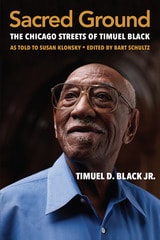
Sacred Ground
The Chicago Streets of Timuel BlackTimuel D. Black Jr., as told to Susan Klonsky, edited by Bart Schultz
Northwestern University Press, 2019
Sacred Ground opens in 1919, during the summer of the Chicago race riot, when infant Black and his family arrive in Chicago from Birmingham, Alabama, as part of the first Great Migration. He recounts in vivid detail his childhood and education in the Black Metropolis of Bronzeville and South Side neighborhoods that make up his "sacred ground."
Revealing a priceless trove of experiences, memories, ideas, and opinions, Black describes how it felt to belong to this place, even when stationed in Europe during World War II. He relates how African American soldiers experienced challenges and conflicts during the war, illuminating how these struggles foreshadowed the civil rights movement. A labor organizer, educator, and activist, Black captures fascinating anecdotes and vignettes of meeting with famous figures of the times, such as Duke Ellington and Martin Luther King Jr., but also with unheralded people whose lives convey lessons about striving, uplift, and personal integrity.
Rounding out this memoir, Black reflects on the legacy of his friend and mentee, Barack Obama, as well as on his public works and enduring relationships with students, community workers, and some very influential figures in Chicago and the world.
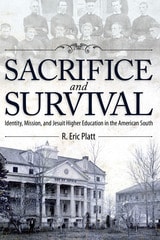
Sacrifice and Survival
Identity, Mission, and Jesuit Higher Education in the American SouthR. Eric Platt
University of Alabama Press, 2014
R. Eric Platt examines in Sacrifice and Survival the history and evolution of Jesuit higher education in the American South and hypothesizes that the identity and mission of southern Jesuit colleges and universities may have functioned as catalytic concepts that affected the “town and gown” relationships between the institutions and their host communities in ways that influenced whether they failed or adapted to survive.
The Catholic religious order known as the Society of Jesus (Jesuits) manages a global network of colleges and universities with a distinct Catholic identity and mission. Despite this immense educational system, several Jesuit institutions have closed throughout the course of the order’s existence. Societal pressures, external perceptions or misperceptions, unbalanced curricular structures rooted in liberal arts, and administrators’ slow acceptance of courses related to practical job seeking may all influence religious-affiliated educational institutions. The religious identity and mission of these colleges and universities are fundamentals that influence their interaction with external environs and contribute to their survival or failure.
Platt traces the roots of Jesuit education from the rise of Ignatius Loyola in the mid-sixteenth century through the European development of the Society of Jesus, Jesuit educational identity and mission, the migration of Jesuits to colonial New Orleans, the expulsion of Jesuits by Papal mandate, the reorganization of Jesuit education, their attempt to establish a network of educational institutions across the South, and the final closure of all but two southern Jesuit colleges and a set of high schools.
Sacrifice and Survival explores the implications of the Galveston Hurricane of 1900, yellow fever, Georgia floods, devastating fires, the Civil War, the expansion of New Orleans due to the 1884 Cotton Centennial Exposition, and ties between town and gown, as well as anti-Catholic/anti-Jesuit sentiment as the Society of Jesus pushed forward to create a system of southern institutions. Ultimately, institutional identity and mission critically impacted the survival of Jesuit education in the American South.

Sagebrush Collaboration
How Harney County Defeated the Takeover of the Malheur Wildlife RefugePeter Walker
Oregon State University Press, 2018
Every American is co-owner of the most magnificent estate in the world—federal public forests, grazing lands, monuments, national parks, wildlife refuges, and other public places. The writer Wallace Stegner famously referred to public lands as “America’s best idea,” but there have always been some who oppose the idea for ideological reasons, or because they have a vested economic interest. In the current decade, federal public lands have been under physical threat as never before, with armed standoffs and takeovers that the US government has proved stunningly unsuccessful at prosecuting in federal courts.
One such incident was the takeover of the Malheur National Wildlife Refuge in Harney County, Oregon, in 2016. Armed militants seized the headquarters of the refuge for forty-one days and occupied the community for three months. Militants threatened and harassed local residents, pledging to “give back” the land to unnamed “rightful owners” in their effort to enact a fringe interpretation of the US Constitution.
Drawing on more than two years of intensive fieldwork, Sagebrush Collaboration shows that the militants failed in their objectives because the sensible and hardworking citizens of Harney County had invested decades in collaboratively solving the very problems that the militia used to justify their anti–federal government revolution.
In Sagebrush Collaboration, Peter Walker offers the first book-length study of why the 2016 takeover of the Malheur National Wildlife Refuge failed. His nuanced and deeply researched account provides the full context for the takeover, including the response from local and federal officials and the grassroots community resistance. It will be essential reading for years to come for anyone who wants to understand the ongoing battle over the future of America’s public lands.
Sagwitch
Shoshone Chieftan, Mormon Elder 1822-1887Scott Christensen
Utah State University Press, 1999
The Northwestern Shoshone knew as home the northern Great Salt Lake, Bear River, Cache, and Bear Lake valleys of northern Utah. Sagwitch was born at a time when his people traded with the mountain men. In the late 1850s, wagons brought Mormon farmers to settle in Cache Valley, the Northwestern Shoshone heartland. Emigrants and settlers reduced Shoshone access to traditional village sites and food resources. Relationships with the Mormons were mostly good but often strained, and the Shoshone treatment of migrants, who now traveled north and south as well as west and east through the area, was increasingly opportunistic. It only took a few violent incidents for a zealous army colonel to seek severe punishment of the Northwestern Shoshone on a winter morning in 1863. The Bear River Massacre was among the bloodiest engagements of America's Indian wars. Hundreds of Shoshone, including Sagwitch's wife and two sons, died; Sagwitch was wounded but escaped. The band was shattered, other chiefs dead.
The following years were very hard for the survivors. The federal government negotiated a treaty with them but failed to get Sagwitch's signature when, en route to the sessions, he was arrested and then wounded by a white assassin. With the world around him changed, Sagwitch sought accommodation with the most immediate threat to his people's traditional way of survival—the Mormons occupying the Shoshone's valleys.
This, then, is also the story of the conversion of Sagwitch and his band to the Mormon Church. Though not without problems, that conversion was long lasting and thorough. Sagwitch and other Shoshone would demonstrate in important ways their new religious devotion. With the assistance of Mormon leaders, they established the Washakie community in northern Utah. Though efforts to secure a land base had an uneven history, they partly succeeded, and the story of these Shoshone's attempts at rural farming diverged significantly from what happened on government reservations. When Sagwitch died, his death went almost unnoticed outside of Washakie, but his children and grandchildren continued to be important voices among a people who, after experiencing near annihilation, survived in the new world into which Sagwitch led them.
Sail, Steam, and Diesel
Moving Cargo on the Great LakesEric Hirsimaki
Michigan State University Press, 2024
Saints Observed
Studies of Mormon Village Life, 1850-2005Howard M. Bahr
University of Utah Press, 2014

Saints, Sinners, and Sovereign Citizens
The Endless War over the West's Public LandsJohn L. Smith
University of Nevada Press, 2026
The grazing rights battle between Nevada rancher Cliven Bundy and the federal government, resulting in a tense, armed standoff between Bundy’s supporters and federal law enforcement officers, garnered international media attention in 2014. Saints, Sinners, and Sovereign Citizens places the Bundy conflict into the larger context of the Sagebrush Rebellion and the long struggle over the use of federal public lands in the American West.
Author John L. Smith skillfully captures the drama of the Bundy legal tangle amid the current political climate. Although no shots were fired during the standoff itself, just weeks later self-proclaimed Bundy supporters murdered two Las Vegas police officers and a civilian. In Eastern Oregon, other Bundy supporters occupied the federal offices of the Malheur National Wildlife Refuge, and one of them died in a hail of bullets.
While examining the complex history of federal public land policies, Smith exposes both sides of this story. He shows that there are passionate true believers on opposite sides of the insurrection, along with government agents and politicians in Washington complicit in efforts to control public lands for their wealthy allies and campaign contributors. With the promise of billions of dollars in natural resource profits and vast tracts of environmentally sensitive lands hanging in the balance, the West’s latest range war is the most important in the nation’s history. This masterful exposé raises serious questions about the fate of America’s public lands and the vehement arguments that are framing the debate from all sides.
Salamander
The Story of the Mormon Forgery MurdersLinda Sillitoe
Signature Books, 2006
What was the “salamander letter” and why were so many people determined to possess—and to conceal—it? Why was this one of the most unusual cases in American forensic history?
A skilled con artist by anyone’s assessment, Mark Hofmann eluded exposure by police and document authenticators—the FBI, Library of Congress, the LDS historical department, and polygraph experts—until George Throckmorton discovered the telltale microscopic alligatoring that was characteristic of the forgeries. What ensued was a suspense-ridden cat-and-mouse game between seasoned prosecutors and a clever, homicidal criminal. In the end, this story only verifies that some facts are indeed stranger than fiction.
Salem's Centuries
New Perspectives on the History of an Old American CityEdited by Donna A. Seger and Brad Austin
Temple University Press, 2026
In advance of the city’s quadricentennial, the editors and contributors highlight the depth and diversity of Salem’s history, including stories of indigenous peoples, early settlers, African Americans, and immigrants, spanning from the American and industrial revolutions to World War II and the present. Chronologically arranged by century, chapters examine how Salem’s history has been lost or distorted in its public presentations over time.
Salem’s Centuries is a fresh look at an old American city. And yes, it includes the accused witches.
Contributors: Kimberly S. Alexander, Emerson W. Baker, Aviva Chomsky, Andrew Darien, Elizabeth Duclos-Orsello, Theresa Giard, Marilyn Hayward, Bethany Jay, Michele Louro, Elizabeth McKeigue, Robert W. McMicken, Dane A. Morrison, Maria Pride, J.D. Scrimgeour, Margo Shea, Hans Schwartz, Brian Valimont, Maryann Zujewski, and the editors
In the series History and the Public
Sally in Three Worlds
An Indian Captive in the House of Brigham YoungVirginia Kerns
University of Utah Press, 2021
In this remarkable and deeply felt book, Virginia Kerns uncovers the singular and forgotten life of a young Indian woman who was captured in 1847 in what was then Mexican territory. Sold to a settler, a son-in-law of Brigham Young, the woman spent the next thirty years as a servant to Young’s family. Sally, as they called her, lived in the shadows, largely unseen. She was later remembered as a “wild” woman made “tame” who happily shed her past to enter a new and better life in civilization.
Drawing from a broad range of primary sources, Kerns retrieves Sally from obscurity and reconstructs her complex life before, during, and after captivity. This true story from the American past resonates deeply in the current moment, attentive as it is to killing epidemics and racial injustices. In telling Sally’s story, Kerns presents a new narrative of the American West.
Salmon, People, and Place
A Biologist's Search for Salmon RecoveryJim Lichatowich
Oregon State University Press, 2013
In Salmon, People, and Place, acclaimed fisheries biologist Jim Lichatowich eloquently exposes the misconceptions underlying salmon management and recovery programs that have fueled the catastrophic decline in Northwest salmon populations for more than a century. These programs will continue to fail, he suggests, so long as they regard salmon as products and ignore their essential relationship with their habitat.
But Lichatowich offers hope. In Salmon, People, and Place he presents a concrete plan for salmon recovery, one based on the myriad lessons learned from past mistakes. What is needed to successfully restore salmon, Lichatowich states, is an acute commitment to healing the relationships among salmon, people, and place.
A significant contribution to the literature on Pacific salmon, Salmon, People, and Place: A Biologist’s Search for Salmon Recovery is an essential read for anyone concerned about the fate of this Pacific Northwest icon.

Salt Lantern
Traces of an American FamilyWilliam Towner Morgan
University of Iowa Press, 1997
Salud!
The Rise Of Santa Barbara's Wine IndustryVictor W. Geraci
University of Nevada Press, 2018
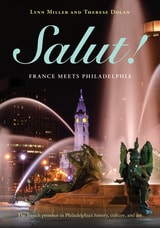
Salut!
France Meets PhiladelphiaLynn Miller and Therese Dolan
Temple University Press, 2021
One highly visible example of French influence on the city of Philadelphia is the Benjamin Franklin Parkway, modeled on the Champs-Élysées. In Salut!, Lynn Miller and Therese Dolan trace the fruitful, three-centuries-long relationship between the City of Brotherly Love and France. This detailed volume illustrates the effect of Huguenots settling in Philadelphia and 18-year-old William Penn visiting Paris, all the way up through more recent cultural offerings that have helped make the city the distinctive urban center it is today.
Salut! provides a magnifique history of Philadelphia seen through a particular cultural lens. The authors chronicle the French influence during colonial and revolutionary times. They highlight the contributions of nineteenth-century French philanthropists, such as Stephen Girard and the Dupont family. And they showcase the city’s vibrant visual arts community featuring works from the Philadelphia Museum of Art, the Rodin Museum, the Barnes Foundation, and the Joan of Arc sculpture, as well as studies of artists Thomas Eakins, Mary Cassatt, and Henry Ossawa Tanner. There is also a profile of renowned Le Bec-Fin chef Georges Perrier, who made Philadelphia a renowned culinary destination in the twentieth century.
With lavish illustrations and enthusiastic text, Salut!celebrates a potpourri of all things French in the Philadelphia region.

Sam Houston's Texas
Photographs and text by Sue Flanagan
University of Texas Press, 1964
When Sam Houston crossed the Red River for the first time in 1832, he termed Texas the "finest portion of the Globe that has ever blessed my vision." He soon made it his "abiding place" and became a lifelong traveller in his adopted country. By carriage and muleback his diplomatic, military, political, and personal activities took him over what is now the eastern half of the state—and he fell in love with every foot of it. With panoramic vision and broad descriptive power, he expressed his lasting affection for the country in everything he said and wrote.
Sue Flanagan, having read every available word by and about Houston and having followed the trail of every trip he made in Texas, here presents the Texas which Houston knew—through his picturesque language and through the camera's carefully focused lens. Her story provides continuity for Houston's activities and perspective for her photographs; it also provides an expression of Houston's views in his own forthright and emphatic manner.
But the essence of this book is its 113 photographs. The face of Texas east of San Antonio is pictured in all its varied features. With great patience and discernment, Sue Flanagan brought to bear all the skills of her artistic photography to capture the landscapes, buildings, and objects in the most revealing light and in the best atmospheric conditions for catching the appropriate mood. These spots in nature which Houston saw, these objects which he knew, these houses where he was entertained and where he lived—all are tangible reminders of "this colorful, cagey, and controversial man," this Texas hero whose life was a tragedy in divided loyalties.
Sam Houston, the Great Designer
By Llerena B. Friend
University of Texas Press, 1954
This biography of Sam Houston goes beyond the romantic frontier life of the "buckskin hero from Tennessee" to examine seriously his role as an American statesman.

San Francisco Bay Area Sports
Golden Gate Athletics, Recreation, and CommunityRita Liberti
University of Arkansas Press, 2017
San Francisco Bay Area Sports brings together fifteen essays covering the issues, controversies, and personalities that have emerged as northern Californians recreated and competed over the last 150 years. The area’s diversity, anti-establishment leanings, and unique and beautiful natural surroundings are explored in the context of a dynamic sporting past that includes events broadcast to millions or activities engaged in by just a few.
Professional and college events are covered along with lesser-known entities such as Oakland’s public parks, tennis player and Bay Area native Rosie Casals, environmentalism and hiking in Marin County, and the origins of the Gay Games. Taken as a whole, this book clarifies how sport is connected to identities based on sexuality, gender, race, and ethnicity. Just as crucial, the stories here illuminate how sport and recreation can potentially create transgressive spaces, particularity in a place known for its nonconformity.
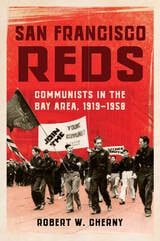
San Francisco Reds
Communists in the Bay Area, 1919-1958Robert W. Cherny
University of Illinois Press, 2024
Founded in 1919, the Communist Party (CP) in San Francisco survived an ineffectual early period to become a force in the trade union heyday of the 1930s. Robert Cherny uses the lives and careers of more than fifty members to tell the story of the city’s CP from its founding through 1958.
Cherny draws on FBI files, the records of the CP at the Russian State Archive for Social and Political History, interviews, and memoirs to follow male and female party and union leaders, rank-and-file members, and others. His history reveals why people joined the CP while charting the frequent changes in policy, constant member turnover, and disruptive factionalism that limited party aims and successes. Cherny also follows his subjects through their resignations, expulsions, or other reasons for departure and looks at the CP’s influence on their lives in subsequent years.
Vivid and exhaustively researched, San Francisco Reds is a long view account of the personal motivations and activism of an Old Left generation in a West Coast city.

San Francisco Year Zero
Political Upheaval, Punk Rock and a Third-Place Baseball TeamLincoln A. Mitchell
Rutgers University Press, 2019
In San Francisco Year Zero, San Francisco native Lincoln Mitchell traces the roots of the current situation back to 1978, when three key events occurred: the assassination of George Moscone and Harvey Milk occurring fewer than two weeks after the massacre of Peoples Temple members in Jonestown, Guyana, the explosion of the city’s punk rock scene, and a breakthrough season for the San Francisco Giants. Through these three strands, Mitchell explores the rifts between the city’s pro-business and progressive-left politicians, the emergence of Dianne Feinstein as a political powerhouse, the increasing prominence of the city’s LGBT community, punk’s reinvigoration of the Bay Area’s radical cultural politics, and the ways that the Giants helped unify one of the most ethnically and culturally diverse cities in the nation.
Written from a unique insider’s perspective, San Francisco Year Zero deftly weaves together the personal and the political, putting a human face on the social upheavals that transformed a city.

San Francisco, 1846-1856
From Hamlet to CityRoger W. Lotchin
University of Illinois Press, 1997
Now back in print with a new introduction by the author, this is the classic study of America's most admired instant city, from its days as a sleepy Mexican village, through the Gold Rush and into its establishment as a major international port. Roger Lotchin examines the urbanizing influences in San Francisco and compares these to other urban centers, doing so against a colorful backdrop of opium dens and other sinful institutions.
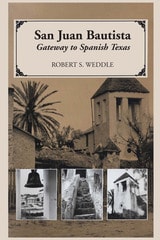
San Juan Bautista
Gateway to Spanish TexasBy Robert S. Weddle
University of Texas Press, 1968
Winner, Presidio La Bahia Award, Sons of the Republic of Texas, 1978
In their efforts to assert dominion over vast reaches of the (now U.S.) Southwest in the seventeenth century, the Spanish built a series of far-flung missions and presidios at strategic locations. One of the most important of these was San Juan Bautista del Río Grande, located at the present-day site of Guerrero in Coahuila, Mexico.
Despite its significance as the main entry point into Spanish Texas during the colonial period, San Juan Bautista was generally forgotten until the first publication of this book in 1968. Weddle's narrative is a fascinating chronicle of the many religious, military, colonial, and commerical expeditions that passed through San Juan and a valuable addition to knowledge of the Spanish borderlands. It won the Texas Institute of Letters Amon G. Carter Award for Best Southwest History in 1969.
San Luis Valley, Second Edition
Land of the Six-Armed CrossVirginia McConnell Simmons
University Press of Colorado, 1999
In this sparkling new edition of The San Luis Valley: Land of the Six-Armed Cross, Virginia McConnell Simmons lays before the reader the stories and voices of this multicultural land. Ranging from prehistoric peoples and historic Indians to early Spanish settlers, trappers, American explorers, railroads, and Euro-American pioneers, this book is a comprehensive volume covering the geography and social history of Colorado's San Luis Valley.
New to the second edition is additional material on Hispanic culture (in particular a description of their fiber arts) and a lengthy appendix cataloging and describing all of the San Luis Valley's Hispanic place names. In addition, the notes and bibliography have been expanded, and the book contains a new introduction by David Fridtjof Halaas, Chief Historian of the Colorado Historical Society. Acclaimed as the standard history for the south-central region of Colorado, The San Luis Valley: Land of the Six-Armed Cross is a book for students, scholars, and others interested in the history of this fascinating and culturally rich corner of the state.
Sancho's Journal
Exploring the Political Edge with the Brown BeretsBy David Montejano
University of Texas Press, 2012
How do people acquire political consciousness, and how does that consciousness transform their behavior? This question launched the scholarly career of David Montejano, whose masterful explorations of the Mexican American experience produced the award-winning books Anglos and Mexicans in the Making of Texas, 1836–1986, a sweeping outline of the changing relations between the two peoples, and Quixote’s Soldiers: A Local History of the Chicano Movement, 1966–1981, a concentrated look at how a social movement “from below” began to sweep away the last vestiges of the segregated social-political order in San Antonio and South Texas. Now in Sancho’s Journal, Montejano revisits the experience that set him on his scholarly quest—“hanging out” as a participant-observer with the South Side Berets of San Antonio as the chapter formed in 1974.
Sancho’s Journal presents a rich ethnography of daily life among the “batos locos” (crazy guys) as they joined the Brown Berets and became associated with the greater Chicano movement. Montejano describes the motivations that brought young men into the group and shows how they learned to link their individual troubles with the larger issues of social inequality and discrimination that the movement sought to redress. He also recounts his own journey as a scholar who came to realize that, before he could tell this street-level story, he had to understand the larger history of Mexican Americans and their struggle for a place in U.S. society. Sancho’s Journal completes that epic story.

Sanctioning Matrimony
Western Expansion and Interethnic Marriage in the Arizona BorderlandsSal Acosta
University of Arizona Press, 2016
Following the Treaty of Mesilla (1853), interethnic relationships played a significant part in the Southwest. Acosta provides previously unseen archival research on the scope and tenor of interracial marriages in Arizona. Contending that scholarship on intermarriage has focused on the upper classes, Acosta takes us into the world of the working and lower classes and illuminates how church and state shaped the behavior of participants in interracial unions.
Marriage practices in Tucson reveal that Mexican women were pivotal in shaping family and social life between 1854 and 1930. Virtually all intermarriages before 1900 were, according to Acosta, between Mexican women and white men, or between Mexican women and blacks or Chinese until the 1920s, illustrating the importance of these women during the transformation of Tucson from a Mexican pueblo to an American town.
Acosta’s deep analysis of vital records, census data, and miscegenation laws in Arizona demonstrates how interethnic relationships benefited from and extended the racial fluidity of the Arizona borderlands.
Sand In a Whirlwind, 30th Anniversary Edition
The Paiute Indian War of 1860Ferol Egan
University of Nevada Press, 1985
Sand and Fire
Exploring a Rare Pine Barrens LandscapeDave Peters
Wisconsin Historical Society Press, 2023
While many people are familiar with the federally protected St. Croix and Namekagon Rivers of northwestern Wisconsin, few know about the Namekagon Barrens, a rare pine barrens landscape within a few miles of their confluence. A tiny remnant of the millions of barrens acres that once covered the region, the Namekagon Barrens Wildlife Area lies in the heart of the state’s Northwest Sands, a band of pine and oak stretching from Bayfield on Lake Superior to St. Croix Falls on the Wisconsin–Minnesota border. Unfathomable amounts of glacial sand and repeated fires over thousands of years shaped a land of scrub oak and jack pine, blueberries and sweet fern, creating an ideal habitat for wolves and sharp-tailed grouse.
Just as compelling is the land’s rich human history, from Paleo-Indian hunters to Ojibwe berry pickers, loggers to early road builders, and immigrants whose farming efforts failed to the wildlife habitat specialists who manage it today. The book, told in memoir style and featuring color photographs by the author, sets the land’s unusual natural history as the backdrop for a multilayered story about the impact of people on this vulnerable landscape.
Silver winner of the 2023 Midwest Book Award for History
"Peters invites his readers on a journey across time and space, to the glacial formation of the Namekagon Barrens into the present. . . . The book is replete with beautiful photographs, useful maps, and a number of other images that seem to appear on nearly every other page. This book should appeal to a wide public readership while at the same time being a useful primer for academics and researchers."
—Hayden L. Nelson, Environmental History
Santa Rita del Cobre
A Copper Mining Community in New MexicoChristopher J. Huggard
University Press of Colorado, 2012
Satan's Playground
Mobsters and Movie Stars at America's Greatest Gaming ResortPaul J. Vanderwood
Duke University Press, 2010
Less than a year after Agua Caliente opened, gangsters held up its money-car in transit to a bank in San Diego, killing the courier and a guard and stealing the company money pouch. Paul J. Vanderwood weaves the story of this heist gone wrong, the search for the killers, and their sensational trial into the overall history of the often-chaotic development of Agua Caliente, Tijuana, and Southern California. Drawing on newspaper accounts, police files, court records, personal memoirs, oral histories, and “true detective” magazines, he presents a fascinating portrait of vice and society in the Jazz Age, and he makes a significant contribution to the history of the U.S.-Mexico border.
Saul Alinsky and the Dilemmas of Race
Community Organizing in the Postwar CityMark Santow
University of Chicago Press, 2023
Saul Alinsky is the most famous—even infamous—community organizer in American history. Almost single-handedly, he invented a new political form: community federations, which used the power of a neighborhood’s residents to define and fight for their own interests. Across a long and controversial career spanning more than three decades, Alinsky and his Industrial Areas Foundation organized Eastern European meatpackers in Chicago, Kansas City, Buffalo, and St. Paul; Mexican Americans in California and Arizona; white middle-class homeowners on the edge of Chicago’s South Side black ghetto; and African Americans in Rochester, Buffalo, Chicago, and other cities.
Mark Santow focuses on Alinsky’s attempts to grapple with the biggest moral dilemma of his age: race. As Santow shows, Alinsky was one of the few activists of the period to take on issues of race on paper and in the streets, on both sides of the color line, in the halls of power, and at the grassroots, in Chicago and in Washington, DC. Alinsky’s ideas, actions, and organizations thus provide us with a unique and comprehensive viewpoint on the politics of race, poverty, and social geography in the United States in the decades after World War II. Through Alinsky’s organizing and writing, we can see how the metropolitan color line was constructed, contested, and maintained—on the street, at the national level, and among white and black alike. In doing so, Santow offers new insight into an epochal figure and the society he worked to change.

Saul Alinsky and the Dilemmas of Race
Community Organizing in the Postwar CityMark Santow
University of Chicago Press, 2023
A groundbreaking examination of Saul Alinsky's organizing work as it relates to race.
Saul Alinsky is the most famous—even infamous—community organizer in American history. Almost single-handedly, he invented a new political form: community federations, which used the power of a neighborhood’s residents to define and fight for their own interests. Across a long and controversial career spanning more than three decades, Alinsky and his Industrial Areas Foundation organized Eastern European meatpackers in Chicago, Kansas City, Buffalo, and St. Paul; Mexican Americans in California and Arizona; white middle-class homeowners on the edge of Chicago’s South Side black ghetto; and African Americans in Rochester, Buffalo, Chicago, and other cities.
Mark Santow focuses on Alinsky’s attempts to grapple with the biggest moral dilemma of his age: race. As Santow shows, Alinsky was one of the few activists of the period to take on issues of race on paper and in the streets, on both sides of the color line, in the halls of power, and at the grassroots, in Chicago and in Washington, DC. Alinsky’s ideas, actions, and organizations thus provide us with a unique and comprehensive viewpoint on the politics of race, poverty, and social geography in the United States in the decades after World War II. Through Alinsky’s organizing and writing, we can see how the metropolitan color line was constructed, contested, and maintained—on the street, at the national level, and among white and black alike. In doing so, Santow offers new insight into an epochal figure and the society he worked to change.

Savage West
The Life and Fiction of Thomas SavageO. Alan Weltzien
University of Nevada Press, 2022
O. Alan Weltzien's insightful and detailed literary biography chronicles the life and work of this neglected but deeply talented novelist. Savage, a closeted gay family man, was both an outsider and an insider, navigating an intense conflict between his sexual identity and the claustrophobic social restraints of the rural West. Unlike many other Western writers, Savage avoided the formula westerns— so popular in his time— and offered instead a realistic, often subversive version of the region. His novels tell a hard, harsh story about dysfunctional families, loneliness, and stifling provincialism in the small towns and ranches of the northern Rockies, and his minority interpretation of the West provides a unique vision and caustic counternarrative contrary to the triumphant settler-colonialism themes that have shaped most Western literature. Savage West seeks to claim Thomas Savage's well-deserved position in American literature and to reintroduce twenty-first-century readers to a major Montana writer.

Saving Grand Canyon
Dams, Deals, and a Noble MythByron E. Pearson
University of Nevada Press, 2019
2020 Spur Awards Finalist Contemporary Nonfiction, Western Writers of America
The Grand Canyon has been saved from dams three times in the last century. Unthinkable as it may seem today, many people promoted damming the Colorado River in the canyon during the early twentieth century as the most feasible solution to the water and power needs of the Pacific Southwest. These efforts reached their climax during the 1960s when the federal government tried to build two massive hydroelectric dams in the Grand Canyon. Although not located within the Grand Canyon National Park or Monument, they would have flooded lengthy, unprotected reaches of the canyon and along thirteen miles of the park boundary.
Saving Grand Canyon tells the remarkable true story of the attempts to build dams in one of America’s most spectacular natural wonders. Based on twenty-five years of research, this fascinating ride through history chronicles a hundred years of Colorado River water development, demonstrates how the National Environmental Policy Act came to be, and challenges the myth that the Sierra Club saved the Grand Canyon. It also shows how the Sierra Club parlayed public perception as the canyon’s savior into the leadership of the modern environmental movement after the National Environmental Policy Act became law.
The tale of the Sierra Club stopping the dams has become so entrenched—and so embellished—that many historians, popular writers, and filmmakers have ignored the documented historical record. This epic story puts the events from 1963–1968 into the broader context of Colorado River water development and debunks fifty years of Colorado River and Grand Canyon myths.

Saving Lake Tahoe
An Environmental History of a National TreasureMichael J. Makley
University of Nevada Press, 2014
Left alone, nature healed itself, and by the 1960s mature forests once again surrounded the lake and its water clarity improved, with visibility more than one hundred feet deep. However, Tahoe’s wonders brought a new kind of threat: millions of annual visitors and incessant development, including ski resorts and casinos. Saving Lake Tahoe looks at the interaction through the years between human activities and Tahoe’s natural ecosystems. It is a dramatic story of ecological disasters and near misses, political successes and failures. Utilizing primary sources and interviews with key figures, Makley provides a meticulously researched account of the battles surrounding the management of the Tahoe basin.
Makley takes the story up to the present, describing the formation and evolution of a new type of governing body, the bistate Tahoe Regional Planning Agency, and groundbreaking efforts to utilize science in establishing policy. He depicts the passionate fights between those who seek to preserve the environment and advocates of individual property rights. Although Tahoe remains unique in its splendor, readers will understand why, with continued pressure for development, reversing environmental deterioration and improving the lake water’s clarity remain elusive goals.

Saving Our Sturgeon
Protecting Wisconsin's Ancient FishRebecca Hogue Wojahn
Wisconsin Historical Society Press, 2025
The story of a fascinating fish and the forward-thinking people who saved them in Wisconsin
For millennia, sturgeon swam the waterways of Wisconsin. Before the 1800s, an estimated eleven million sturgeon lived in Lake Michigan alone. Menominee and Ojibwe people depended on the fish for food and harvested them sustainably. But in the early 1900s, the lake sturgeon was near extinction. Saving Our Sturgeon tells the remarkable story of lake sturgeon in Wisconsin, the conservation efforts to save the species, and what is being done to keep the population healthy and thriving today.
Readers will learn about the natural history of the lake sturgeon—its anatomy, behavior, and habitat—and the factors that threatened its survival, from overharvesting to the building of dams that prevented sturgeon from reaching spawning areas. The book, written for young readers aged eleven and up, explains how government agencies, conservationists, and citizen groups worked together to save the sturgeon population in Wisconsin.
Saving Our Sturgeon includes a chapter about the Menominee Nation’s work to revitalize cultural traditions focused on the sturgeon and restore access to the fish on their reservation. The book also highlights how young people can get involved with sturgeon conservation efforts.
A great resource for classroom use, Saving Our Sturgeon contains maps, photos, and diagrams, plus a glossary of terms, a timeline of events, a Who’s Who list of individuals and groups featured in the book, and a bibliography that highlights kid-friendly sources to learn more. Young readers will learn basic facts about sturgeon biology, what it means for a species to be threatened or endangered, and how scientists use data to support repopulation. This inspiring book shares a conservation success story about one remarkable (and plenty peculiar) species of fish and shows young readers how they, too, can help protect these incredible creatures.
Ages 11 - 14; Grade level 6 - 9; Lexile® measure 1060L
Saving San Francisco
Relief and Recovery after the 1906 DisasterAndrea Rees Davies
Temple University Press, 2011
Combining the experiences of ordinary people with urban politics and history, Saving San Francisco challenges the long-lived myth that the 1906 disaster erased social differences as it leveled the city. Highlighting new evidence from San Francisco’s relief camps, Andrea Rees Davies shows that as policy makers directed various forms of aid to groups and projects that enjoyed high social status before the disaster, the widespread need and dislocation created opportunities for some groups to challenge biased relief policy. Poor and working-class refugees organized successful protests, while Chinatown business leaders and middle-class white women mobilized resources for the less privileged. Ultimately, however, the political and financial elite shaped relief and reconstruction efforts and cemented social differences in San Francisco.

Saving the Big Sky
A Chronicle of Land Conservation in MontanaBruce A. Bugbee
Oregon State University Press, 2025
Winner of the 2026 Western Writers of America Spur Award for Best Western Contemporary Nonfiction
Winner of the 2025 Nature and the Environment National Outdoor Book Award
“The essential purpose of Saving the Big Sky is to inspire the reader to help conserve even more of Montana,” write Bruce Bugbee, Robert Kiesling, and John Wright in this compelling study of how six million acres of biodiverse land were conserved in Montana over the past fifty years. Indigenous and non-Indigenous knowledge about land stewardship has evolved and since the 1970s tribes, nonprofit organizations, land trusts, and government agencies have conserved land in many creative ways. Beautifully illustrated with more than ninety color photographs and thirty detailed maps, Saving the Big Sky showcases land conservation achievements across eight regions of the state: the Rocky Mountain Front, the Blackfoot Valley, the Greater Yellowstone, the Missoula Region, the Helena Region, Northwest Montana, the Flathead Indian Reservation, and the American Prairie.
Land protection is shown to work best when large, intact, connected landscapes can be conserved, rather than small, fragmented, isolated parcels. Conservationists have found that landowners in Montana more widely accept conservation easements and other voluntary, financially compensating tools that respect private property rights. The brilliant images and striking before-and-after maps featured here celebrate the ranches, farms, wildlife habitats, and scenic open spaces that are forever safeguarded.
In documenting conservation accomplishments and suggesting what more can be done, Saving the Big Sky invites readers to participate in conserving Montana—or whatever cherished landscape they call home.

Saving the Pryor Mountain Mustang
A Legacy of Local and Federal CooperationChrstine Reed
University of Nevada Press, 2015
Saving the Pryor Mountain Mustang explores the unique and ongoing relationship between locals and the federal government, highlighting the Lovell citizens’ philosophy of cooperation instead of the typical mistrust that exists between wild horse advocates and federal agencies. The book provides a rich analysis of how a determined group of people saved an endangered wild horse herd. The book will have wide appeal to wild horse activists, scholars of local and federal governance, and western history enthusiasts.

Scandinavians in Chicago
The Origins of White Privilege in Modern AmericaErika K. Jackson
University of Illinois Press, 2019

Scandinavians in Michigan
Jeffrey W. Hancks
Michigan State University Press, 2006
The Scandinavian countries, Denmark, Norway, and Sweden, are commonly grouped together by their close historic, linguistic, and cultural ties. Their age-old bonds continued to flourish both during and after the period of mass immigration to the United States in the nineteenth and early twentieth centuries. Scandinavians felt comfortable with each other, a feeling forged through centuries of familiarity, and they usually chose to live in close proximity in communities throughout the Upper Midwest of the United States.
Beginning in the middle of the nineteenth century and continuing until the 1920s, hundreds of thousands left Scandinavia to begin life in the United States and Canada. Sweden had the greatest number of its citizens leave for the United States, with more than one million migrating between 1820 and 1920. Per capita, Norway was the country most affected by the exodus; more than 850,000 Norwegians sailed to America between 1820 and 1920. In fact, Norway ranks second only to Ireland in the percentage of its population leaving for the New World during the great European migration. Denmark was affected at a much lower rate, but it too lost more than 300,000 of its population to the promise of America. Once gone, the move was usually permanent; few returned to live in Scandinavia. Michigan was never the most popular destination for Scandinavian immigrants. As immigrants began arriving in the North American interior, they settled in areas to the west of Michigan, particularly in Wisconsin, Minnesota, Illinois, Iowa, and North and South Dakota. Nevertheless, thousands pursued their American dream in the Great Lakes State. They settled in Detroit and played an important role in the city’s industrial boom and automotive industry. They settled in the Upper Peninsula and worked in the iron and copper mines. They settled in the northern Lower Peninsula and worked in the logging industry. Finally, they settled in the fertile areas of west Michigan and contributed to the state’s burgeoning agricultural sector. Today, a strong Scandinavian presence remains in town names like Amble, in Montcalm County, and Skandia, in Marquette County, and in local culinary delicacies like æbleskiver, in Greenville, and lutefisk, found in select grocery stores throughout the state at Christmastime.

Scarface Al and the Crime Crusaders
Chicago's Private War Against CaponeDennis E. Hoffman
Southern Illinois University Press, 1993
According to the Eliot Ness myth, which has been widely disseminated through books, television shows, and movies, Ness and the Untouchables defeated Al Capone by marshaling superior firepower. In Scarface Al and the Crime Crusaders, Dennis Hoffman presents a fresh new perspective on the downfall of Al Capone. To debunk the Eliot Ness myth, he shows how a handful of private citizens brought Capone to justice by outsmarting him rather than by outgunning him.
Drawing on previously untapped sources, Hoffman dissects what he terms a “private war” against Capone. He traces the behind-the-scenes work of a few prominent Chicago businessmen from their successful lobbying of presidents Coolidge and Hoover on behalf of federal intervention to the trial, sentencing, and punishment of Al Capone. Hoffman also reconstructs in detail a number of privately sponsored citizen initiatives directed at stopping Capone. These private ventures included prosecuting the gangsters responsible for election crimes; establishing a crime lab to assist in gangbusting; underwriting the costs of the investigation of the Jake Lingle murder; stigmatizing Capone; and protecting the star witnesses for the prosecution in Al Capone’s income tax evasion case.
Hoffman suggests that as American society continues to be threatened by illegal drugs, gangs, and widespread violence, it is important to remember that the organized crime and political corruption of Prohibition-era Chicago were checked through the efforts of private citizens.
Dennis E. Hoffman is an associate professor of criminal justice at the University of Nebraska at Omaha.

Scarlet and Black, Volume Three
Making Black Lives Matter at Rutgers, 1945-2020Miya Carey
Rutgers University Press, 2021

Scarlet and Black, Volume Two
Constructing Race and Gender at Rutgers, 1865-1945Kendra Boyd
Rutgers University Press, 2020
To learn more about the work of the Committee on Enslaved and Disenfranchised Population in Rutgers History, visit the project's website at http://scarletandblack.rutgers.edu

Scarlet and Black
Slavery and Dispossession in Rutgers HistoryFuentes, Marisa J
Rutgers University Press, 2016
Scarlet and Black documents the history of Rutgers’s connection to slavery, which was neither casual nor accidental—nor unusual. Like most early American colleges, Rutgers depended on slaves to build its campuses and serve its students and faculty; it depended on the sale of black people to fund its very existence. Men like John Henry Livingston, (Rutgers president from 1810–1824), the Reverend Philip Milledoler, (president of Rutgers from 1824–1840), Henry Rutgers, (trustee after whom the college is named), and Theodore Frelinghuysen, (Rutgers’s seventh president), were among the most ardent anti-abolitionists in the mid-Atlantic.
Scarlet and black are the colors Rutgers University uses to represent itself to the nation and world. They are the colors the athletes compete in, the graduates and administrators wear on celebratory occasions, and the colors that distinguish Rutgers from every other university in the United States. This book, however, uses these colors to signify something else: the blood that was spilled on the banks of the Raritan River by those dispossessed of their land and the bodies that labored unpaid and in bondage so that Rutgers could be built and sustained. The contributors to this volume offer this history as a usable one—not to tear down or weaken this very renowned, robust, and growing institution—but to strengthen it and help direct its course for the future.
The work of the Committee on Enslaved and Disenfranchised Population in Rutgers History.
Visit the project's website at http://scarletandblack.rutgers.edu
Scots in Michigan
Alan T. Forrester
Michigan State University Press, 2003
Scots began settling in North America in the earliest colonial days. They were heavily involved in the Great Lakes region’s major industries, as these evolved from fur trade to farming and lumbering to industry. From early settlement to the industrial revolution, Scots brought to the state a pioneer spirit and an extraordinary level of education. Though rendered almost invisible both by clustering under the umbrella of the British Commonwealth and by the fact that few Scottish traditions are considered whatsoever foreign, ethnic, or exotic, Scottish influences run deep in Michigan history and culture. From ice hockey to industry, much of what represents Michigan has roots that were embedded in Scotland. Although Alan T. Forrester notes that symbolic Scottish ethnicity—Highland Games, Scottish Festivals, and Burns Night Suppers—is practically the only obvious relic of Scottish heritage in Michigan, he illuminates how much more of this legacy is a part of this state.
Scouting for the Bluecoats
Navajos, Apaches, and the U.S. Military, 1873–1911Robert S. McPherson
University Press of Colorado, 2022
—Kent Powell, Senior historian at Utah Division of State History and editor of Utah State Historical Quarterly (retired)
"Scouting for the Bluecoats examines the important role that Navajos played in military operations during the last quarter of the nineteenth and beginning of the twentieth centuries. Unlike the famous Navajo code talkers of World War II, little has been written about these men who served in some of the most challenging and noteworthy struggles against the Apaches. Until now, their story has been forgotten. Navajo skills in understanding and tracking a wily foe across an inhospitable landscape proved to be essential elements in ending the Apache wars. For those interested in the recruitment and deployment of the scouts, measures taken to counter enemy tactics, and the challenge of obtaining recognition for their service, this book is an invaluable source and a must-read for any serious scholar of Navajo history."
—Ronald P. Maldonado, Tribal historic preservation officer (retired), Navajo Nation

Scream! Bleed! Take Off Your Clothes!
Stuart Gordon and Chicago’s Organic Theater CompanyMary Griswold, Cordis Heard, Jim Rinnert and Mike Saad
University of Chicago Press, 2026
A captivating firsthand account of Chicago’s groundbreaking, tumultuous Organic Theater Company.
When the founder of the Organic Theater Company died in 2020, the Chicago Tribune asked, “Did one person invent Chicago theater? If so, it was Stuart Gordon.” And yet, this iconic theater group is arguably the most influential Chicago company whose story has never been fully told.
In its heyday, from 1969 through 1985, the Organic’s high-spirited, gutsy, and close-knit company created more than thirty idiosyncratic works. A springboard for playwright David Mamet and for the television series ER, it also was formative in the careers of many well-known actors, including Joe Mantegna, André De Shields, Meshach Taylor, and Dennis Franz. Scream! Bleed! Take Off Your Clothes! is the story of a young theater company that always pushed boundaries with an anarchic exuberance. Drawing on extensive interviews and archival research, this insiders’ account, assembled by three Organic members and an artistic associate, details those exciting productions and the company’s complicated internal dynamics, while also positioning the group within Chicago’s vibrant theater scene and the larger culture of the time.