Results by title
308 books match the query 'Story' and 22 start with s
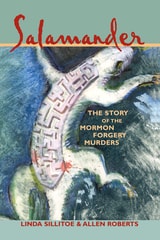
Salamander
The Story of the Mormon Forgery MurdersLinda Sillitoe
Signature Books, 2006
What was the “salamander letter” and why were so many people determined to possess—and to conceal—it? Why was this one of the most unusual cases in American forensic history?
A skilled con artist by anyone’s assessment, Mark Hofmann eluded exposure by police and document authenticators—the FBI, Library of Congress, the LDS historical department, and polygraph experts—until George Throckmorton discovered the telltale microscopic alligatoring that was characteristic of the forgeries. What ensued was a suspense-ridden cat-and-mouse game between seasoned prosecutors and a clever, homicidal criminal. In the end, this story only verifies that some facts are indeed stranger than fiction.

Sawmill
The Story of Cutting the Last Great Virgin Forest East of the RockiesKenneth L. Smith
University of Arkansas Press, 1986
Sawmill is a history of logging in the Arkansas and Oklahoma Ouachita Mountains from 1900 to 1950, a penetrating study of the lumber industry, and a significant view of man’s interaction with a major forest resource. It is also a social history in its account of the lumbermen’s quest for the last virgin timber and the effects of its depletion. Kenneth L. Smith interviewed more than three hundred people to develop this lively history of the cutting of virgin shortleaf pine forests.
The Caddo River Lumber Company and the Arkansas mill towns of Rosboro, Glenwood, and Forester provided jobs and homes for many during the brief heyday of the big sawmills. Smith takes a close look at several important timber companies, and at the personality of T. W. Rosborough, a man who bought and sold vast tracts of land and had an almost fatherly concern for both white and black sawmill workers.
The recollections included here provide insight into a population that lived through the Depression years in isolated mountain communities where cats were sometimes sold as possum meat, and where men enjoyed weekend “sip and sniff” poker parties. The book is richly illustrated with photographs from the time of the mills and includes a foldout map.
Sawmill was originally published in 1986 and reprinted in 2006.
Winner of the Virginia C. Ledbetter Prize
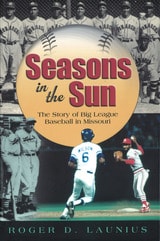
Seasons in the Sun
The Story of Big League Baseball in MissouriRoger D. Launius
University of Missouri Press, 2002
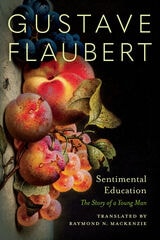
Sentimental Education
The Story of a Young ManGustave Flaubert
University of Minnesota Press, 2024
A fresh and vivid translation of Flaubert’s influential bildungsroman
Gustave Flaubert conceived Sentimental Education, his final complete novel, as the history of his own generation, one that failed to fulfill the promise of the Revolution of 1848. Published a few months before the start of the 1870 Franco–Prussian War, it offers both a sweeping panorama of French society over three decades and an intimate bildungsroman of a young man from a small town who arrives in Paris when protests against the monarchy are increasing.
The novel’s protagonist, Frédéric Moreau, alternates between aimlessness and ambition as he searches for a meaningful life through love affairs and republican politics. Flaubert’s narrative includes scenes of high drama, as scattered protests across Paris swell into revolution, and quiet moments of self-aware romanticism, crafting a story that possesses the sweep and scope of a historical novel combined with deep emotion and scandalous intimacy. Suffused with tragedy and the poignancy of lost chances and wasted lives, Sentimental Education is sharpened by satirical observations of what Flaubert condemned as the Second Empire’s endemic hypocrisy and willful blindness.
This vibrant, new translation by Raymond N. MacKenzie includes an extensive critical introduction and annotations to help the modern reader appreciate Flaubert’s achievement. Sentimental Education intertwines the personal, the intimate, and the subjective with the political, social, and cultural, embedding Frédéric’s story in the larger arc of what Flaubert saw as France’s decline into mediocrity and imbecility in its politics and manners.

Shell Day
A Story of 24 Hours and 24 Molluscan LivesHelen Scales
University of Chicago Press, 2026
From morning to night and from the Arctic to the equator, snails, clams, and other shell-making mollusks have busy days. In this short book, acclaimed author and marine biologist Helen Scales shows readers exactly how these animals spend their time. Each chapter of Shell Day features a single mollusk during a single hour, highlighting twenty-four different species.
Far in the north, the Svalbard archipelago lies deep in the darkness of the polar night. And yet, in what remains a scientific mystery, Iceland scallops continue their daily rhythms, closing and opening their fan-shaped shells using an internal clock. At noon, we observe a clam shell sitting still on the seabed of a sandy tropical lagoon. The two shells open slightly, and a pair of rounded eyes peep out. A small, rust-colored coconut octopus hiding inside lets the clam shells fall apart and gathers them up in her arms. This mollusk’s ancestors long ago lost the ability to produce their own shells, but the cephalopod is happy to use another animal’s castoff as a temporary home. At ten that night, we find ourselves in Southern France. A male moon snail uses his huge, fleshy foot like a plow as he digs down into the seabed in search of food. When the moon snail finds a cockle, he swiftly smothers it, then sets about drilling, aided by a daub of acidic slime. Cockles are tasty, but so are other moon snails, and his snacking has a cannibalistic flavor.
For each chapter, illustrator and cartoonist Aaron John Gregory has depicted molluscan scenes with entrancing pen-and-ink drawings. Working together to narrate and illustrate these unique moments in time, Scales and Gregory have created an engaging read that is a perfect way to spend an hour or two—and a true gift for beachcombers, naturalists, or anyone eager to learn about the mollusks that make their favorite shells.
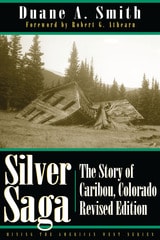
Silver Saga
The Story of Caribou, Colorado, Revised EditionDuane A. Smith
University Press of Colorado, 2002
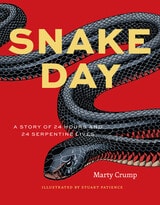
Snake Day
A Story of 24 Hours and 24 Serpentine LivesMarty Crump
University of Chicago Press, 2026
Does a snake crossing your path trigger delight or dread? The answer is clear for celebrated biologist Marty Crump, who shows us that snakes deserve our respect, admiration, and protection. In her short book Snake Day, each chapter introduces a single snake during a single hour, highlighting twenty-four different species from around the globe.
In the dark morning of a Brazilian forest, we avoid stepping on a jararaca, a nocturnal viper. If she bites, her venom will make our blood pressure—and us—drop. A synthetic version of this venom is now a lifesaving drug, used to treat hypertension and heart failure. Later in the morning, in the Zagros Mountains that trace Iran’s northwest border, what appears to be a tiny arachnid wiggles on the ground. When a hungry warbler approaches for a meal, realizes too late that the spider is actually a snake’s tail, and an Iranian spider-tailed viper makes a meal of the bird. In the early afternoon, in a pine forest outside Atlanta, Georgia, an eastern hognose snake strikes at us—a bluff—and then rolls over and plays dead. By the end of our snake day, we’ll have glimpsed the diversity of this unique group of reptiles, met serpentine friends who frighten and fascinate, and learned how humans can protect these amazing species.
For each hour, celebrated artist Stuart Patience has depicted serpentine scenes in stunning pen-and-ink drawings. Working together to narrate and illustrate these unique moments in time, Crump and Patience have created an engaging read that is a perfect way to spend an hour or two—and a true gift for amateur scientists or anyone who recoils at or relishes the sight of a snake.

Soccer in a Football World
The Story of America's Forgotten GameDavid Wangerin
Temple University Press, 2008
David Beckham’s arrival in Los Angeles represents the latest attempt to jump-start soccer in the United States where, David Wangerin says, it “remains a minority sport.” With the rest of the globe so resolutely attached to the game, why is soccer still mostly dismissed by Americans?
Calling himself “a soccer fan born in the wrong country at nearly the wrong time,” Wangerin writes with wit and passion about the sport’s struggle for acceptance in Soccer in a Football World. A Wisconsin native, he traces the fragile history of the game from its early capitulation to gridiron on college campuses to the United States’ impressive performance at the 2002 World Cup. Placing soccer in the context of American sport in general, he chronicles its enduring struggle alongside the country’s more familiar pursuits and recounts the shifting attitudes toward the “foreign” game. His story is one that will enrich the perspective of anyone whose heart beats for the sport, and is curious as to where the game has been in America—and where it might be headed.

Sold American
The Story of Alaska Natives and Their Land 1867-1959Donald Craig Mitchell
University of Alaska Press, 2003
Don Mitchell's companion volume, Take My Land, Take My Life, concludes that story by describing the events that in 1971 resulted in Congress's enactment of the Alaska Native Claims Settlement Act, the most generous aboriginal land claims settlement in the nation's history. Insightful and drawn from years of painstaking research of primary source materials, Sold American and Take My Land, Take My Life are an indispensable resource for readers who are interested in the history of the nation's largest state and of the federal government's involvement with Alaska's indigenous peoples.
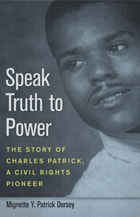
Speak Truth to Power
The Story of Charles Patrick, a Civil Rights PioneerMignette Y. Patrick Dorsey
University of Alabama Press, 2010
"Patrick did not intend to become a civil rights pioneer, but a minor dispute over a parking spot led to his arrest, beating while in custody, and eventual legal tribulations. His daughter's account of his ordeal is well researched, beautifully narrated, and extremely informative." —Journal of Southern History
On December 11, 1954, Charles Patrick drove to downtown Birmingham to buy a Boy Scout uniform for his son. Christmas traffic around the downtown department stores was heavy, and Patrick circled unsuccessfully until at last a streetside spot opened up and he began to pull in. As he did so, he was cut off by a woman who ordered him out of the way, as she was the wife of a city police officer. Patrick pulled away, remarking, "Ma’am, he doesn’t own the streets of Birmingham."
Normal low-level urban hassle? Not in 1954 Birmingham, when the woman was white and Patrick black. The woman reported to her husband that a black man had sassed her, and Patrick was summarily arrested, charged with disorderly conduct, and placed in a cell where he was beaten by the husband and another police officer.
Usually that would have been the end of it, but Patrick was not the sort of man to meekly endure an injustice. He found an attorney, went to court to fight the charges, and brought his assailants to justice--as whites, blacks, politicians and the press offered public support.
This book tells the story of Patrick’s quest for justice in segregated Alabama on the eve of the civil rights movement and represents a telling instance of the growing determination of African Americans to be treated fairly, part of the broadening and deepening stream of resolve that led to the widespread activism of the civil rights movement.
Stacked Deck
A Story of Selfishness in AmericaLawrence E. Mitchell
Temple University Press, 1998
To understand this ideology and its effect on society, Lawrence E. Mitchell instructs us to look at the myth of individualism that pervades our laws, our social thought, our institutions, and our philosophies. It is the touchstone of our national debates on welfare reform, salary equity, FDA regulations, and a criminal defendant's right to a fair trial -- and it even infiltrates our private lives every time we argue about the division of household chores or television time. In Stacked Deck, Mitchell shows us how this artificial reality buries the way we truly live.
Mithcell uses examples drawn from history, politics, law, and culture to show how our singular concern with fairness has diminished our sense of vulnerability, so that our ideas of justice, equality, and efficiency are modeled on the capabilities of the strongest in society. Large scale examples -- such as blue collar layoffs and corporate downsizing, natural disasters and catastrophic illnesses -- illustrates the rickety bridge between comfort and disaster. We must be reminded that we are all vulnerable to the forces of economics, society, politics, and nature. Thus, Mitchell proposes, those who start out at the top tend to stay there, just as the weak tend to remain weak.
Stacked Deck does more than outline this problem of American selfishness; it proposes a solution tha tis nothing less than a massive reconception of the way we relate to one another. Mitchell retains what is productive about the myth of the self-reliant individual, while asserting what is necessary to restore a sense of community. He suggests a sweeping intellectual recovery of fairness available to all levels of American society, thereby reclaiming our true sense of responsibility to others in society.

Star Day
A Story of 24 Hours and 24 Stellar LivesMarcia Bartusiak and Stephen Lowe
University of Chicago Press, 2027
An hourly guide that tracks twenty-four stars, stellar clusters, and constellations across the sky to reveal their luminous lives and lore.
Over the course of a day, the constellations slowly shift, rising in the east and setting in the west, due to Earth’s rotation. A full turn of the celestial sphere, that bowl above us where the stars seemingly appear fixed to the surface, is completed once every twenty-four hours. In fact, the stars inspired the twenty-four-hour day, and one star, our Sun, rules the circadian rhythms of all life on our planet. This short book sweeps through the celestial sphere hour by hour, introducing a remarkable cast of stellar characters with each chapter. Celebrated science writer Marcia Bartusiak and mathematician Stephen Lowe blend practical astronomy with fascinating history to share unique cosmological stories.
This husband and wife team explain that observers have long split the sky into twenty-four hours of right ascension—a celestial equivalent of longitude and a universal scheme for locating cosmological objects. Each chapter of Star Day presents a single right ascension hour, from the stellar death of S Andromedae (zeroth hour)—an explosion that helped reveal the size of the universe—to Scheat (twenty-third hour), an aging red giant. Twice the mass of the Sun and some 1,500 times as bright, Scheat sometimes guides amateur astronomers to distant galaxies. In between, we learn about humans’ pole star, Polaris (second hour), and meet the supermassive black hole at the center of our Milky Way galaxy (seventeenth hour). By the end of our star day, we will appreciate both our own stellar origins and the fragile and deep connections between human civilizations and the ever-changing heavens. Star Day reminds us that wonder and discovery are easily available, all for the simple price of looking up.
For each chapter, artist Matthew Green has depicted these stellar scenes with entrancing pen-and-ink drawings. Working together to narrate and illustrate these stars' stories, Bartusiak, Lowe, and Green have created an engaging read that is a perfect way to spend an hour or two—and a true gift to both seasoned skywatchers and curious beginners.
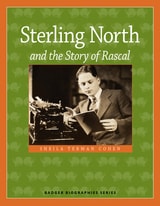
Sterling North and the Story of Rascal
Sheila Terman Cohen
Wisconsin Historical Society Press, 2015
This Badger Bio shares the story of author Sterling North – his adventures and misadventures as a young boy growing up in Edgerton, Wisconsin. Young readers will learn how North’s early experience in Wisconsin influenced him in writing some of his best loved children’s books – such as Rascal and So Dear To My Heart.
The story gives readers a glimpse of early 20th century customs and lifestyles in the rural Midwest. It also includes global issues of the time, including World War I and the Spanish flu pandemic, which greatly affected Sterling’s boyhood. As examples, his admired older brother Hershel served overseas in WWI as Sterling was growing up, bringing world events to the North family’s doorstep. His mother Gladys died when Sterling was only 7 years old because of the lack of medical advances in the early 1900s. And, as a young man, Sterling was hit by polio, a common epidemic scourge that left many children with paralysis.
Readers will learn of Sterling North’s successes, not only as a beloved author of children’s books, but as a columnist for the Chicago Daily News, an editor of North Star children’s history books, and a well-respected critic of other children’s literature.
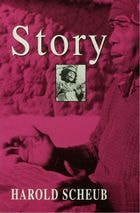
Story
Harold Scheub
University of Wisconsin Press, 1998
What is the essence of story? How does the storyteller convey meaning? Leading scholar Harold Scheub tackles these questions and more, demonstrating that the power of story lies in emotion.
While others have focused on the importance of structure in the art of story, Scheub emphasizes emotion. He shows how an expert storyteller uses structural elements—image, rhythm, and narrative—to shape a story's fundamental emotional content. The storyteller uses traditional images, repetition, and linear narrative to move the audience past the story’s surface of morals and ideas, and make connections to their past, present, and future. To guide the audience on this emotional journey is the storyteller’s art.
The traditional stories from South African, Xhosa, and San cultures included in the book lend persuasive support to Scheub’s. These stories speak for themselves, demonstrating that a skilled performer can stir emotions despite the obstacles of space, time, and culture.
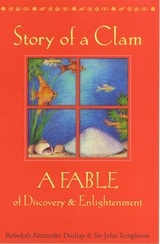
Story Of A Clam
Visionary FictionSir John Templeton
Templeton Press, 2001
Story of a Clam is a special, magical tale of an egotistical clam who thinks he and his community are the center of the universe. It offers us the artistry of the written word, creating an adventure in evolving consciousness. In an exciting series of events, the clam becomes aware that "there is more to life than you presently know and experience."
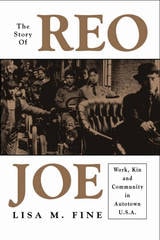
Story Of Reo Joe
Work, Kin, And CommunityLisa M. Fine
Temple University Press, 2004
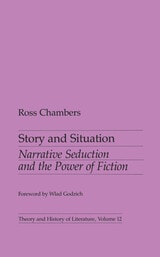
Story and Situation
Narrative Seduction and the Power of FictionRoss Chambers
University of Minnesota Press, 1984
Ross Chambers shifs the emphasis to precisely the play of authority and mastery by focusing on the narrative situation or the “point” of telling a story in given context. He studies the relation between teller and listener in a set of French, English, and American short stories from the nineteenth and early twentieth centuries and detects in that relationship the key to the power of fiction. In each of these stories, the author identifies the narrative situation by recourse to the metaphor of seduction, a phenomenon Chambers finds characteristic of literary production in the modern period.
“Story and Situation is a powerful work of criticism, the best work in short narrative I know, and will redirect critics’ attention to a form which has always engaged readers but has recently been neglected by literary theorists. . . . It is clear, assured, and intelligently paced.”-Jonathan Culler, Cornell University
Story of Willow Run
Marion F. Wilson
University of Michigan Press, 1956
Story of a Stammer
Gábor Vida
Seagull Books, 2022
In the novel Story of a Stammer, Gábor Vida asks a fundamental question: Where does stammering come from? In the process of answering this question, he discovers that an entire historical period and an entire world have been stammering, too. Through Vida’s eyes, we see that stammering comprises all the lies accumulated over time and over generations because nobody had ever articulated what they felt or thought, nor done what they really wanted. Nobody, Vida shows, had ever told the truth.
Describing life in the 1970s and ’80s under Romanian Communist dictator Nicolae Ceauçescu’s authoritarian regime, Vida writes with disarming honesty, breaking taboos and chronicling the ways in which tyranny and exploitation seep into family relationships. The novel charts the first two decades of a young Hungarian man’s life in Romania, telling a story of coming to terms with a stammer, loneliness, and an unstimulating environment where religion, alcoholism, and suicide are the most common escape strategies. A Bildungsroman, a novel about Transylvania, a chronicle of minority life, a sociological analysis of cultural identity, and ultimately a deeply personal account of a historical era, Story of a Stammer is a major contribution to contemporary Hungarian literature—an unfailingly serious yet humorously delightful witness to a turbulent period in recent history.
Style and Story
Literary Methods for Writing NonfictionStephen J. Pyne
University of Arizona Press, 2018
Style and Story is for those who wish to craft nonfiction texts that do more than simply relay facts and arguments. Pyne explains how writers can employ literary tools and strategies to have art and craft add value to their theme. With advice gleaned from nearly a dozen years of teaching writing to graduate students, Pyne offers pragmatic guidance on how to create powerful nonfiction, whether for an academic or popular audience.
Each chapter offers samples that span genres, showcasing the best kinds of nonfiction writing. Pyne analyzes these examples that will help writers understand how they can improve their nonfiction through their choice of voice, words, structure, metaphors, and narrative. Pyne builds on his previous guide, Voice and Vision, expanding the range of topics to include openings and closings, humor and satire, historical writing, setting scenes, writing about technical matters and deep details, long and short narration, reading for craft, and thoughts on writing generally. He also includes in this volume a set of exercises to practice writing techniques.
Style and Story will be treasured by anyone, whether novice or expert, who seeks guidance to improve the power of their nonfiction writing.

Sugar's Life in the Hood
The Story of a Former Welfare MotherBy Sugar Turner and Tracy Bachrach Ehlers
University of Texas Press, 2002
All her life, Sugar Turner has had to hustle to survive. An African American woman living in the inner city, she has been a single mother juggling welfare checks, food stamps, boyfriends and husbands, illegal jobs, and home businesses to make ends meet for herself and her five children. Her life's path has also wandered through the wilderness of crack addiction and prostitution, but her strong faith in God and her willingness to work hard for a better life pulled her through. Today, Turner is off welfare and is completing her education. She is computer literate, holds a job in the local school system, has sent three of her children to college, and is happily married.
In this engrossing book, Sugar Turner collaborates with anthropologist Tracy Bachrach Ehlers in telling her story. Through conversations with Ehlers, diary entries, and letters, Turner vividly and openly describes all aspects of her life, including motherhood, relationships with men, welfare and work, and her attachment to her friends, family, and life in the "hood." Ehlers also gives her reactions to Turner's story, discussing not only how it belies the "welfare queen" stereotype, but also how it forced her to confront her own lingering confusions about race, her own bigotry.
What emerges from this book is a fascinating story of two women from radically different backgrounds becoming equal witnesses to each other's lives. By allowing us into the real world of an inner-city African American mother, they replace with compassion and insight the stereotypes, half-truths, and scorn that too often dominate public discourse.
Survivance, Sovereignty, and Story
Teaching American Indian RhetoricsLisa King
Utah State University Press, 2015
Focusing on the importance of discussions about sovereignty and of the diversity of Native American communities, Survivance, Sovereignty, and Story offers a variety of ways to teach and write about indigenous North American rhetorics.
These essays introduce indigenous rhetorics, framing both how and why they should be taught in US university writing classrooms. Contributors promote understanding of American Indian rhetorical and literary texts and the cultures and contexts within which those texts are produced. Chapters also supply resources for instructors, promote cultural awareness, offer suggestions for further research, and provide examples of methods to incorporate American Indian texts into the classroom curriculum.
Survivance, Sovereignty, and Story provides a decolonized vision of what teaching rhetoric and writing can be and offers a foundation to talk about what rhetoric and pedagogical practice can mean when examined through American Indian and indigenous epistemologies and contemporary rhetorics.
Contributors include Joyce Rain Anderson, Resa Crane Bizzaro, Qwo-Li Driskill, Janice Gould, Rose Gubele, Angela Haas, Jessica Safran Hoover, Lisa King, Kimberli Lee, Malea D. Powell, Andrea Riley-Mukavetz, Gabriela Raquel Ríos, and Sundy Watanabe.