52 books match the query 'Structure' and 9 start with s

cover of Selected Papers, Volume 1: Stellar Structure and Stellar Atmospheres

Selected Papers, Volume 1

Stellar Structure and Stellar Atmospheres

S. Chandrasekhar

University of Chicago Press, 1989

This is the first of six volumes collecting significant papers of the distinguished astrophysicist and Nobel laureate S. Chandrasekhar. His work is notable for its breadth as well as for its brilliance; his practice has been to change his focus from time to time to pursue new areas of research. The result has been a prolific career full of discoveries and insights, some of which are only now being fully appreciated.

Chandrasekhar has selected papers that trace the development of his ideas and that present aspects of his work not fully covered in the books he has periodically published to summarize his research in each area.

Volume 1, Stellar Structure and Stellar Atmospheres, covers primarily the period 1930-40 and includes early papers on the theory of white dwarfs. In the Preface, Chandrasekhar explains the criteria for selection and provides historical background. Each subsequent volume will include a foreword by an authority on the topics covered.

[more]
cover of Shugendo: Essays on the Structure of Japanese Folk Religion

Shugendo

Essays on the Structure of Japanese Folk Religion

Miyake Hitoshi; Edited and with an Introduction by H. Byron Earhart

University of Michigan Press, 2001

This volume of essays is the first comprehensive publication in English of the work of Miyake Hitoshi, a distinguished scholar of Shugendō (mountain asceticism) and one of the foremost researchers on Japanese folk religion. Miyake defines folk religion as “religion that merges from the necessities of community life.” In Miyake’s systematic methodological and theoretical approach, Shugendō is a classic example of Japanese folk religion, for it blends many traditions (shamanism, Taoism, Buddhism, and Shinto) into a distinctive Japanese religious worldview and is typical of Japanese religion generally.
The first part of this book is devoted to Shugendō’s history, organization, ritual, austerities, thought, and cosmology. Related subjects include exorcism and the exclusion of women. The second part of the book provides research and reflection on Japanese folk religion, including essays on the idea of nature, worldly benefits, new religions, death and rebirth, and the structure of folk religion.
Shugendō: Essays on the Structure of Japanese Folk Religion clarifies much of the logic behind Japanese religious syncretism. It is essential reading not only for those interested in Japanese history, culture, and religion but also for those studying world religions and folk culture.
[more]
cover of Social Life in Northwest Alaska: The Structure of Inupiaq Eskimo Nations

Social Life in Northwest Alaska

The Structure of Inupiaq Eskimo Nations

Ernest Burch Jr.

University of Alaska Press, 2006
This landmark volume will stand for decades as one of the most comprehensive studies of a hunter-gatherer population ever written. In this third and final volume in a series on the early contact period Iñupiaq Eskimos of northwestern Alaska, Burch examines every topic of significance to hunter-gatherer research, ranging from discussions of social relationships and settlement structure to nineteenth-century material culture.
[more]
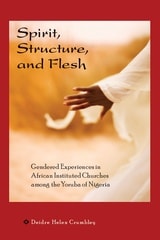
cover of Spirit, Structure, and Flesh: Gender and Power in Yoruba African Instituted Churches

Spirit, Structure, and Flesh

Gender and Power in Yoruba African Instituted Churches

Deidre Helen Crumbley

University of Wisconsin Press, 2008

Although popularized in Africa by Western missionaries, the Christian faith as practiced by Africans has acquired unique traits over time. Some of the most radical reinterpretations of Christianity are offered by those churches known as “AICs” (variously, African Initiated, African Instituted, or African Independent Churches)—new denominations founded by Africans skeptical of dogma offered by mainstream churches with roots in European empires. As these churches spread throughout the African diaspora, they have brought with them distinct practices relating to gender. Such practices range from the expectation that women avoid holy objects and sites during menstruation to the maintenance of church structures in which both men and women may be ordained and assigned the same duties and responsibilities.
            How does having a female body affect one’s experience of indigenized Christianity in Africa? Spirit, Structure, and Flesh addresses this question by exploring the ways ritual, symbol, and dogma circumscribe, constrain, and liberate women in AICs. Through detailed description of worship and doctrine, as well as careful analyses of church history and organizational processes, Deidre Helen Crumbley explores gendered experiences of faith and power in three Nigerian indigenous AICs, demonstrating the roles of women in the day-to-day life of these churches.
[more]
cover of Structure and Process in Southeastern Archaeology

Structure and Process in Southeastern Archaeology

Edited by Roy Dickens Jr and H. Trawick Ward

University of Alabama Press, 1985

A Dan Josselyn Memorial Publication

Within the general structure-and-process theme of this compendium, the authors have focused on either intrasite problems (those dealing with the formation and structure of a site, type of site, or type of feature) or intersite problems (those dealing with behavioral organization and process as developed from comparative site data). These papers, from a broad range of specialists, present a comprehensive study of southeastern archaeology.

Structure and Process in Southeastern Archaeology is a foundational work that reshapes how scholars understand the cultural and social dynamics of prehistoric communities in the Southeastern United States. Roy S. Dickens, Jr. and H. Trawick Ward bring together decades of fieldwork, theoretical insight, and regional expertise to explore how ancient societies organized themselves, interacted, and evolved over time. Rather than focusing solely on artifacts or isolated site reports, this volume emphasizes the broader patterns—both structural and processual—that define the archaeological record of the Southeast.

Through a careful synthesis of settlement data, material culture, and environmental context, the authors reveal how social organization, political structures, and cultural practices were deeply embedded in the landscape. Their approach integrates processual archaeology with a nuanced understanding of regional variation, offering readers a dynamic view of how prehistoric communities adapted to changing conditions and interacted across space and time.

This book is particularly valuable for archaeologists, anthropologists, and historians seeking to move beyond descriptive accounts toward more interpretive frameworks. It provides a model for analyzing archaeological data in ways that illuminate the lived experiences of ancient peoples, making it a vital resource for both academic research and classroom instruction. The authors’ clear writing and thoughtful analysis make complex ideas accessible without sacrificing scholarly rigor.

Whether you're studying Mississippian chiefdoms, Woodland period settlements, or the broader cultural landscapes of the American South, Structure and Process in Southeastern Archaeology offers essential tools for understanding the past. It stands as a testament to the importance of theory-driven, context-rich archaeological interpretation.


[more]
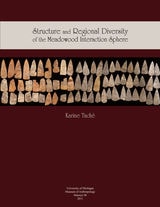
cover of Structure and Regional Diversity in the Meadowood Interaction Sphere

Structure and Regional Diversity in the Meadowood Interaction Sphere

Karine Taché

University of Michigan Press, 2011
This monograph offers the first major synthesis of the Meadowood phenomenon, one of the earliest and largest interaction spheres in northeastern North America. This volume breathes new life into our understanding of the Early Woodland phenomenon (3000–2400 BP).
[more]
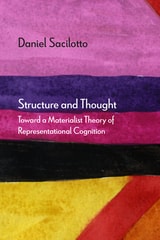
cover of Structure and Thought: Toward a Materialist Theory of Representational Cognition

Structure and Thought

Toward a Materialist Theory of Representational Cognition

Daniel Sacilotto; Foreword by Ray Brassier

Northwestern University Press, 2024

Offers a new understanding of representational cognition that synthesizes postwar philosophical approaches to the question of objective knowledge

This study develops a novel account of representational cognition, explaining how cognitive systems progressively come to map the structure of their worlds. Daniel Sacilotto offers a constructive response to the critique of representation formulated throughout the post‑Kantian philosophical tradition. Rather than a skepticism or idealism whereby thinking can grasp appearances but never the real, representation, Sacilotto shows, is a constitutive dimension of cognitive systems’ creative capacity to know and intervene in the world of which they are part.

Structure and Thought: Toward a Materialist Theory of Representational Cognition integrates various lines in contemporary philosophy, including those often seen as incommensurable or in irresolvable tension with one another. Sacilotto thus advances a productive synthesis of a materialist ambition to provide a creative and historical understanding of cognition with a structural realist account of representation. He shows how the different forms of sensory, discursive, and theoretical mediation that characterize human cognition are conducive to a realist epistemological framework that explains how the possibility of knowledge about a mind‑independent reality is conceivable.

[more]
cover of Structure of the Brothers Karamazov

Structure of the Brothers Karamazov

Robert Belknap

Northwestern University Press, 1989

Long unavailable, The Structure of "The Brothers Karamazov" is a classic in American Slavic studies. Robert L. Belknap's study clarifies the complex architectonics of Dostoevsky's most carefully constructed and painstakingly written book by employing structuralist critical methods. This first paperback edition includes a new preface by the author, reflecting on the theory of the book and on recent developments in Dostoevsky criticism and relevant critical theory.
[more]
cover of Structure, Alignment and Optimality in Swedish

Structure, Alignment and Optimality in Swedish

Peter Sells

CSLI, 2001

Very little research has been performed on the grammatical structure of sentences in Swedish. Structure, Alignment and Optimality in Swedish is one of the first books to explore the Swedish sentence structure, presenting an account of the order of the words and phrases within the sentence. The book uses the theoretical framework of Lexical-Functional Grammar (LFG), which provides syntactic analysis in terms of subject, object, topic, and focus, as well as part-of-speech analysis in terms of noun phrase and verb phrase. The book also uses Optimality Theory, a theory of constraint interpretation that allows constraints to conflict by allowing the satisfaction of certain constraints or requirements to lead to a grammatical structure even if less important constraints are violated.
[more]