Results by title
206 books match the query 'Study & Teaching' and 10 start with s
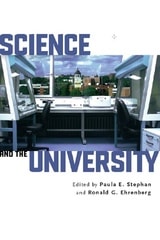
Science and the University
Edited by Paula E. Stephan and Ronald G. Ehrenberg
University of Wisconsin Press, 2007
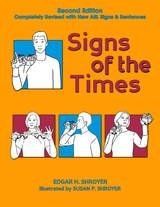
Signs of the Times
Edgar H. Shroyer
Gallaudet University Press, 2011
•Completely Revised with New Signs and Lessons
•Each Sign Illustration Features Sentences in English and ASL Order
•New Class Activities and New Student Activities for Homework or Quizzes
•New Facts about American Sign Language Grammar and Deaf Culture
Now, the bestselling American Sign Language textbook Signs of the Times has been completely revised and updated. The new, second edition is an excellent beginner’s American Sign Language textbook designed for use in the classroom or at home. Organized into 44 lessons, it presents more than 1,300 signs representing 3,500 English glosses. Each lesson contains clear illustrations of all signs, English equivalent words and synonyms, sample sentences to define vocabulary context, and practice sentences to display and reinforce ASL usage.
Signs of the Times is a complete text that includes new class activities for teachers, plus new student activities that can be done in class, as homework, or as quizzes. The new edition features the Contextual Sign/Word Appendix, which displays groups of sentences using the same English word to show different meanings along with the corresponding ASL signs. It also provides an expanded index, vocabulary lists, and a reading reference list. The new edition offers facts on ASL grammar and Deaf culture and includes mind ticklers that enliven the lessons with hints, tips, and mnemonic devices.
The new Signs of the Times expands the features that made it a standard, easy-to-use ASL textbook. Signs are repeated in sentences throughout the book to provide excellent practice for the students. The clear, easy-to-understand sign illustrations facilitates the learning process, enhancing students’ success while also making ASL fun.
Situating Composition
Composition Studies and the Politics of LocationLisa Ede
Southern Illinois University Press, 2004
Responding to a growing pedagogical paralysis in debates over the nature and status of composition studies as an academic discipline, Lisa Ede offers a provocative inquiry into the politics of composition’s place in the academy. The result is a timely and engaging reflection on the rhetoric, ideology, and ethics of scholarship and instruction in composition studies today.
Situating Composition: Composition Studies and the Politics of Location delves into some of the most vexing issues presently facing the field: its status in relation to English studies, the nature and consequences of the writing process movement, the uneven professionalization of composition teachers, and the widening chasm between theory and practice. Ede interrogates key moments and texts in composition’s evolution, from the writing process movement to Susan Miller’s Textual Carnivals, through the interpretive lenses of historical analysis, theoretical critique, feminist and cultural theory, and Ede’s own two decades of experiences as a teacher and writing program administrator.
Questioning the narratives of progress and paradigm shifts that inform the field’s highly regarded recent theoretical studies, Ede urges scholars to carefully reconsider these claims, to honor the roles of teachers and students as more than dupes of ideology, and to more fully acknowledge—and utilize—the differences between the practice of theory and the practice of teaching. As academic hierarchies of knowledge increasingly privilege scholarship over instruction, Ede warns researchers to be cognizant of the politics and power inherent in their own location in the academy, particularly when professing to speak for teachers and students. To that end, the volume’s conclusion advocates pragmatic avenues for change and proffers topics for future discussion and debate.
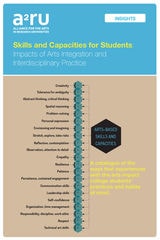
Skills and Capacities for Students
Impacts of Arts Integration and Interdisciplinary PracticeGabriel Harp
A2RU Intervals, 2020
Something Old, Something New
College Writing Teachers and Classroom ChangeWendy Bishop. Foreword by Patrick Hartwell
Southern Illinois University Press, 1990
How do college writing teachers learn new ways to teach? Most current composition research focuses almost exclusively on student writers, ignoring the role the teacher plays in classroom development. Here is the first book to focus on college writing teachers and the ways in which they are affected by graduate rhetoric pedagogy courses.
Wendy Bishop observed teachers enrolled in a doctoral seminar, titled "Teaching Basic Writing," and then conducted case studies of five of those teachers in their college writing classrooms to investigate how their teaching practices changed and how their previous professional and personal histories influenced their ability to make those changes.
Standing at the Threshold
Working through Liminality in the Composition and Rhetoric TAshipWilliam J. Macauley
Utah State University Press, 2021
These authors enrich the TA experience by supporting agency and self-efficacy, encouraging TAs to take active roles in understanding their positions and making the most of that experience. Many chapters are written by current or former TAs who are writing as a means of preparing, informing, and guiding new rhet/comp TAs, encouraging them to make choices about how they want to think through and participate in their teaching work.
The first work on the market to delve deeply into the TAship itself and what it means for the larger discipline, Standing at the Threshold provides a rich new theorizing based in the real experiences and liminalities of teaching assistants in composition and rhetoric, approached from a productive array of perspectives.
Contributors: Lew Caccia, Lillian Campbell, Rachel Donegan, Jaclyn Fiscus-Cannady, Jennifer K. Johnson, Ronda Leathers Dively, Faith Matzker, Jessica Restaino, Elizabeth Saur, Megan Schoettler, Kylee Thacker Maurer
Storytelling in Alcoholics Anonymous
A Rhetorical AnalysisGeorge H. Jensen
Southern Illinois University Press, 2000
Based on an ethnographic study spanning four years, George H. Jensen’s Storytelling in Alcoholics Anonymous: A Rhetorical Analysis calls upon Bakhtinian theory to analyze storytelling in AA.
Jensen introduces his study with an analysis of “Bill W.’s Story” as it appears in the first chapter of AA’s central text, Alcoholics Anonymous. Drawing on Walter Ong’s work on orality and literacy, he argues that “Bill W.’s Story” as it appears in print cannot fully capture the oral tradition of storytelling as it occurs in AA meetings.
In his first section, Jensen discusses storytelling as practiced by the Washingtonians, a temperance organization much like AA. He also discusses the influence of the Oxford Group’s (an international and interdenominational religious movement seeking to recapture the enthusiasm and dedication of first-century Christianity) spiritual program to the development of AA’s Twelve Steps. The remainder of the first section serves as an introduction of the culture of AA to outsiders.
In the second section, Jensen covers Bakhtin’s theory of the relationship between the author and the hero of a text, using Lillian Roth’s autobiographies as counterexamples of AA talks. He devotes an entire chapter in this section to explaining how AA meetings provide an example of what Bakhtin meant by carnival, a process through which humor, irony, and parody supply a mechanism for questioning commonly held beliefs. He shows how newcomers to AA move away from their egocentric personae as practicing alcoholics to adopt a new identity within AA. Drawing further on Bakhtin, he examines the autobiographical moments of AA talks, stressing that these moments never become fully autobiographical. AA talks, Jensen argues, are fragmented, yet achieve coherence through the interweaving of two important chronotopes. Finally, using Bakhtin’s discussion of heroes in autobiography, Jensen discusses the kinds of heroes one typically finds in AA talks.
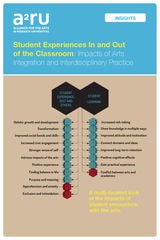
Student Experiences In and Out of the Classroom
Impacts of Arts Integration and Interdisciplinary PracticeGabriel Harp
A2RU Intervals, 2020
Surrender
Feminist Rhetoric and Ethics in Love and IllnessJessica Restaino
Southern Illinois University Press, 2019
One of Library Journal's Top 20 Best-Selling Language Titles of 2019
In an ethnographic study spanning the last years of research collaborator and friend Susan Lundy Maute’s life with terminal breast cancer, author Jessica Restaino argues the interpretative challenges posed by research and writing amid illness and intimacy demand a methodological break from accepted genres and established practices of knowledge making. Restaino searches their experiences—recorded in interviews, informal writings, and correspondence—to discover a rhetoric of love and illness. She encourages a synthesis of methods and the acceptance of a reversal of roles—researcher and researched, writer and written-about—and emphasizes the relevancy of methodological diversity, the necessity of the personal, and the analytical richness of unpredictability and risk in being who we are in our scholarship at any given moment.
Bringing together critical analysis, qualitative-style research methods, close reading, Surrender: Feminist Rhetoric and Ethics inLove and Illness resists traditional ideas about academic writing and invites others to pursue collaborations that subvert accepted approaches to representation, textual production, and subjectivity. Restaino demonstrates a way of writing—the rendering of the academic text itself—that suggests how we do our work has resonance for what we produce. She offers framing questions for use by others interested in doing similar kinds of scholarship that may frighten, overwhelm, or confound. This book deepens our understanding of subjectivity and the gains made by feminist resistance to conventional concepts of objectivity in research collaborations.
Surveying the Landscape
Arts Integration at Research Universities: A Review of Best Practices and Challenges for Arts Integration in Higher EducationBruce M. Mackh, PhD
Michigan Publishing Services, 2015
This study presents “best practices in the integration of arts practice in U.S. research universities . . . , fulfill[ing] the need for a document that articulates models, obstacles, implementation strategies, costs, and impact on students and faculty as well as on research, practice, and teaching in other knowledge areas” (ArtsEngine). Rather than providing a detailed set of instructions, this document maps the landscape of arts integration at 30 partner institutions in the Alliance for the Arts in Research Universities (a2ru) and at 16 other institutions. It highlights aspirational models and presents an overall guide to current practices linking the arts to other learning areas.