Results by title
73 books match the query 'Style' and 14 start with s
Senses of Style
Poetry before InterpretationJeff Dolven
University of Chicago Press, 2017
Shakespeare from the Margins
Language, Culture, ContextPatricia Parker
University of Chicago Press, 1996
Combining feminist and historical approaches with attention to the "matter" of language as well as of race and gender, Parker's brilliant "edification from the margins" illuminates much that has been overlooked, both in Shakespeare and in early modern culture. This book, a reexamination of popular and less familiar texts, will be indispensable to all students of Shakespeare and the early modern period.
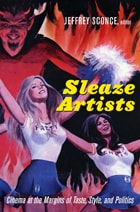
Sleaze Artists
Cinema at the Margins of Taste, Style, and PoliticsJeffrey Sconce, ed.
Duke University Press, 2007
Writing about horror, exploitation, and sexploitation films, the contributors delve into topics ranging from the place of the “Aztec horror film” in debates about Mexican national identity to a cycle of 1960s films exploring homosexual desire in the military. One contributor charts the distribution saga of Mario Bava’s 1972 film Lisa and the Devil through the highs and lows of art cinema, fringe television, grindhouse circuits, and connoisseur DVD markets. Another offers a new perspective on the work of Doris Wishman, the New York housewife turned sexploitation director of the 1960s who has become a cult figure in bad-cinema circles over the past decade. Other contributors analyze the relation between image and sound in sexploitation films and Italian horror movies, the advertising strategies adopted by sexploitation producers during the early 1960s, the relationship between art and trash in Todd Haynes’s oeuvre, and the ways that the Friday the 13th series complicates the distinction between “trash” and “legitimate” cinema. The volume closes with an essay on why cinephiles love to hate the movies.
Contributors. Harry M. Benshoff, Kay Dickinson, Chris Fujiwara, Colin Gunckel, Joan Hawkins, Kevin Heffernan, Matt Hills, Chuck Kleinhans, Tania Modleski, Eric Schaefer, Jeffrey Sconce, Greg Taylor
Some Words of Jane Austen
Stuart M. Tave
University of Chicago Press, 2019

Spurs
Nietzsche's Styles/Eperons: Les Styles de NietzscheJacques Derrida
University of Chicago Press, 1981
Spurs, then, is aptly titled, for Derrida's "deconstructions" of Nietzsche's meanings will surely act as spurs to further thought and controversy. This dual-language edition offers the English-speaking reader who has some knowledge of French an opportunity to examine the stylistic virtuosity of Derrida's writing—of particular significance for his analysis of "the question of style."
Style and Music
Theory, History, and IdeologyLeonard B. Meyer
University of Chicago Press, 1997
Meyer devotes the latter part of his book to a sketch-history of nineteenth-century music. He shows explicitly how the beliefs and attitudes of Romanticism influenced the choices of composers from Beethoven to Mahler and into our own time.
"A monumental work. . . . Most authors concede the relation of music to its cultural milieu, but few have probed so deeply in demonstrating this interaction."—Choice
"Probes the foundations of musical research precisely at the joints where theory and history fold into one another."—Kevin Korsyn, Journal of American Musicological Society
"A remarkably rich and multifaceted, yet unified argument. . . . No one else could have brought off this immense project with anything like Meyer's command."—Robert P. Morgan, Music Perception
"Anyone who attempts to deal with Romanticism in scholarly depth must bring to the task not only musical and historical expertise but unquenchable optimism. Because Leonard B. Meyer has those qualities in abundance, he has been able to offer fresh insight into the Romantic concept."—Donal Henahan, New York Times
Style and Seduction
Jewish Patrons, Architecture, and Design in Fin de Siècle ViennaElana Shapira
Brandeis University Press, 2016
Style and Story
Literary Methods for Writing NonfictionStephen J. Pyne
University of Arizona Press, 2018
Style and Story is for those who wish to craft nonfiction texts that do more than simply relay facts and arguments. Pyne explains how writers can employ literary tools and strategies to have art and craft add value to their theme. With advice gleaned from nearly a dozen years of teaching writing to graduate students, Pyne offers pragmatic guidance on how to create powerful nonfiction, whether for an academic or popular audience.
Each chapter offers samples that span genres, showcasing the best kinds of nonfiction writing. Pyne analyzes these examples that will help writers understand how they can improve their nonfiction through their choice of voice, words, structure, metaphors, and narrative. Pyne builds on his previous guide, Voice and Vision, expanding the range of topics to include openings and closings, humor and satire, historical writing, setting scenes, writing about technical matters and deep details, long and short narration, reading for craft, and thoughts on writing generally. He also includes in this volume a set of exercises to practice writing techniques.
Style and Story will be treasured by anyone, whether novice or expert, who seeks guidance to improve the power of their nonfiction writing.
Style and Time
Essays on the Politics of AppearanceAndrew Benjamin
Northwestern University Press, 2006
Nothing less than a rethinking of the conditions of Western art as it relates to politics, architecture, and time, this study of Walter Benjamin's modernity in temporal and spatial terms is a provocative and original work of philosophy in its own right—a work that suggests that the time has come to revise existing paradigms.
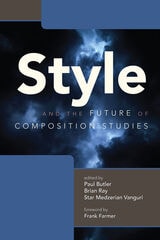
Style and the Future of Composition Studies
Paul Butler
Utah State University Press, 2020
Many college writing teachers operate under the belief that style still refers primarily to the kinds of issues discussed in Strunk and White’s popular but outdated book The Elements of Style. This work not only challenges this view but also offers theories and pedagogies from diverse perspectives that help teachers and students develop strategic habits and mindsets to negotiate languages, genres, and discourse conventions. The chapters explore the ways in which style directly affects—and is affected by—multiple sources of shifting disciplinary inquiry, contributing new insights by drawing on research in cultural studies, sociolinguistics, discourse studies, translingualism, and writing across the curriculum, as well as new approaches to classical rhetorical theory.
The reemergence of stylistic inquiry can be used dynamically to produce new insights not only about emerging disciplinary interests but also about the study of style as a kind of language in and of itself. Style and the Future of Composition Studies demonstrates that style deserves to be a central focus of writing teaching. More than just the next style collection, the book advocates for style’s larger prominence in composition discussions generally. It will be of interest to a broad range of students and scholars of writing studies, as well as a wider set of readers in academe.
Contributors:
Cydney Alexis, Laura Aull, Anthony Box, Jimmy Butts, Mike Duncan, William FitzGerald, Melissa Goldthwaite, Eric House, TR Johnson, Almas Khan, Zak Lancaster, Eric Leake, Andrea Olinger, Thomas Pace, Jarron Slater, Jonathan Udelson
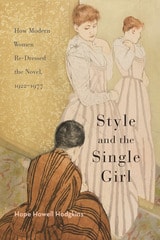
Style and the Single Girl
How Modern Women Re-Dressed the Novel, 1922–1977Hope Howell Hodgkins
The Ohio State University Press, 2016
Hodgkins delineates how in the 1920s and 1930s, popular novels by Dorothy Sayers and high-art fiction by Jean Rhys used dress to comment wittily and bitterly on gender relations. During World War II, changes in British Vogue and compromises made by the literary journal Horizon signaled the death of modernist styles, as Elizabeth Bowen’s gender-bent wartime stories show. Then demure and reserved postwar styles—Dior’s curvy New Look, the Movement’s understated literary irony—were intertwined in the fictions of Barbara Pym and Muriel Spark, who re-dressed the novel with a vengeance. Whether fashioning detective fiction, literary impressionism, or postwar comedy, these novelists used style in every sense to redefine that famous question, “What do women want?”

Style as Argument
Contemporary American NonfictionChirs Anderson
Southern Illinois University Press, 1987
Taking the position that style has a value in its own right, that language forms a major component of the story a nonfiction writer has to tell, Anderson analyzes the work of America’s foremost practitioners of New Journalism—Tom Wolfe, Truman Capote, Norman Mailer, and Joan Didion.
Anderson does for nonfiction what insightful critics have long been doing for fiction and poetry. His approach is rhetorical, and his message is that the rhetoric of Wolfe, Capote, Mailer, and Didion is a direct response to the problem of trying to convey to a general audience the sublime, inexplicable, or private and intuitive experiences that conventional rhetoric cannot evoke.
The emphasis in this book is on style, not genre, and the analysis characterizes the distinctive styles of four American writers, showing how the richness and complexity of their prose discloses an important argument about the value of language itself. Their prose is complex, nuanced, layered, affecting, always aware of itself as style. This self-consciousness, Anderson contends, prepares the reader to regard style as argument, a “tacit but powerful statement about the value of form as form, style as style.”
Style, Function, Transmission
Evolutionary Archaeological PerspectivesMichael J O'Brien
University of Utah Press, 2003
Darwin's theory of evolutionary descent with modification rests in part on the notion that there is heritable continuity affected by transmission between ancestor and descendant. It is precisely this continuity that allows one to trace hylogenetic histories between fossil taxa of various ages and recent taxa. Darwin was clear that were an analyst to attempt such tracings, then the anatomical characters of choice are those least influenced by natural selection, or what are today referred to as adaptively neutral traits. The transmission of these traits is influenced solely by such mechanisms as drift and not by natural selection.
The application of Darwin's theory to archaeological phenomena requires that the theory be retooled to accommodate artifacts. One aspect that has undergone this retooling concerns cultural transmission, the mechanism that affects heritable continuity between cultural phenomena. Archaeologists have long traced what is readily interpreted as heritable continuity between artifacts, but the theory underpinning their tracings is seldom explicit. Thus what have been referred to as artifacts styles underpin such tracings because styles are adaptively neutral. Other traits are referred to as functional.
In their introduction to Style, Function, Transmission, Michael O’Brien and R. Lee Lyman outline in detail the interrelations of a theory of cultural descent with modification and the concepts of drift, style, and function. The chapters in the volume specifically address the issues of selection and drift and their relation to style and function. In non-polemic presentations, contributors specify empirical implications of aspects of cultural transmission for evolutionary lineages of artifacts and then present archaeological data for those implications.
Style
Toward Clarity and GraceJoseph M. Williams
University of Chicago Press, 1990
"Buy Williams's book. And dig out from storage your dog-eared old copy of The Elements of Style. Set them side by side on your reference shelf."—Barbara Walraff, Atlantic
"Let newcoming writers discover this, and let their teachers and readers rejoice. It is a practical, disciplined text that is also a pleasure to read."—Christian Century
"An excellent book....It provides a sensible, well-balanced approach, featuring prescriptions that work."—Donald Karzenski, Journal of Business Communication
"Intensive fitness training for the expressive mind."—Booklist