Results by title
250 books match the query 'Subjects' and 15 start with s
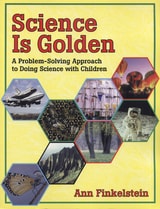
Science is Golden
A Problem-Solving Approach to Doing Science with ChildrenAnn Finkelstein
Michigan State University Press, 2002
The first book of its kind, Science is Golden discusses how to implement an inquiry-based, problem-solving approach to science education (grades K-5). Finkelstein shows parents and teachers how to help students investigate their own scientific questions. Rather than a set of guidelines for science fair projects, this book presents a method for helping students expand their creativity and develop logical thinking while learning science.
Starting with an introduction to the "brains-on method," Science is Golden explains brainstorming, experimental controls, collecting data, and how to streamline children's questions about science so that the questions define an experiment. Students will learn how to: ask good questions; clarify terminology; research, plan, and design experiments and controls; test assumptions; collect and analyze data; present results to others; and collaborate with adults.
Science is Golden is consistent with the National Science Education Standards proposed by the National Academy of Sciences, and the Michigan Essential Goals and Objectives for Science Education (K-12) from the Michigan State Board of Education.
Second Language Acquisition Myths
Applying Second Language Research to Classroom TeachingSteven Brown and Jenifer Larson-Hall
University of Michigan Press, 2012
This volume was conceived as a first book in SLA for advanced undergraduate or introductory master’s courses that include education majors, foreign language education majors, and English majors. It’s also an excellent resource for practicing teachers.
Both the research and pedagogy in this book are based on the newest research in the field of second language acquisition. It is not the goal of this book to address every SLA theory or teach research methodology. It does however address the myths and questions that non-specialist teacher candidates have about language learning.
Steven Brown is the co-author of the introductory applied linguistics textbook Understanding Language Structure, Interaction, and Variation textbook (and workbook).
The myths challenged in this book are:
§ Children learn languages quickly and easily while adults are ineffective in comparison.
§ A true bilingual is someone who speaks two languages perfectly.
§ You can acquire a language simply through listening or reading.
§ Practice makes perfect.
§ Language students learn (and retain) what they are taught.
§ Language learners always benefit from correction.
§ Individual differences are a major, perhaps the major, factor in SLA.
§ Language acquisition is the individual acquisition of grammar.
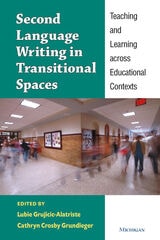
Second Language Writing in Transitional Spaces
Teaching and Learning across Educational ContextsLubie Grujicic-Alatriste and Cathryn Crosby Grundleger
University of Michigan Press, 2020
The chapters examine the writing that English learners are producing because of the Common Core and the writing they are required to do once they reach the college or university, and then consider where the intersections exist—that is, what do educators think English learners ought to be writing across educational levels?
Each chapter describes the educational setting where the researchers were engaged, examines specific issues related to transitions, and offers—where relevant—recommendations for classroom practices, teaching strategies, and instructional materials that may be useful for practicing teachers and all others professionally engaged in educating writers across K–16.
Securing a Place for Reading in Composition
The Importance of Teaching for TransferEllen C. Carillo
Utah State University Press, 2014
Securing a Place for Reading in Composition addresses the dissonance between the need to prepare students to read, not just write, complex texts and the lack of recent scholarship on reading-writing connections. Author Ellen C. Carillo argues that including attention-to-reading practices is crucial for developing more comprehensive literacy pedagogies. Students who can read actively and reflectively will be able to work successfully with the range of complex texts they will encounter throughout their post-secondary academic careers and beyond.
Considering the role of reading within composition from both historical and contemporary perspectives, Carillo makes recommendations for the productive integration of reading instruction into first-year writing courses. She details a “mindful reading” framework wherein instructors help students cultivate a repertoire of approaches upon which they consistently reflect as they apply them to various texts. This metacognitive frame allows students to become knowledgeable and deliberate about how they read and gives them the opportunity to develop the skills useful for moving among reading approaches in mindful ways, thus preparing them to actively and productively read in courses and contexts outside first-year composition.
Securing a Place for Reading in Composition also explores how the field of composition might begin to effectively address reading, including conducting research on reading, revising outcome statements, and revisiting the core courses in graduate programs. It will be of great interest to writing program administrators and other compositionists and their graduate students.
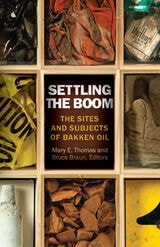
Settling the Boom
The Sites and Subjects of Bakken OilMary E. Thomas
University of Minnesota Press, 2023
Examines how settler colonial and sexist infrastructures and narratives order a resource boom
Over the past decade, new oil plays have unsettled U.S. energy landscapes and imaginaries. Settling the Boom studies how the disruptive forces of an oil boom in the northern Great Plains are contained through the extension of settler temporalities, reassertions of heteropatriarchy, and the tethering of life to the volatility of oil and its cruel optimisms.
This collection reveals the results of sustained research in Williston, North Dakota, the epicenter of the “Bakken Boom.” While the boom brought a rapid influx of capital and workers, the book questions simple timelines of before and after. Instead, Settling the Boom demonstrates how the unsettling forces of an oil play resolve through normative narratives and material and affective infrastructures that support settler colonialism’s violent extension and its gendered orders of time and space. Considering a wide range of evidence, from urban and regional policy, interviews with city officials, media, photography, and film, these essays analyze the ongoing material, aesthetic, and narrative ways of life and land in the Bakken.
Contributors: Morgan Adamson, Macalester College; Kai Bosworth, Virginia Commonwealth U; Thomas S. Davis, Ohio State U; Jessica Lehman, Durham U.

Sex in an Age of Technological Reproduction
<i>ICSI<i/> and <i>Taboos<i/>Carl Djerassi
University of Wisconsin Press, 2008
Social Action Stories
Impact Tales for the School and CommunityKevin D. Cordi, Ph.D., Kirstin J. Milks, PhD., Rebecca Van Tassell
Parkhurst Brothers, Inc., 2022
Story By Story
Creating a School Storytelling Troupe & Making the Common Core ExcitingKaren Chace
Parkhurst Brothers, Inc., 2014
Karen Chace’s book, Story by Story, Building a Storytelling Troupe is a must have for anyone even slightly interested in starting a storytelling group with students. I know I am guilty of sometimes skipping over sections, but every word that Karen writes is important and useful distilled (and therefore potent) information. Ms. Chace not only tells you what to do to run a successful troupe, but also WHY you need to do it. This is, to me, very important. Sometimes one is tempted to skip things, but this book explains how important the steps are. Everything from how many hours Karen thought it would take, to ACTUAL hours, where the funding comes from, how and why to lay foundations and expectations (including ‘no teasing policies’ and group dynamics), right the way through presentation skills to advertising the event and getting bums on seats (emphasis important)!
Over the years Karen has and continues to come up with new and inventive ways of teaching the skills of storytelling, and a great many of these exercises and activities are included in the book. When it comes to research and materials as well as technique, Karen adds new meaning to "thorough". There are links to websites for stories, for grants, for microphone techniques, and how storytelling connects to the school curriculum and more. And if you prefer to read books, there is an extensive bibliography, too.
Basically, I believe if you want to succeed in building a storytelling troupe or group, all you need is Karen Chace’s book, Story by Story, Building a Storytelling Troupe and to do everything Karen suggests. I am sure it would be very hard to fail if you follow her words of wisdom between the covers of her goldmine of a book.
Simon Brooks, storyteller, and educator
Storytelling Tips
Creating, Crafting & Telling StoriesMark Goldman
Parkhurst Brothers, Inc., 2015
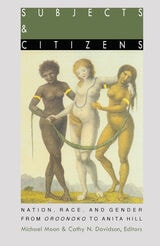
Subjects and Citizens
Nation, Race, and Gender from Oroonoko to Anita HillMichael Moon and Cathy N. Davidson, eds.
Duke University Press, 1995
Defining the landscape of the New American literary history, these essays are united by three interrelated concerns: ideas of origin (where does "American literature" begin?), ideas of nation (what does "American literature" mean?), and ideas of race and gender (what does "American literature" include and exclude and how?). Work by writers as diverse as Aphra Behn, James Fenimore Cooper, Edgar Allan Poe, Frances Harper, Harriet Beecher Stowe, Herman Melville, William Faulkner, Harriet Jacobs, Frederick Douglass, Abraham Lincoln, Bharati Mukherjee, Booker T. Washington, Mark Twain, Kate Chopin, Américo Paredes, and Toni Morrison are discussed from several theoretical perspectives, using a variety of methodologies. Issues of the "frontier" and the "border" as well as those of coloniality and postcoloniality are explored. In each case, these essays emphasize the ideological nature of national identity and, more specifically, the centrality of race and gender to our concept of nationhood.
Collected from recent issues of American Literature, with three new essays added, Subjects and Citizens charts the new directions being taken in American literary studies.
Contributors. Daniel Cooper Alarcón, Lori Askeland, Stephanie Athey, Nancy Bentley, Lauren Berlant, Michele A. Birnbaum, Kristin Carter-Sanborn, Russ Castronovo, Joan Dayan, Julie Ellison, Sander L. Gilman, Karla F. C. Holloway, Annette Kolodny, Barbara Ladd, Lora Romero, Ramón Saldívar, Maggie Sale, Siobhan Senier, Timothy Sweet, Maurice Wallace, Elizabeth Young
Subjects and Narratives in Archaeology
Ruth M. Van Dyke
University Press of Colorado, 2015
Seeking to move beyond the customary limits of archaeological prose and representation, Subjects and Narratives in Archaeology presents archaeology in a variety of nontraditional formats. The volume demonstrates that visual art, creative nonfiction, archaeological fiction, video, drama, and other artistic pursuits have much to offer archaeological interpretation and analysis.
Chapters in the volume are augmented by narrative, poetry, paintings, dialogues, online databases, videos, audio files, and slideshows. The work will be available in print and as an enhanced ebook that incorporates and showcases the multimedia elements in archaeological narrative. While exploring these new and not-so-new forms, the contributors discuss the boundaries and connections between empirical data and archaeological imagination.
Both a critique and an experiment, Subjects and Narratives in Archaeology addresses the goals, advantages, and difficulties of alternative forms of archaeological representation. Exploring the idea that academically sound archaeology can be fun to create and read, the book takes a step beyond the boundaries of both traditional archaeology and traditional publishing.

Subjects of Affection
Rights of Resistance on the Early Modern French StageAnna Rosensweig
Northwestern University Press, 2022
Contemporary scholars have critiqued the modern rights paradigm for its failure to acknowledge the ways in which individual rights depend upon state protection and national belonging. Through a reappraisal of early modern French tragedy, Rosensweig provides a corrective to accounts of human rights that begin with the French Revolution, exploring previously unrecognized models for collective action that had emerged during the religious wars. Subjects of Affection reveals how French tragedy sustained these models of collective action by binding together individuals and groups through affect. Rosensweig places sixteenth-century political treatises in dialogue with dramas by Robert Garnier, Jean Rotrou, Pierre Corneille, and Jean Racine that were performed and published between 1550 and 1700. In so doing, she demonstrates how these tragedies, through their poetics and performance potential, stage a subject of rights whose collective constitution differs from the individualism of our modern rights framework. Through fresh insights and incisive readings, Subjects of Affection explores a form of political subjectivity that locates political power in connection to others—from staged characters and choruses to unseen collectives.

Subjects of the Sun
Solar Energy in the Shadows of Racial CapitalismMyles Lennon
Duke University Press, 2025
Subjects of the World
Darwin's Rhetoric and the Study of Agency in NaturePaul Sheldon Davies
University of Chicago Press, 2009
Being human while trying to scientifically study human nature confronts us with our most vexing problem. Efforts to explicate the human mind are thwarted by our cultural biases and entrenched infirmities; our first-person experiences as practical agents convince us that we have capacities beyond the reach of scientific explanation. What we need to move forward in our understanding of human agency, Paul Sheldon Davies argues, is a reform in the way we study ourselves and a long overdue break with traditional humanist thinking.
Davies locates a model for change in the rhetorical strategies employed by Charles Darwin in On the Origin of Species. Darwin worked hard to anticipate and diminish the anxieties and biases that his radically historical view of life was bound to provoke. Likewise, Davies draws from the history of science and contemporary psychology and neuroscience to build a framework for the study of human agency that identifies and diminishes outdated and limiting biases. The result is a heady, philosophically wide-ranging argument in favor of recognizing that humans are, like everything else, subjects of the natural world—an acknowledgement that may free us to see the world the way it actually is.
Subjects on Display
Psychoanalysis, Social Expectation, and Victorian FemininityBeth Newman
Ohio University Press, 2004
Subjects on Display explores a recurrent figure at the heart of many nineteenth-century English novels: the retiring, self-effacing woman who is conspicuous for her inconspicuousness. Beth Newman draws upon both psychoanalytic theory and recent work in social history as she argues that this paradoxical figure, who often triumphs over more dazzling, eye-catching rivals, is a response to the forces that made personal display a vexed issue for Victorian women. Chief among these is the changing socioeconomic landscape that made the ideal of the modest woman outlive its usefulness as a class signifier even as it continued to exert moral authority.
This problem cannot be grasped in its full complexity, Newman shows, without considering how the unstable social meanings of display interacted with psychical forces-specifically, the desire to be seen by others that is central to both masculine and feminine subjectivity. This desire raises an issue that feminist theorists have been reluctant to address: the importance of pleasure in being the object of the look. Their reluctance is characteristic of cultural theory, which has tended to equate subjectivity with the position of the observer rather than the observed.
Through a consideration of fiction by Charlotte Brontë, Charles Dickens, George Eliot, and Henry James, Newman shifts the inquiry toward the observed in the experience of being seen. In the process she reopens the question of the gaze and its relation to subjectivity.
Subjects on Display will appeal to scholars and students in several disciplines as it returns psychoanalysis to a central position within literary and cultural studies.