Results by title
75 books match the query 'Syntax' and 5 start with s
Specifying Syntactic Structures
Edited by Patrick Blackburn and Maarten de Rijke
CSLI, 1997
The papers in this book apply mathematical and logical methods to the description of linguistic structures. Such descriptions are useful for a variety of purposes. For example, they make it easier to design and debug software for dealing with human languages. The purpose of the volume is to introduce a number of new and better methods for describing linguistic structures. The volume contains contributions on the logical foundations of current syntactic theories, as well as on logical methods that lead to new ways of describing syntactic structures.
[more]
Syntactic Categories and Grammatical Relations
The Cognitive Organization of InformationWilliam Croft
University of Chicago Press, 1991
[more]
Syntactic Development
William O'Grady
University of Chicago Press, 1997
Syntactic Development presents a broad critical survey of the research literature on child language development. Giving balanced coverage to both theoretical and empirical issues, William O'Grady constructs an up-to-date picture of how children acquire the syntax of English.
Part 1 offers an overview of the developmental data pertaining to a range of syntactic phenomena, including word order, subject drop, embedded clauses, wh-questions, inversion, relative clauses, passives, and anaphora. Part 2 considers the various theories that have been advanced to explain the facts of development as well as the learnability problem, reporting on work in the mainstream formalist framework but also considering the results of alternative approaches.
Covering a wide range of perspectives in the modern study of syntactic development, this book is an invaluable reference for specialists in the field of language acquisition and provides an excellent introduction to the acquisition of syntax for students and researchers in psychology, linguistics, and cognitive science.
[more]
Syntactic Theory
A Formal Introduction, 2nd EditionIvan A. Sag, Thomas Wasow, and Emily M. Bender
CSLI, 2003
This second edition of Syntactic Theory: A Formal Introduction expands and improves upon a truly unique introductory syntax textbook. Like the first edition, its focus is on the development of precisely formulated grammars whose empirical predictions can be directly tested. There is also considerable emphasis on the prediction and evaluation of grammatical hypotheses, as well as on integrating syntactic hypotheses with matters of semantic analysis.
The book covers the core areas of English syntax from the last quarter century, including complementation, control, "raising constructions," passives, the auxiliary system, and the analysis of long distance dependency constructions. Syntactic Theory's step-by-step introduction to a consistent grammar in these core areas is complemented by extensive problem sets drawing from a variety of languages.
The book's theoretical perspective is presented in the context of current models of language processing, and the practical value of the constraint-based, lexicalist grammatical architecture proposed has already been demonstrated in computer language processing applications. This thoroughly reworked second edition includes revised and extended problem sets, updated analyses, additional examples, and more detailed exposition throughout.
Praise for the first edition:
"Syntactic Theory sets a new standard for introductory syntax volumes that all future books should be measured against."—Gert Webelhuth, Journal of Linguistics
[more]
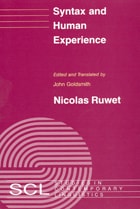
Syntax and Human Experience
Nicolas Ruwet
University of Chicago Press, 1991
"[Ruwet] raises fundamental questions about the place of grammar in the study of language and provides several studies which suggest the possibility that some core data are outside the realm of grammatical explanation. A very remarkable book, in which the breadth of Ruwet's reflection is both challenging and deeply rewarding."—Denis Bouchard, University of Quebec, Montreal
[more]