Results by title
461 books match the query 'Teaching' and 17 start with s
SOFLA®
The Synchronous Online Flipped Learning ApproachHelaine W. Marshall and Ilka Kostka
University of Michigan Press, 2026
Schooling, Democracy, and the Quest for Wisdom
Partnerships and the Moral Dimensions of TeachingRobert V. Bullough Jr. and John R. Rosenberg
Rutgers University Press, 2018
In response to growing concern in the 1980s about the quality of public education across the United States, a tremendous amount of energy was expended by organizations such as the Holmes Group and the Carnegie Forum to organize professional development schools (PDS) or “partner schools” for teacher education. On the surface, the concept of partnering is simple; however, the practice is very costly, complex, and difficult. In Schooling, Democracy, and the Quest for Wisdom, Robert V. Bullough, Jr. and John R. Rosenberg examine the concept of partnering through various lenses and they address what they think are the major issues that need to be, but rarely are, discussed by thousands of educators in the U.S. who are involved and invested in university-public school partnerships. Ultimately, they assert that the conversation around partnering needs re-centering (most especially on the purposes of public education), refreshing, and re-theorizing.
Schoolteacher
A Sociological StudyDan C. Lortie
University of Chicago Press, 2002
Science is Golden
A Problem-Solving Approach to Doing Science with ChildrenAnn Finkelstein
Michigan State University Press, 2002
The first book of its kind, Science is Golden discusses how to implement an inquiry-based, problem-solving approach to science education (grades K-5). Finkelstein shows parents and teachers how to help students investigate their own scientific questions. Rather than a set of guidelines for science fair projects, this book presents a method for helping students expand their creativity and develop logical thinking while learning science.
Starting with an introduction to the "brains-on method," Science is Golden explains brainstorming, experimental controls, collecting data, and how to streamline children's questions about science so that the questions define an experiment. Students will learn how to: ask good questions; clarify terminology; research, plan, and design experiments and controls; test assumptions; collect and analyze data; present results to others; and collaborate with adults.
Science is Golden is consistent with the National Science Education Standards proposed by the National Academy of Sciences, and the Michigan Essential Goals and Objectives for Science Education (K-12) from the Michigan State Board of Education.
Second Language Acquisition Myths
Applying Second Language Research to Classroom TeachingSteven Brown and Jenifer Larson-Hall
University of Michigan Press, 2012
This volume was conceived as a first book in SLA for advanced undergraduate or introductory master’s courses that include education majors, foreign language education majors, and English majors. It’s also an excellent resource for practicing teachers.
Both the research and pedagogy in this book are based on the newest research in the field of second language acquisition. It is not the goal of this book to address every SLA theory or teach research methodology. It does however address the myths and questions that non-specialist teacher candidates have about language learning.
Steven Brown is the co-author of the introductory applied linguistics textbook Understanding Language Structure, Interaction, and Variation textbook (and workbook).
The myths challenged in this book are:
§ Children learn languages quickly and easily while adults are ineffective in comparison.
§ A true bilingual is someone who speaks two languages perfectly.
§ You can acquire a language simply through listening or reading.
§ Practice makes perfect.
§ Language students learn (and retain) what they are taught.
§ Language learners always benefit from correction.
§ Individual differences are a major, perhaps the major, factor in SLA.
§ Language acquisition is the individual acquisition of grammar.
Second Language Writing in Transitional Spaces
Teaching and Learning across Educational ContextsLubie Grujicic-Alatriste and Cathryn Crosby Grundleger
University of Michigan Press, 2020
The chapters examine the writing that English learners are producing because of the Common Core and the writing they are required to do once they reach the college or university, and then consider where the intersections exist—that is, what do educators think English learners ought to be writing across educational levels?
Each chapter describes the educational setting where the researchers were engaged, examines specific issues related to transitions, and offers—where relevant—recommendations for classroom practices, teaching strategies, and instructional materials that may be useful for practicing teachers and all others professionally engaged in educating writers across K–16.
Securing a Place for Reading in Composition
The Importance of Teaching for TransferEllen C. Carillo
Utah State University Press, 2014
Securing a Place for Reading in Composition addresses the dissonance between the need to prepare students to read, not just write, complex texts and the lack of recent scholarship on reading-writing connections. Author Ellen C. Carillo argues that including attention-to-reading practices is crucial for developing more comprehensive literacy pedagogies. Students who can read actively and reflectively will be able to work successfully with the range of complex texts they will encounter throughout their post-secondary academic careers and beyond.
Considering the role of reading within composition from both historical and contemporary perspectives, Carillo makes recommendations for the productive integration of reading instruction into first-year writing courses. She details a “mindful reading” framework wherein instructors help students cultivate a repertoire of approaches upon which they consistently reflect as they apply them to various texts. This metacognitive frame allows students to become knowledgeable and deliberate about how they read and gives them the opportunity to develop the skills useful for moving among reading approaches in mindful ways, thus preparing them to actively and productively read in courses and contexts outside first-year composition.
Securing a Place for Reading in Composition also explores how the field of composition might begin to effectively address reading, including conducting research on reading, revising outcome statements, and revisiting the core courses in graduate programs. It will be of great interest to writing program administrators and other compositionists and their graduate students.
Selected Annotated Bibliography on Foreign Language Learning and Teaching
Raji Rammuny
University of Michigan Press, 2013
Service-Learning
What Every ESL Teacher Needs to KnowTrisha Dowling and James M. Perren
University of Michigan Press, 2021

Sex in an Age of Technological Reproduction
<i>ICSI<i/> and <i>Taboos<i/>Carl Djerassi
University of Wisconsin Press, 2008
Shaping Higher Education with Students
Ways to Connect Research and TeachingEdited by Vincent C. H. Tong, Alex Standen, and Mina Sotiriou
University College London, 2018
In Shaping Higher Education with Students, leading researchers and educators from a range of disciplines lay out practical steps for shaping research-based education. Written in collaboration with university students, the book encourages active partnerships between students and educators and offers an accessible guide to accomplishing this, including connecting students with real-world projects and workplaces, working with students as partners in higher education, encouraging students to pursue research activities that transcend disciplinary boundaries, and rethinking current assessment and teaching practices. Together, the contributions poses fundamental questions about the future of education in universities.
Situating Writing Processes
Physicality, Improvisation, and the Teaching of WritingHannah Rule
University Press of Colorado, 2020
Social Action Stories
Impact Tales for the School and CommunityKevin D. Cordi, Ph.D., Kirstin J. Milks, PhD., Rebecca Van Tassell
Parkhurst Brothers, Inc., 2022
Social-Emotional Learning in English Language Teaching
Luis Javier Pentón Herrera and Janine J. Darragh
University of Michigan Press, 2024
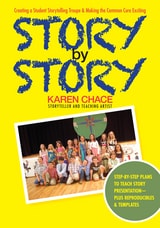
Story By Story
Creating a School Storytelling Troupe & Making the Common Core ExcitingKaren Chace
Parkhurst Brothers, Inc., 2014
Karen Chace’s book, Story by Story, Building a Storytelling Troupe is a must have for anyone even slightly interested in starting a storytelling group with students. I know I am guilty of sometimes skipping over sections, but every word that Karen writes is important and useful distilled (and therefore potent) information. Ms. Chace not only tells you what to do to run a successful troupe, but also WHY you need to do it. This is, to me, very important. Sometimes one is tempted to skip things, but this book explains how important the steps are. Everything from how many hours Karen thought it would take, to ACTUAL hours, where the funding comes from, how and why to lay foundations and expectations (including ‘no teasing policies’ and group dynamics), right the way through presentation skills to advertising the event and getting bums on seats (emphasis important)!
Over the years Karen has and continues to come up with new and inventive ways of teaching the skills of storytelling, and a great many of these exercises and activities are included in the book. When it comes to research and materials as well as technique, Karen adds new meaning to "thorough". There are links to websites for stories, for grants, for microphone techniques, and how storytelling connects to the school curriculum and more. And if you prefer to read books, there is an extensive bibliography, too.
Basically, I believe if you want to succeed in building a storytelling troupe or group, all you need is Karen Chace’s book, Story by Story, Building a Storytelling Troupe and to do everything Karen suggests. I am sure it would be very hard to fail if you follow her words of wisdom between the covers of her goldmine of a book.
Simon Brooks, storyteller, and educator
Storytelling Tips
Creating, Crafting & Telling StoriesMark Goldman
Parkhurst Brothers, Inc., 2015
Students in the Archives
Pedagogy in PracticeEdited by Heather Fox and Amanda Stuckey
University of Illinois Press, 2026
The contributors examine approaches that integrate exhibitions with archived artifacts, collections, recovery, and digital humanities projects. Throughout, they connect these approaches to conversations about using archived materials in teaching and learning. The essays also feature observations about the work produced from collaborations and provide resources for sustaining future archival pedagogy. Topics include teaching in the twenty-first century; ways to support inclusivity, accessibility, and equity through engagements with digital and non-digital sources; and partnerships across disciplines, grade levels, and learning spaces through the collaborative relationships that emerge from archival teaching.
Interdisciplinary and up-to-date, Students in the Archives reveals how engagement with archived artifacts and collections opens spaces for conversations about the historical, social, and political contexts embedded in their productions and dissemination.