Results by title
234 books match the query 'Technological innovations' and 12 start with s
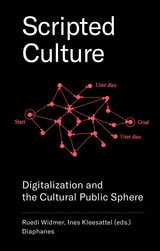
Scripted Culture
Digitalization and the Cultural Public SphereEdited by Ruedi Widmer and Ines Kleesattel
Diaphanes, 2018

Small Tech
The Culture of Digital ToolsByron Hawk
University of Minnesota Press, 2008
The essays in Small Tech investigate the cultural impact of digital tools and provide fresh perspectives on mobile technologies such as iPods, digital cameras, and PDAs and software functions like cut, copy, and paste and WYSIWYG. Together they advance new thinking about digital environments.
Contributors: Wendy Warren Austin, Edinboro U; Jim Bizzocchi, Simon Fraser U; Collin Gifford Brooke, Syracuse U; Paul Cesarini, Bowling Green State U; Veronique Chance, U of London; Johanna Drucker, U of Virginia; Jenny Edbauer, Penn State U; Robert A. Emmons Jr., Rutgers U; Johndan Johnson-Eilola, Clarkson U; Richard Kahn, UCLA; Douglas Kellner, UCLA; Karla Saari Kitalong, U of Central Florida; Steve Mann, U of Toronto; Lev Manovich, U of California, San Diego; Adrian Miles, RMIT U; Jason Nolan, Ryerson U; Julian Oliver; Mark Paterson, U of the West of England, Bristol; Isabel Pedersen, Ryerson U; Michael Pennell, U of Rhode Island; Joanna Castner Post, U of Central Arkansas; Teri Rueb, Rhode Island School of Design; James J. Sosnoski; Lance State, Fordham U; Jason Swarts, North Carolina State U; Barry Wellman, U of Toronto; Sean D. Williams, Clemson U; Jeremy Yuille, RMIT U.
Byron Hawk is assistant professor of English at George Mason University.
David M. Rieder is assistant professor of English at North Carolina State University.
Ollie Oviedo is associate professor of English at Eastern New Mexico University.
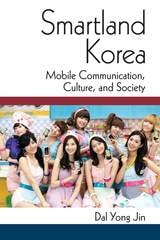
Smartland Korea
Mobile Communication, Culture, and SocietyDal Yong Jin
University of Michigan Press, 2017

Social Knowledge Creation in the Humanities
Volume 1Edited by Alyssa Arbuckle, Aaron Mauro, and Daniel Powell
Iter Press, 2017
The ubiquity of social media has transformed the scope and scale of scholarly communication in the arts and humanities. The consequences of this new participatory and collaborative environment for humanities research has allowed for fresh approaches to communicating research. Social Knowledge Creation takes up the norms and customs of online life to reorient, redistribute, and oftentimes flatten traditional academic hierarchies. This book discusses the implications of how humanists communicate with the world and looks to how social media shapes research methods. This volume addresses peer-review, open access publishing, tenure and promotion, mentorship, teaching, collaboration, and interdisciplinarity as a comprehensive introduction to these rapidly changing trends in scholarly communication, digital pedagogy, and educational technology. Collaborative structures are rapidly augmenting disciplinary focus of humanities curriculum and the public impact of humanities research teams with new organizational and disciplinary thinking. Social Knowledge Creation represents a particularly dynamic and growing field in which the humanities seeks to find new ways to communicate the legacy and traditions of humanities based inquiry in a 21st century context.
New Technologies in Medieval and Renaissance Studies Volume 7.
Edited by Alyssa Arbuckle, Aaron Mauro, and Daniel Powell
Social Science Knowledge and Economic Development
An Institutional Design PerspectiveVernon W. Ruttan
University of Michigan Press, 2003
With its emphasis on interdisciplinarity, Social Science Knowledge and Economics Developmentis important reading for social scientists, development economists, and in the development studies classroom.
Vernon W. Ruttan is Regents Professor Emeritus in the Department of Applied Economics at the University of Minnesota.

Spaceship in the Desert
Energy, Climate Change, and Urban Design in Abu DhabiGökçe Günel
Duke University Press, 2019
Speaking into the Air
A History of the Idea of CommunicationJohn Durham Peters
University of Chicago Press, 1999
"This is a most interesting and thought-provoking book. . . . Peters maintains that communication is ultimately unthinkable apart from the task of establishing a kingdom in which people can live together peacefully. Given our condition as mortals, communication remains not primarily a problem of technology, but of power, ethics and art." —Antony Anderson, New Scientist
"Guaranteed to alter your thinking about communication. . . . Original, erudite, and beautifully written, this book is a gem." —Kirkus Reviews
"Peters writes to reclaim the notion of authenticity in a media-saturated world. It's this ultimate concern that renders his book a brave, colorful exploration of the hydra-headed problems presented by a rapid-fire popular culture." —Publishers Weekly
What we have here is a failure-to-communicate book. Funny thing is, it communicates beautifully. . . . Speaking Into the Air delivers what superb serious books always do-hours of intellectual challenge as one absorbs the gradually unfolding vision of an erudite, creative author." —Carlin Romano, Philadelphia Inquirer
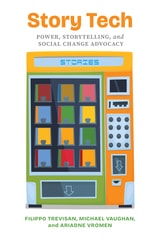
Story Tech
Power, Storytelling, and Social Change AdvocacyFilippo Trevisan, Michael Vaughan, and Ariadne Vromen
University of Michigan Press, 2025
Story Tech explores the increasingly influential impact of technologies—such as databases, algorithms, and digital story banks—that are usually invisible to the public. It shows that hidden “story tech” enables political organizations to treat stories as data that can be queried for storylines and used to intervene in news and information cycles in real time. In particular, the authors review successful story-centered campaigns that helped change dominant narratives on disability rights, marriage equality, and essential workers’ rights in the United States and Australia. They compare the use of storytelling advocacy across different types of organizations including volunteer grassroots groups, large national advocacy coalitions, and trade unions, and examine how trends differ for storytellers, organizers, and their technology partners. As political stories shift to being “on demand,” they reshape power relationships in key public debates in ways that produce moments of tension as well as positive narrative change. Story Tech examines these trends and illustrates how storytelling success can—and should—be achieved in conjunction with personal dignity, privacy, and empowerment for storytellers and their communities, particularly marginalized ones.

Streaming Music, Streaming Capital
Eric Drott
Duke University Press, 2024

Studying Technological Change
A Behavioral ApproachMichael Brian Schiffer
University of Utah Press, 2011
Studying Technological Change synthesizes nearly four decades of research by Michael Brian Schiffer, a cofounder of the field of behavioral archaeology. This new book asks historical and scientific questions about the interaction of people with artifacts during all times and in all places. The book is not about the history or prehistory of technology, nor is it a catalog of methods and techniques for inferring how specific technologies were made or used. Rather, it supplies conceptual tools that can be used to help craft an explanation of any technological change in any society.
Surrogate Humanity
Race, Robots, and the Politics of Technological FuturesNeda Atanasoski and Kalindi Vora
Duke University Press, 2019
Switching Codes
Thinking Through Digital Technology in the Humanities and the ArtsEdited by Thomas Bartscherer and Roderick Coover
University of Chicago Press, 2011
Half a century into the digital era, the profound impact of information technology on intellectual and cultural life is universally acknowledged but still poorly understood. The sheer complexity of the technology coupled with the rapid pace of change makes it increasingly difficult to establish common ground and to promote thoughtful discussion.
Responding to this challenge, Switching Codes brings together leading American and European scholars, scientists, and artists—including Charles Bernstein, Ian Foster, Bruno Latour, Alan Liu, and Richard Powers—to consider how the precipitous growth of digital information and its associated technologies are transforming the ways we think and act. Employing a wide range of forms, including essay, dialogue, short fiction, and game design, this book aims to model and foster discussion between IT specialists, who typically have scant training in the humanities or traditional arts, and scholars and artists, who often understand little about the technologies that are so radically transforming their fields. Switching Codes will be an indispensable volume for anyone seeking to understand the impact of digital technology on contemporary culture, including scientists, educators, policymakers, and artists, alike.