Results by title
64 books match the query 'Text' and 9 start with s
Science Fiction in Argentina
Technologies of the Text in a Material MultiverseJoanna Page
University of Michigan Press, 2016
Semeia 83/84
Slavery in Text and InterpretationAllen Dwight Callahan
SBL Press, 2001
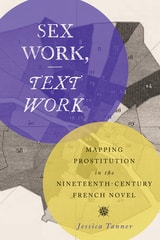
Sex Work, Text Work
Mapping Prostitution in the Nineteenth-Century French NovelJessica Tanner
Northwestern University Press, 2027
While prostitutes in nineteenth-century Paris were subject to municipal laws that policed their bodies and movements, writers of the era enlisted them to stake their own claims on both the city and the novel as literary territory. Sex Work, Text Work: Mapping Prostitution in the Nineteenth-Century French Novel explores how prostitutes depicted by Émile Zola, Joris-Karl Huysmans, Edmond de Goncourt, Adolphe Tabarant, and Charles-Louis Philippe “write back,” confounding civil and literary efforts to contain them in space and in narrative.
In city-regulated brothels, brasseries à femmes, Haussmannian boulevards, and the novel itself, working-class prostitutes served to reinforce the boundaries of social inclusion and exclusion. And yet, Jessica Tanner contends, even the novels that most explicitly aligned with the disciplinary logic of regulated prostitution make space for a distinctly literary form of resistance: these women elude or disrupt the mapping that would claim them as literary territory, revealing their authors’ failure to secure their narratives as property. Tanner pushes back against the critical tendency to attribute agency only to courtesans who became published authors and forwards a new framework for understanding the political work novels engage in as they circulate. Observing that debates about the regulation of prostitution surfaced in tandem with racialized anxieties about the boundaries of the French nation, Tanner ultimately expands that framework to the history of French colonialism and the politics of immigration in the current day. This book shows that while sex workers have been recruited to mark the borders of civic and moral life, prostitution can also make space for more inclusive forms of community, both in the novel and in the world beyond its bounds.
Social Research in the Judicial Process
Cases, Readings, and TextWallace D. Loh
Russell Sage Foundation, 1984
Social Semiotics As Praxis
Text, Social Meaning Making, and Nabokov’s AdaPaul J. Thibault
University of Minnesota Press, 1991
In Social Semiotics as Praxis, Paul J. Thibault rescues semiotics from terminal formalism by recognizing that the object of a semiotic inquiry is necessarily the way in which human beings, individually and collectively, make sense of their lives. Focusing on Vladimir Nabokov’s Ada, he develops a conception of social semiotics that is a form of both social action and political praxis.
Thibault’s principal intellectual sources are, among others, Bakhtin, Volosinov, Derrida, Foucault, Gramsci, Habermas, and Halliday. Thibault combines the work of Halliday in particular with is own theories of semiotics to explore the dynamics of quoting and reporting speech and to develop a critique of the categories of “self” and “representation.” Thibault accounts for the meaningful relationships constructed among texts and elaborates on the two main themes of relational levels in texts and the dynamics of contextualization to give voice to a unifying discourse for talking about social meaning making.
Society as Text
Essays on Rhetoric, Reason, and RealityRichard Harvey Brown
University of Chicago Press, 1987
Songs for Dead Parents
Corpse, Text, and World in Southwest ChinaErik Mueggler
University of Chicago Press, 2017
Drawing on more than twenty years of fieldwork in a mountain community in Yunnan Province, Songs for Dead Parents shows how people view the dead as both material and immaterial, as effigies replace corpses, tombstones replace effigies, and texts eventually replace tombstones in a long process of disentangling the dead from the shared world of matter and memory. It is through these processes that people envision the cosmological underpinnings of the world and assess the social relations that make up their community. Thus, state interventions aimed at reforming death practices have been deeply consequential, and Mueggler traces the transformations they have wrought and their lasting effects.
Starring the Text
The Place of Rhetoric in Science StudiesAlan G. Gross
Southern Illinois University Press, 2006
Starring the Text: The Place of Rhetoric in Science Studies firmly establishes the rhetorical analysis of science as a respected field of study. Alan G. Gross, one of rhetoric’s foremost authorities, summarizes the state of the field and demonstrates the role of rhetorical analysis in the sciences. He documents the limits of such analyses with examples from biology and physics, explores their range of application, and sheds light on the tangled relationships between science and society. In this deep revision of his important Rhetoric of Science, Gross examines how rhetorical analyses have a wide range of application, effectively exploring the generation, spread, certification, and closure that characterize scientific knowledge. Gross anchors his position in philosophical rather than in rhetorical arguments and maintains there is rhetorical criticism from which the sciences cannot be excluded.
Gross employs a variety of case studies and examples to assess the limits of the rhetorical analysis of science. For example, in examining avian taxonomy, he demonstrates that both taxonomical and evolutionary species are the product of rhetorical interactions. A review of Newton’s two formulations of optical research illustrates that their only significant difference is rhetorical, a difference in patterns of style, arrangement, and argument. Gross also explores the range of rhetorical analysis in his consideration of the “evolution of evolution” of Darwin’s notebooks. In his analysis of science and society, he explains the limits of citizen action in executive, judicial, and legislative democratic realms in the struggle to prevent, ameliorate, and provide adequate compensation for occupational disease. By using philosophical, historical, and psychological perspectives, Gross concludes, rhetorical analysis can also supplement other viewpoints in resolving intellectual problems.
Starring the Text, which includes fourteen illustrations, is an updated, readable study geared to rhetoricians, historians, philosophers, and sociologists interested in science. The volume effectively demonstrates that the rhetoric of science is a natural extension of rhetorical theory and criticism.
Syncretism in the West
Pico's 900 Theses (1486) With Text, Translation, and CommentaryEdited by S. A. Farmer
Arizona Center for Medieval and Renaissance Studies, 2016
This is the 2016 paperback printing of the 2008 edition of the popular text, translation, and commentary by S. A. Farmer. (The 2008 edition was a revised edition of the 1998 original publication).
Published by ACMRS (Arizona Center for Medieval and Renaissance Studies) in Tempe, Arizona as part of the MRTS (Medieval and Renaissance Texts and Studies) Series, this book -- previously available only in hardcover and otherwise out-of-print since 2014 -- is now available in its entirety in paperback format.