Results by title
967 books match the query 'Theater' and 108 start with s
Sacred Players
The Politics of Response in the Middle English Religious DramaHeather Hill-Vásquez
Catholic University of America Press, 2007

Sacred Theatre
Edited by Ralph Yarrow
Intellect Books, 2007
Salmon Is Everything
Community-Based Theatre in the Klamath WatershedTheresa May with Susanne Burcell, Kathleen McCovey, and Jean O'Hara
Oregon State University Press, 2014
Salmon Is Everything simultaneously illuminates the logistics of a crisis in the third largest watershed in the Pacific Northwest—the premature death of more than 30,000 salmon on the Lower Klamath River in 2002—and documents what happened when one community decided to use art to amplify the experiences of its members. The fish kill had unprecedented impact throughout the watershed, and for many tribal communities it signified an ongoing loss of traditional cultural practices. But in the political and ecological upheaval that followed, the role of salmon in tribal life went largely unacknowledged, which inspired the collaboration between May and members of the Yurok, Hoopa Valley, and Karuk tribes, as well as farmers, ranchers, and others invested in the Klamath watershed.
Salmon is Everything will appeal to readers interested in the environmental and cultural history of the Pacific Northwest and the ecological and civil challenges its communities face. For artists and activists, it’s a useful case study. Salmon is Everything offers a unique interdisciplinary resource for high school and college level courses in environmental studies, Native American studies, and theatre arts education.
Salmon is Everything
Community-Based Theatre in the Klamath WatershedTheresa May with Susanne Burcell, Kathleen McCovey, and Jean O'Hara
Oregon State University Press, 2018
Salmon Is Everything simultaneously illuminates the logistics of a crisis in the third largest watershed in the Pacific Northwest—the premature death of more than 30,000 salmon on the Lower Klamath River in 2002—and documents what happened when one community decided to use art to amplify the experiences of its members. The fish kill had unprecedented impact throughout the watershed, and for many tribal communities it signified an ongoing loss of traditional cultural practices. But in the political and ecological upheaval that followed, the role of salmon in tribal life went largely unacknowledged, which inspired the collaboration between May and members of the Yurok, Hoopa Valley, and Karuk tribes, as well as farmers, ranchers, and others invested in the Klamath watershed.
Salmon is Everything will appeal to readers interested in the environmental and cultural history of the Pacific Northwest and the ecological and civil challenges its communities face. For artists and activists, it’s a useful case study. Salmon is Everything offers a unique interdisciplinary resource for high school and college level courses in environmental studies, Native American studies, and theatre arts education.
New materials in this second edition include additional essays by Native faculty and actors, an updated introduction by the author, minor textual corrections throughout, and a new online resource guide.
Salome's Modernity
Oscar Wilde and the Aesthetics of TransgressionPetra Dierkes-Thrun
University of Michigan Press, 2014
Oscar Wilde's 1891 symbolist tragedy Salomé has had a rich afterlife in literature, opera, dance, film, and popular culture. Salome's Modernity: Oscar Wilde and the Aesthetics of Transgression is the first comprehensive scholarly exploration of that extraordinary resonance that persists to the present. Petra Dierkes-Thrun positions Wilde as a founding figure of modernism and Salomé as a key text in modern culture's preoccupation with erotic and aesthetic transgression, arguing that Wilde's Salomé marks a major turning point from a dominant traditional cultural, moral, and religious outlook to a utopian aesthetic of erotic and artistic transgression. Wilde and Salomé are seen to represent a bridge linking the philosophical and artistic projects of writers such as Mallarmé, Pater, and Nietzsche to modernist and postmodernist literature and philosophy and our contemporary culture. Dierkes-Thrun addresses subsequent representations of Salome in a wide range of artistic productions of both high and popular culture through the works of Richard Strauss, Maud Allan, Alla Nazimova, Ken Russell, Suri Krishnamma, Robert Altman, Tom Robbins, and Nick Cave, among others.
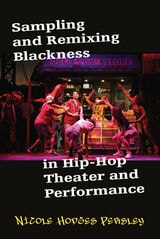
Sampling and Remixing Blackness in Hip-Hop Theater and Performance
Nicole Hodges Persley
University of Michigan Press, 2021
Sampling and Remixing Blackness is a timely and accessible book that examines the social ramifications of cultural borrowing and personal adaptation of Hip-hop culture by non-Black and non-African American Black artists in theater and performance. In a cultural moment where Hip-hop theater hits such as Hamilton offer glimpses of Black popular culture to non-Black people through musical soundtracks, GIFs, popular Hip-hop music, language, clothing, singing styles and embodied performance, people around the world are adopting a Blackness that is at once connected to African American culture--and assumed and shed by artists and consumers as they please. As Black people around the world live a racial identity that is not shed, in a cultural moment of social unrest against anti-blackness, this book asks how such engagements with Hip-hop in performance can be both dangerous and a space for finding cultural allies. Featuring the work of some of the visionaries of Hip-hop theater including Lin-Manuel Miranda, Sarah Jones and Danny Hoch, this book explores the work of groundbreaking Hip-hop theater and performance artists who have engaged Hip-hop's Blackness through popular performance. The book challenges how we understand the performance of race, Hip-hop and Blackness in the age of Instagram, TikTok and Facebook. In a cultural moment where racial identity is performed through Hip-hop culture's resistance to the status quo and complicity in maintaining it, Hodges Persley asks us to consider who has the right to claim Hip-hop's blackness when blackness itself is a complicated mixtape that offers both consent and resistance to transgressive and inspiring acts of performance.

Sanctuary Stage
The Greenwich Mews Theatre, 1951-1974Hillary Miller
University of Michigan Press, 2027
In 1951, white and Black artists from the progressive theaters of downtown and Harlem came together to create the Greenwich Mews Theatre. For over two decades the venue defied Jim Crow casting practices and Red Scare censorship; the theatre provided refuge to blacklisted artists and a stage for dramas of the civil rights movement. In Sanctuary Stage: The Greenwich Mews Theatre, 1951-1974, author Hillary Miller tells the history of this groundbreaking West Village institution through its productions and its network of leftist dramatists. Jointly sponsored and protected by a Presbyterian church and a synagogue, the Mews and its innovative producer Stella Holt earned accolades with staging works by Alice Childress, Langston Hughes, Loften Mitchell, Seán O’Casey, and George Tabori, and in its final chapter, the creation of the bilingual Greenwich Mews Spanish Theatre. Miller traces the rise and demise of this interracial and interfaith hub for cultural expression until its final fracture amid artistic and social turbulence in the 1970s.
Through its oppositional performance practices, the collective blurred the lines between the mainstream and the underground, bringing together multiethnic theater communities, anti-fascist activists, pro-labor audiences, and circles of interfaith justice movements.
Say Word!
Voices from Hip Hop TheaterAn Anthology Edited and with an Introduction by Daniel Banks
University of Michigan Press, 2011
The phenomenon known as Hip Hop encompasses a global, multiethnic, grassroots culture committed to social justice and self-expression through performance. Hip Hop Theater emerged from that culture, mixing spoken-word performance with music and dance and marked by Hip Hop's strong sense of activism and resistance. Hip Hop Theater is engaged with questions of identity – culture, heritage, ethnicity, class, gender, sexuality, and difference—narrating the experiences of historically marginalized peoples and putting them in dialogue with other oppressed communities.
Say Word! Voices from Hip Hop Theater collects eight works by contemporary artists who confront today's compelling issues, ranging from racial profiling and police brutality to women's empowerment and from the commercial exploitation of Hip Hop to identity politics. Editor Daniel Banks has assembled work by Abiola Abrams, Zakiyyah Alexander, Chadwick Boseman, Kristoffer Diaz, Rha Goddess, Antoy Grant, Joe Hernandez-Kolski, Rickerby Hinds, and Ben Snyder, augmented with an extensive introduction and other informative commentary. The book also includes a roundtable moderated by Holly Bass and featuring Hip Hop pioneers Eisa Davis, Danny Hoch, Sarah Jones, and Will Power, a conversation that traces the roots of Hip Hop Theater and imagines its future directions.
Scenes from Bourgeois Life
Nicholas Ridout
University of Michigan Press, 2020

Scenes from the Revolution
Making Political Theatre 1968-2019Edited by Kim Wiltshire, Billy Cowan and James Harkar
Pluto Press, 2018
Scenes from the Revolution is a celebration of fifty years of radical theater in Britain. Beginning with a short history of pre-1968 political theater—covering Brecht, Joan Littlewood, and Ewan McColl—the editors move on to explore agit-prop, working-class, youth, community, POC, women’s, and LGBTQ theater. Comprehensive in scope, and featuring many of the leading voices in the field today, as well as “lost” scripts from the radical theater companies of the past, Scenes from the Revolution is a must-read for anyone interested in politics in the arts.

Sceno-Graphic Techniques
W. Oren Parker
Southern Illinois University Press, 1987
The first book to bring together the drafting techniques, descriptive geometry, engineering drawing, and graphics of perspective needed to plan and execute a setting for the theatre.
Parker presents these elements in a logical three-part format. “The Language of Lines” offers a study of drafting techniques, conventions, and symbols peculiar to the theatre; “Graphic Solutions” deals with the graphic problem-solving often needed to draw and make the frequent irregular forms of present-day scene design; and “Perspective in the Theatre” treats the two-dimensional perspective of the designer’s sketch and the three-dimensional perspective required for an illusion or stylistic concept.
Schechner Plays
Edited by Richard Schechner
Intellect Books, 2025
This book offers a collection of Richard Schechner’s performance texts ranging from orthodox plays to group-devised texts. Covering the full breadth of his work from the 1950s to the present, it includes several never-before-published early texts as well as updated versions of well-known productions such as Dionysus in 69, YokastaS, Makbeth, and Imagining O. Márta Minier's introduction gives an overview of Schechner's work, while Schechner introduces each script in terms of their intellectual and production contexts.

Scream! Bleed! Take Off Your Clothes!
Stuart Gordon and Chicago’s Organic Theater CompanyMary Griswold, Cordis Heard, Jim Rinnert and Mike Saad
University of Chicago Press, 2026
A captivating firsthand account of Chicago’s groundbreaking, tumultuous Organic Theater Company.
When the founder of the Organic Theater Company died in 2020, the Chicago Tribune asked, “Did one person invent Chicago theater? If so, it was Stuart Gordon.” And yet, this iconic theater group is arguably the most influential Chicago company whose story has never been fully told.
In its heyday, from 1969 through 1985, the Organic’s high-spirited, gutsy, and close-knit company created more than thirty idiosyncratic works. A springboard for playwright David Mamet and for the television series ER, it also was formative in the careers of many well-known actors, including Joe Mantegna, André De Shields, Meshach Taylor, and Dennis Franz. Scream! Bleed! Take Off Your Clothes! is the story of a young theater company that always pushed boundaries with an anarchic exuberance. Drawing on extensive interviews and archival research, this insiders’ account, assembled by three Organic members and an artistic associate, details those exciting productions and the company’s complicated internal dynamics, while also positioning the group within Chicago’s vibrant theater scene and the larger culture of the time.
Scripting Survival
Yiddish Theater in Cold War RomaniaCorina L. Petrescu
Rutgers University Press, 2027
In Cold War Romania, the Jewish State Theater in Bucharest (TES) was a site for high-stakes cultural negotiations. While the state used the theater to consolidate Yiddish stagecraft into a tool for state propaganda, a more nuanced story unfolded behind the scenes: TES was also a vehicle for preserving and advancing Yiddish culture within the confines of a socialist state. This book focuses on five commemorative volumes published between 1956 and 1976 by editors who were Shoah survivors—individuals uniquely torn between their passion for Yiddish culture and the communist ideal. By analyzing these volumes, the study reveals the hidden ideological tensions and cultural ambitions embedded within the theater’s operations and provides a rare window into the struggle to maintain a distinctive Jewish identity while navigating the rigid political realities of the time. It is a compelling look at the editorial strategies used to safeguard a vanishing heritage.
Scriptwork
A Director's Approach to New Play DevelopmentDavid Kahn and Donna Breed. Foreword by Lanford Wilson
Southern Illinois University Press, 1995
Despite the popular myth that plays arrive at the theater fully formed and ready for production, the truth is that for centuries, most scripts have been developed through a collaborative process in rehearsal and in concert with other theater artists. David Kahn and Donna Breed provide the first codified approach to this time-honored method of play development, with a flexible methodology that takes into account differing environments and various stages of formation.
Directors can use this unique guidebook for new play development from the beginning to the end of the process. Kahn and Breed explore ways of choosing new projects, talk about where to find new scripts, and explore the legal aspects of script development. They present a detailed system for theatrical analysis of the new script and show how to continue exploration and development of the script within the laboratory of the theater. Most importantly, they delineate the parameters of the relationship between the director and the playwright, offering proven methods to help the playwright and help facilitate the healthy development of the script.
Breed and Kahn offer suggestions on casting, incorporating rewrites, and script handling plus how and when to use audience response and how to decide what step to take next. They also include extended interviews with developmental directors, dramaturgs, and playwrights, who give credence to the new script development process.
In short, Kahn and Breed demystify a common, though often convoluted, theater process, providing a unique codification of ways to work on new plays.
Selected Plays of Stan Lai
Volume 1: Secret Love in Peach Blossom Land and Other PlaysStan Lai, edited by Lissa Tyler Renaud
University of Michigan Press, 2021
Volume One contains:
Secret Love in Peach Blossom Land
Look Who's Crosstalking Tonight
The Island and the Other Shore
I Me She Him
Ménage à 13
Selected Plays of Stan Lai
Volume 2: The Village and Other PlaysStan Lai, edited by Lissa Tyler Renaud
University of Michigan Press, 2021
Volume Two contains:
Millennium Teahouse
Sand on a Distant Star
Like Shadows
The Village
Writing in Water
Selected Plays of Stan Lai
Volume 3: A Dream Like a Dream and AgoStan Lai, edited by Lissa Tyler Renaud
University of Michigan Press, 2021
Volume Three contains:
A Dream Like a Dream
Ago
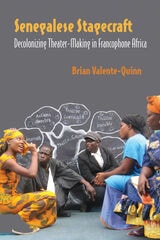
Senegalese Stagecraft
Decolonizing Theater-Making in Francophone AfricaBrian Valente-Quinn
Northwestern University Press, 2021
Through a study of the innovative work of Senegalese theater-makers from the 1930s onward, Senegalese Stagecraft explores a wide range of historical contexts and themes, including French colonial education, cultural Pan‑Africanism, West African Sufism, uses of television and mass media, and popular theater and activism. Using a multidisciplinary approach that includes field, archival, and literary methods, Valente‑Quinn offers a fresh look at performance cultures of West Africa and the Global South in a book that will interest students and scholars in African, Francophone, and performance studies.
Sensational Devotion
Evangelical Performance in Twenty-First-Century AmericaJill Stevenson
University of Michigan Press, 2015
Seriously Mad
Mental Distress and the Broadway MusicalAleksei Grinenko
University of Michigan Press, 2023
Theatermakers in the United States have long been drawn to madness as a source of dramatic spectacle. During the Broadway musical’s golden age in the mid-twentieth century, creative teams used the currently in-vogue psychoanalytic ideas about mental life to construct troubled characters at odds with themselves and their worlds. As the clinical and cultural profile of madness transformed over the twentieth century, musicals continued to delve into the experience of those living with mental pain, trauma, and unhappiness.
Seriously Mad offers a dynamic account of stage musicals’ engagement with historically significant theories about mental distress, illness, disability, and human variance in the United States. By exploring who is considered mad and what constitutes madness at different moments in U.S. history, Aleksei Grinenko shows how, in attempts to bring the musicals closer to highbrow sophistication, theater dramatized serious medical conditions and social problems. Among the many Broadway productions discussed are Next to Normal, A Strange Loop, Sweeney Todd, Man of La Mancha, Gypsy, Oklahoma!, and Lady in the Dark.
Seven Gothic Dramas, 1789–1825
1789-1825Jeffrey N. Cox
Ohio University Press, 1994
The Gothic drama came at a critical moment in the history of the theater, of British culture, and of European politics in the shadow of France’s revolution and the fall of Napoleon. It offered playwrights a medium to express the prevailing ideological tensions of romanticism and revolution, and also responded to a growing and changing theater audience.
In a wide-ranging introduction, Cox explores Gothic drama’s links with romanticism and its relation to other social and ideological shifts of the day. The texts are presented so as to reflect the dual life of dramatic works—on the stage and on the page. The plays are annotated and accompanied by biographic and bibliographic sketches.
Includes The Kentish Barons, by Francis North; Julia of Louvain; or, Monkish Cruelty, by J.C. Cross; The Castle Spectre, by Matthew G. Lewis; The Captive, by Matthew G. Lewis; De Monfort, by Joanna Baillie; Bertram; or, The Castle of St. Aldobrand, by C.R. Maturin; and Presumption; or, The Fate of Frankenstein, by R.B. Peake.
Sex on Stage
Gender and Sexuality in Post-War British TheatreAndrew Wyllie
Intellect Books, 2009
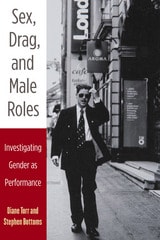
Sex, Drag, and Male Roles
Investigating Gender as PerformanceDiane Torr and Stephen Bottoms
University of Michigan Press, 2010
"Few books blend the critical and creative approaches to drag performance this provocatively and engagingly, and none provides both the historical and the personal perspectives so effectively. Torr and Bottoms fundamentally challenge many long-standing ideas about drag kings and the performance of masculinity."
---Sarah Bay-Cheng, University at Buffalo
"This book brings the reader inside an artist's creative imagination and intellect, showing us Diane Torr's work in a detailed, thoughtful, and engaging way. We discover how Torr uses different physical disciplines to explore how gender is constructed, interpreted, and expressed. Along the way---by taking us into various venues in which she performed---she evokes the lively, dynamic scene in New York in the '80s and '90s."
---Alisa Solomon, Columbia University
Why would women want to perform as men? Why is gender crossing so compelling, whether it happens onstage or in everyday life? What can drag performance teach, and what aesthetic, political, and personal questions does it raise?
Performance artist Diane Torr has been experimenting with the performance of gender for thirty years---exploring everything from feminist go-go dancing to masculine power play. One of the key pioneers of "drag king" performance, Torr has been celebrated internationally for her gender transformation workshops, in which she has taught hundreds of ordinary women how to pass as men on city streets around the world. This cultural subterfuge appeals to participants for many different reasons: personal confidence-building, sexual frisson, gender subversion, trans-curiosity, or simply the appeal of disguise and role play.
Sex, Drag, and Male Roles documents the evolution of Torr's work by blending first-person memoir and commentary from Torr with critical reflections and contextualization from leading performance critic Stephen J. Bottoms. The book includes a consideration of the long cultural history of female-to-male cross-dressing and concludes with Torr's "Do-It-Yourself" guide to becoming a "Man for a Day."
Diane Torr developed her cross-disciplinary art in the downtown New York art scene from 1976 to 2002. Now living in Scotland, Torr has earned an international reputation for her performances and gender transformation workshops (featured on HBO, BBC, and This American Life on NPR, among others). Her work is the focus of a feature film, Man for a Day.
Stephen J. Bottoms is Wole Soyinka Professor of Drama and Theatre Studies at the University of Leeds. His books include Playing Underground: A Critical History of the 1960s Off-Off-Broadway Movement and Small Acts of Repair: Performance, Ecology, and Goat Island.
Cover: Diane Torr walks the streets of London, 1995. Photo by Debbie Humphreys.
Shakespeare Dwelling
Designs for the Theater of LifeJulia Reinhard Lupton
University of Chicago Press, 2018
Focusing on five works (Romeo and Juliet, Macbeth, Pericles, Cymbeline, and The Winter’s Tale), Lupton remakes the concept of dwelling by drawing on a variety of sources, including modern design theory, Renaissance treatises on husbandry and housekeeping, and the philosophies of Hannah Arendt and Martin Heidegger. The resulting synthesis not only offers a new entry point into the contemporary study of environments; it also shows how Shakespeare’s works help us continue to make sense of our primal creaturely need for shelter.
Shakespeare and Chekhov in Production and Reception
Theatrical Events and Their AudiencesTulloch, John
University of Iowa Press, 2005
With a focus on the canonical institutions of Shakespeare and Chekhov, John Tulloch brings together for the first time new concepts of “the theatrical event” with live audience analysis. Using mainstream theatre productions from across the globe that were highly successful according to both critics and audiences, this book of case studies—ethnographies of production and reception—offers a combined cultural and media studies approach to analyzing theatre history, production, and audience.
Tulloch positions these concepts and methodologies within a broader current theatrical debate between postmodernity and risk modernity. He also describes the continuing history of Shakespeare and Chekhov as a series of stories “currently and locally told” in the context of a blurring of academic genres that frames the two writers. Drawn from research conducted over nearly a decade in Australia, Britain, and the U.S., Shakespeare and Chekhov in Production and Reception will be of interest to students and scholars of theatre studies, media studies, and audience research.
Shakespeare and Contemporary Fiction
Theorizing Foundling and Lyric PlotsBarbara L. Estrin
University of Delaware Press, 2012
In the first book to use fiction as theory, Barbara L. Estrin reverses chronological direction, beginning with contemporary novels to arrive at a re-visioned Shakespeare, uncovering a telling difference in the stories that script us and that influence our political unconscious in ways that have never been explored in literary-critical interpretations. Describing the animus against foreign blood, central to the dynamic of the foundling and lyric plots that form the nexus of her study, Estrin describes how late modern writers change those plots. Reading backward through the theoretical lens of their revisions allows us to rethink the Shakespeare we thought we knew. That innovative methodology, in turn, encourages us to read forward again with different tellings, ones that challenge the mythological homogeneity of the traditional classifications and that suggest new formulaic paradigms.
With close readings of four contemporary novels and three Shakespeare plays, Estrin identifies the cultural walls that contribute to political gate-keeping as she chronicles the connection between plot variations and gender revisionism in the work of Caryl Phillips, Liz Jensen, Anne Michaels, and W.G. Sebald, as well as two film-makers (Mona Hatoum and Mieke Bal) who demonstrate an understanding that mythical repercussions prove dangerous in the twentieth and twenty-first centuries even as they suggest how the heritage shaping their work, and to which they are themselves drawn, in turn proposes an alternative Shakespeare, one who frees us to ask other questions: At the time that the nation state was beginning to coalesce, what does Shakespeare’s frequent use of the foundling plot and his significant variations portend? How does his infusion of a revised lyric dynamic in The Merchant of Venice, Othello and The Winter’s Tale change our reading of plays where the two plots coalesce as they do in the contemporary novels that shape Estrin’s late modern interpretations? All the works in this study share the underlying premise that the connection between cultural origins and political destinies is reciprocal and that it is necessary and possible to transform the constructs—in memory and imagination—that continue to shape our lives.
Published by University of Delaware Press. Distributed worldwide by Rutgers University Press.
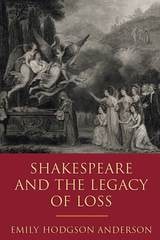
Shakespeare and the Legacy of Loss
Emily Hodgson Anderson
University of Michigan Press, 2018
How do we recapture, or hold on to, the live performances we most love, and the talented artists and performers we most revere? Shakespeare and the Legacy of Loss tells the story of how 18th-century actors, novelists, and artists, key among them David Garrick, struggled with these questions through their reenactments of Shakespearean plays. For these artists, the resurgence of Shakespeare, a playwright whose works just decades earlier had nearly been erased, represented their own chance for eternal life. Despite the ephemeral nature of performance, Garrick and company would find a way to make Shakespeare, and through him the actor, rise again.
In chapters featuring Othello, Richard III, Hamlet, The Winter’s Tale, and The Merchant of Venice, Emily Hodgson Anderson illuminates how Garrick’s performances of Shakespeare came to offer his contemporaries an alternative and even an antidote to the commemoration associated with the monument, the portrait, and the printed text. The first account to read 18th-century visual and textual references to Shakespeare alongside the performance history of his plays, this innovative study sheds new light on how we experience performance, and why we gravitate toward an art, and artists, we know will disappear.
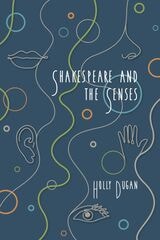
Shakespeare and the Senses
Holly E. Dugan
Arizona Center for Medieval and Renaissance Studies, 2024
Could something as seemingly natural as a smell, taste, sight, or sound be socially constructed and change over time? Shakespeare and the Senses argues that understanding the original conditions in which Shakespeare’s plays were performed allows us to explore the senses as both visceral, bodily experiences and constructed, social phenomena. As Ben Jonson famously wrote in the First Folio of 1623, Shakespeare can seem to be “not of an age, but for all time.” While this is clever marketing, Shakespeare did write his plays in a particular time and place far removed from our own. Many of his most powerful metaphors rely on sensory details—Aaron’s black hue; Cleopatra’s strange, invisible perfumes; Fluellen’s Welsh accent; Lady Macbeth’s overly scrubbed hands; Malvolio’s yellow stockings—which Elizabethan-era audiences may have understood very differently from us.
Shakespeare and the Senses draws on interdisciplinary research methods in the new field of sensory studies to expand our understanding of what Shakespeare meant to his first audiences.
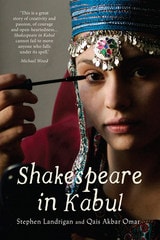
Shakespeare in Kabul
Stephen Landrigan and Qais Akbar Omar
Haus Publishing, 2012
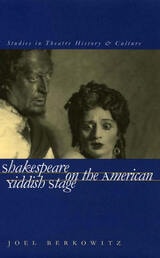
Shakespeare on the American Yiddish Stage
Joel Berkowitz
University of Iowa Press, 2002
The professional Yiddish theatre started in 1876 in Eastern Europe; with the assassination of Tsar Alexander II in 1881, masses of Eastern European Jews began moving westward, and New York—Manhattan’s Bowery and Second Avenue—soon became the world’s center of Yiddish theatre. At first the Yiddish repertoire revolved around comedies, operettas, and melodramas, but by the early 1890s America's Yiddish actors were wild about Shakespeare. In Shakespeare on the American Yiddish Stage, Joel Berkowitz knowledgeably and intelligently constructs the history of this unique theatrical culture.
The Jewish King Lear of 1892 was a sensation. The year 1893 saw the beginning of a bevy of Yiddish versions of Hamlet; that year also saw the first Yiddish production of Othello. Romeo and Juliet inspired a wide variety of treatments. The Merchant of Venice was the first Shakespeare play published in Yiddish, and Jacob Adler received rave reviews as Shylock on Broadway in both 1903 and 1905. Berkowitz focuses on these five plays in his five chapters. His introduction provides an orientation to the Yiddish theatre district in New York as well as the larger picture of Shakespearean production and the American theatre scene, and his conclusion summarizes the significance of Shakespeare’s plays in Yiddish culture.
Shakespeare the Actor and the Purposes of Playing
Meredith Anne Skura
University of Chicago Press, 1993
Despite the obvious differences between our theater and Shakespeare's, sixteenth-century testimony suggests that the experience of acting has not changed much over the centuries. Beginning with a psychoanalytically informed account of acting today, Skura shows how this intense and ambivalent experience appears not only in literal references to acting in Shakespearean drama but also in recurring narrative concerns, details of language, and dramatic strategies used to engage the audience. Looking at the plays in the context of both public and private worlds outside the theater, Skura rereads the canon to identify new configurations in the plays and new ways of understanding theatrical self-consciousness in Renaissance England. Rich in theatrical, psychoanalytic, biographical, and historical insight, this book will be invaluable to students of Shakespeare and instructive to all readers interested in the dynamics of performance.
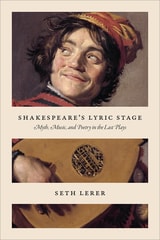
Shakespeare's Lyric Stage
Myth, Music, and Poetry in the Last PlaysSeth Lerer
University of Chicago Press, 2018
As Seth Lerer shows in this pioneering book, Shakespeare’s late plays invite us to contemplate that very question, offering up lyric as a displaced and sometimes desperate antidote to situations of duress or powerlessness. Lerer argues that the theme of lyric misalignment running throughout The Tempest, The Winter’s Tale, Henry VIII, and Cymbeline serves a political purpose, a last-ditch effort at transformation for characters and audiences who had lived through witch-hunting, plague, regime change, political conspiracies, and public executions.
A deep dive into the relationship between aesthetics and politics, this book also explores what Shakespearean lyric is able to recuperate for these “victims of history” by virtue of its disjointed utterances. To this end, Lerer establishes the concept of mythic lyricism: an estranging use of songs and poetry that functions to recreate the past as present, to empower the mythic dead, and to restore a bit of magic to the commonplaces and commodities of Jacobean England. Reading against the devotion to form and prosody common in Shakespeare scholarship, Lerer’s account of lyric utterance’s vexed role in his late works offers new ways to understand generational distance and cultural change throughout the playwright’s oeuvre.
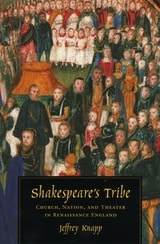
Shakespeare's Tribe
Church, Nation, and Theater in Renaissance EnglandJeffrey Knapp
University of Chicago Press, 2004
To be sure, Renaissance playwrights rarely sermonized in their plays, which seemed preoccupied with sex, violence, and crime. During a time when acting was regarded as a kind of vice, many theater professionals used their apparent godlessness to advantage, claiming that it enabled them to save wayward souls the church could not otherwise reach. The stage, they argued, made possible an ecumenical ministry, which would help transform Reformation England into a more inclusive Christian society.
Drawing on a variety of little-known as well as celebrated plays, along with a host of other documents from the English Renaissance, Shakespeare's Tribe changes the way we think about Shakespeare and the culture that produced him.
Winner of the Best Book in Literature and Language from the Association of American Publishers' Professional/Scholarly division, the Conference on Christianity and Literature Book Award, and the Roland H. Bainton Prize for Literature from the Sixteenth Century Society and Conference.
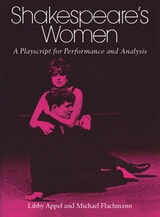
Shakespeare's Women
A Playscript for Performance and AnalysisLibby Appel and Michael Flachmann
Southern Illinois University Press, 1986
Serves both as a script for performance and as a text for high school and college theater and English classes.
This self-contained script brings together different scenes from Shakespeare’s plays to portray women “in all their infinite variety.” Two narrators, a man and a woman, introduce and comment on these scenes, weaving together the different characters and situations.
This book combines literary and theatrical techniques in examining Shakespeare’s women. Its promptbook format provides clear, helpful stage directions on pages facing each of the scenes. Also helpful are concise glosses and footnotes to define difficult words and phrases plus a commentary to explain each scene in its dramatic context.
Other features include sheet music for each song in the play, a bibliography on the topic of women in Shakespeare’s plays, and suggestions for directors who wish to stage the play.
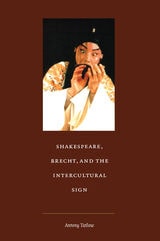
Shakespeare, Brecht, and the Intercultural Sign
Antony Tatlow
Duke University Press, 2001
Reflecting on how, why, and to what effect knowledges and styles of performance pollinate across cultures, Tatlow demonstrates that the employment of one culture’s material in the context of another defamiliarizes the conventions of representation in an act that facilitates access to what previously had been culturally repressed. By reading the intercultural, Tatlow shows, we are able not only to historicize the effects of those repressions that create a social unconscious but also gain access to what might otherwise have remained invisible.
This remarkable study will interest students of cultural interaction and aesthetics, as well as readers interested in theater, Shakespeare, Brecht, China, and Japan.
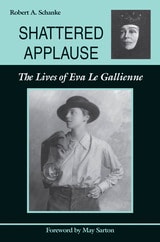
Shattered Applause
The Lives of Eva Le GallienneRobert A. Schanke. Foreword by May Sarton
Southern Illinois University Press, 1992
This comprehensive biography of the actress film critic Rex Reed called “a national treasure” draws on Robert A. Schanke’s interviews and correspondence not only with Eva Le Gallienne but also with more than one hundred of her colleagues and friends, including Glenda Jackson, Burgess Meredith, Eli Wallach, Peter Falk, Ellen Burstyn, Anne Jackson, Farley Granger, Jane Alexander, Uta Hagen, and Rosemary Harris. Forty-two illustrations offer highlights of Le Gallienne’s many notable performances in such plays as Hedda Gabler, Liliom, The Cherry Orchard, Peter Pan, Camille, Mary Stuart, The Royal Family,and The Dream Watcher.
Behind her public role as a famous actress and as the founding and maintaining force of the first civic repertory theatre in the United States, Eva Le Gallienne led a private life complicated by her identity as a lesbian. Schanke considers Le Gallienne’s sexuality and how it played a role in the struggles, defeats, and triumphs that combined to inspire her greatness. Shattered Applause, a finalist for the Lambda Literary Award for Lesbian Nonfiction, tells a fascinating story that also serves as a barometer of the changing values, tastes, and attitudes of American society.
Shattering Hamlet's Mirror
Theatre and RealityMarvin Carlson
University of Michigan Press, 2016

Show & The Gaze Of Theatre
A European PerspectiveErika Fischer-Lichte
University of Iowa Press, 1997
Theatre, in some respects, resembles a market. Stories, rituals, ideas, perceptive modes, conversations, rules, techniques, behavior patterns, actions, language, and objects constantly circulate back and forth between theatre and the other cultural institutions that make up everyday life in the twentieth century. These exchanges, which challenge the established concept of theatre in a way that demands to be understood, form the core of Erika Fischer-Lichte's dynamic book.
Each eclectic essay investigates the boundaries that separate theatre from other cultural domains. Every encounter between theatre and other art forms and institutions renegotiates and redefines these boundaries as part of an ongoing process. Drawing on a wealth of fascinating examples, both historical and contemporary, Fischer-Lichte reveals new perspectives in theatre research from quite a number of different approaches. Energetically and excitingly, she theorizes history, theorizes and historicizes performance analysis, and historicizes theory.
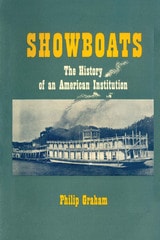
Showboats
The History of an American InstitutionBy Philip Graham
University of Texas Press, 1951
This book is a delightful and authoritative record of America's showboats from the first one, launched in 1831, to the last, ultimately tied up at a St. Louis dock.
It is also a record of the men and women who built and loved these floating theaters, of those who performed on their stages, and of the thousands who sat in their auditoriums.
And, lastly, it is a record of a genuine folk institution, as American as catfish, which for more than a century did much to relieve the social and cultural starvation of our vast river frontier.
For these showboats brought their rich cargoes of entertainment—genuine laughter, a glimpse of other worlds, a respite from the grinding hardship of the present, emotional relaxation—to valley farmers, isolated factory workers and miners, and backwoodsmen who otherwise would have lacked all such opportunities.
To the more privileged , the showboats brought pleasant reminder of a half-forgotten culture. They penetrated regions where churches and school had not gone, and where land theaters were for generations to be impossible. Like circuit preachers, they carried their message to the outer fringes of American civilization. In spite of many faults, it was a good message.
The frontier had created this institution to fill a genuine need, and it lasted only until other and better means of civilizing these regions could reach them—good roads, automobiles, motion pictures, schools, churches, newspapers, and theaters. But although the showboats have passed into history, they have left a rich legacy. As long as the Mississippi flows into the Gulf, their story will fire the imagination of Americans.
Showboating has become so legendary that few Americans know what this unique institution was really like. In Showboats, at long last, the true story emerges. It differs in many important respects from the motion picture and fictional versions to which Americans are accustomed, but it is not a whit the less glamorous.
Philip Graham has told his story with imagination, genuine insight, and complete devotion to facts. No one who is interested in America's past should fail to read it.
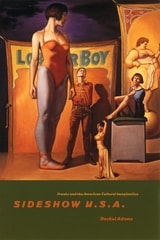
Sideshow U.S.A.
Freaks and the American Cultural ImaginationRachel Adams
University of Chicago Press, 2001
Sideshow U.S.A. begins by revisiting the terror and fascination the original freak shows provided for their audiences, as well as exploring the motivations of those who sought fame and profit in the business of human exhibition. With this history in mind, Adams turns from live entertainment to more mediated forms of cultural expression: the films of Tod Browning, the photography of Diane Arbus, the criticism of Leslie Fiedler, and the fiction Carson McCullers, Toni Morrison, and Katherine Dunn. Taken up in these works of art and literature, the freak serves as a metaphor for fundamental questions about self and other, identity and difference, and provides a window onto a once vital form of popular culture.
Adams's study concludes with a revealing look at the revival of the freak show as live performance in the late 1980s and the 1990s. Celebrated by some, the freak show's recent return is less welcome to those who have traditionally been its victims. At the beginning of a new century, Adams sees it as a form of living history, a testament to the vibrancy and inventiveness of American popular culture, as well as its capacity for cruelty and injustice.
"Because of its subject matter, this interesting and complex study is provocative, as well as thought-provoking."—Virginia Quarterly Review
Sign Language Interpreting for Theatre
A Collaborative ApproachLynnette Taylor
Gallaudet University Press, 2025
Written by three veteran interpreters with deep roots in the Deaf community and the performing arts, Sign Language Interpreting for Theatre is the first of its kind: a comprehensive guide to the art of sign language interpreting for the theatre as a collaborative practice. Drawing from their years of experience of interpreting On- and Off-Broadway and blending the theoretical with the practical, Lynnette Taylor, Stephanie Feyne, and Candace Broecker Penn provide guiding principles, best practices, processes, and strategies for creating dynamic, collaborative, culturally grounded sign language translations for theatre performances. Written in an engaging, conversational style, chapters include in-depth discussion of both theory and practice, providing techniques for translation and stagecraft along with practical insights for issues such as interpreting team attributes, character depiction, working with scripts, song translations, interpreting for young audiences, and interpreting virtual and recorded performances. With its emphasis upon dialogic interpretation, shared responsibility, and alliances, this guide is an indispensable resource for interpreters, educators, and theatre professionals.
Signs of Change
New Directions in Theatre EducationJoan Lazarus
Intellect Books, 2012
Silver Screens
A Pictorial History of Milwaukee's Movie TheatersLarry Widen
Wisconsin Historical Society Press, 2007
Silver Screens traces the rich history of Milwaukee's movie theaters, from 1890s nickelodeons to the grand palaces of the Roaring Twenties to the shopping mall outlets of today. And the story doesn't end there: in the past two decades, the revival of interest in preservation and restoration of theaters has confirmed that there's still life in these beloved old structures. With the publication of Silver Screens, authors Larry Widen and Judi Anderson help ensure that our old theaters, those being restored and those long since vanished, will remain forever embedded in our collective memory.
In this revised edition of their book Milwaukee Movie Palaces, the authors present new findings on film innovations, drive-in theaters, projection booths, movie promotions, noted theater personalities, recent restoration efforts, and much more. Illuminated with more than a hundred photographs, including many never before published, Silver Screens is a stunning tribute to the legacy of the movie theater.
Simming
Participatory Performance and the Making of MeaningScott Magelssen
University of Michigan Press, 2014
At an ecopark in Mexico, tourists pretend to be illegal migrants, braving inhospitable terrain and the U.S. Border Patrol as they attempt to cross the border. At a living history museum in Indiana, daytime visitors return after dark to play fugitive slaves on the Underground Railroad. In the Mojave Desert, the U.S. Army simulates entire provinces of Iraq and Afghanistan, complete with bustling villages, insurgents, and Arabic-speaking townspeople, to train soldiers for deployment to the Middle East. At a nursing home, trainees put on fogged glasses and earplugs, thick bands around their finger joints, and sandbag harnesses to simulate the effects of aging and to gain empathy for their patients.
These immersive environments in which spectator-participants engage in simulations of various kinds—or “simming”—are the subject of Scott Magelssen’s book. His book lays out the ways in which simming can provide efficacy and promote social change through affective, embodied testimony. Using methodology from theater history and performance studies (particularly as these fields intersect with cultural studies, communication, history, popular culture, and American studies), Magelssen explores the ways these representational practices produce, reify, or contest cultural and societal perceptions of identity.
Sistuhs in the Struggle
An Oral History of Black Arts Movement Theater and PerformanceLa Donna L. Forsgren
Northwestern University Press, 2021
Outstanding Academic Title, CHOICE
The first oral history to fully explore the contributions of black women intellectuals to the Black Arts Movement, Sistuhs in the Struggle reclaims a vital yet under-researched chapter in African American, women’s, and theater history. This groundbreaking study documents how black women theater artists and activists—many of whom worked behind the scenes as directors, designers, producers, stage managers, and artistic directors—disseminated the black aesthetic and emboldened their communities.
Drawing on nearly thirty original interviews with well-known artists such as Ntozake Shange and Sonia Sanchez as well as less-studied figures including distinguished lighting designer Shirley Prendergast, dancer and choreographer Halifu Osumare, and three-time Tony-nominated writer and composer Micki Grant, La Donna L. Forsgren centers black women’s cultural work as a crucial component of civil rights and black power activism. Sistuhs in the Struggle is an essential collection for theater scholars, historians, and students interested in learning how black women’s art and activism both advanced and critiqued the ethos of the Black Arts and Black Power movements.
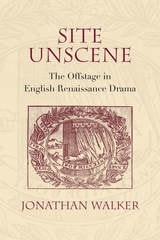
Site Unscene
The Offstage in English Renaissance DramaJonathan Walker
Northwestern University Press, 2017
Jonathan Walker demonstrates that by removing scenes from visible performance, playwrights take up the nondramatic mode of storytelling in order to transcend the limits of the stage. Through this technique, they present dramatic action from the subjective, self-interested, and idiosyncratic perspectives of individual characters. By recovering these offstage elements, Walker reveals the pervasive and formative dynamic between the onstage and offstage and between the seen and unseen in Renaissance drama.
Examining premodern dramatic theory, Renaissance plays, period amphitheaters, and material texts, this interdisciplinary work considers woodcuts, engravings, archaeology, architecture, rhetoric, the history of the book, as well as plays by Shakespeare, Marlowe, Kyd, Ford, Middleton, and Webster, among others. It addresses readers engaged in literary criticism, dramatic theory, theater history, and textual studies.
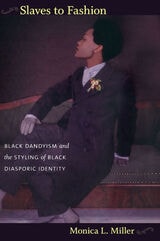
Slaves to Fashion
Black Dandyism and the Styling of Black Diasporic IdentityMonica L. Miller
Duke University Press, 2009
Dandyism was initially imposed on black men in eighteenth-century England, as the Atlantic slave trade and an emerging culture of conspicuous consumption generated a vogue in dandified black servants. “Luxury slaves” tweaked and reworked their uniforms, and were soon known for their sartorial novelty and sometimes flamboyant personalities. Tracing the history of the black dandy forward to contemporary celebrity incarnations such as Andre 3000, Miller explains how black people became arbiters of style and how they have historically used the dandy’s signature tools—clothing, gesture, and wit—to break down limiting identity markers and propose new ways of fashioning political and social possibility in the black Atlantic world. With an aplomb worthy of her iconographic subject, she considers the black dandy in relation to nineteenth-century American literature and drama, W. E. B. Du Bois’s reflections on black masculinity and cultural nationalism, the modernist aesthetics of the Harlem Renaissance, and representations of black cosmopolitanism in contemporary visual art.

Sleep with Spectators
Feminist Performance and PracticeDanielle Drees
University of Minnesota Press, 2026
A rejuvenating look at sleep’s integral role in feminist practice, critique, and imagination
Inequality is notoriously exhausting to confront, but through theater, performance art, and theory, feminist artists and thinkers have explored a radical counter to this exhaustion: sleep. Centering creative work on this restorative practice, Sleep with Spectators is a refreshing and visionary counterhistory of feminism that offers sleep as a tool for imagining new ways of living—ones that prioritize not only rest but also care and interdependence.
Taking performance as a unique means of perceiving private and unconscious aspects of daily life, Danielle Drees draws from opera, plays, and avant-garde theater to find instances of sleep and sleeplessness as novel embodiments of core feminist concerns. Among her subjects are Sarah Kane’s free verse text 4.48 Psychosis; María Irene Fornés’s queer drama of racial–sexual transformation, Enter THE NIGHT; and Regina José Galindo’s America’s Family Prison, in which Galindo, her partner, and their baby spent twenty-four hours in a “family-sized” cell rented from a private prison outfitter. Adeptly engaging this fascinating collection of international archival material through the lenses of Marxist feminism, trans and queer studies, and disability studies, Sleep with Spectators illuminates how sleep performances reveal and critique inequalities rooted in gender, sexuality, race, class, and disability.
Idiosyncratic and interdisciplinary, Sleep with Spectators charts an original path through the feminist performance archive, presenting new ways of indexing injustice and interrogating the political conditions of rest.
Retail e-book files for this title are screen-reader friendly.
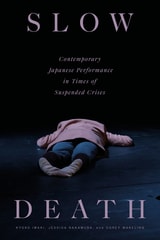
Slow Death
Contemporary Japanese Performance in Times of Suspended CrisesKyoko Iwaki, Jessica Nakamura, Corey Wakeling
Northwestern University Press, 2027
Bringing together performance studies, critical theory, and contemporary Japanese cultural studies to offer an unsettling glimpse into a global future of crisis already arriving
Slow Death examines contemporary artistic practice as a form of active engagement with the condition of “slow death”: the diffused feeling of decline with no end in sight. The theater and performance artists discussed here confront the realities of a state that is no longer tenable, rehearsing slow death’s modalities, probing its implications, and imagining possible endpoints through dramaturgy. As these artists show, the very notion of progress—whether framed as a march toward a hopeful future or a retreat into the comforts of a nostalgic past—carries an inescapable irony. Both trajectories seem equally unsustainable, rendering any prospect of radical transformation elusive. This sense of endless suspendedness emerges as a pervasive motif across the artworks discussed, such as the anticapitalist performance spaces created by Tanino Kurō and the queer feminist dramaturgy of Ichihara Satoko. Yet, as coauthors Kyoko Iwaki, Jessica Nakamura, and Corey Wakeling identify throughout, to enact slow death in performance is not to capitulate to despair but to expose its structure and, in doing so, uncover latent forms of everyday resistance.