303 books match the query 'Time' and 11 start with s

cover of Science in Translation: Movements of Knowledge through Cultures and Time

Science in Translation

Movements of Knowledge through Cultures and Time

Scott L. Montgomery

University of Chicago Press, 2000

In this innovative work, Scott L. Montgomery explores the diverse roles that translation has played in the development of science from antiquity to the present—from the Arabic translations of Greek and Latin texts whose reintroduction to Europe was crucial to the Renaissance, to the origin and evolution of modern science in Japan.

"[A] book of great richness, as much for its examples as for its ideas, which keenly illustrate the development of knowledge across languages and epochs. It is a book to read and reread. Its subject is important; it is ours, it is our history." -André Clas, Meta: Journal des Traducteurs

"[T]his book . . . seems to stand alone on the shelf. A good thing, therefore, that it is so full of good things, both in the content and the prose." —William R. Everdell, MAA Online

"[A]n impressive work. . . . By reminding us of the role of diverse cultures in the elevation of science within a particular nation or civilization, the book makes a substantial contribution to the postmodern worldview that emphasizes multiculturalism." —Choice

[more]
cover of Sentencing in Time

Sentencing in Time

Linda Ross Meyer

Amherst College Press, 2017
Exactly how is it we think the ends of justice are accomplished by sentencing someone to a term in prison? How do we relate a quantitative measure of time—months and years—to the objectives of deterring crime, punishing wrongdoers, and accomplishing justice for those touched by a criminal act? Linda Ross Meyer investigates these questions, examining the disconnect between our two basic modes of thinking about time—chronologically (seconds, minutes, hours), or phenomenologically (observing, taking note of, or being aware of the passing of time). In Sentencing in Time, Meyer asks whether—in overlooking the irreconcilability of these two modes of thinking about time—we are failing to accomplish the ends we believe the criminal justice system is designed to serve. Drawing on work in philosophy, legal theory, jurisprudence, and the history of penology, Meyer explores how, rather than condemning prisoners to an experience of time bereft of meaning, we might instead make the experience of incarceration constructively meaningful—and thus better aligned with social objectives of deterring crime, reforming offenders, and restoring justice.
[more]
cover of Service in a Time of Suspicion: Experiences of Muslims Serving in the U.S. Military Post-9/11

Service in a Time of Suspicion

Experiences of Muslims Serving in the U.S. Military Post-9/11

Michelle Sandhoff

University of Iowa Press, 2017

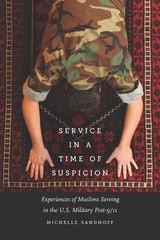
On September 11, 2001, nineteen members of the Islamist extremist organization al-Qaeda launched four coordinated attacks on the United States, killing 2,977 people. These events and the government’s subsequent “War on Terror” refueled long-standing negative stereotypes about Muslims and Islam among many Americans. And yet thousands of practicing Muslims continued to serve or chose to enlist in the U.S. military during these years.

In Service in a Time of Suspicion, fifteen such service members talk about what it means to be Muslim, American, and a uniformed member of the armed services in the twenty-first century. These honest accounts remind us of our shared humanity. 

[more]
cover of Shopping, or The End of Time

Shopping, or The End of Time

Emily Bludworth de Barrios

University of Wisconsin Press, 2022

“I am going to make a poem,” writes Emily Bludworth de Barrios, “As if / I could put beautiful things in a box to keep them there.” With Shopping, or The End of Time she has done that and so much more. These kaleidoscopic images reflect and reverberate across time and space, revealing collisions of identity, motherhood, childhood, houses, shopping malls, industrial canals—the hopes and fears of what we’ve lost and gained over the decades in our mad rush for connection, for ownership, for goods.

A detective’s red thread spiderweb mapping the constellations among parenting, capitalism, aging, and ghosts, this stunning collection is wistful, unmoored, glamorous, and immense. These tour-de-force poems simultaneously capture an impression of emptiness and pleasure, of existing in a liminal space filled with both hollowness and potential. 
 
Even though we lived at the edge of a great rupture,
It was difficult to tell when the world broke.
—Excerpt from “Ravine”

[more]
cover of Slavery and the Numbers Game: A CRITIQUE OF TIME ON THE CROSS

Slavery and the Numbers Game

A CRITIQUE OF TIME ON THE CROSS

Herbert G. Gutman

University of Illinois Press, 1975

 
This detailed analysis of slavery in the antebellum South was written in 1975 in response to the prior year's publication of Robert Fogel and Stanley Engerman's controversial Time on the Cross, which argued that slavery was an efficient and dynamic engine for the southern economy and that its success was due largely to the willing cooperation of the slaves themselves.
 
Noted labor historian Herbert G. Gutman was unconvinced, even outraged, by Fogel and Engerman's arguments. In this book he offers a systematic dissection of Time on the Cross, drawing on a wealth of data to contest that book's most fundamental assertions. A benchmark work of historical inquiry, Gutman's critique sheds light on a range of crucial aspects of slavery and its economic effectiveness.
 
Gutman emphasizes the slaves' responses to their treatment at the hands of slaveowners. He shows that slaves labored, not because they shared values and goals with their masters, but because of the omnipresent threat of 'negative incentives,' primarily physical violence.
 
In his introduction to this new edition, Bruce Levine provides a historical analysis of the debate over Time on the Cross. Levine reminds us of the continuing influence of the latter book, demonstrated by Robert W. Fogel's 1993 Nobel Prize in Economic Sciences, and hence the importance and timeliness of Gutman's critique.

 
[more]
cover of Space, Time, and Gravity: The Theory of the Big Bang and Black Holes

Space, Time, and Gravity

The Theory of the Big Bang and Black Holes

Robert M. Wald

University of Chicago Press, 1992

Writing for the general reader or student, Wald has completely revised and updated this highly regarded work to include recent developments in black hole physics and cosmology. Nature called the first edition "a very readable and accurate account of modern relativity physics for the layman within the unavoidable constraint of almost no mathematics. . . . A well written, entertaining and authoritative book."
[more]
cover of Standing on the Walls of Time: Ancient Art of Utah's Cliffs and Canyons

Standing on the Walls of Time

Ancient Art of Utah's Cliffs and Canyons

Kevin T. Jones and Layne Miller

University of Utah Press, 2019

In western culture, rock art has traditionally been viewed as “primitive” and properly belonging in the purview of anthropologists rather than art scholars and critics. This volume, featuring previously unpublished photographs of Utah’s magnificent rock art by long-time rock art researcher Layne Miller and essays by former Utah state archaeologist Kevin Jones, views rock art through a different lens.

Miller’s photographs include many rare and relatively unknown panels and represent a lifetime of work by someone intimately familiar with the Colorado Plateau. The photos highlight the astonishing variety of rock art as well as the variability within traditions and time periods. Jones’s essays furnish general information about previous Colorado Plateau cultures and shine a light on rock art as art. The book emphasizes the exqui­site artistry of these ancient works and their capacity to reach through the ages to envelop and inspire viewers.
[more]
cover of Stitches on Time: Colonial Textures and Postcolonial Tangles

Stitches on Time

Colonial Textures and Postcolonial Tangles

Saurabh Dube

Duke University Press, 2004

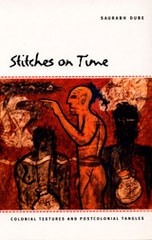
Destined to become a key work of subaltern studies and a crucial intervention in postcolonial scholarship, Stitches on Time probes the relationships between empire and modernity, nation and history, the colonial and the postcolonial, and power and difference. Saurabh Dube combines history and anthropology to provide critical understandings of the theory and practice of historical ethnography and contemporary historiography. Drawing on extensive archival research and innovative fieldwork as well as political economy and social theory—including considerations of gender—he unpacks the implications of specific Indian pasts from the middle of the nineteenth century through the end of the twentieth century.

Dube provides incisive accounts of the interactions between North American evangelical missionaries and Christian converts of central India, and between colonial legal systems and Indian popular laws. He reflects on the difficulties of history writing by considering the production and reception of recent Hindu nationalist histories. Assessing the work of the South Asian Subaltern Studies Collective, he offers substantial critical readings of major writings by Ranajit Guha, Dipesh Chakrabarty, Partha Chatterjee, and others. Dube develops the concept and practice of a “history without warranty” as a means of rigorously rethinking categories such as modernity, colonialism, the West, the postcolonial, and the nation.

[more]
cover of Stratigraphic Paleobiology: Understanding the Distribution of Fossil Taxa in Time and Space

Stratigraphic Paleobiology

Understanding the Distribution of Fossil Taxa in Time and Space

Mark E. Patzkowsky and Steven M. Holland

University of Chicago Press, 2012
Whether the fossil record should be read at face value or whether it presents a distorted view of the history of life is an argument seemingly as old as many fossils themselves. In the late 1700s, Georges Cuvier argued for a literal interpretation, but in the early 1800s, Charles Lyell’s gradualist view of the earth’s history required a more nuanced interpretation of that same record. To this day, the tension between literal and interpretive readings lies at the heart of paleontological research, influencing the way scientists view extinction patterns and their causes, ecosystem persistence and turnover, and the pattern of morphologic change and mode of speciation.
 
With Stratigraphic Paleobiology, Mark E. Patzkowsky and Steven M. Holland present a critical framework for assessing the fossil record, one based on a modern understanding of the principles of sediment accumulation. Patzkowsky and Holland argue that the distribution of fossil taxa in time and space is controlled not only by processes of ecology, evolution, and environmental change, but also by the stratigraphic processes that govern where and when sediment that might contain fossils is deposited and preserved. The authors explore the exciting possibilities of stratigraphic paleobiology, and along the way demonstrate its great potential to answer some of the most critical questions about the history of life: How and why do environmental niches change over time? What is the tempo and mode of evolutionary change and what processes drive this change? How has the diversity of life changed through time, and what processes control this change? And, finally, what is the tempo and mode of change in ecosystems over time?
 
[more]
cover of Style and Time: Essays on the Politics of Appearance

Style and Time

Essays on the Politics of Appearance

Andrew Benjamin

Northwestern University Press, 2006

Interruption is often read as the foundational gesture of modernity—the means through which modernity asserts its existence by claiming its discontinuity with the past. Exposing the limitations of such an understanding, this book offers a very different approach: here, modernity is the site that poses the question of how we are to continue when every attempt to think and understand the present is marked by the necessity of an interruption. Through a reading of Walter Benjamin's writings—particularly on interruption, fashion, and Jugendstil (or Art Nouveau)—Andrew Benjamin in this work offers a sustained meditation on the role of interruption in modernity. His book departs from and elaborates an important but overlooked dimension of Benjamin's discourse: the question of style as it bears upon temporality and spatiality. Extending this meditation in exciting and unexpected ways--toward problems of cosmopolitanism, immigration, and the graphically pornographic, for instance—the author is able to translate Benjamin's multifaceted formulations on style, the dialectical image, awakening, temporality, and spatiality into lucid and highly intelligent stylistics underscoring the philosophical notions of Schein and Erscheining, the interruptions of modernity, and the politics of sameness and otherness.

Nothing less than a rethinking of the conditions of Western art as it relates to politics, architecture, and time, this study of Walter Benjamin's modernity in temporal and spatial terms is a provocative and original work of philosophy in its own right—a work that suggests that the time has come to revise existing paradigms.

[more]
cover of Surveillance in the Time of Insecurity

Surveillance in the Time of Insecurity

Monahan, Torin

Rutgers University Press, 2010

Threats of terrorism, natural disaster, identity theft, job loss, illegal immigration, and even biblical apocalypse—all are perils that trigger alarm in people today. Although there may be a factual basis for many of these fears, they do not simply represent objective conditions. Feelings of insecurity are instilled by politicians and the media, and sustained by urban fortification, technological surveillance, and economic vulnerability.

Surveillance in the Time of Insecurity fuses advanced theoretical accounts of state power and neoliberalism with original research from the social settings in which insecurity dynamics play out in the new century. Torin Monahan explores the counterterrorism-themed show 24, Rapture fiction, traffic control centers, security conferences, public housing, and gated communities, and examines how each manifests complex relationships of inequality, insecurity, and surveillance. Alleviating insecurity requires that we confront its mythic dimensions, the politics inherent in new configurations of security provision, and the structural obstacles to achieving equality in societies.
[more]