Results by title
89 books match the query 'Transgender Studies' and 6 start with s

Selfie Aesthetics
Seeing Trans Feminist Futures in Self-Representational ArtNicole Erin Morse
Duke University Press, 2022

Sex Isn't Real
The Invention of an Incoherent BinaryBeans Velocci
Duke University Press, 2026
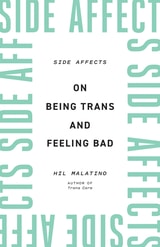
Side Affects
On Being Trans and Feeling BadHil Malatino
University of Minnesota Press, 2022
How the “bad feelings” of trans experience inform trans survival and flourishing
Some days—or weeks, or months, or even years—being trans feels bad. Yet as Hil Malatino points out, there is little space for trans people to think through, let alone speak of, these bad feelings. Negative emotions are suspect because they unsettle narratives of acceptance or reinforce virulently phobic framings of trans as inauthentic and threatening.
In Side Affects, Malatino opens a new conversation about trans experience that acknowledges the reality of feeling fatigue, envy, burnout, numbness, and rage amid the ongoing onslaught of casual and structural transphobia in order to map the intricate emotional terrain of trans survival. Trans structures of feeling are frequently coded as negative on both sides of transition. Before transition, narratives are framed in terms of childhood trauma and being in the “wrong body.” Posttransition, trans individuals—especially trans people of color—are subject to unrelenting transantagonism. Yet trans individuals are discouraged from displaying or admitting to despondency or despair.
By moving these unloved feelings to the center of trans experience, Side Affects proposes an affective trans commons that exists outside political debates about inclusion. Acknowledging such powerful and elided feelings as anger and exhaustion, Malatino contends, is critical to motivating justice-oriented advocacy and organizing—and recalibrating new possibilities for survival and well-being.

Sideways Selves
Travesti and Jotería Struggles Across the AméricasPJ DiPietro
University of Texas Press, 2025
2026 Sylvia Rivera Award in Transgender Studies, The Center for LGBTQ Studies (CLAGS), CUNY
How trans and non-binary networks engage in decoloniality across hemispheres.
A deeply informed, theoretically rich work of inquiry and critique, Sideways Selves learns from two communities of migrants as they contest their marginalization under the colonial regime of gender—colonial because, as PJ DiPietro affirms, Indigenous and Afro-diasporic conceptions of embodiment have been displaced by the European-Christian order of gender. Following gender-nonconforming Aymara, Kolla, and mixed-race exiles in Buenos Aires and K’iche’, Nahua, and Central American migrants in the San Francisco Bay Area, DiPietro takes stock of a collective, transnational effort to reimagine ideas of personhood and kinship that gender makes unthinkable.
The communities DiPietro studies create new kinds of identities, collective and genderless in nature. Their ways of thinking and doing, though radical, are motivated by old wisdom, storytelling, healing, and religion—brujería, curanderismo, Voudoun, and other practices that colonialism, capitalism, and the nation-state have unsuccessfully tried to erase. In equal measures philosophical and ethnographic, Sideways Selves witnesses and listens as these displaced people—displaced from their homes and from the moral geography of the West—show us what a just, decolonial world could actually be.

Standardizing Sex
A History of Trans MedicineKetil Slagstad
University of Chicago Press, 2025
Standardizing Sex traces the emergence of trans medicine in Scandinavia in the twentieth century, exploring the construction and negotiation of medical expertise among medical professionals, patients, and activists in the media and government bureaucracy. The book combines the author’s analysis of medical records and other archival sources with oral history interviews with former patients, activists, doctors, psychologists, and civil servants. Physician-historian Ketil Slagstad uses the Scandinavian story of sex reassignment to anchor not only the role of the state but also bureaucracy and social rights. Scandinavian countries, he shows, played a foundational role in the emergence of trans medicine internationally. As a result, Standardizing Sex tells a transnational history of medicine that sheds light on a set of relations and problems that continue to impact discussions of trans medicine and trans rights around the world.
Slagstad’s sources offer a rare opportunity to explore the emergence of trans medicine in action in the clinic, laboratory, waiting room, and operating room, as well as in the bureaucrat’s office, on the psychologist’s couch, and in the publications and meetings of activist groups. Together, these sources allow for the analysis of the increasingly complex negotiations of nosological criteria, medical knowledge, and medical practices in a formative period for transgender medicine. More generally, the book offers a story about the reshaping of the normal and the pathological in modern societies.
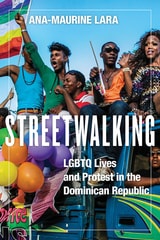
Streetwalking
LGBTQ Lives and Protest in the Dominican RepublicAna-Maurine Lara
Rutgers University Press, 2021
Streetwalking: LGBTQ Lives and Protest in the Dominican Republic is an exploration of the ways that lesbian, gay, bisexual, trans and queer persons exercise power in a Catholic Hispanic heteropatriarchal nation-state, namely the Dominican Republic. Lara presents the specific strategies employed by LGBTQ community leaders in the Dominican Republic in their struggle for subjectivity, recognition, and rights. Drawing on ethnographic encounters, film and video, and interviews, LGBTQ community leaders teach readers about streetwalking, confrontación, flipping the script, cuentos, and the use of strategic universalisms in the exercise of power and agency. Rooted in Maria Lugones's theorization of streetwalker strategies and Audre Lorde's theorization of silence and action, this text re-imagines the exercise and locus of power in examples provided by the living, thriving LGBTQ community of the Dominican Republic.