Results by title
80 books match the query 'Transition' and 5 start with s
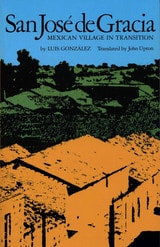
San José de Gracia
Mexican Village in TransitionBy Luis González
University of Texas Press, 1974
The village of San José de Gracia is not mentioned in any history of Mexico, nor is it referred to in any of the annals of the state of Michoacán. It is not to be found at all on most maps, and almost none show its correct location. It is an unknown point in space, in time, and in the consciousness of the Mexican republic.
In Luis González's classic history of the world of San José, he turns his attention in every direction: toward what is lasting and what is ephemeral, everyday and unusual, material and spiritual. The story is, to some extent, the story of rural life anywhere, in any age; to some extent it is peculiar to the world of the peasant all through Mexico's history; and to some extent it can be said to be true only of San José.
The history of San José is also the history of the village as victim of the megalopolis, not only in Mexico but everywhere in our time. With the small community will be lost traditions and a sense of continuity that may prove irreplaceable and essential to human wellbeing. While Luis González does not suggest that he knows what the fate of San José will be, one feels that he knows all too well, and that his questions are only "How?" and "How soon?"

Screening the Transition
Spanish Cinema and the Challenges of DemocracyFederico Bonaddio
Intellect Books, 2026
A timely study of Spanish cinema during the country’s transition to democracy, including how popular and auteur films grappled with the authoritarian past.
Screening the Transition examines how Spanish cinema produced in the years immediately following Francisco Franco’s death articulated—through its narratives and characterizations—the social and cultural challenges encountered during the country’s transition to democracy. These films reflect emergent post-dictatorship realities, including increased openness toward sexuality and nudity; the erosion of traditional family structures; persistent attachments to, and reckonings with, the Francoist past; the development of political plurality and expanded freedom of expression; and various forms of marginalization, whether economic or based on gender and sexuality. In doing so, the analysis conceptualizes Spain’s transition not solely in political terms, as is commonly the case, but as a profoundly personal and affective process.
Federico Bonaddio demonstrates the limitations of cinema in this period, which at times revealed an inability to transcend deep-seated prejudices and forms of reticence cultivated over nearly four decades of authoritarian rule. These limitations surface in the prurient treatment of female nudity and sexual violence; in the deployment of comedy to belittle or trivialize democratic change; in a preference for metaphor and allegory over direct political engagement; and in the restricted investigative ambitions of historical dramas.
Considering both popular and auteur cinema, the book is primarily concerned with how filmmaking registered the difficulties of consigning the dictatorship fully to the past, despite the so-called pact of forgetting promoted by political elites to facilitate national reconciliation.
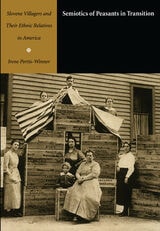
Semiotics of Peasants in Transition
Slovene Villagers and Their Ethnic Relatives in AmericaIrene Portis-Winner
Duke University Press, 2002
Describing a process of continuous and enduring interaction between these geographically separate communities, Portis-Winner explains how, for instance, financial assistance from the emigrants enabled their Slovenian hometown to survive the economic depressions of the 1890s and 1930s. She also analyzes the extent to which memories, rituals, myths, and traditional activities from Slovenia have sustained their Cleveland relatives. The result is a unique anthropological investigation into the signifying practices of a strongly cohesive—yet geographically split—ethnic group, as well as an illuminating application of semiotic analyses to communities and the complex problems they face.
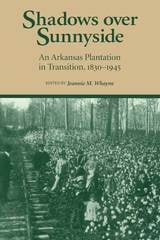
Shadows Over Sunnyside
An Arkansas Plantation in Transition, 1830-1945Jeannie M. Whayne
University of Arkansas Press, 1993

Society As Educator in an Age of Transition
Edited by Kenneth D. Benne and Steven Tozer
University of Chicago Press, 1987