Results by title
86 books match the query 'Translating & Interpreting' and 9 start with s
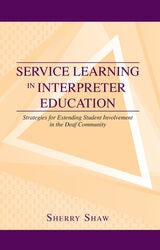
Service Learning in Interpreter Education
Strategies for Extending Student Involvement in the Deaf CommunitySherry Shaw
Gallaudet University Press, 2013
Institutions of higher learning around the nation have embraced the concept of student civic engagement as part of their curricula, a movement that has spurred administrators in various fields to initiate programs as part of their disciplines. In response, sign language interpreting educators are attempting to devise service-learning programs aimed at Deaf communities. Except for a smattering of journal articles, however, they have had no primary guide for fashioning these programs. Sherry Shaw remedies this in her new book Service Learning in Interpreter Education: Strategies for Extending Student Involvement in the Deaf Community.
Shaw begins by outlining how to extend student involvement beyond the field experience of an internship or practicum and suggests how to overcome student resistance to a course that seems atypical. She introduces the educational strategy behind service-learning, explaining it as a tool for re-centering the Deaf community in interpreter education. She then provides the framework for a service-learning course syllabus, including establishing Deaf community partnerships and how to conduct student assessments.
Service Learning in Interpreter Education concludes with first-person accounts from students and community members who recount their personal and professional experiences with service learning. With this thorough guide, interpreter education programs can develop stand-alone courses or modules within existing coursework.
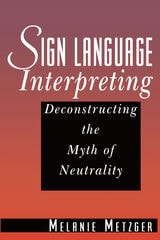
Sign Language Interpreting
Deconstructing the Myth of NeutralityMelanie Metzger
Gallaudet University Press, 1998
Sign Language Interpreting relies upon an interactional sociolinguistic approach to ask fundamental questions regarding interpreter neutrality. First, do interpreters influence discourse, and if so, how? Also, what kind of expectations do the participants bring to the event, and what do the interpreters bring to discussions? Finally, how do their remarks affect their alignment with participants in the interaction? Using careful assessments of how these interviews were framed, and also re-interviewing the participants for their perspectives, this penetrating book discloses the ways in which interpreters influence these situations. It also addresses the potential implications of these findings regarding sign language interpretation in medical, educational, and all other general interactions. Interpreter trainers and their students will join certified interpreters and Deaf studies scholars in applauding and benefiting from the fresh ground broken by this provocative study.
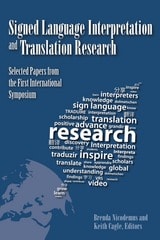
Signed Language Interpretation and Translation Research
Selected Papers from the First International SymposiumBrenda Nicodemus
Gallaudet University Press, 2015
The ten papers in Signed Language Interpretation and Translation Research cover a range of topics, including the need for Deaf perspectives in interpretation research, discourse strategies and techniques that are unique to video relay call settings, the benefits of using sociology as a lens for examining sign language interpreting work, translating university entrance exams from written Portuguese into Libras (Brazilian Sign Language), the linguistic choices interpreters make when interpreting ASL figurative language into English, the nature of designated interpreting, and grammatical ambiguity in trilingual VRS interpreting. The research findings and insights contained here will be invaluable to scholars, students, and practitioners.
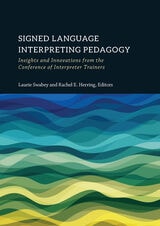
Signed Language Interpreting Pedagogy
Insights and Innovations from the Conference of Interpreter TrainersLaurie Swabey
Gallaudet University Press, 2022
The contributors explore other important topics in interpreter education including ethics, Deaf translation, performance evaluation, consecutive and simultaneous interpreting, discourse analysis, critical thinking, curriculum sequencing, the social construction of learning, and mentoring. Through this collaborative approach featuring more than thirty scholars, Signed Language Interpreting Pedagogy presents a wealth of theoretical and practical information for interpreter educators and their students.
Signed Language Interpreting in Brazil
Ronice Müller de Quadros
Gallaudet University Press, 2012
The ninth volume in the Studies in Interpretation series offers six succinct chapters on the state of signed language interpreting by Brazil by editors Ronice Müller de Quadros, Earl Fleetwood, Melanie Metzger and ten Brazilian researchers. The first chapter advocates for the affiliation of Brazilian Sign Language (Libras) interpretation research with the field of Translation Studies to generate greater academic power empowerment of Libras. The second chapter outlines how Brazilian sign language interpreters construct a position in discourse. Chapter 3 explores the possibility that bimodal, bilingual interpreters—hearing children of deaf adults—face unique cognitive tasks compared to unimodal bilingual interpreters.
Chapter 4 describes how the systematic expansion and documentation of new academic and technical terms in Brazilian Sign Language, in which fingerspelling is uncommon, resulted in the development of an online glossary. The fifth chapter details the challenges of Libras interpreters in high schools. Chapter 6 concludes this revealing collection with findings on whether gender traits influence the act of interpretation of Brazilian Sign Language.
Signed Language Interpreting in the 21st Century
An Overview of the ProfessionLen Roberson
Gallaudet University Press, 2018
Each chapter provides students with objectives, keywords, and discussion questions. The chapters convey clear information about topics that include credentialing, disposition and aptitude for becoming an interpreter, interpreting for people who are DeafBlind, and working within specialty settings, such as legal and healthcare. A key resource for interpreter certification test preparation, this text follows the interpreter’s ethical, practical, and professional development through a career of lifelong learning and service.
Signed Language Interpreting in the Workplace
Jules Dickinson
Gallaudet University Press, 2017
Jules Dickinson’s examination of interpreted workplace interactions is based on the only detailed, empirical study of this setting to date. Using practitioner responses and transcripts of real-life interpreted workplace interactions, Dickinson’s findings demonstrate the complexity of the interpreter’s role and responsibilities. The book concentrates on the ways in which signed language interpreters affect the interaction between deaf and hearing employees in team meetings by focusing on humor, small talk, and the collaborative floor. Signed Language Interpreting in the Workplace demonstrates that deaf employees require highly skilled professionals to enable them to integrate into the workplace on a level equal with their hearing peers. It also provides actionable insights for interpreters in workplace settings that will be a valuable resource for interpreting students, practitioners, interpreter trainers, and researchers.
Speaking in Tongues
Languages at Play in the TheatreMarvin Carlson
University of Michigan Press, 2010
The book begins by investigating various "levels" of language-high and low style, prose and poetry-and the ways in which these have been used historically to mark social positions and relationships. It next considers some of the political and historical implications of dialogue theatre, as well as theatre that literally employs several languages, from classical Greek examples to the postmodern era. Carlson treats with special attention the theatre of the postcolonial world, and especially the triangulation of the local language, the national language, and the colonial language, drawing on examples of theatre in the Caribbean, Africa, Australia, and New Zealand. Finally, Carlson considers the layering of languages in the theatre, such as the use of supertitles or simultaneous signing.
Speaking in Tongues draws important social and political conclusions about the role of language in cultural power, making a vital contribution to the fields of theatre and performance.
Marvin Carlson is Sidney E. Cohn Professor of Theatre and Comparative Literature, CUNY Graduate Center. He is author of Performance: A Critical Introduction; Theories of the Theatre: A Historical and Critical Survey, from the Greeks to the Present; and The Haunted Stage: The Theatre as Memory Machine, among many other books.

Staging Christ's Passion in Eighteenth-Century Nahua Mexico
Louise M. Burkhart
University Press of Colorado, 2023
A cast with over fifty distinct roles acted out events extending from Palm Sunday to Christ’s death on the cross. One actor became a localized embodiment of Jesus through a process of investiture and mimesis that carried aspects of pre-Columbian materialized divinity into the later colonial period. The play told afar richer version of the Passion story than what later colonial Nahuas typically learned from their priests or catechists. And by assimilating Jesus to an Indigenous, or macehualli, identity, the players enacted a protest against colonial rule.
The situation in eighteenth-century New Spain presents both a unique confrontation between Indigenous communities and Enlightenment era religious reformers and a new chapter in an age-old power game between popular practice and religious orthodoxy. By focusing on how Nahuas localized the universalizing narrative of Christ’s Passion, Staging Christ’s Passion in Eighteenth-Century Nahua Mexico offers an unusually in-depth view of religious life under colonial rule.
Burkhart’s accompanying website also makes available transcriptions and translations of the six Nahuatl-language plays, four Spanish-language plays composed in response to the suppression of the Nahuatl practice, and related documentation, providing a valuable resource for anyone interested in consulting the original material.
Comments restricted to single page
plays composed in response to the suppression of the Nahuatl practice, and related documentation,
providing a valuable resource for anyone interested in consulting the original material