Results by title
124 books match the query 'Twenty - First Century' and 6 start with s
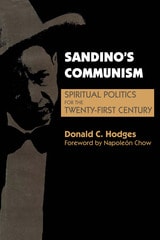
Sandino's Communism
Spiritual Politics for the Twenty-First CenturyBy Donald C. Hodges
University of Texas Press, 1992
Drawing on previously unknown or unassimilated sources, Donald C. Hodges here presents an entirely new interpretation of the politics and philosophy of Augusto C. Sandino, the intellectual progenitor of Nicaragua's Sandinista revolution.
The first part of the book investigates the political sources of Sandino's thought in the works of Babeuf, Buonarroti, Blanqui, Proudhon, Bakunin, Most, Malatesta, Kropotkin, Ricardo Flores Magón, and Lenin—a mixed legacy of pre-Marxist and non-Marxist authoritarian and libertarian communists.
The second half of the study scrutinizes the philosophy of nature and history that Sandino made his own. Hodges delves deeply into this philosophy as the supreme and final expression of Sandino's communism and traces its sources in the Gnostic and millenarian occult undergrounds. This results in a rich study of the ways in which Sandino's revolutionary communism and communist spirituality intersect—a spiritual politics that Hodges presents as more realistic than the communism of Karl Marx.
While accepting the current wisdom that Sandino was a Nicaraguan liberal and social reformer, Hodges also makes a persuasive case that Sandino was first and foremost a communist, although neither of the Marxist nor anarchist variety. He argues that Sandino's eclectic communist spirituality was more of an asset than a liability for understanding the human condition, and that his spiritual politics promises to be more relevant than Marxism-Leninism for the twenty-first century. Indeed, Hodges believes that Sandino's holistic communism embraces both deep ecology and feminist spirituality—a finding that is sure to generate lively and productive debate.
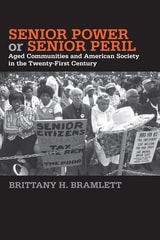
Senior Power or Senior Peril
Aged Communities and American Society in the Twenty-First CenturyBrittany H Bramlett
Temple University Press, 2015
In Senior Power or Senior Peril, Bramlett examines the assertions that the increasing number of older adult-concentrated communities across the United States form a growing bloc of senior power that will influence the redistribution of particularized welfare benefits to older adults at the expense of younger people. However, others suggest that political influence declines with old age. Bramlett uses interviews and on-site research at various senior communities to explore what qualities make an aged community politically unique, and the impact of the local aged context on residents' political knowledge, safety-net policy attitudes, efficacy, and political activity.
This path-breaking book identifies the political behaviors, attitudes, and political consciousness of both older and younger residents as it recounts the perceived and actual political power of seniors.
In the series The Social Logic of Politics, edited by Scott McClurg
Sociology for the Twenty-first Century
Continuities and Cutting EdgesEdited by Janet L. Abu-Lughod
University of Chicago Press, 1999
The chapters in part 1 revise theory and methods to comprehend the economic and political institutions that increasingly dominate the lives of individuals and groups, arguing that these giants must be made more democratically accountable. Part 2 explores the social effects that growing globalization, transnationalization, and information technologies are having on politics, economics, and the environment. The final chapters compare how new immigrants from increasingly diversified backgrounds are being absorbed in Canada and the United States, exploring the impact that immigrants are having on preexisting ethnic minorities and on the dominant political culture.
While it is a major attempt to refocus the discipline of sociology, the book's clear, nontechnical style and its attention to issues of central concern to all citizens make it also highly accessible to nonspecialists.
Contributors are Janet L. Abu-Lughod, Tomas Almaguer, Giovanni Arrighi, Gilles Bourque, Randall Collins, Jules Duchastel, Joe Feagin, Harriet Friedmann, Pierre Hamel, Moon-Kie Jung, Joel Levine, Henri Lustiger-Thaler, Louis Maheu, Joel Perlmann, Saskia Sassen, Gideon Sjoberg, Dorothy Smith, Roger Waldinger, and Barry Wellman.
State Trading in the Twenty-First Century
The World Trade Forum, Volume 1Thomas Cottier and Petros C. Mavroidis, Editors
University of Michigan Press, 1998
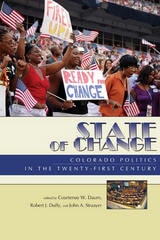
State of Change
Colorado Politics in the Twenty-first CenturyCourtenay W. Daum
University Press of Colorado, 2011
The increased use of direct democracy has resulted in the adoption of term limits, major reconstruction of fiscal policy, and many other changes in both statutory and constitutional law. Individual chapters address these changes within a range of contexts--electoral, political, partisan, and institutional--as well as their ramifications. Contributors also address the possible impacts of these changes on the state in the future, concluding that the current state of affairs is fated to be short-lived.
State of Change is the most up-to-date book on Colorado politics available and will be of value to undergraduate- and graduate-level students, academics, historians, and anyone involved with or interested in Colorado politics.
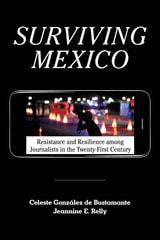
Surviving Mexico
Resistance and Resilience among Journalists in the Twenty-first CenturyBy Celeste González de Bustamante and Jeannine E. Relly
University of Texas Press, 2021
Mott KTA Journalism and Mass Communication Research Award, Kappa Tau Alpha
Tankard Book Award, Association for Education in Journalism and Mass Communication (AEJMC)
Knudson Latin America Prize, Association for Education in Journalism and Mass Communication (AEJMC)
Since 2000, more than 150 journalists have been killed in Mexico. Today the country is one of the most dangerous in the world in which to be a reporter. In Surviving Mexico, Celeste González de Bustamante and Jeannine E. Relly examine the networks of political power, business interests, and organized crime that threaten and attack Mexican journalists, who forge ahead despite the risks.
Amid the crackdown on drug cartels, overall violence in Mexico has increased, and journalists covering the conflict have grown more vulnerable. But it is not just criminal groups that want reporters out of the way. Government forces also attack journalists in order to shield corrupt authorities and the very criminals they are supposed to be fighting. Meanwhile some news organizations, enriched by their ties to corrupt government officials and criminal groups, fail to support their employees. In some cases, journalists must wait for a “green light” to publish not from their editors but from organized crime groups. Despite seemingly insurmountable constraints, journalists have turned to one another and to their communities to resist pressures and create their own networks of resilience. Drawing on a decade of rigorous research in Mexico, González de Bustamante and Relly explain how journalists have become their own activists and how they hold those in power accountable.