Results by title
91 books match the query 'West Virginia' and 8 start with s
Sarah’s Girls
A Chronicle of Big Ugly CreekLenore McComas Coberly
Ohio University Press, 2006
Situated in a remote outpost in West Virginia at the turn of the last century, the story that Lenore McComas Coberly tells in Sarah’s Girls is one of place, people, and unquenchable spirit. In this fictionalized account of her recent ancestors, Coberly masterfully traces the journeys of their lives, their dreams, and their hardships over the course of the twentieth century.
At its center is the story of Lena, who returns to care for her dead sister’s daughters, giving up the promise of a life that can spare her the adversity rural living guarantees. The author goes back to Big Ugly Creek, the place where her grandparents met—and the place whose memory she cannot leave.
Using the stories she was told in her childhood as a bridge to the past, Coberly uncovers facts about her family history from documents that have made their way from one generation to another and the truth from the inherent understanding she has of these people who are so close to her.
But Sarah’s Girls is not about the author; it is about the people and a place she loves. It is fiction written to tell the deeper truth about the hold West Virginia—its mountains and its valleys—has on its people.

Screaming with the Cannibals
LEE MAYNARD
West Virginia University Press, 2012
Smokeless Coal Fields of West Virginia
A Brief HistoryW. P. Tams, Jr., Introduction by Ronald D. Eller
West Virginia University Press, 2001
The Smokeless Coal Fields of West Virginia: A Brief History first appeared in 1963, a little book by a man with no training as either a writer or a historian. Since then, this volume has become an essential sourcebook, consulted and quoted in nearly every study of coal field history. The surprising impact and durability of the book are due to both the information in it and the personality behind it. Through the first half of the twentieth century, William Purviance Tams lived coal. Rising from a young coal engineer to a senior coal baron, Tams stood at the center of Southern West Virginia industrialization. When he sold his company in 1955, Tams was the last of the old owner-operators, men with no personal or financial interest outside of coal. Tams wrote a book which could only have come from an ultimate insider. The everyday work of mining coal is here-laying track, blasting and loading the coal. So is the everyday business of coal, from sinking shafts and ventilating the work area, to administering a town and keeping the workers happy.
Tams gives the financial details of the volatile business, and offers capsule biographies of the other major developers of the Southern West Virginia coal fields. It was a passion for Tams. He never married, and tended his business and his town with paternal care. After retirement, this industrial baron spent his final decades in a modest bungalow in his little coal-camp community, watching the town he had built fade back into the mountains. It is W. P. Tams's passion and attitude, as much as his place at the center of history, which make The Smokeless Coal Fields of West Virginia worth reading nearly 40 years after its first publication. Tams's 1963 account of his career, The Smokeless Coal Fields of West Virginia, offers a unique perspective on the business and the life of coal mining. The book is especially valuable for its account of the daily life and work of the miners, engineers, and families in the mines and in the mining towns. Our reprint of this fascinating and important book combines Tams's original work with a new introduction by Ronald D. Eller, author of Miners, Millhands, & Mountaineers.
Smokestacks in the Hills
Rural-Industrial Workers in West VirginiaLouis Martin
University of Illinois Press, 2015
As Martin shows, access to land in and around steel and pottery towns allowed residents to preserve rural habits and culture. Workers in these places valued place and local community. Because of their belief in localism, an individualistic ethic of "making do," and company loyalty, they often worked to place limits on union influence. At the same time, this localism allowed workers to adapt to the dictates of industrial capitalism and a continually changing world on their own terms--and retain rural ways to a degree unknown among their urbanized peers. Throughout, Martin ties these themes to illuminating discussions of capital mobility, the ways in which changing work experiences defined gender roles, and the persistent myth that modernizing forces bulldozed docile local cultures.
Revealing and incisive, Smokestacks in the Hills reappraises an overlooked stratum of American labor history and contributes to the ongoing dialogue on shifts in national politics in the postwar era.

Snakehunter
Chuck Kinder
West Virginia University Press, 2018
First published in 1973, this debut novel is the deeply moving coming-of-age story of Speer Whitfield, whose recollection of his upbringing and his large, remarkable, and often peculiar family evokes the forces that set the path for a boy’s growth into manhood in 1940s Appalachia.
So Much to Be Angry About
Appalachian Movement Press and Radical DIY Publishing, 1969–1979Shaun Slifer
West Virginia University Press, 2021
In a remarkable act of recovery, So Much to Be Angry About conjures an influential but largely obscured strand in the nation’s radical tradition—the “movement” printing presses and publishers of the late 1960s and 1970s, and specifically Appalachian Movement Press in Huntington, West Virginia, the only movement press in Appalachia. More than a history, this craft- and activist-centered book positions the frontline politics of the Appalachian Left within larger movements in the 1970s. As Appalachian Movement Press founder Tom Woodruff wrote: “Appalachians weren’t sitting in the back row during this struggle, they were driving the bus.”
Emerging from the Students for a Democratic Society chapter at Marshall University, and working closely with organizer and poet Don West, Appalachian Movement Press made available an eclectic range of printed material, from books and pamphlets to children’s literature and calendars. Many of its publications promoted the Appalachian identity movement and “internal colony” theory, both of which were cornerstones of the nascent discipline of Appalachian studies. One of its many influential publications was MAW, the first feminist magazine written by and for Appalachian women.
So Much to Be Angry About combines complete reproductions of five of Appalachian Movement Press’s most engaging publications, an essay by Shaun Slifer about his detective work resurrecting the press’s history, and a contextual introduction to New Left movement publishing by Josh MacPhee. Amply illustrated in a richly produced package, the volume pays homage to the graphic sensibility of the region’s 1970s social movements, while also celebrating the current renaissance of Appalachia’s DIY culture—in many respects a legacy, Slifer suggests, of the movement publishing documented in his book.
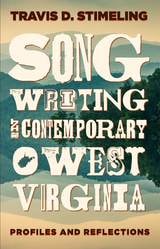
Songwriting in Contemporary West Virginia
Profiles and ReflectionsTravis D. Stimeling
West Virginia University Press, 2018
Stimeling is attentive to breadth and diversity, presenting sketches of established personalities like Larry Groce, who oversees Mountain Stage, and emerging musicians like Maria Allison, who dreams of one day performing there. Each profile includes a brief selected discography to guide readers to recordings of these musicians’ work.

Spring Wildflowers of West Virginia
EARL L. CORE
West Virginia University Press, 2005
Back in print just in time for spring! Originally published in 1948, this is the germinal text on nearly 250 species of spring wildflowers found in West Virginia. Common or English names and scientific or Latin names are given for each species. The descriptions are in two sections: The first description includes the meaning of the name of the flower, uses, habitats, and ranges in West Virginia. Secondly, the plant itself is described in deep detail to help in identification. Each description is accompanied by a facing page detailed line drawing. This book is a must have for those interested in the beauty and science of West Virginia's spring flora. The author, Earl L. Core, also co-wrote the four-volume Flora of West Virginia. He received his bachelor's and master's degrees from West Virginia University and his doctorate from Columbia. He was a biology professor at WVU where the 75-acre arboretum managed by the university bears his name. The illustrator, William A. Lunk, received his doctorate at the University of Michigan and went on to become curator of their University Museums.