Results by title
211 books match the query 'Working class' and 9 start with s
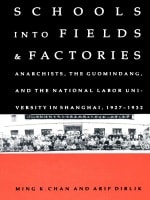
Schools into Fields and Factories
Anarchists, the Guomindang, and the National Labor University in Shanghai, 1927–1932Ming K. Chan and Arif Dirlik
Duke University Press, 1991
During its five years of existence, Labor University was the most impressive institutional embodiment in twentieth-century China of the labor-learning ideal, which was introduced by anarchists in the first decade of the century and came to be shared by a diverse group of revolutionaries in the 1920s. This detailed study places Labor University within the broad context of anarchist social ideals and educational experiments that inspired it directly, as well as comparable socialist experiments within labor education in Europe that Labor University’s founders used as models. The authors bring to bear the perspectives of institutional and intellectual history on their examination of the structure and operation of the University, presenting new material on its faculty, curriculum, physical plant, and history.
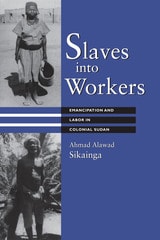
Slaves into Workers
Emancipation and Labor in Colonial SudanBy Ahmad Alawad Sikainga
University of Texas Press, 1996
Unlike African slavery in Europe and the Americas, slavery in the Sudan and other parts of Africa persisted well into the twentieth century. Sudanese slaves served Sudanese masters until the region was conquered by the Turks, who practiced slavery on a larger, institutional scale. When the British took over the Sudan in 1898, they officially emancipated the slaves, yet found it impossible to replace their labor in the country’s economy.
This pathfinding study explores the process of emancipation and the development of wage labor in the Sudan under British colonial rule. Ahmad Sikainga focuses on the fate of ex-slaves in Khartoum and on the efforts of the colonial government to transform them into wage laborers. He probes into what colonial rule and city life meant for slaves and ex-slaves and what the city and its people meant for colonial officials.
This investigation sheds new light on the legacy of slavery and the status of former slaves and their descendants. It also reveals how the legacy of slavery underlies the current ethnic and regional conflicts in the Sudan. It will be vital reading for students of race relations and slavery, colonialism and postcolonialism, urbanization, and labor history in Africa and the Middle East.
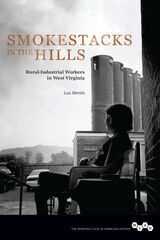
Smokestacks in the Hills
Rural-Industrial Workers in West VirginiaLouis Martin
University of Illinois Press, 2015
As Martin shows, access to land in and around steel and pottery towns allowed residents to preserve rural habits and culture. Workers in these places valued place and local community. Because of their belief in localism, an individualistic ethic of "making do," and company loyalty, they often worked to place limits on union influence. At the same time, this localism allowed workers to adapt to the dictates of industrial capitalism and a continually changing world on their own terms--and retain rural ways to a degree unknown among their urbanized peers. Throughout, Martin ties these themes to illuminating discussions of capital mobility, the ways in which changing work experiences defined gender roles, and the persistent myth that modernizing forces bulldozed docile local cultures.
Revealing and incisive, Smokestacks in the Hills reappraises an overlooked stratum of American labor history and contributes to the ongoing dialogue on shifts in national politics in the postwar era.
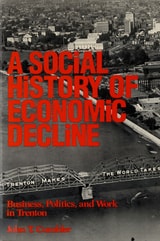
Social History of Economic Decline
Business, Politics, and Work in TrentonCumbler, John T.
Rutgers University Press, 1989
Solidarity and Fragmentation
Working People and Class Consciousness in Detroit, 1875-1900Richard Jules Oestreicher
University of Illinois Press, 1985

Southern Insurgency
The Coming of the Global Working ClassImmanuel Ness
Pluto Press, 2015
The product of extensive firsthand field research, Southern Insurgency paints a picture of the new industrial proletariat in the Global South—a group that lives a precarious, frightening existence yet at the same time offers hope for new approaches to solidarity and the anti-capitalist struggle.
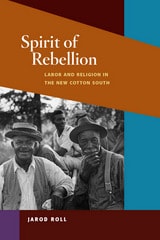
Spirit of Rebellion
Labor and Religion in the New Cotton SouthJared Roll
University of Illinois Press, 2010
Winner of the Herbert G. Gutman Prize from the Labor and Working-Class History Association
In Spirit of Rebellion, Jarod Roll documents an alternative tradition of American protest by linking working-class political movements to grassroots religious revivals. He reveals how ordinary rural citizens in the south used available resources and their shared faith to defend their agrarian livelihoods amid the political and economic upheaval of the first half of the twentieth century.On the frontier of the New Cotton South in Missouri's Bootheel, the relationships between black and white farmers were complicated by racial tensions and bitter competition. Despite these divisions, workers found common ground as dissidents fighting for economic security, decent housing, and basic health, ultimately drawing on the democratic potential of evangelical religion to wage working-class revolts against commodity agriculture and the political forces that buoyed it. Roll convincingly shows how the moral clarity and spiritual vigor these working people found in the burgeoning Pentecostal revivals gave them the courage and fortitude to develop an expansive agenda of workers' rights by tapping into the powers of existing organizations such as the Socialist Party, the Universal Negro Improvement Association, the NAACP, and the interracial Southern Tenant Farmers' Union.
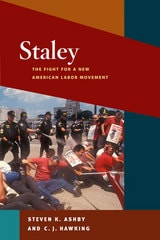
Staley
The Fight for a New American Labor MovementSteven K. Ashby and C. J. Hawking
University of Illinois Press, 2008
Streets, Railroads, and the Great Strike of 1877
David O. Stowell
University of Chicago Press, 1999
Whereas most historians treat the event solely as a massive labor strike that targeted the railroads, David O. Stowell examines America's predicament more broadly to uncover the roots of this rebellion. He studies the urban origins of the Strike in three upstate New York cities—Buffalo, Albany, and Syracuse. He finds that locomotives rumbled through crowded urban spaces, sending panicked horses and their wagons careening through streets. Hundreds of people were killed and injured with appalling regularity. The trains also disrupted street traffic and obstructed certain forms of commerce. For these reasons, Stowell argues, The Great Strike was not simply an uprising fueled by disgruntled workers. Rather, it was a grave reflection of one of the most direct and damaging ways many people experienced the Industrial Revolution.
"Through meticulously crafted case studies . . . the author advances the thesis that the strike had urban roots, that in substantial part it represented a community uprising. . . .A particular strength of the book is Stowell's description of the horrendous accidents, the toll in human life, and the continual disruption of craft, business, and ordinary movement engendered by building railroads into the heart of cities."—Charles N. Glaab, American Historical Review