18284 books match the query 'United States' and 1181 start with s
cover of So Much to Be Angry About: Appalachian Movement Press and Radical DIY Publishing, 1969–1979

So Much to Be Angry About

Appalachian Movement Press and Radical DIY Publishing, 1969–1979

Shaun Slifer

West Virginia University Press, 2021

A richly produced, craft- and activist-centered celebration of radical DIY publishing, for readers of Appalachian Reckoning.

In a remarkable act of recovery, So Much to Be Angry About conjures an influential but largely obscured strand in the nation’s radical tradition—the “movement” printing presses and publishers of the late 1960s and 1970s, and specifically Appalachian Movement Press in Huntington, West Virginia, the only movement press in Appalachia. More than a history, this craft- and activist-centered book positions the frontline politics of the Appalachian Left within larger movements in the 1970s. As Appalachian Movement Press founder Tom Woodruff wrote: “Appalachians weren’t sitting in the back row during this struggle, they were driving the bus.”

Emerging from the Students for a Democratic Society chapter at Marshall University, and working closely with organizer and poet Don West, Appalachian Movement Press made available an eclectic range of printed material, from books and pamphlets to children’s literature and calendars. Many of its publications promoted the Appalachian identity movement and “internal colony” theory, both of which were cornerstones of the nascent discipline of Appalachian studies. One of its many influential publications was MAW, the first feminist magazine written by and for Appalachian women.

So Much to Be Angry About combines complete reproductions of five of Appalachian Movement Press’s most engaging publications, an essay by Shaun Slifer about his detective work resurrecting the press’s history, and a contextual introduction to New Left movement publishing by Josh MacPhee. Amply illustrated in a richly produced package, the volume pays homage to the graphic sensibility of the region’s 1970s social movements, while also celebrating the current renaissance of Appalachia’s DIY culture—in many respects a legacy, Slifer suggests, of the movement publishing documented in his book.

[more]
cover of So Ole Says to Lena: Folk Humor of the Upper Midwest

So Ole Says to Lena

Folk Humor of the Upper Midwest

Compiled and edited by James P. Leary

University of Wisconsin Press, 2002

In the land of beer, cheese, and muskies—where the polka is danced and winter is unending and where Lutherans and Catholics predominate—everybody is ethnic, the politics are clean, and the humor is plentiful. This collection includes jokes, humorous anecdotes, and tall tales from ethnic groups (Woodland Indians, French, Cornish, Germans, Irish, Scandinavians, Finns, and Poles) and working folk (loggers, miners, farmers, townsfolk, hunters, and fishers). Dig into the rich cultural context supplied by the notes and photographs, or just laugh at the hundreds of jokes gathered at small-town cafes, farm tables, job sites, and church suppers. This second edition includes an afterword and indexes of motifs and tale types.

[more]
cover of So You Want to Be an Academic Library Director

So You Want to Be an Academic Library Director

Colleen S. Harris

American Library Association, 2017

[more]
cover of Soap Fans: Pursuing Pleasure and Making Meaning in Everyday Life

Soap Fans

Pursuing Pleasure and Making Meaning in Everyday Life

C. Lee Harrington and Denise D. Bielby

Temple University Press, 1995

Do soap opera fans deserve their reputation as lonely people, hopeless losers, or bored housewives? No, according to C. Lee Harrington and Denise D. Bielby. These authors—soap fans themselves—argue that soap fans are normal individuals who translate their soap watching into a broad range of public and private experience. People who cut across all categories of age, gender, race, ethnicity, income, education, and ideology incorporate a love of the soaps into their day-to-day leisure activities.

Interviews with soap opera viewers, actors, writers, producers, directors, the daytime press, and fan club staff members reveal fascinating details about the inside world of fandom and the multitude of outlets for fan expression—clubs, newsletters, electronic bulletin boards, and public events. Numerous examples illustrate the pleasure fans derive from critiquing characters, speculating on plot twists, and swapping memorabilia.

Examining the experiences that shape fan culture, Harrington and Bielby analyze the narrative structure and various aspects of the production of the soaps. Their examination reveals that the "meaning" of soaps is complex, individualized, and not simply a reflection of the narrative content of the stories. The authors show fans who actively contemplate what it means to be a fan, and who adjust their level of involvement accordingly.
[more]
cover of Soapbox Rebellion: The Hobo Orator Union and the Free Speech Fights of the Industrial Workers of the World, 1909-1916

Soapbox Rebellion

The Hobo Orator Union and the Free Speech Fights of the Industrial Workers of the World, 1909-1916

Matthew S. May

University of Alabama Press, 2013

Soapbox Rebellion, a new critical history of the free speech fights of the Industrial Workers of the World (IWW), illustrates how the lively and colorful soapbox culture of the “Wobblies” generated novel forms of class struggle.
 
From 1909 to 1916, thousands of IWW members engaged in dozens of fights for freedom of speech throughout the American West. The volatile spread and circulation of hobo agitation during these fights amounted to nothing less than a soapbox rebellion in which public speech became the principal site of the struggle of the few to exploit the many. While the fights were not always successful, they did produce a novel form of fluid union organization that offers historians, labor activists, and social movement scholars a window into an alternative approach to what it means to belong to a union. Matthew May coins the phrase “Hobo Orator Union” to characterize these collectives.
 
Soapbox Rebellion highlights the methodological obstacles to recovering a workers’ history of public address; closely analyzes the impact of hobo oratorical performances; and discusses the implications of the Wobblies’ free speech fights for understanding grassroots resistance and class struggle today—in an era of the decline of the institutional business union model and workplace contractualism.
 
 
[more]
cover of Soapy: A Biography of G. Mennen Williams

Soapy

A Biography of G. Mennen Williams

Thomas J. Noer

University of Michigan Press, 2005

"This is an important book about an important public official, G. Mennen 'Soapy' Williams---an unabashed liberal, a true humanitarian, and a great patriot."
---George McGovern

"Soapy Williams had a deep talent not only to compel but on occasion to repel."
---John Kenneth Galbraith

"Thomas Noer has written a model biography of a fascinating political figure. He brings Williams to life with all his contradictions, old-fashioned qualities, and admirable idealism."
---Robert Divine, George W. Littlefield Professor Emeritus in American History, University of Texas

"G. Mennen 'Soapy' Williams was not only a giant in the 20th century history of the Michigan Democratic Party, the history of the state of Michigan and our nation-he was a giant ahead of his time. Throughout his long and extremely distinguished career as Governor of Michigan, Assistant Secretary of State for African Affairs and Chief Justice of the Michigan Supreme Court, Soapy maintained an unwavering commitment to equality, justice and civil rights for all people."
---Senator Carl Levin

In this first complete biography of G. Mennen "Soapy" Williams, author Thomas Noer brings to life the story of one of the most controversial and colorful politicians in twentieth-century American politics and a giant in the Michigan Democratic Party.

In 1948, winning a stunning upset, Williams became Michigan's second Democratic governor since the Civil War and was reelected five times. He served under Kennedy and Johnson as Assistant Secretary of State for Africa, briefly held the post of U.S. Ambassador to the Philippines, and was a member of the Michigan Supreme Court from 1970 to 1986, serving as Chief Justice in his last term.

Sporting his instantly recognizable trademark green and white polka-dot bow tie, Williams was a flamboyant character. He was also known for his energetic campaign style: he could say "hello" in seventeen languages, would shake hands with as many as five thousand factory workers a day, and made seemingly endless diplomatic trips to Africa. All of this captured the attention of the media and the public and made Williams into a celebrity.

Beneath his showy public persona, however, Williams also made important contributions to American diplomatic and political history. He built an unrivaled political machine in Michigan, bringing organized labor, African Americans, and ethnic groups into a new coalition; influenced the shift in American policy toward support for African independence; and wrote landmark decisions as a jurist on the Michigan Supreme Court.

The fascinating story of a complex and complicated man, Soapy will introduce one of the great American political figures of the twentieth century to a new generation of readers.

[more]
cover of Soccer in American Culture: The Beautiful Game’s Struggle for Status

Soccer in American Culture

The Beautiful Game’s Struggle for Status

G. Edward White

University of Missouri Press, 2023

2022 Choice Outstanding Academic Title

In Soccer in American Culture: The Beautiful Game’s Struggle for Status, G. Edward White seeks to answer two questions. The first is why the sport of soccer failed to take root in the United States when it spread from England around much of the rest of the world in the late nineteenth and twentieth centuries. The second is why the sport has had a significant renaissance in America since the last decade of the twentieth century, to the point where it is now the 4th largest participatory sport in the United States and is thriving, in both men’s and women’s versions, at the high school, college, and professional levels.

White considers the early history of “Association football” (soccer) in England, the persistent struggles by the sport to establish itself in America for much of the twentieth century, the role of public high schools and colleges in marginalizing the sport, the part played by FIFA, the international organization charged with developing soccer around the globe, in encumbering the development of the sport in the United States, and the unusual history of women’s soccer in America, which evolved in the twentieth century from a virtually nonexistent sport to a major factor in the emergence of men’s—as well as women's—soccer in the U.S. in the twentieth century.
           
Incorporating insights from sociology and economics, White explores the multiple factors that have resulted in the sport of soccer struggling to achieve major status in America and why it currently has nothing like the cultural impact of other popular American sports—baseball and American football— which can be seen by the comparative lack of attention paid to it in sports media, its low television ratings, and virtually nonexistent radio broadcast coverage.

[more]
cover of Soccer in a Football World: The Story of America's Forgotten Game

Soccer in a Football World

The Story of America's Forgotten Game

David Wangerin

Temple University Press, 2008

David Beckham’s arrival in Los Angeles represents the latest attempt to jump-start soccer in the United States where, David Wangerin says, it “remains a minority sport.” With the rest of the globe so resolutely attached to the game, why is soccer still mostly dismissed by Americans?

Calling himself “a soccer fan born in the wrong country at nearly the wrong time,” Wangerin writes with wit and passion about the sport’s struggle for acceptance in Soccer in a Football World. A Wisconsin native, he traces the fragile history of the game from its early capitulation to gridiron on college campuses to the United States’ impressive performance at the 2002 World Cup. Placing soccer in the context of American sport in general, he chronicles its enduring struggle alongside the country’s more familiar pursuits and recounts the shifting attitudes toward the “foreign” game. His story is one that will enrich the perspective of anyone whose heart beats for the sport, and is curious as to where the game has been in America—and where it might be headed.
[more]
cover of Soccer's Neoliberal Pitch: The Sport's Power, Profit, and Discursive Politics

Soccer's Neoliberal Pitch

The Sport's Power, Profit, and Discursive Politics

John M. Sloop

University of Alabama Press, 2023

A powerful cultural critique of soccer’s public rhetoric

American sports agnostics might raise an eyebrow at the idea that soccer represents a staging ground for cultural, social, and political possibility. It is just another game, after all, in a society where mass-audience spectator sports largely avoid any political stance other than a generic, corporate-friendly patriotism. But John M. Sloop picks up on the work of Laurent Dubois and others to see in American soccer—a sport that has achieved immense participation and popularity despite its struggle to establish major league status—a game that permits surprisingly diverse modes of thinking about national identity because of its marginality.

As a rhetorician who draws on both critical theory and culture, Sloop seeks to read soccer as the game intersects with gender, race, sexuality, and class. The result of this engagement is a sense of both enormous possibility and real constraint. If American soccer offers more possibility because of its marginality, looking at how those possibilities are constrained can provide valuable insights into neoliberal logics of power, profit, politics, and selfhood.

In Soccer’s Neoliberal Pitch, Sloop analyzes a host of soccer-adjacent phenomena: the equal pay dispute between the US women’s national team and the US Soccer Federation, the significance of hooligan literature, the introduction of English soccer to American TV audiences, the strange invisibility of the Mexican soccer league despite its consistent high TV ratings, and the reading of US national teams as “underdogs” despite the nation’s quasi-imperial dominance of the Western hemisphere. An invaluable addition to a growing bookshelf on soccer titles, Soccer’s Neoliberal Pitch serves as a model for critical cultural work with sports, with appeal to not only sports studies, but cultural studies, communication, and even gender studies classrooms.
 

[more]
cover of Social Awakening: Adolescent Behavior as Adulthood Approaches

Social Awakening

Adolescent Behavior as Adulthood Approaches

Robert T. Michael

Russell Sage Foundation, 2001
While headlines about violent crimes committed by adolescents often capture the public's attention, many more young people excel in the classroom, on the athletic field, and in the community. Why do some youngsters strive to achieve while others court disaster? Using new data from the National Longitudinal Survey of Youth (NLSY), a survey of more than nine thousand young people between the ages of twelve and sixteen, Social Awakening explores the choices adolescents make about their lives and their futures. The book focuses on the key role the family plays as teenagers navigate the difficult transition from childhood to adulthood. Social Awakening analyzes a wide range of adolescent behavior and issues that affect teenagers' lives—from their dating and sexual behavior, drug and alcohol use, and physical and mental well-being, to their career goals and expectations for the future. The findings strengthen our understanding of how an array of family characteristics—single parenthood, income, educational level, race, and geographical location—influences teens' lives. One contributor explores why children from single-parent families are more likely to perform poorly in school and to indulge in risky behavior, such as drug abuse or promiscuous sexual activity. Another chapter examines why children of parents with a college degree are less likely to engage in early sexual activity. And another looks at different levels of criminal behavior among urban and rural youths. One of the advantages of an in-depth interview such as the NLSY is the wide array of behavior and experiences by the same youths that can be mutually investigated. The analysis in Social Awakening helps confirm or refute what we think we know—to explore what we could not explore with older or less complex surveys. The NLSY, which forms the foundation of Social Awakening, will be updated annually over the coming decades to enable experts to learn how those who were adolescents at the dawn of the twenty-first century handled the move to adulthood. Social Awakening provides a compelling first look at these young peoples' lives.
[more]
cover of Social Capital and Poor Communities

Social Capital and Poor Communities

Susan Saegert

Russell Sage Foundation, 2001
Neighborhood support groups have always played a key role in helping the poor survive, but combating poverty requires more than simply meeting the needs of day-to-day subsistence. Social Capital and Poor Communities shows the significant achievements that can be made through collective strategies, which empower the poor to become active partners in revitalizing their neighborhoods. Trust and cooperation among residents and local organizations such as churches, small businesses, and unions form the basis of social capital, which provides access to resources that would otherwise be out of reach to poor families. Social Capital and Poor Communities examines civic initiatives that have built affordable housing, fostered small businesses, promoted neighborhood safety, and increased political participation. At the core of each initiative lie local institutions—church congregations, parent-teacher groups, tenant associations, and community improvement alliances. The contributors explore how such groups build networks of leaders and followers and how the social power they cultivate can be successfully transferred from smaller goals to broader political advocacy. For example, community-based groups often become platforms for leaders hoping to run for local office. Church-based groups and interfaith organizations can lobby for affordable housing, job training programs, and school improvement. Social Capital and Poor Communities convincingly demonstrates why building social capital is so important in enabling the poor to seek greater access to financial resources and public services. As the contributors make clear, this task is neither automatic nor easy. The book's frank discussions of both successes and failures illustrate the pitfalls—conflicts of interest, resistance from power elites, and racial exclusion—that can threaten even the most promising initiatives. The impressive evidence in this volume offers valuable insights into how goal formation, leadership, and cooperation can be effectively cultivated, resulting in a remarkable force for change and a rich public life even for those communities mired in seemingly hopeless poverty. A Volume in the Ford Foundation Series on Asset Building
[more]
cover of Social Class: How Does It Work?

Social Class

How Does It Work?

Annette Lareau

Russell Sage Foundation, 2008

Class differences permeate the neighborhoods, classrooms, and workplaces where we lead our daily lives. But little is known about how class really works, and its importance is often downplayed or denied. In this important new volume, leading sociologists systematically examine how social class operates in the United States today. Social Class argues against the view that we are becoming a classless society. The authors show instead the decisive ways social class matters—from how long people live, to how they raise their children, to how they vote. The distinguished contributors to Social Class examine how class works in a variety of domains including politics, health, education, gender, and the family. Michael Hout shows that class membership remains an integral part of identity in the U.S.—in two large national surveys, over 97 percent of Americans, when prompted, identify themselves with a particular class. Dalton Conley identifies an intangible but crucial source of class difference that he calls the "opportunity horizon"—children form aspirations based on what they have seen is possible. The best predictor of earning a college degree isn't race, income, or even parental occupation—it is, rather, the level of education that one's parents achieved. Annette Lareau and Elliot Weininger find that parental involvement in the college application process, which significantly contributes to student success, is overwhelmingly a middle-class phenomenon. David Grusky and Kim Weeden introduce a new model for measuring inequality that allows researchers to assess not just the extent of inequality, but also whether it is taking on a more polarized, class-based form. John Goldthorpe and Michelle Jackson examine the academic careers of students in three social classes and find that poorly performing students from high-status families do much better in many instances than talented students from less-advantaged families. Erik Olin Wright critically assesses the emphasis on individual life chances in many studies of class and calls for a more structural conception of class. In an epilogue, journalists Ray Suarez, Janny Scott, and Roger Hodge reflect on the media's failure to report hardening class lines in the United States, even when images on the nightly news—such as those involving health, crime, or immigration—are profoundly shaped by issues of class. Until now, class scholarship has been highly specialized, with researchers working on only one part of a larger puzzle. Social Class gathers the most current research in one volume, and persuasively illustrates that class remains a powerful force in American society.
[more]
cover of Social Contracts Under Stress: The Middle Classes of America, Europe, and Japan at the Turn of the Century

Social Contracts Under Stress

The Middle Classes of America, Europe, and Japan at the Turn of the Century

Olivier Zunz

Russell Sage Foundation, 2002
The years following World War II saw a huge expansion of the middle classes in the world's industrialized nations, with a significant part of the working class becoming absorbed into the middle class. Although never explicitly formalized, it was as though a new social contract called for government, business, and labor to work together to ensure greater political freedom and more broadly shared economic prosperity. For the most part, they succeeded. In Social Contracts Under Stress, eighteen experts from seven countries examine this historic transformation and look ahead to assess how the middle class might fare in the face of slowing economic growth and increasing globalization. The first section of the book focuses on the differing experiences of Germany, Britain, France, the United States, and Japan as they became middle-class societies. The British working classes, for example, were slowest to consider themselves middle class, while in Japan by the 1960s, most workers had abandoned working-class identity. The French remain more fragmented among various middle classes and resist one homogenous entity. Part II presents compelling evidence that the rise of a huge middle class was far from inclusive or free of social friction. Some contributors discuss how the social contract reinforced long-standing prejudices toward minorities and women. In the United States, Ira Katznelson writes, Southern politicians used measures that should have promoted equality, such as the GI bill, to exclude blacks from full access to opportunity. In her review of gender and family models, Chiara Saraceno finds that Mediterranean countries have mobilized the power of the state to maintain a division of labor between men and women. The final section examines what effect globalization might have on the middle class. Leonard Schoppa's careful analysis of the relevant data shows how globalization has pushed "less skilled workers down and more skilled workers up out of a middle class that had for a few decades been home to both." Although Europe has resisted the rise of inequality more effectively than the United States or Japan, several contributors wonder how long that resistance can last. Social Contracts Under Stress argues convincingly that keeping the middle class open and inclusive in the face of current economic pressures will require a collective will extending across countries. This book provides an invaluable guide for assessing the issues that must be considered in such an effort.
[more]
cover of Social Controversy and Public Address in the 1960s and Early 1970s: A Rhetorical History of the United States, Volume IX

Social Controversy and Public Address in the 1960s and Early 1970s

A Rhetorical History of the United States, Volume IX

Richard J. Jensen

Michigan State University Press, 2017

The period between the 1960s and 1970s is easily one of the most controversial in American history. Examining the liberal movements of the era as well as those that opposed them, this volume offers analyses of the rhetoric of leaders, including those of the civil rights movement, the Chicano movement, the gay rights movement, second-wave feminism, and conservative resistance groups. It also features an introduction that summarizes much of the significant research done by communication scholars on dissent in the 1960s and 1970s. This time period is still a fertile area of study, and this book provides insights into the era that are both provocative and illuminating, making it an essential read for anyone looking to learn more about this time in America.
[more]
cover of Social Darwinism: Science and Myth in Anglo-American Social Thought

Social Darwinism

Science and Myth in Anglo-American Social Thought

Robert C. Bannister

Temple University Press, 1989

"The most systematic and comprehensive effort yet made to assess the role played by Darwinian ideas in the writings of English-speaking social theorists of the late-nineteenth and early-twentieth centuries." --Isis "In seeking to set the record straight, Bannister cuts through the amalgam with an intellectual shredder, exposing the illogic and incompatibility involved in fusing Charles Darwin's On the Origin of Species with Herbert Spencer's Social Statics.... Bannister's familiarity with relevant texts and their reception by contemporary social theorists, scholars, and critics on both sides of the Atlantic is impressive." --Journal of Interdisciplinary History "A fine contribution to Anglo-American intellectual history." --Journal of American History
[more]
cover of Social Dimensions of U.S. Trade Policies

Social Dimensions of U.S. Trade Policies

Alan V. Deardorff and Robert M. Stern, Editors

University of Michigan Press, 2000
The contributors to this volume include numerous members of the trade policy community who analyze and discuss the salient social dimensions of U.S. trade policies. These issues include the effects of trade on wage inequality; trade and immigration policy; U.S. trade adjustment assistance policies; the effects of NAFTA on environmental quality; the role of labor standards in U.S. trade policies; the economics of labor standards and the GATT; issues of child labor; and the role of interest groups in the design and implementation of U.S. trade policies.
Chapter authors are Kyle Bagwell, Claude Barfield, George J. Borjas, Drusilla K. Brown, Alan V. Deardorff, Nancy Dunne, Gary S. Fields, John Kirton, Mike Jendrzejczyk, Phyllis Shearer Jones, Edward E. Leamer, Robert Naiman, Gregory K. Schoepfle, Robert W. Staiger, and Robert M. Stern.
Commenters are Steve Beckman, Jagdish Bhagwati, Alan V. Deardorff, Avinash Dixit, Pharis Harvey, David van Hoogstraten, John H. Jackson, Lawrence Mishel, Jack Otero, J. David Richardson, Dani Rodrik, Mark Silbergeld, and T. N. Srinivasan.
Alan V. Deardorff and Robert M. Stern are Professors of Economics and Public Policy, University of Michigan.
[more]
cover of Social Experimentation

Social Experimentation

Edited by Jerry A. Hausman and David A. Wise

University of Chicago Press, 1985

Since 1970 the United States government has spent over half a billion dollars on social experiments intended to assess the effect of potential tax policies, health insurance plans, housing subsidies, and other programs. Was it worth it? Was anything learned from these experiments that could not have been learned by other, and cheaper, means? Could the experiments have been better designed or analyzed? These are some of the questions addressed by the contributors to this volume, the result of a conference on social experimentation sponsored in 1981 by the National Bureau of Economic Research.

The first section of the book looks at four types of experiments and what each accomplished. Frank P. Stafford examines the negative income tax experiments, Dennis J. Aigner considers the experiments with electricity pricing based on time of use, Harvey S. Rosen evaluates housing allowance experiments, and Jeffrey E. Harris reports on health experiments. In the second section, addressing experimental design and analysis, Jerry A. Hausman and David A. Wise highlight the absence of random selection of participants in social experiments, Frederick Mosteller and Milton C. Weinstein look specifically at the design of medical experiments, and Ernst W. Stromsdorfer examines the effects of experiments on policy. Each chapter is followed by the commentary of one or more distinguished economists.
[more]
cover of Social Inequality

Social Inequality

Kathryn Neckerman

Russell Sage Foundation, 2004
Inequality in income, earnings, and wealth has risen dramatically in the United States over the past three decades. Most research into this issue has focused on the causes—global trade, new technology, and economic policy—rather than the consequences of inequality. In Social Inequality, a group of the nation's leading social scientists opens a wide-ranging inquiry into the social implications of rising economic inequality. Beginning with a critical evaluation of the existing research, they assess whether the recent run-up in economic inequality has been accompanied by rising inequality in social domains such as the quality of family and neighborhood life, equal access to education and health care, job satisfaction, and political participation. Marcia Meyers and colleagues find that many low-income mothers cannot afford market-based child care, which contributes to inequality both at the present time—by reducing maternal employment and family income—and through the long-term consequences of informal or low-quality care on children's educational achievement. At the other end of the educational spectrum, Thomas Kane links the growing inequality in college attendance to rising tuition and cuts in financial aid. Neil Fligstein and Taek-Jin Shin show how both job security and job satisfaction have decreased for low-wage workers compared with their higher-paid counterparts. Those who fall behind economically may also suffer diminished access to essential social resources like health care. John Mullahy, Stephanie Robert, and Barbara Wolfe discuss why higher inequality may lead to poorer health: wider inequality might mean increased stress-related ailments for the poor, and it might also be associated with public health care policies that favor the privileged. On the political front, Richard Freeman concludes that political participation has become more stratified as incomes have become more unequal. Workers at the bottom of the income scale may simply be too hard-pressed or too demoralized to care about political participation. Social Inequality concludes with a comprehensive section on the methodological problems involved in disentangling the effects of inequality from other economic factors, which will be of great benefit to future investigators. While today's widening inequality may be a temporary episode, the danger is that the current economic divisions may set in motion a self-perpetuating cycle of social disadvantage. The most comprehensive review of this quandary to date, Social Inequality maps out a new agenda for research on inequality in America with important implications for public policy.
[more]
cover of Social Justice in Diverse Suburbs: History, Politics, and Prospects

Social Justice in Diverse Suburbs

History, Politics, and Prospects

Christopher Niedt

Temple University Press, 2013

American suburbs have been seen as both exclusive idylls for elites as well as crucibles for new ideologies of gender, class, race, and property. But few have considered what the growing diversity of suburban America has meant for progressive social, economic, and political justice movements. Social Justice in Diverse Suburbs is a pioneering and multidisciplinary volume that reassesses commonplace understandings of suburban activism. 

Editor Christopher Niedt and his contributors shed light on organizing and conflict in the suburbs with historical and contemporary case studies. Chapters address topical issues ranging from how suburbanites actively fought school segregation to industrial pollution and displacement along the suburban-rural fringe. Social Justice in Diverse Suburbs also considers struggles for integration and environmental justice as well as efforts to preserve suburban history and organize immigrant communities.

Contributors include: Douglas R. Appler, Aaron Cavin, Nancy A. Denton, Lisa Feldstein, Casey Gallagher, Anne Galletta, Joseph Gibbons, Robert Gioielli, Lucas Owen Kirkpatrick, JoAnna Mitchell-Brown, Manuel Pastor, john a. powell, Jason Reece, Alex Schafran, June Williamson, and the editor.

[more]
cover of Social Patterns in Normal Aging: Findings from the Duke Longitudinal Studies

Social Patterns in Normal Aging

Findings from the Duke Longitudinal Studies

Erdman Palmore

Duke University Press, 1981
Erdman Palmore has written a comprehensive, systematic summary of all extant findings on social patterns in normal aging learned from the landmark Duke Longitudinal Studies in aging. Palmore discusses the implications of these findings for major issues in gerontology and answers such questions as: Do elderly people reduce their social activity? Do they come to resemble one another or become more different as they age? Do major events in later life produce stress resulting in physical and/or mental illnesses? Does sexual activity maintain or reduce life satisfaction and longevity? Palmore's conclusions challenge many current ideas and prejudices widely held about people over the age of 65.
[more]
cover of Social Programs that Work

Social Programs that Work

Jonathan Crane

Russell Sage Foundation, 1998
Many Americans seem convinced that government programs designed to help the poor have failed. Social Programs That Work shows that this is not true. Many programs have demonstrably improved the lives of people trapped at the bottom of the social and economic ladder. Social Programs That Work provides an in-depth look at some of the nation's best interventions over the past few decades, and considers their potential for national expansion. Examined here are programs designed to improve children's reading skills, curb juvenile delinquency and substance abuse, and move people off welfare into the workforce. Each contributor discusses the design and implementation of a particular program, and assesses how well particular goals were met. Among the critical issues addressed: Are good results permanent, or do they fade over time? Can they be replicated successfully under varied conditions? Are programs cost effective, and if so are the benefits seen immediately or only over the long term? How can public support be garnered for a large upfront investment whose returns may not be apparent for years? Some programs discussed in this volume were implemented only on a small, experimental scale, prompting discussion of their viability at the national level. An important concern for social policy is whether one-shot programs can lead to permanent results. Early interventions may be extremely effective at reducing future criminal behavior, as shown by the results of the High/Scope Perry preschool program. Evidence from the Life Skills Training Program suggests that a combination of initial intervention and occasional booster sessions can be an inexpensive and successful approach to reducing adolescent substance abuse. Social Programs That Work also acknowledges that simply placing welfare recipients in jobs isn't enough; they will also need long-term support to maintain those jobs. The successes and failures of social policy over the last thirty-five years have given us valuable feedback about the design of successful social policy. Social Programs That Work represents a landmark attempt to use social science criteria to identify and strengthen the programs most likely to make a real difference in addressing the nation's social ills.
[more]
cover of Social Research in the Judicial Process: Cases, Readings, and Text

Social Research in the Judicial Process

Cases, Readings, and Text

Wallace D. Loh

Russell Sage Foundation, 1984
"How to inform the judicial mind," Justice Frankfurter remarked during the school desegregation cases, "is one of the most complicated problems." Social research is a potential source of such information. Indeed, in the 1960s and 1970s, with activist courts at the forefront of social reform, the field of law and social science came of age. But for all the recent activity and scholarship in this area, few books have attempted to create an intellectual framework, a systematic introduction to applied social-legal research. Social Research in the Judicial Process addresses this need for a broader picture. Designed for use by both law students and social science students, it constructs a conceptual bridge between social research (the realm of social facts) and judicial decision making (the realm of social values). Its unique casebook format weaves together judicial opinions, empirical studies, and original text. It is a process-oriented book that teaches skills and perspectives, cultivating an informed sensitivity to the use and misuse of psychology, social psychology, and sociology in apellate and trial adjudication. Among the social-legal topics explored are school desegregation, capital punishment, jury impartiality, and eyewitness identification. This casebook is remarkable for its scope, its accessibility, and the intelligence of its conceptual integration. It provides the kind of interdisciplinary teaching framework that should eventually help lawyers to make knowledgeable use of social research, and social scientists to conduct useful research within a legally sophisticated context.
[more]
cover of Social Science and Policy-Making: A Search for Relevance in the Twentieth Century

Social Science and Policy-Making

A Search for Relevance in the Twentieth Century

David L. Featherman and Maris A. Vinovskis, Editors

University of Michigan Press, 2001
This collection of essays examines how the social sciences in America were developed as a means of social reform and later, especially after World War II, as a tool in federal policymaking and policy analysis. It also uses arenas of policymaking, such as early childhood education and welfare and its reform, as case studies in which social research was used, in policy decisions or in setting and evaluating policy goals. The book is written to aid students of public policy to appreciate the complex relationship of information--principally, of social science research--to policymaking at the federal level.
David L. Featherman is Professor of Sociology and Psychology, Director and Senior Research Scientist, Institute for Social Research, University of Michigan. Maris A. Vinovskis is Bentley Professor of History, Senior Research Scientist, Institute for Social Research, Faculty member, School of Public Policy, University of Michigan.
[more]
cover of Social Science for What?: Philanthropy and the Social Question in a World Turned Rightside Up

Social Science for What?

Philanthropy and the Social Question in a World Turned Rightside Up

Alice O'Connor

Russell Sage Foundation, 2007

Much like today, the early twentieth century was a period of rising economic inequality and political polarization in America. But it was also an era of progressive reform—a time when the Russell Sage Foundation and other philanthropic organizations were established to promote social science as a way to solve the crises of industrial capitalism. In Social Science for What? Alice O'Connor relates the history of philanthropic social science, exploring its successes and challenges over the years, and asking how these foundations might continue to promote progressive social change in our own politically divided era. The philanthropic foundations established in the early 1900s focused on research which, while intended to be objective, was also politically engaged. In addition to funding social science research, in its early years the Russell Sage Foundation also supported social work and advocated reforms on issues from child welfare to predatory lending. This reformist agenda shaped the foundation's research priorities and methods. The Foundation's landmark Pittsburgh Survey of wage labor, conducted in 1907-1908, involved not only social scientists but leaders of charities, social workers, and progressive activists, and was designed not simply to answer empirical questions, but to reframe the public discourse about industrial labor. After World War II, many philanthropic foundations disengaged from political struggles and shifted their funding toward more value-neutral, academic social inquiry, in the belief that disinterested research would yield more effective public policies. Consequently, these foundations were caught off guard in the 1970s and 1980s by the emergence of a network of right-wing foundations, which was successful in promoting an openly ideological agenda. In order to counter the political in-roads made by conservative organizations, O'Connor argues that progressive philanthropic research foundations should look to the example of their founders. While continuing to support the social science research that has contributed so much to American society over the past 100 years, they should be more direct about the values that motivate their research.  In this way, they will help foster a more democratic dialogue on important social issues by using empirical knowledge to engage fundamentally ethical concerns about rising inequality. O'Connor's message is timely: public-interest social science faces unprecedented challenges in this era of cultural warfare, as both liberalism and science itself have come under assault. Social Science for What? is a thought-provoking critique of the role of social science in improving society and an indispensable guide to how progressives can reassert their voice in the national political debate. A Volume in the Russell Sage Foundation's Centennial Series
[more]
cover of Social Science in America: The First Two Hundred Years

Social Science in America

The First Two Hundred Years

Edited by Charles M. Bonjean, Louis Schneider, and Robert L. Lineberry

University of Texas Press, 1976

This outstanding symposium concerns the development of the social sciences in the United States over its first two hundred years and was brought together by the editors of Social Science Quarterly as the journal's contribution to the nation's Bicentennial celebration.

Six prominent scholars representing history, economics, sociology, political science, anthropology, and geography were invited to write essays about the general topic of the progress of the social sciences, and to pursue original lines of thought as well. Each was asked to address three key questions regarding their own discipline: (1) the distinctive contributions made to each discipline by American scholars; (2) the impact of these contributions upon American society; and (3) the relationship of these contributions to the character or nature of life in the United States. The result is a coherent collection of considerable breadth and exceptional quality.

The essays include "Time's American Adventures: American History and Historical Writing since 1776" by William Goetzmann; "Economics: Its Direct and Indirect Impact in America, 1776-1976" by Joseph J. Spengler; "Sociology in America: The Experience of Two Centuries" by Robin M. Williams; "Understanding Political Life in America: The Contribution of Political Science" by Heinz Eulau; "Anthropology in America" by Walter Goldschmidt; and "Geography As a Social Science: Recent American Experience" by Kevin Cox.

[more]
cover of Social Science in the Crucible: The American Debate over Objectivity and Purpose, 1918–1941

Social Science in the Crucible

The American Debate over Objectivity and Purpose, 1918–1941

Mark C. Smith

Duke University Press, 1994

The 1920s and 30s were key decades for the history of American social science. The success of such quantitative disciplines as economics and psychology during World War I forced social scientists to reexamine their methods and practices and to consider recasting their field as a more objective science separated from its historical foundation in social reform. The debate that ensued, fiercely conducted in books, articles, correspondence, and even presidential addresses, made its way into every aspect of social science thought of the period and is the subject of this book.
Mark C. Smith first provides a historical overview of the controversy over the nature and future of the social sciences in early twentieth-century America and, then through a series of intellectual biographies, offers an intensive study of the work and lives of major figures who participated in this debate. Using an extensive range of materials, from published sources to manuscript collections, Smith examines "objectivists"—economist Wesley Mitchell and political scientist Charles Merriam—and the more "purposive thinkers"—historian Charles Beard, sociologist Robert Lynd, and political scientist and neo-Freudian Harold Lasswell. He shows how the debate over objectivity and social purpose was central to their professional and personal lives as well as to an understanding of American social science between the two world wars. These biographies bring to vivid life a contentious moment in American intellectual history and reveal its significance in the shaping of social science in this country.
[more]
cover of Social Science in the Making: Essays on the Russell Sage Foundation, 1907-1972

Social Science in the Making

Essays on the Russell Sage Foundation, 1907-1972

David C. Hammack

Russell Sage Foundation, 1994
"Together, the historical essays in this volume provide the best account of how the Foundation moved away from its roots as a policy think tank.... This book of essays is the only extended treatment of the Foundation's history that includes both its distinguished early years and its emergence after World War II as the principal private foundation devoted to strengthening basic research in the social sciences." —ERIC WANNER, president of the Russell Sage Foundation, in his foreword to the volume
[more]
cover of Social Science, Social Policy, and the Law

Social Science, Social Policy, and the Law

Patricia Ewick

Russell Sage Foundation, 1999
Social science has been an important influence on legal thought since the legal realists of the1930s began to argue that laws should be socially workable as well as legally valid. With the expansion of legal rights in the 1960s, the law and social science were bound together by an optimistic belief that legal interventions, if fully informed by social science, could become an effective instrument of social improvement. Legal justice, it was hoped, could translate directly into social justice. Though this optimism has receded in both disciplines, social science and the law have remained intimately connected. Social Science, Social Policy, and the Law maps out this new relationship, applying social science to particular legal issues and reflecting upon the role of social science in legal thought. Several case studies illustrate the way that the law is embedded within the tangled interests and incentives that drive the social world. One study examines the entrepreneurialism that has shaped our systems of punishment from the colonial practice of deportation to today's privatized jails. Another case shows how many of those who do not qualify for legal aid cannot afford an effective legal defense with the consequence that economic inequality leads to inequality before the law. Two other studies look at the mixed results of legal regulation: the failure of legal safeguards to stop NASA's fatal 1986 Challenger launch decision, and the complicated effects of regulations to curb conflicts of interest in law firms. These two cases demonstrate that the law's effectiveness can depend, not only on how it is drafted, but also on how well it harmonizes with pre-existing social norms and patterns of self-regulation. The contributors to this volume share the belief that social science can and should influence legal policymaking. Empirical research is necessary to offset anecdotal evidence and untested assertions. But research that is acceptable to the academy may not stand up in court, and, as a result, social science does not always get a sympathetic hearing from legal decision makers. The relationship between social science and the law will always be complex; this volume takes a lead in showing how it can nonetheless be productive.
[more]
cover of Social Security Policy in a Changing Environment

Social Security Policy in a Changing Environment

Edited by Jeffrey R. Brown, Jeffrey B. Liebman, and David A. Wise

University of Chicago Press, 2009

Social Security Policy in a Changing Environment analyzes the changing economic and demographic environment in which social insurance programs that benefit elderly households will operate.  It also explores how these ongoing trends will affect future beneficiaries, under both the current social security program and potential reform options.    In this volume, an esteemed group of economists probes the challenge posed to Social Security by an aging population.  The researchers examine trends in private sector retirement saving and health care costs, as well as the uncertain nature of future demographic, economic, and social trends—including marriage and divorce rates and female participation in the labor force. Recognizing the ambiguity of the environment in which the Social Security system must operate and evolve, this landmark book explores factors that policymakers must consider in designing policies that are resilient enough to survive in an economically and demographically uncertain society.
 
 
[more]
cover of Social Security: A Fresh Look at Policy Alternatives

Social Security

A Fresh Look at Policy Alternatives

Jagadeesh Gokhale

University of Chicago Press, 2010

Many of us suspect that Social Security faces eventual bankruptcy. But the government projects its future finances using long outdated methods. Employing a more up-to-date approach, Jagadeesh Gokhale here argues that the program faces insolvency far sooner than previously thought.

To assess Social Security’s fate more accurately under current and alternative policies, Gokhale constructs a detailed simulation of the forces shaping American demographics and the economy to project their future evolution. He then uses this simulation to analyze six prominent Social Security reform packages—two liberal, two centrist, and two conservative—to demonstrate how far they would restore the program’s financial health and which population groups would be helped or hurt in the process.

Arguments over Social Security have raged for decades, but they have taken place in a relative informational vacuum; Social Security provides the necessary bedrock of analysis that will prove vital for anyone with a stake in this important debate.

[more]
cover of Social Security: The Phony Crisis

Social Security

The Phony Crisis

Dean Baker and Mark Weisbrot

University of Chicago Press, 1999

Is it true that the Social Security system is in serious trouble and must be repaired? As baby boomers begin to retire, will they inevitably, by force of their sheer numbers, bankrupt the system? Is Social Security a big Ponzi scheme that will leave future generations with little to show for their lifetime of contributions? Is the only way to solve the Social Security crisis through radical changes like privatization or bolstering it with massive new taxes?

According to the authors of this important new study, the answer to these questions is a resounding no. In Social Security: The Phony Crisis, economists Dean Baker and Mark Weisbrot argue that there is no economic, demographic, or actuarial basis for the widespread belief that the program needs to be fixed.

As the authors emphasize, there is virtually no disagreement about the facts of Social Security's finances, or even the projections for its future. Rather, the Social Security debate has been foundering on misconceptions, confusion, and lack of agreement on the meaning of crucial terms.

The authors also take on related issues: that privatization would help save Social Security, that America has a pressing need to increase its national savings, and that future generations will suffer from the costs—especially for health care—of supporting a growing elderly population.

As New York Times columnist Fred Brock recently wrote, "So-called reform of the Social Security system is looking more and more like a solution in search of a problem." In this accessible and insightful work, Baker and Weisbrot seek to cut through some of the myths and fallacies surrounding this crucial policy issue.

"Dean Baker and Mark Weisbrot have no trouble at all demonstrating that even on highly conservative assumptions about economic growth, the much-forecast insolvency of the Social Security system by about 2030 is most unlikely to happen then, if indeed ever."—The Economist
"The authors challenge basic assumptions with vigor and intelligence. . . . An absolutely relevant and important analysis, presented with force and clarity, that asks, basically, what kind of a nation we really are."—Kirkus Reviews

"Proponents—like George W. Bush—of Social Security privatization . . . typically ignore prospects for a stagnant or falling stock market. In Social Security: The Phony Crisis, [Baker and Weisbrot] show how a falling stock market could place pressure on both future Social Security payments and privatization schemes because earnings from the trust fund could actually fall."—Jeff Madrick, New York Review of Books
[more]
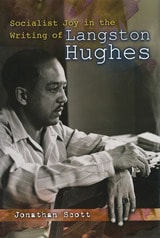
cover of Socialist Joy in the Writing of Langston Hughes

Socialist Joy in the Writing of Langston Hughes

Jonathan Scott

University of Missouri Press, 2007

One of the foremost African American writers of his generation, Langston Hughes waged a tireless campaign against racial oppression that defied the anticommunist currents of cold war America. Socialist Joy in the Writing of Langston Hughes examines his writing during this period to show that his approach to the main philosophical currents of the era was original, dynamic, and systematic in ways that most scholars have yet to appreciate.

Jonathan Scott has written the first book-length study to analyze the extraordinary range of Hughes’s creative output, showing that his unassailable reputation as one of America’s finest “folk poets” barely scratches the surface of his oeuvre. Scott offers a robust account of the relations between Hughes and political activism to show that Hughes’s direct involvement with the U.S. socialist movement of the 1920s and 1930s was largely responsible for the variety of his writing. Scott also contends that the goal of overthrowing white oppression produced a “socialist joy” that would express itself repeatedly in Hughes’s work during the anticommunist crusades of the 1950s and 1960s.

In his provocative study, Scott explores four areas of Hughes’s intellectual work: his relationship with Afro-Caribbean arts, Soviet Russia, and the Harlem Renaissance; his postwar newspaper writing for the African American press; his extensive cultural work as an anthologist; and his writings for young people. Through these analyses, Scott proposes the concept of “red, white, and black” as an alternative paradigm for appreciating Hughes in particular and the American scene in general. 

Scott views Hughes not simply as a great author but as an American working-class intellectual trickster whose eccentric projects require a redefinition of the very concept of authorship. By focusing on Hughes’s intellectual method, Scott also contests the notion of reducing all African Americans to one undifferentiated social status beneath that of any class within the white oppressing group—a hallmark of racial oppression that has diminished, in the U.S. academy, Hughes’s international status.

As Scott persuasively argues, it is only through an understanding of Hughes’s literary method that we can undertake a thorough account of his prolific production during the cold war era. His book situates Hughes’s life and work in their proper contexts, both reconfirming Hughes’s reputation as an intellectual of the American Left and establishing his long-denied place in American studies as the most well-rounded writer of his time.

[more]
cover of Society and Natural Resources: A Summary of Knowledge

Society and Natural Resources

A Summary of Knowledge

Michael J. Manfredo

University Press of Colorado, 2023

This book is a reprint of the original edited volume first published in 2004. In thirty-one chapters, the edited volume documents the exciting period of the emerging interdisciplinary field of society and natural resource scholarship from 1986 to 2004. It was published in part to commemorate the tenth International Symposium on Society and Resources Management (ISSRM) in Keystone, Colorado. ISSRM has brought together natural resource professionals, social science researchers, non-government agencies, private sector organizations, and students on a biennial basis since 1986. The book presents the most significant contributions to the symposia hosted by Pennsylvania State University, Colorado State University, University of Wisconsin-Madison, Texas A&M University, University of Illinois at Urbana-Champaign, Oregon State University, University of Missouri at Columbia, Western Washington University, and Indiana University. The first International ISSRM was held in Belize, Australia, and Italy and started a fruitful cross-continental exchange on society and natural resources showcased in this book.

Contributors: Jim Absher, Kathleen Andereck, Jill Belsky, John Bergstrom, Carter Betz, Alan Bright, Perry J. Brown, Tommy Brown, Mark Brunson, Rabel Burdge, Fred Buttel, KristinCheek, Chia-Kuen Cheng, Tony Cheng, David Cole, H Ken Cordell, Terry Daniel, Steven Daniels, Dan Decker, Robert Ditton, John Dwyer, Alan Ewert, Don Field, Myron Floyd, R Bruce Gill, Alan  Graefe, Gary Green, Doug Jackson-Smith, Rebecca Johnson, Richard Knopf, Rick Krannich, Jessica Leahy, Xinran You Lehto, John Loomas, Al Luloff, Mike Manfredo, Robert Manning, Sarah McCaffrey, Stephen McCool, Yoon-Jung Oh, Joseph O'Leary, Carol Saunders, Steve Selin, Bruce Shindler, George Stankey, Bill Stewart, Vicky Sturtevant, Jonathan Taylor, Suzanne Taylor, Tara Teel, Brijesh Thapa, Gene Theodori, Carla Koons Trentelman, Jerry Vaske, Joanne Vining, Doug Whittaker, Dan Williams

[more]
cover of Sociology and Its Publics: The Forms and Fates of Disciplinary Organization

Sociology and Its Publics

The Forms and Fates of Disciplinary Organization

Edited by Terence C. Halliday and Morris Janowitz

University of Chicago Press, 1992
Sociology faces troubling developments as it enters its second century in the United States. A loss of theoretical coherence and a sense of disciplinary fragmentation, a decline in the quality of its recruits, the cooptation of its clients, a muted public voice, and sinking prestige in governmental circles—these are only a few of the trends signalling a need for renewed debate about how sociology is organized. In this volume, some of the most authoritative voices in the field confront these conditions, offering a variety of perspectives as they challenge sociologists to self-examination.
[more]
cover of Sociology and the Race Problem: THE FAILURE OF A PERSPECTIVE

Sociology and the Race Problem

THE FAILURE OF A PERSPECTIVE

James B. McKee

University of Illinois Press, 1993

Tracing developments in the sociology of race relations from the 1920s to the 1960s, McKee maintains that sociologists assumed the United States would move unimpeded toward modernization and assimilation, aided by industrialization and urbanization. The fatal flaw in their perspective was the notion that blacks were culturally inferior, backward, and pre-modern, a people who had lost their own culture and couldn't grasp that of their new society. Designed to detail a failure the author says is widely acknowledged but little examined, this book will be of interest to both specialists and general readers.
"Masterful. . . . McKee transports the reader back to the intellectual world in which the early sociologists worked and does not simply treat them as evil racists. His approach is informed by the sociology of knowledge." -- Lewis M. Killian, author of The Impossible Revolution, Phase 2: Black Power and the American Dream

[more]
cover of Sociology in America: A History

Sociology in America

A History

Edited by Craig Calhoun

University of Chicago Press, 2007

Though the word “sociology” was coined in Europe, the field of sociology grew most dramatically in America. Despite that disproportionate influence, American sociology has never been the subject of an extended historical examination. To remedy that situation—and to celebrate the centennial of the American Sociological Association—Craig Calhoun assembled a team of leading sociologists to produce Sociology in America.

Rather than a story of great sociologists or departments, Sociology in America is a true history of an often disparate field—and a deeply considered look at the ways sociology developed intellectually and institutionally. It explores the growth of American sociology as it addressed changes and challenges throughout the twentieth century, covering topics ranging from the discipline’s intellectual roots to understandings (and misunderstandings) of race and gender to the impact of the Depression and the 1960s.

Sociology in America will stand as the definitive treatment of the contribution of twentieth-century American sociology and will be required reading for all sociologists.


Contributors:

Andrew Abbott, Daniel Breslau, Craig Calhoun, Charles Camic, Miguel A. Centeno, Patricia Hill Collins, Marjorie L. DeVault, Myra Marx Ferree, Neil Gross, Lorine A. Hughes, Michael D. Kennedy, Shamus Khan, Barbara Laslett, Patricia Lengermann, Doug McAdam, Shauna A. Morimoto, Aldon Morris, Gillian Niebrugge, Alton Phillips, James F. Short Jr., Alan Sica, James T. Sparrow, George Steinmetz, Stephen Turner, Jonathan VanAntwerpen, Immanuel Wallerstein, Pamela Barnhouse Walters, Howard Winant
[more]
cover of Sociology on Film: Postwar Hollywood's Prestige Commodity

Sociology on Film

Postwar Hollywood's Prestige Commodity

Cagle, Chris

Rutgers University Press, 2016

After World War II, Hollywood’s “social problem films”—tackling topical issues that included racism, crime, mental illness, and drug abuse—were hits with critics and general moviegoers alike. In an era of film famed for its reliance on pop psychology, these movies were a form of popular sociology, bringing the academic discipline’s concerns to a much broader audience. 
 
Sociology on Film examines how the postwar “problem film” translated contemporary policy debates and intellectual discussions into cinematic form in order to become one of the preeminent genres of prestige drama. Chris Cagle chronicles how these movies were often politically fractious, the work of progressive directors and screenwriters who drew scrutiny from the House Un-American Activities Committee. Yet he also proposes that the genre helped to construct an abstract discourse of “society” that served to unify a middlebrow American audience.  
 
As he considers the many forms of print media that served to inspire social problem films, including journalism, realist novels, and sociological texts, Cagle also explores their distinctive cinematic aesthetics. Through a close analysis of films like Gentleman’s Agreement, The Lost Weekend, and Intruder in the Dust, he presents a compelling case that the visual style of these films was intimately connected to their more expressly political and sociological aspirations. Sociology on Film demonstrates how the social problem picture both shaped and reflected the middle-class viewer’s national self-image, making a lasting impact on Hollywood’s aesthetic direction. 
 
[more]
cover of Soda Goes Pop: Pepsi-Cola Advertising and Popular Music

Soda Goes Pop

Pepsi-Cola Advertising and Popular Music

Joanna K. Love

University of Michigan Press, 2019

From its 1939 “Nickel, Nickel” jingle to pathbreaking collaborations with Michael Jackson and Madonna to its pair of X Factor commercials in 2011 and 2012, Pepsi-Cola has played a leading role in drawing the American pop music industry into a synergetic relationship with advertising. This idea has been copied successfully by countless other brands over the years, and such commercial collaboration is commonplace today—but how did we get here? How and why have pop music aesthetics been co-opted to benefit corporate branding? What effect have Pepsi’s music marketing practices in particular had on other brands, the advertising industry, and popular music itself?

Soda Goes Pop investigates these and other vital questions around the evolving relationships between popular music and corporate advertising. Joanna K. Love joins musical analysis, historical research, and cultural theory to trace parallel shifts in these industries over eight decades. In addition to scholarly and industry resources, she draws on first-hand accounts, pop culture magazines, trade press journals, and other archival materials. Pepsi’s longevity as an influential American brand, its legendary commercials, and its pioneering, relentless pursuit of alliances with American musical stars makes the brand a particularly instructive point of focus. Several of the company’s most famous ad campaigns are prime examples of the practice of redaction, whereby marketers select, censor, and restructure musical texts to fit commercial contexts in ways that revise their aesthetic meanings and serve corporate aims. Ultimately, Love demonstrates how Pepsi’s marketing has historically appropriated and altered images of pop icons and the meanings of hit songs, and how these commercials shaped relationships between the American music business, the advertising industry, and corporate brands.

Soda Goes Pop is a rich resource for scholars and students of American studies, popular culture, advertising, broadcast media, and musicology. It is also an accessible and informative book for the general reader, as Love’s musical and theoretical analyses are clearly presented for non-specialist audiences and readers with varying degrees of musical knowledge.

 
[more]
cover of Soda Science: Making the World Safe for Coca-Cola

Soda Science

Making the World Safe for Coca-Cola

Susan Greenhalgh

University of Chicago Press, 2024

Takes readers deep inside the secret world of corporate science, where powerful companies and allied academic scientists mold research to meet industry needs.
 
The 1990s were tough times for the soda industry. In the United States, obesity rates were exploding. Public health critics pointed to sugary soda as a main culprit and advocated for soda taxes that might decrease the consumption of sweetened beverages—and threaten the revenues of the giant soda companies.
 
Soda Science tells the story of how industry leader Coca-Cola mobilized allies in academia to create a soda-defense science that would protect profits by advocating exercise, not dietary restraint, as the priority solution to obesity, a view few experts accept. Anthropologist and science studies specialist Susan Greenhalgh discovers a hidden world of science-making—with distinctive organizations, social networks, knowledge-making practices, and ethical claims—dedicated to creating industry-friendly science and keeping it under wraps. By tracing the birth, maturation, death, and afterlife of the science they made, Greenhalgh shows how corporate science has managed to gain such a hold over our lives.
 
Spanning twenty years, her investigation takes her from the US, where the science was made, to China, a key market for sugary soda. In the US, soda science was a critical force in the making of today’s society of step-counting, fitness-tracking, weight-obsessed citizens. In China, this distorted science has left its mark not just on national obesity policies but on the apparatus for managing chronic disease generally. By following the scientists and their ambitious schemes to make the world safe for Coke, Greenhalgh offers an account that is more global—and yet more human—than the story that dominates public understanding today.
 
Coke’s research isn’t fake science, Greenhalgh argues; it was real science, conducted by real and eminent scientists, but distorted by its aim. Her gripping book raises crucial questions about conflicts of interest in scientific research, the funding behind familiar messages about health, and the cunning ways giant corporations come to shape our diets, lifestyles, and health to their own needs.
[more]
cover of Soft Canons: American Women Writers

Soft Canons

American Women Writers

Karen L. Kilcup

University of Iowa Press, 1999
Recognizing that masculine literary tradition can include marginalized male writers as well as canonized female writers and that traditions themselves change over time, the essays in this insightful and coherent collection also explore the investment of the writers, as well as ninetieth- and twentieth-century readers, in canon creation. As it reconstructs conversations between these earlier authors and initiates new dialogues for today’s readers, Soft Canons offers provocative reconceptualizations of American literary and cultural history.
[more]
cover of Soft Corruption: How Unethical Conduct Undermines Good Government and What To Do About It

Soft Corruption

How Unethical Conduct Undermines Good Government and What To Do About It

Schluter, William E

Rutgers University Press, 2017

[more]
cover of Soft Patriarchs, New Men: How Christianity Shapes Fathers and Husbands

Soft Patriarchs, New Men

How Christianity Shapes Fathers and Husbands

W. Bradford Wilcox

University of Chicago Press, 2004

In the wake of dramatic, recent changes in American family life, evangelical and mainline Protestant churches took markedly different positions on family change. This work explains why these two traditions responded so differently to family change and then goes on to explore how the stances of evangelical and mainline Protestant churches toward marriage and parenting influenced the husbands and fathers that fill their pews.

According to W. Bradford Wilcox, the divergent family ideologies of evangelical and mainline churches do not translate into large differences in family behavior between evangelical and mainline Protestant men who are married with children. Mainline Protestant men, he contends, are "new men" who take a more egalitarian approach to the division of household labor than their conservative peers and a more involved approach to parenting than men with no religious affiliation. Evangelical Protestant men, meanwhile, are "soft patriarchs"—not as authoritarian as some would expect, and given to being more emotional and dedicated to their wives and children than both their mainline and secular counterparts. Thus, Wilcox argues that religion domesticates men in ways that make them more responsive to the aspirations and needs of their immediate families.

[more]
cover of Softly, With Feeling: Joe Wilder and the Breaking of Barriers in American Music

Softly, With Feeling

Joe Wilder and the Breaking of Barriers in American Music

Edward Berger

Temple University Press, 2014

"Joe Wilder set the table. His struggles made it easier for me and many others."--From the Foreword by Wynton Marsalis


Trumpeter Joe Wilder is distinguished for his achievements in both the jazz and classical worlds. He was a founding member of the Symphony of the New World, where he played first trumpet, and he performed as lead trumpet and soloist with Lionel Hampton, Jimmy Lunceford, Dizzy Gillespie, and Count Basie.  Yet Wilder is also known as a pioneer who broke down racial barriers, the first African American to hold a principal chair in a Broadway show orchestra, and one of the first African Americans to join a network studio orchestra. 


In Softly, with Feeling, Edward Berger tells Wilder's remarkable story-from his growing up in working-class Philadelphia to becoming one of the first 1,000 black Marines during World War II-with tremendous feeling and extensive reminiscences by Wilder and his colleagues, including renowned Philadelphia-area musicians Jimmy Heath and Buddy DeFranco.  Berger also places Wilder's experiences within a broader context of American musical and social history.


Wilder's modesty and ability to perform in many musical genres may have prevented him from achieving popular recognition, but in Softly, with Feeling, his legacy and contributions to music and culture are assured. 



[more]
cover of Sojourner Truth's America

Sojourner Truth's America

Margaret Washington

University of Illinois Press, 2009
This fascinating biography tells the story of nineteenth-century America through the life of one of its most charismatic and influential characters: Sojourner Truth. In an in-depth account of this amazing activist, Margaret Washington unravels Sojourner Truth's world within the broader panorama of African American slavery and the nation's most significant reform era.
 
Born into bondage among the Hudson Valley Dutch in Ulster County, New York, Isabella was sold several times, married, and bore five children before fleeing in 1826 with her infant daughter one year before New York slavery was abolished. In 1829, she moved to New York City, where she worked as a domestic, preached, joined a religious commune, and then in 1843 had an epiphany. Changing her name to Sojourner Truth, she began traveling the country as a champion of the downtrodden and a spokeswoman for equality by promoting Christianity, abolitionism, and women's rights.
 
Gifted in verbal eloquence, wit, and biblical knowledge, Sojourner Truth possessed an earthy, imaginative, homespun personality that won her many friends and admirers and made her one of the most popular and quoted reformers of her times. Washington's biography of this remarkable figure considers many facets of Sojourner Truth's life to explain how she became one of the greatest activists in American history, including her African and Dutch religious heritage; her experiences of slavery within contexts of labor, domesticity, and patriarchy; and her profoundly personal sense of justice and intuitive integrity.
 
Organized chronologically into three distinct eras of Truth's life, Sojourner Truth's America examines the complex dynamics of her times, beginning with the transnational contours of her spirituality and early life as Isabella and her embroilments in legal controversy. Truth's awakening during nineteenth-century America's progressive surge then propelled her ascendancy as a rousing preacher and political orator despite her inability to read and write. Throughout the book, Washington explores Truth's passionate commitment to family and community, including her vision for a beloved community that extended beyond race, gender, and socioeconomic condition and embraced a common humanity. For Sojourner Truth, the significant model for such communalism was a primitive, prophetic Christianity.
 
Illustrated with dozens of images of Truth and her contemporaries, Sojourner Truth's America draws a delicate and compelling balance between Sojourner Truth's personal motivations and the influences of her historical context. Washington provides important insights into the turbulent cultural and political climate of the age while also separating the many myths from the facts concerning this legendary American figure.
[more]
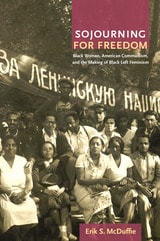
cover of Sojourning for Freedom: Black Women, American Communism, and the Making of Black Left Feminism

Sojourning for Freedom

Black Women, American Communism, and the Making of Black Left Feminism

Erik S. McDuffie

Duke University Press, 2011
Sojourning for Freedom portrays pioneering black women activists from the early twentieth century through the 1970s, focusing on their participation in the U.S. Communist Party (CPUSA) between 1919 and 1956. Erik S. McDuffie considers how women from diverse locales and backgrounds became radicalized, joined the CPUSA, and advocated a pathbreaking politics committed to black liberation, women’s rights, decolonization, economic justice, peace, and international solidarity. McDuffie explores the lives of black left feminists, including the bohemian world traveler Louise Thompson Patterson, who wrote about the “triple exploitation” of race, gender, and class; Esther Cooper Jackson, an Alabama-based civil rights activist who chronicled the experiences of black female domestic workers; and Claudia Jones, the Trinidad-born activist who emerged as one of the Communist Party’s leading theorists of black women’s exploitation. Drawing on more than forty oral histories collected from veteran black women radicals and their family members, McDuffie examines how these women negotiated race, gender, class, sexuality, and politics within the CPUSA. In Sojourning for Freedom, he depicts a community of radical black women activist intellectuals who helped to lay the foundation for a transnational modern black feminism.
[more]
cover of Sol Butler: An Olympian's Odyssey through Jim Crow America

Sol Butler

An Olympian's Odyssey through Jim Crow America

Brian Hallstoos

University of Illinois Press, 2026

A superstar in both football and track and field Sol Butler pioneered the parlaying of sports fame into business prosperity. Brian Hallstoos tells the story of a Black athlete’s canny use of mainstream middle-class values and relationships with white society to transcend the athletic, economic, and social barriers imposed by white supremacy. Butler built on his feats as a high school athlete to become a four-year starter for the football team at Dubuque German College (later the University of Dubuque), a record-setting sprinter and long jumper, and an Olympian at the 1920 Summer Games. Hallstoos follows Butler’s sporting accomplishments while charting how family and interracial communities influenced the ways Butler tested the limits of social and physical mobility and gave him an exceptional ability to discern where he might be most free. From there, Hallstoos turns to Butler’s use of fame to boost his entrepreneurial efforts and his multifaceted success capitalizing on his celebrity in the Black communities of Chicago, New York, and Los Angeles. An engaging look at a forgotten trailblazer, Sol Butler illuminates the multifaceted life of a Black sports entrepreneur.
[more]
cover of Solar Adobe: Energy, Ecology, and Earthen Architecture

Solar Adobe

Energy, Ecology, and Earthen Architecture

Albert Narath

University of Minnesota Press, 2024

How a centuries-old architectural tradition reemerged as a potential solution to the political and environmental crises of the 1970s

Against the backdrop of a global energy crisis, a widespread movement embracing the use of raw earth materials for building construction emerged in the 1970s. Solar Adobe examines this new wave of architectural experimentation taking place in the United States, detailing how an ancient tradition became a point of convergence for issues of environmentalism, architecture, technology, and Indigenous resistance. 


Utilized for centuries by the Pueblo people of the American Southwest and by Spanish colonialists, adobe construction found renewed interest as various groups contended with the troubled legacies of modern architecture and an increasingly urgent need for sustainable design practices. In this period of critical experimentation, design networks that included architects, historians, counterculture communities, government weapons labs, and Indigenous activists all looked to adobe as a means to address pressing environmental and political issues.


Albert Narath charts the unique capacities of adobe construction across a wide range of contexts, consistently troubling simple distinctions between traditional and modern technologies, high design and vernacular architecture. Drawing insightful parallels between architecture, environmentalism, and movements for Indigenous sovereignty, Solar Adobe stresses the importance of considering the history of the built environment in conjunction with architecture’s larger impact on the natural world.
[more]
cover of Sold Down the River: Slavery in the Lower Chattahoochee Valley of Alabama and Georgia

Sold Down the River

Slavery in the Lower Chattahoochee Valley of Alabama and Georgia

Anthony Gene Carey

University of Alabama Press, 2023

Examines a  small part of slavery’s North American domain, the lower Chattahoochee River Valley between Alabama and Georgia

In the New World, the buying and selling of slaves and of the commodities that they produced generated immense wealth, which reshaped existing societies and helped build new ones. From small beginnings, slavery in North America expanded until it furnished the foundation for two extraordinarily rich and powerful slave societies, the United States of America and then the Confederate States of America. The expansion and concentration of slavery into what became the Confederacy in 1861 was arguably the most momentous development after nationhood itself in the early history of the American republic.

This book examines a relatively small part of slavery’s North American domain, the lower Chattahoochee river Valley between Alabama and Georgia. Although geographically at the heart of Dixie, the valley was among the youngest parts of the Old South; only thirty-seven years separate the founding of Columbus, Georgia, and the collapse of the Confederacy. In those years, the area was overrun by a slave society characterized by astonishing demographic, territorial, and economic expansion. Valley counties of Georgia and Alabama became places where everything had its price, and where property rights in enslaved persons formed the basis of economic activity. Sold Down the River examines a microcosm of slavery as it was experienced in an archetypical southern locale through its effect on individual people, as much as can be determined from primary sources.

Published in cooperation with the Historic Chattahoochee Commission and the Troup County Historical Society.

 

[more]
cover of Sold Separately: Children and Parents in Consumer Culture

Sold Separately

Children and Parents in Consumer Culture

Seiter, Ellen

Rutgers University Press, 1993

"A radical approach to children's TV. . . . Seiter argues cogently that watching Saturday cartoons isn't a passive activity but a tool by which even the very young decode and learn about their culture, and develop creative imagination as well. Bolstered by social, political, developmental, and media research, Seiter ties middle-class aversion to children's TV and mass-market toys to an association with the 'uncontrollable consumerism'––and hence supposed moral failure––of working class members, women, and 'increasingly, children.' . . . Positive guidance for parents uncertain of the role of TV and TV toys in their children's lives."––Kirkus Reviews

"Sold Separately is about television and toys, and the various roles that they play in the lives of children and parents. In particular, Seiter examines toy advertising, both in print media and on television; TV commercials; toy-based video for girls, with an in-depth look at "My Little Pony"; action TV for boys, using "Slimer and the Real Ghostbusters" as her case study; and the stores where toys are sold, both Toys "R" Us and the more upscale shops . . . contains many provocative observations."––Women's Review of Books

"Ellen Seiter has a holiday message for yuppie parents who feel guilty shopping at Toys "R" Us. The mass-produced toys that dominate the chain's shelves need not be the enemy of every right-thinking parent. "Ghostbuster" figurines and "My Little Pony" can share the toy chest with those sensible wooden blocks."––Chronicle of Higher Education

"Emphasizing problems of socioeconomic class, gender, and race stereotyping, this study acknowledges the usual parental complaints about toys like Barbie and G.I. Joe, but insists that they do play an important role in children's culture, especially for working class families. A thought-provoking analysis."––Wilson Library Journal

"In this thought provoking study, Seiter reasonably urges parents and others to put aside their own tastes and to understand that children's consumer culture promotes solidarity and sociability among youngsters."––Publishers Weekly

"An important book for those desiring an overview of the toy industry's impact on consumer culture . . . [it] presents a fair and well-balanced view of the industry."––Kathleen M. Carson, associate editor, Playthings

"A refreshing, thoughtful, and insightful investigation of an enormously important subject––consumer culture for kids. . . . I can't recommend it highly enough."––Janice Radway, Duke University, author of Reading the Romance

[more]
cover of Soldados Razos at War: Chicano Politics, Identity, and Masculinity in the U.S. Military from World War II to Vietnam

Soldados Razos at War

Chicano Politics, Identity, and Masculinity in the U.S. Military from World War II to Vietnam

Steven Rosales

University of Arizona Press, 2017

What were the catalysts that motivated Mexican American youth to enlist or readily accept their draft notices in World War II, Korea, or Vietnam? In Soldados Razos at War, historian and veteran Steven Rosales chronicles the experiences of Chicano servicemen who fought for the United States, explaining why these men served, how they served, and the impact of their service on their identity and political consciousness.

As a social space imbued with its own martial and masculine ethos, the U.S. military offers an ideal way to study the aspirations and behaviors that carried over into the civilian lives of these young men. A tradition of martial citizenship forms the core of the book. Using rich oral histories and archival research, Rosales investigates the military’s transformative potential with a particular focus on socioeconomic mobility, masculinity, and postwar political activism across three generations.

The national collective effort characteristic of World War II and Korea differed sharply from the highly divisive nature of American involvement in Vietnam. Thus, for Mexican Americans, military service produced a wide range of ideological reactions, with the ideals of each often in opposition to the others. Yet a critical thread connecting these diverse outcomes was a redefined sense of self and a willingness to engage in individual and collective action to secure first-class citizenship.

[more]