Results by title
3703 books match the query '19th century' and 256 start with s
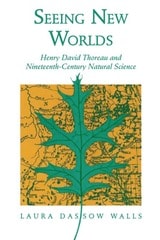
Seeing New Worlds
Henry David Thoreau and Nineteenth-Century Natural ScienceLaura Dassow Walls
University of Wisconsin Press, 1995
Thoreau was a poet, a naturalist, a major American writer. Was he also a scientist? He was, Laura Dassow Walls suggests. Her book, the first to consider Thoreau as a serious and committed scientist, will change the way we understand his accomplishment and the place of science in American culture.
Walls reveals that the scientific texts of Thoreau’s day deeply influenced his best work, from Walden to the Journal to the late natural history essays. Here we see how, just when literature and science were splitting into the “two cultures” we know now, Thoreau attempted to heal the growing rift. Walls shows how his commitment to Alexander von Humboldt’s scientific approach resulted in not only his “marriage” of poetry and science but also his distinctively patterned nature studies. In the first critical study of his “The Dispersion of Seeds” since its publication in 1993, she exposes evidence that Thoreau was using Darwinian modes of reasoning years before the appearance of Origin of Species.
This book offers a powerful argument against the critical tradition that opposes a dry, mechanistic science to a warm, “organic” Romanticism. Instead, Thoreau’s experience reveals the complex interaction between Romanticism and the dynamic, law-seeking science of its day. Drawing on recent work in the theory and philosophy of science as well as literary history and theory, Seeing New Worlds bridges today’s “two cultures” in hopes of stimulating a fuller consideration of representations of nature.
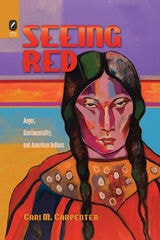
Seeing Red
Anger, Sentimentality, and American IndiansCari M. Carpenter
The Ohio State University Press, 2008
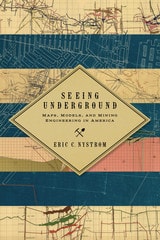
Seeing Underground
Maps, Models, and Mining Engineering in AmericaEric C. Nystrom
University of Nevada Press, 2014
Starting in the late nineteenth century, mining engineers developed a new set of practices, artifacts, and discourses to visualize complex, pitch-dark three-dimensional spaces. These maps and models became necessary tools in creating and controlling those spaces. They made mining more understandable, predictable, and profitable. Nystrom shows that this new visual culture was crucial to specific developments in American mining, such as implementing new safety regulations after the Avondale, Pennsylvania fire of 1869 killed 110 men and boys; understanding complex geology, as in the rich ores of Butte, Montana; and settling high-stakes litigation, such as the Tonopah, Nevada, Jim Butler v. West End lawsuit, which reached the US Supreme Court.
Nystrom demonstrates that these neglected artifacts of the nineteenth and early twentieth centuries have much to teach us today. The development of a visual culture helped create a new professional class of mining engineers and changed how mining was done. Seeing Undergound is the winner of the 2015 Mining History Association’s Clark Spence Award for the best book on mining history.
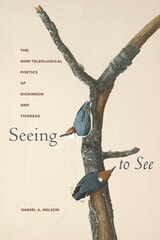
Seeing to See
The Non-Teleological Poetics of Dickinson and ThoreauDaniel A. Nelson
University of Massachusetts Press, 2025
Seeing to See focuses on two American authors who are notoriously hard to classify: Emily Dickinson and Henry David Thoreau. Dickinson proves challenging due to her short and obscure poems and Thoreau due to his insistence on capturing even the most seemingly mundane information. Daniel A. Nelson uncovers evidence that the works of these authors are often intentionally and painstakingly without aim or purpose. He argues that in their texts there is in fact an avoidance of teleological structures of writing and thinking, whereby a thing’s—or a word’s, or a text’s—value hinges on its relation to the world or other contexts.
In Nelson’s reading, Thoreau and Dickinson seem to be able to set aside all thought of distinct personal and professional goals, through which readers typically try to make an overarching sense out of, and to derive some form of profit from, disparate experiences, events, actions, and feelings. Further, both authors seem to be able to get outside of the worldview according to which the value and meaning of something, be it a natural object, a word, or an experience, is a function of its participation in a larger system. Examples of such systems include an ecosystem, taxonomic system, or syntactic system; a writer’s career, or life, or philosophy; even a single poem or journal entry. In the absence of such connections to broader categorical spheres, both writers force readers to contemplate the ineffable, constantly changing relation between words and the natural world. This contemporary reading of two iconic writers reframes their work and how readers think of nature, accepting, as these authors did, the potential freedom of the unknown.
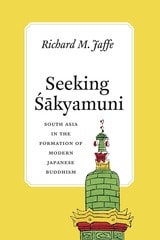
Seeking Sakyamuni
South Asia in the Formation of Modern Japanese BuddhismRichard M. Jaffe
University of Chicago Press, 2019

Seeking the One Great Remedy
Francis George Shaw and Nineteenth-Century ReformLorien Foote
Ohio University Press, 2003
A radical abolitionist and early feminist, Francis George Shaw (1809–1882) was a prominent figure in American reform and intellectual circles for five decades. He rejected capitalism in favor of a popular utopian socialist movement; during the Civil War and Reconstruction, he applied his radical principles to the Northern war effort and to freedmen’s organizations.
A partnership with Henry George in the late 1870s provided an international audience for Shaw’s alternative vision of society. Seeking the One Great Remedy is the biography of this remarkable and influential man. In compelling detail, author Lorien Foote depicts the many aspects and exploits of the Shaw family. Their activities provide a perspective on the course of American reform that calls into question previous interpretations of the reform movement of this period.
Francis George Shaw is perhaps best known as the father of Robert Gould Shaw, subject of the movie Glory. Francis and his wife, Sarah Blake Shaw, achieved considerable notoriety for their activities, including their effort to shape public opinion during the Civil War. Turning the tragic death of their son into a public relations and propaganda triumph, they altered Northern opinion about the war and shaped a historical perception of the famous Massachusetts Fifty-fourth that continues today.
Seeking the One Great Remedy argues that social radicalism was pervasive among elite reformers before and after the Civil War and finds in the dramatic story of Francis George Shaw a model of that cause.
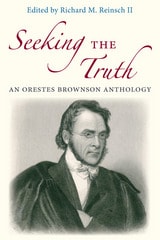
Seeking the Truth
Richard Reinsch II
Catholic University of America Press, 2016
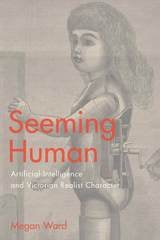
Seeming Human
Artificial Intelligence and Victorian Realist CharacterMegan Ward
The Ohio State University Press, 2018
In Seeming Human, Megan Ward contends that mid-twentieth-century versions of artificial intelligence (AI) offer a theory of verisimilitude omitted by traditional histories of character, which often focus on the development of interiority and the shift from “flat” to “round” characters in the Victorian era. Instead, by reading character through AI, Megan Ward’s Seeming Human argues that routinization, predictability, automation, and even flatness are all features of realist characters.
Early artificial intelligence movements such as cybernetics, information theory, and the Turing test define ways of seeming—rather than being—human. Using these theories of verisimilitude to read Victorian novelists such as Elizabeth Gaskell, Margaret Oliphant, Anthony Trollope, Thomas Hardy, and Henry James, Seeming Human argues that mechanicity has been perceived as anti-realist because it is the element that we least want to identify as human. Because AI produces human-like intelligence, it makes clear that we must actually turn to machines in order to understand what makes realist characters seem so human.
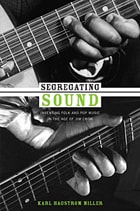
Segregating Sound
Inventing Folk and Pop Music in the Age of Jim CrowKarl Hagstrom Miller
Duke University Press, 2010
In a cultural history filled with musicians, listeners, scholars, and business people, Miller describes how folklore studies and the music industry helped to create a “musical color line,” a cultural parallel to the physical color line that came to define the Jim Crow South. Segregated sound emerged slowly through the interactions of southern and northern musicians, record companies that sought to penetrate new markets across the South and the globe, and academic folklorists who attempted to tap southern music for evidence about the history of human civilization. Contending that people’s musical worlds were defined less by who they were than by the music that they heard, Miller challenges assumptions about the relation of race, music, and the market.

Selected Letters of Charles Baudelaire
The Conquest of SolitudeCharles Baudelaire
University of Chicago Press, 1986
Writing to family, friends, and lovers, Baudelaire reveals the incidents and passions that went into his poetry. In letters to editors, idols, and peers—Hugo, Flaubert, Vigny, Wagner, Cladel, among others—he elucidates the methods and concerns of his own art and criticism and comments tellingly on the arts and politics of his day. In all, ranging from childhood to days shortly before his death, these letters comprise a complex and moving portrait of the quintessential poet and his time.

Selected Letters of Stéphane Mallarmé
Stéphane Mallarmé
University of Chicago Press, 1988

Selected Letters of Walt Whitman
Edwin Haviland Miller
University of Iowa Press, 1990
There has never been an edition of the selected letters of Walt Whitman, a remarkable fact considering how accustomed we are to becoming acquainted with major writers through their letters. Now Edwin Haviland Miller, editor of the six-volume collected writings of Whitman, has used his intimate knowledge of the "good gray poet's" correspondence to produce this revealing selection of 250 letters, introduced and annotated concisely and evocatively. Whitman in these letters is simple, direct, colloquial, adding a counterpoint to his artistic voice and persona as a poet.
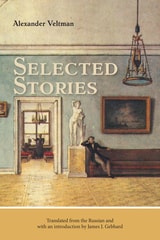
Selected Stories
A. F. Veltman
Northwestern University Press, 2026
In 1830s and ’40s Russia, A. F. Veltman’s eccentric writings were a fixture on the bookshelves of the reading public. In his era, his work influenced writers including Pushkin, Gogol, and Dostoevsky. The five stories collected here, united by themes of social satire, display Veltman’s characteristic pivots between the tragic, comic, and grotesque.
“Erotida” riffs on the genre of the society tale with linguistic puns and a bizarre plot resolution. In “Roland the Furious,” provincial officials mistake a traveler for a high-ranking government functionary. “Travel Impressions, and, among Other Things, a Pot of Geraniums” plays on the travelogue genre and includes what may be the first description in Russian literature of journey by railroad. “A Traveler from the Provinces; or, A Commotion in the Capital” parodies the Moscow literary salons of Veltman’s day. Finally, “It’s Not a House, but a Plaything!” toys with yet another storytelling convention of the time—the Russian folkloric tradition of “house spirits.”

Senator Thomas J. Walsh of Montana
Law and Public Affairs, from TR to FDRJ. Leonard Bates
University of Illinois Press, 1999
Walsh fought throughout his long career against corruption and monopoly power. During his early years as a lawyer-politician in Helena, he was often in conflict with the "Copper Kings" and other powerful figures. As a senator, he became an internationalist, working throughout the 1920s for naval disarmament, the World Court, the St. Lawrence Seaway, and the Kellogg-Briand Pact for the "outlawry" of war.
In his most celebrated coup, breaking open the Teapot Dome scandal of 1923-24, Walsh revealed that the secretary of the interior had accepted "loans" from oil men in return for leases of U.S. naval oil reserves. Working through the Public Lands Committee of the Senate, Walsh enjoyed support for his investigation from members of both parties, and the Supreme Court endorsed his interpretation of the scandal in 1927. Shortly before his death, he presided over the Democratic National Convention that nominated Franklin Roosevelt and served for a brief time as a key figure in the new leader's circle.
Drawing on archival sources of unprecedented depth, including personal letters between Walsh and his first wife, Elinor McClements Walsh, Bates's expansive study paints a richly detailed portrait of an influential and principled figure whose political career spanned world war, depression, and the administrations of six presidents.

Sensing Chicago
Noisemakers, Strikebreakers, and MuckrakersAdam Mack
University of Illinois Press, 2015
In Sensing Chicago, Adam Mack lets fresh air into the sensory history of Chicago in the nineteenth and early twentieth centuries by examining five case studies: the Chicago River, the Great Fire, the 1894 Pullman Strike, the publication of Upton Sinclair's The Jungle, and the rise and fall of the White City amusement park. His vivid recounting of the smells, sounds, and tactile miseries of city life reveals how input from the five human senses influenced the history of class, race, and ethnicity in the city. At the same time, he transports readers to an era before modern refrigeration and sanitation, when to step outside was to be overwhelmed by the odor and roar of a great city in progress.

Sensory Experiments
Psychophysics, Race, and the Aesthetics of FeelingErica Fretwell
Duke University Press, 2020
Sentimental Collaborations
Mourning and Middle-Class Identity in Nineteenth-Century AmericaMary Louise Kete
Duke University Press, 2000
Many scholars have written about the sentimental novel as a primarily female genre and have stressed its negative ideological aspects. Kete finds that in fact many men—from writers to politicians—participated in nineteenth-century sentimental culture. Importantly, she also recovers the utopian dimension of the phenomenon, arguing that literary sentimentality, specifically in the form of poetry, is the written trace of a broad cultural discourse that Kete calls “sentimental collaboration”—an exchange of sympathy in the form of gifts that establishes common cultural or intellectual ground. Kete reads the work of Ralph Waldo Emerson, Henry Wadsworth Longfellow, Mark Twain, Harriet Beecher Stowe, and Lydia Huntley Sigourney with an eye toward the deployment of sentimentality for the creation of Americanism, as well as for political and abolitionist ends. Finally, she locates the origins of sentimental collaboration in the activities of ordinary people who participated in mourning rituals—writing poetry, condolence letters, or epitaphs—to ease their personal grief.
Sentimental Collaborations significantly advances prevailing scholarship on Romanticism, antebellum culture, and the formation of the American middle class. It will be of interest to scholars of American studies, American literature, cultural studies, and women’s studies.
Sentimental Materialism
Gender, Commodity Culture, and Nineteenth-Century American LiteratureLori Merish
Duke University Press, 2000
The phenomenon of female consumption was capitalism’s complement to male production: It created what Merish calls the “Other Protestant Ethic,”a feminine and sentimental counterpart to Max Weber’s ethic of hard work, economic rationality, and self-control. In addition, driven by the culture’s effort to civilize the “cannibalistic” practices of ethnic, class, and national otherness, appropriate female consumerism, marked by taste and refinement, identified certain women and their families as proper citizens of the United States. The public nature of consumption, however, had curiously conflicting effects: While the achievement of cultured material circumstances facilitated women’s civic agency, it also reinforced stereotypes of domestic womanhood.
Sentimental Materialism’s inquiry into middle-class consumption and accompanying ideals of womanhood will appeal to readers in a variety of disciplines, including American studies, cultural studies, feminist theory, and cultural history.

Separate Spheres No More
Gender Convergence in American Literature, 1830-1930Monika Elbert
University of Alabama Press, 2000
Examines the intersection of male and female spheres in American literature
Although they wrote in the same historical milieu as their male counterparts, women writers of the 19th- and early 20th-centuries have generally been "ghettoized" by critics into a separate canonical sphere. These original essays argue in favor of reconciling male and female writers, both historically and in the context of classroom teaching.
While some of the essays pair up female and male authors who write in a similar style or with similar concerns, others address social issues shared by both men and women, including class tensions, economic problems, and the Civil War experience. Rather than privileging particular genres or certain well-known writers, the contributors examine writings ranging from novels and poetry to autobiography, utopian fiction, and essays. And they consider familiar figures like Harriet Beecher Stowe, Emily Dickinson, and Ralph Waldo Emerson alongside such lesser-known writers as Melusina Fay Peirce, Susie King Taylor, and Mary Gove Nichols.
Each essay revises the binary notions that have been ascribed to males and females, such as public and private, rational and intuitive, political and domestic, violent and passive. Although they do not deny the existence of separate spheres, the contributors show the boundary between them to be much more blurred than has been assumed until now.
Settlement Folk
Social Thought and the American Settlement Movement, 1885-1930Mina Carson
University of Chicago Press, 1990
These extraordinary individuals left an enduring legacy of beliefs about professional and voluntary responsibility for welfare services. As Carson shows, however, their genius for image creation and their myriad connections with other intellectual and social leaders extended the influence of the settlement ideology in many directions: fostering new attitudes toward the American city and the equality of the sexes, initiating a new social-scientific approach to social problems, and shaping the self-definition of the American educated middle class.
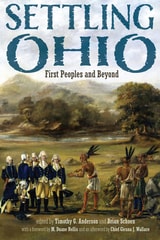
Settling Ohio
First Peoples and BeyondTimothy G. Anderson and Brian Schoen
Ohio University Press, 2023

Seven Gothic Dramas, 1789–1825
1789-1825Jeffrey N. Cox
Ohio University Press, 1994
The Gothic drama came at a critical moment in the history of the theater, of British culture, and of European politics in the shadow of France’s revolution and the fall of Napoleon. It offered playwrights a medium to express the prevailing ideological tensions of romanticism and revolution, and also responded to a growing and changing theater audience.
In a wide-ranging introduction, Cox explores Gothic drama’s links with romanticism and its relation to other social and ideological shifts of the day. The texts are presented so as to reflect the dual life of dramatic works—on the stage and on the page. The plays are annotated and accompanied by biographic and bibliographic sketches.
Includes The Kentish Barons, by Francis North; Julia of Louvain; or, Monkish Cruelty, by J.C. Cross; The Castle Spectre, by Matthew G. Lewis; The Captive, by Matthew G. Lewis; De Monfort, by Joanna Baillie; Bertram; or, The Castle of St. Aldobrand, by C.R. Maturin; and Presumption; or, The Fate of Frankenstein, by R.B. Peake.

Seven Stories of Threatening Speech
Women's Suffrage Meets Machine CodeRuth A. Miller
University of Michigan Press, 2012
This book thus represents a radical methodological initiative not just for scholars of history and language but for specialists in law, political theory, political science, gender studies, semiotics, and science and technology studies. It takes posthumanist scholarship to an exciting and essential, if sometimes troubling, conclusion.
“It is an erudite work by a scholar of enormous talent, who advances a thesis that is richly insightful and deeply provocative.”—Mary Hawkesworth, Rutgers University
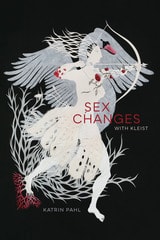
Sex Changes with Kleist
Katrin Pahl
Northwestern University Press, 2019
Focusing on the theatricality of Kleist’s interventions in the performance of gender, sexuality, and emotion and examining how his dramatic texts unhinge major tenets of classical European theater, Sex Changes with Kleist is vital reading for anyone interested in queer studies, feminist studies, performance studies, literary studies, or emotion studies. This book changes our understanding of Kleist and breathes new life into queer thought.

Sex Radicals and the Quest for Women's Equality
Joanne E. Passet
University of Illinois Press, 2003
In charting the growth of the sex radical movement, Joanne E. Passet draws on a host of documents from the period -- letters, periodicals, lectures, and pamphlets -- to establish a strong link between the rise of print culture and the freedom of citizens, especially women, to build geographically dispersed communities of ideas. She also advances models of sexuality that challenge the restrictive mores of society at large and shows that the majority of correspondents who participated in the sex radical movement resided in the Midwest and the Great Plains states, where ideas of individual freedom and sovereignty resonated particularly strongly.
Passet vividly demonstrates how this sex radical movement laid the foundations upon which later generations of women’s rights crusaders and feminists would build, placing discussions of sex and sexuality squarely in the public arena.
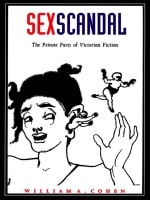
Sex Scandal
The Private Parts of Victorian FictionWilliam A. Cohen
Duke University Press, 1996
Scandal, then as now, makes public the secret indiscretions of prominent people, engrossing its audience in salacious details that violate the very code of propriety it aims to enforce. In narratives ranging from Great Expectations to the Boulton and Park sodomy scandal of 1870–71, from Eliot’s and Trollope’s novels about scandalous women to Oscar Wilde’s writing and his trials for homosexuality, Cohen shows how, in each instance, sexuality appears couched in coded terms. He identifies an assortment of cunning narrative techniques used to insinuate sex into Victorian writing, demonstrating that even as such narratives air the scandalous subject, they emphasize its unspeakable nature.
Written with an eye toward the sex scandals that still whet the appetites of consumers of news and novels, this work is suggestive about our own modes of imagining sexuality today and how we arrived at them. Sex Scandal will appeal to scholars and general readers interested in Victorian literature, the history of sexuality, gender studies, nineteenth-century Britain, and gay, lesbian, and queer studies.

Sex Trafficking, Scandal, and the Transformation of Journalism, 1885-1917
Gretchen Soderlund
University of Chicago Press, 2013
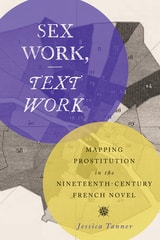
Sex Work, Text Work
Mapping Prostitution in the Nineteenth-Century French NovelJessica Tanner
Northwestern University Press, 2027
While prostitutes in nineteenth-century Paris were subject to municipal laws that policed their bodies and movements, writers of the era enlisted them to stake their own claims on both the city and the novel as literary territory. Sex Work, Text Work: Mapping Prostitution in the Nineteenth-Century French Novel explores how prostitutes depicted by Émile Zola, Joris-Karl Huysmans, Edmond de Goncourt, Adolphe Tabarant, and Charles-Louis Philippe “write back,” confounding civil and literary efforts to contain them in space and in narrative.
In city-regulated brothels, brasseries à femmes, Haussmannian boulevards, and the novel itself, working-class prostitutes served to reinforce the boundaries of social inclusion and exclusion. And yet, Jessica Tanner contends, even the novels that most explicitly aligned with the disciplinary logic of regulated prostitution make space for a distinctly literary form of resistance: these women elude or disrupt the mapping that would claim them as literary territory, revealing their authors’ failure to secure their narratives as property. Tanner pushes back against the critical tendency to attribute agency only to courtesans who became published authors and forwards a new framework for understanding the political work novels engage in as they circulate. Observing that debates about the regulation of prostitution surfaced in tandem with racialized anxieties about the boundaries of the French nation, Tanner ultimately expands that framework to the history of French colonialism and the politics of immigration in the current day. This book shows that while sex workers have been recruited to mark the borders of civic and moral life, prostitution can also make space for more inclusive forms of community, both in the novel and in the world beyond its bounds.

Sex and Death on the Western Emigrant Trail
The Biology of Three American TragediesDonald K. Grayson
University of Utah Press, 2018
The plights of these emigrant groups have been addressed by different historians in different ways; this book is the first to examine the tragedies in terms of biology. Grayson shows that who lived or died can largely be explained by age, sex, and family ties. His investigation reveals what happens when our cultural mechanisms for dealing with famine and extreme cold are reduced to only what our bodies can provide within structured social contexts. His results are surprising and not always intuitive as he investigates who survived in these life threatening situations.
Sex, Celibacy, and Deviance
The Victorians and the Song of SongsDuc Dau
The Ohio State University Press, 2024
Sex, Celibacy, and Deviance is the first major study to explore the Song of Songs (or Song of Solomon) in Victorian literature and art. As the Bible’s only erotic poem, the Song of Songs is the canonical Judeo-Christian book about love, furnishing the Victorians with an authoritative and literary language for love, marriage, sex, mourning, and religious celibacy.
Duc Dau adopts a queer and feminist lens to consider how Victorians employed and interpreted the Song of Songs in their work. How did writers and artists fashion and, most importantly, challenge the norms of gender, romantic love, and marriage? Spanning the early Victorian era through the first two decades of the twentieth century, Sex, Celibacy, and Deviance considers the works of Charlotte Brontë, Thomas Hardy, Christina Rossetti, John Gray, Michael Field, Edward Burne-Jones, and Simeon Solomon alongside two lesser-known figures: Irish-born Scottish artist Phoebe Anna Traquair and the Catholic religious leader Augusta Theodosia Drane. By addressing the relevance of the Song of Songs in light of shifting and conflicting religious and social contexts, Dau provides a fresh perspective on Victorian literature, religion, and culture.
Sex, Sickness, and Slavery
Illness in the Antebellum SouthMarli F. Weiner with Mazie Hough
University of Illinois Press, 2014
Sex, Skulls, and Citizens
Gender and Racial Science in Argentina (1860-1910)Ashley Elizabeth Kerr
Vanderbilt University Press, 2020
PROSE Awards Subject Category Finalist—Biological Anthropology, Ancient History, and Archaeology, 2021
Best Nineteenth-Century Book Award, Latin American Studies Association Nineteenth-Century Section, 2021
Analyzing a wide variety of late-nineteenth-century sources, Sex, Skulls, and Citizens argues that Argentine scientific projects of the era were not just racial encounters, but were also conditioned by sexual relationships in all their messy, physical reality.
The writers studied here (an eclectic group of scientists, anthropologists, and novelists, including Estanislao Zeballos, Lucio and Eduarda Mansilla, Ramón Lista, and Florence Dixie) reflect on Indigenous sexual practices, analyze the advisability and effects of interracial sex, and use the language of desire to narrate encounters with Indigenous peoples as they try to scientifically pinpoint Argentina's racial identity and future potential.
Kerr's reach extends into history of science, literary studies, and history of anthropology, illuminating a scholarly time and place in which the lines betwixt were much blurrier, if they existed at all.
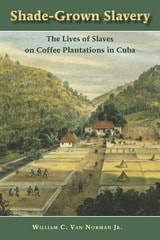
Shade-Grown Slavery
The Lives of Slaves on Coffee Plantations in CubaWilliam C. Van Norman
Vanderbilt University Press, 2013
In this broad, interdisciplinary study, William Van Norman describes how each type of plantation and the amount of manual labor it required directly influenced the nature of slave life in that community. Slaves on coffee plantations lived in a unique context in comparison to that of their fellow slaves on sugar plantations, one that gave them greater flexibility in cultural and artistic creativity. To gain a deeper understanding of plantation slavery in Cuba, Van Norman explores what life and labor was like for coffee slaves and how it was different from what sugar slaves experienced. Shade-Grown Slavery reconstructs their world and in turn deconstructs the picture we now have of Cuba in the late eighteenth and early nineteenth centuries.
Ultimately, Shade-Grown Slavery reveals the lives of enslaved Africans on Cuban coffee plantations and shows how they were able to maintain and transform their cultural traditions in spite of slavery.
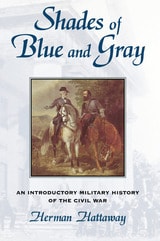
Shades of Blue and Gray
An Introductory Military History of the Civil WarHerman Hattaway
University of Missouri Press, 1997
An introductory military history of the American Civil War, Shades of Blue and Gray places the 1861-1865 conflict within the broad context of evolving warfare. Emphasizing technology and its significant impact, Hattaway includes valuable material on land and sea mines, minesweepers, hand grenades, automatic weapons, the Confederate submarine, and balloons. The evolution of professionalism in the American military serves as an important connective theme throughout. Hattaway extrapolates from recent works by revisionists William Skelton and Roy Roberts to illustrate convincingly that the development of military professionalism is not entirely a post-Civil War phenomenon.
The author also incorporates into his work important new findings of recent scholars such as Albert Castel (on the Atlanta Campaign), Reid Mitchell (on soldiers' motivation), Mark Grimsley (on "hard war"), Brooks D. Simpson (on Ulysses S. Grant), and Lauren Cook Burgess (on women who served as soldiers, disguised as men). In addition, Hattaway comments on some of the best fiction and nonfiction available in his recommended reading lists, which will both enlighten and motivate readers.
Informative and clearly written, enhanced by graceful prose and colorful anecdotes, Shades of Blue and Gray will appeal to all general readers.
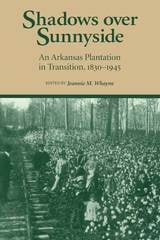
Shadows Over Sunnyside
An Arkansas Plantation in Transition, 1830-1945Jeannie M. Whayne
University of Arkansas Press, 1993
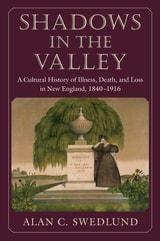
Shadows in the Valley
A Cultural History of Illness, Death, and Loss in New England, 1840-1916Alan Swedlund
University of Massachusetts Press, 2010
How does the experience of sickness, death, and loss change over time? We know that the incidence and virulence of particular diseases have varied from one period to another, as has their medical treatment. But what was it like for the individuals who suffered and died from those illnesses, for the health practitioners and institutions that attended to them, and for the families who buried and mourned them?
In Shadows in the Valley, Alan Swedlund addresses these questions by closely examining the history of mortality in several small communities in western Massachusetts from the mid-nineteenth to the early twentieth century—from just before the acceptance of the germ theory of disease through the early days of public health reform in the United States. This was a time when most Americans lived in rural areas or small towns rather than large cities. It was also a time when a wide range of healing practices was available to the American public, and when the modern form of Western medicine was striving for dominance and authority. As Swedlund shows, this juncture of competing practices and ideologies provides a rich opportunity for exploring the rise of modern medicine and its impact on the everyday lives of ordinary Americans.
To indicate how individuals in different stages of their lives were exposed to varying assaults on their health, the book is structured in a way that superimposes what the author calls “life-course time” onto chronological time. Thus the early chapters look at issues of infancy and childhood in the 1840s and 1850s and the last chapters at the problems of old age after 1900. The reader becomes familiar with specific individuals and families as they cope with the recurrent loss of children, struggle to understand the causes of new contagions, and seek to find meaning in untimely death. By using a broad time frame and a narrow geographical lens, Swedlund is able to engage with both the particularities and generalities of evolving medical knowledge and changing practice, and to highlight the differences in personal as well as collective responses to illness and loss.
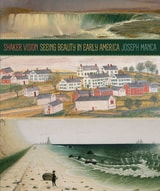
Shaker Vision
Seeing Beauty in Early AmericaJoseph Manca
University of Massachusetts Press, 2019
In Shaker Vision, Joseph Manca explores original texts, especially diaries and travel journals, and material culture to demonstrate that Shakers enjoyed a remarkably deep experience of the visual world. Shakers shared tastes with mainstream Americans and often employed a similar aesthetic vocabulary, but all within a belief system that made them distinct. In addition to their well-known ascetic architecture, furniture, and handicraft styles, they expressed themselves through ornate and detailed spiritual art and in vivid, visionary experiences. Based on firsthand accounts of the believers themselves, this richly illustrated volume will dramatically change how we assess the visual world of this uniquely American religious sect.
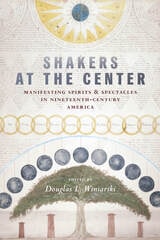
Shakers at the Center
Manifesting Spirits & Spectacles in Nineteenth-Century AmericaEdited by Douglas L. Winiarski
University of Massachusetts Press, 2026
Exploring the theological, social, and cultural dimensions of one of America’s most ambitious prophetic movements
The Shakers’ Era of Manifestations ranks among the most astounding events in American religious history. During the 1840s, members of the United Society of Believers in Christ’s Second Appearing embarked on an audacious project of receiving visions, revelations, and other manifestations from the spirit world and convincing both themselves and the world’s people of their reality. Gifted Shakers known as “instruments” surrendered their bodies to possessing spirits and celestial beings who, in turn, provided the Believers with an unimaginable number of revelatory communications that collapsed time and space, rewrote the Bible, and vastly expanded traditional Protestant beliefs and practices. The fruits of Shaker spiritualism would gain a permanent place in America’s public consciousness.
Hundreds of volumes and thousands of pages of inspired writings, music, and art from the New Era or period of Mother's Work, as the Shakers called it, crowd the shelves of a half dozen major research libraries. The archive is so vast, so extraordinary, so seemingly bizarre that few scholars have dared tackle it in its totality. The authors of this volume, specialists in nineteenth-century American religious studies, have collaborated to produce an extensive analysis of Mother Ann’s Work. They examine a fascinating range of topics: speaking with the dead; the spectacle of Shaker rituals; race, gender, and family life; and the material culture of physical and spiritual things; as well as manuscripts, books, songs, objects, and art produced during the New Era.
Shakers at the Center brings the sprawling elements of the Era of Manifestations together in a single volume. Written for students, scholars, and general readers alike, it will stand for years as the definitive history of the Shakers’ most fascinating and vexing historical period.
Contributors include the volume editor as well as Emily Suzanne Clark, Brett Malcolm Grainger, Sonia Hazard, Dana Logan, Carol Medlicott, Sally M. Promey, Erik R. Seeman, Ryan K. Smith, and David Walker.

Shall Not Be Denied
Women Fight for the VoteLibrary of Library of Congress
Rutgers University Press, 2019
Official Companion to the Library of Congress Exhibition.
The campaign for women’s suffrage—considered the largest reform movement in American history—lasted more than seven decades. The struggle was not for the fainthearted. For years, determined women organized, lobbied, paraded, petitioned, lectured, picketed, and faced imprisonment in pursuit of the right to vote. Drawing from the Library’s extensive collections of photographs, personal papers, and the organizational records of such figures as Susan B. Anthony, Elizabeth Cady Stanton, Mary Church Terrell, Carrie Chapman Catt, the National Woman’s Party, and the National American Woman Suffrage Association, Shall Not Be Denied traces the movement leading to the women’s rights convention at Seneca Falls, the contributions of suffragists who worked to persuade women that they deserved the same rights as men, the divergent political strategies and internal divisions they overcame, the push for a federal women’s suffrage amendment, and the legacy of the movement.
A companion to the exhibition staged by the Library of Congress, which opened on June 4, 2019—the 100th anniversary of the US Senate’s passage of the suffrage amendment that would become the 19th amendment—Shall Not Be Denied: Women Fight for the Vote is part of the national commemoration of the 100th anniversary of women’s suffrage.
Published by Rutgers University Press in association with the Library of Congress.

Shame and Endurance
The Untold Story of the Chiricahua Apache Prisoners of WarH. Henrietta Stockel
University of Arizona Press, 2004
First removed from Arizona to Florida, the prisoners were eventually relocated to Mount Vernon Barracks in Alabama, where, in the words of one Apache, "We didn’t know what misery was until they dumped us in those swamps." Pulmonary disease took its toll—by 1894, disease had killed nearly half of the Apaches—and after years of pressure from Indian rights activists and bureaucratic haggling, Fort Sill in Oklahoma was chosen as a more healthful location. Here they were given the opportunity to farm, and here Geronimo, who eventually converted to Christianity, died of pneumonia in 1909 at the age of 89, still a prisoner of war. In the meantime, many Apache children had been removed to Carlisle, Pennsylvania, for education—despite earlier promises that families would not be split up—and most eventually lost their cultural identity.
Henrietta Stockel has combed public records to reconstruct this story of American shame and Native endurance. Unabashedly speaking on behalf of the Apaches, she has framed these documents within a readable narrative to show how exasperated public officials, eager to openly demonstrate their superiority over "savages" who had successfully challenged the American military for years, had little sympathy for the consequences of their confinement. Although the Chiricahua Apaches were not alone in losing their ancestral homelands, they were the only American Indians imprisoned for so long a time in an environment that continually exposed them to illnesses against which they had no immunity, devastating families even more than warfare. Shame and Endurance records events that ought never to be repeated—and tells a story that should never be forgotten.
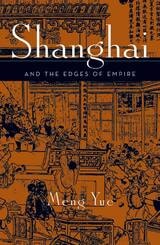
Shanghai and the Edges of Empires
Meng Yue
University of Minnesota Press, 2006
Calling into question conventional ways of conceptualizing modernity, colonialism, and intercultural relations, Meng Yue examines such cultural practices as the work of the commercial press, street theater, and literary arts, and shows that what appear to be minor cultural changes often signal the presence of larger political and economic developments. Engaging theories of modernity and postcolonial and global cultural studies, Meng Yue reveals the paradoxical interdependence between imperial and imperialist histories and the retranslation of culture that characterized the most notable result of China’s urban relocation—the emergence of the international city of Shanghai.
Meng Yue is assistant professor of East Asian languages and literature at the University of California, Irvine.
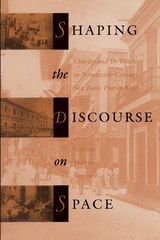
Shaping the Discourse on Space
Charity and Its Wards in Nineteenth-Century San Juan, Puerto RicoBy Teresita Martínez-Vergne
University of Texas Press, 1999
As an inchoate middle class emerged in Puerto Rico in the early nineteenth century, its members sought to control not only public space, but also the people, activities, and even attitudes that filled it. Their instruments were the San Juan town council and the Casa de Beneficencia, a state-run charitable establishment charged with responsibility for the poor.
In this book, Teresita Martínez-Vergne explores how municipal officials and the Casa de Beneficencia shaped the discourse on public and private space and thereby marginalized the worthy poor and vagrants, "liberated" Africans, indigent and unruly women, and destitute children. Drawing on extensive and innovative archival research, she shows that the men who comprised the San Juan ayuntamiento and the board of charity regulated the public discourse on topics such as education, religious orthodoxy, hygiene, and family life, thereby establishing norms for "correct" social behavior and chastising the "deviant" lifestyles of the working poor.
This research clarifies the ways in which San Juan's middle class defined itself in the midst of rapid social and economic change. It also offers new insights into notions of citizenship and the process of nation-building in the Caribbean.

Shared Secrets
The Queer World of Newbery Medalist Charles J. FingerElizabeth Findley Shores
University of Arkansas Press, 2021
Winner, 2023 Booker Worthern Literary Prize
For nearly a century, British expatriate Charles Joseph Finger (1867–1941) was best known as an award-winning author of children’s literature. In Shared Secrets, Elizabeth Findley Shores relates Finger’s untold story, exploring the secrets that connected the author to an international community of twentieth-century queer literati.
As a young man, Finger reveled in the easy homosociality of his London polytechnical school, where he launched a student literary society in the mold of the city’s private men’s clubs. Throughout his life, as he wandered from England to Patagonia to the United States, he tried to recreate similarly open spaces—such as Gayeta, his would-be art colony in Arkansas. But it was through his idiosyncratic magazine All’s Well that he constructed his most successful social network, writing articles filled with coded signals and winking asides for an inner circle of understanding readers.
Capitalizing on the publishing opportunities of the day, Finger used every means available to express his twin loves—literature and men. He produced an enormous body of work, and his short, semiautobiographical fiction won some critical acclaim. Ultimately, the children’s book that won Finger a Newbery Medal ushered him into the public eye, ending his development as an author of serious queer literature.
Shared Secrets is both the story of Finger’s remarkable, adventurous life and a rare look at a community of gay writers and artists who helped shaped twentieth-century American culture, even as they artfully concealed their own identities.
Shared Traditions
SOUTHERN HISTORY AND FOLK CULTURECharles Joyner
University of Illinois Press, 1999
By examining the mutual influence of history and folk culture, Shared Traditions reveals the essence of southern culture in the complex and dynamic interactions of descendants of Europeans, Africans, and Native Americans. The book covers a broad spectrum of southern folk groups, folklore expressions, and major themes of southern history, including antebellum society, slavery, the coming of the Civil War, economic modernization in the Appalachians and the Sea Islands, immigration, the civil rights movement, and the effects of cultural tourism.
Joyner addresses the convergence of African and European elements in the Old South and explores how specific environmental and demographic features shaped the acculturation process. He discusses divergent practices in worship services, funeral and burial services, and other religious ceremonies. He examines links between speech patterns and cultural patterns, the influence of Irish folk culture in the American South, and the southern Jewish experience. He also investigates points of intersection between history and legend and relations between the new social history and folklore.
Ranging from rites of power and resistance on the slave plantation to the creolization of language to the musical brew of blues, country, jazz, and rock, Shared Traditions reveals the distinctive culture born of a sharing by black and white southerners of their deep-rooted and diverse traditions.

Shareholder Democracies?
Corporate Governance in Britain and Ireland before 1850Mark Freeman, Robin Pearson, and James Taylor
University of Chicago Press, 2011
Understanding the challenges of corporate governance is central to our comprehension of the economic dynamics driving corporations today. Among the most important institutions in capitalism today, corporations and joint-stock companies had their origins in Europe during the seventeenth and eighteenth centuries. And as they became more prevalent, the issue of internal governance became more pressing. At stake—and very much contested—was the allocation of rights and obligations among shareholders, directors, and managers.
This comprehensive account of the development of corporate governance in Britain and Ireland during its earliest stages highlights the role of political factors in shaping the evolution of corporate governance as well as the important debates that arose about the division of authority and responsibility. Political and economic institutions confronted similar issues, including the need for transparency and accountability in decision making and the roles of electors and the elected, and this book emphasizes how political institutions—from election procedures to assemblies to annual reporting—therefore provided apt models upon which companies drew readily. Filling a gap in the literature on early corporate economy, this book provides insight into the origins of many ongoing modern debates.
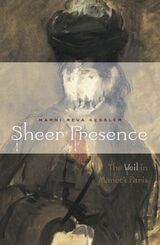
Sheer Presence
The Veil in Manet’s ParisMarni Reva Kessler
University of Minnesota Press, 2006
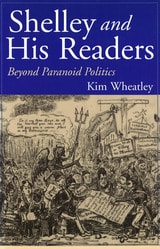
Shelley and His Readers
Beyond Paranoid PoliticsKim Wheatley
University of Missouri Press, 1999
In Shelley and His Readers, the first full-length critical analysis of the dialogue between Shelley's poetry and its contemporary reviewers, Kim Wheatley argues that Shelley's idealism can be recovered through the study of his poetry's reception. Incorporating extensive research in major early-nineteenth-century British periodicals, Wheatley integrates a reception-based methodology with careful textual analysis to demonstrate that the early reception of Shelley's work registers the immediate impact of the poet's increasingly idealistic passion for reforming the world.
Wheatley examines Shelley's poetry within the context of Romantic-era "paranoid politics," a simultaneously empowering and disabling dynamic in which the reviewers employ a heightened language of defensiveness and persecution that paints their adversaries as Satanic rebels against orthodoxy. This "paranoid style" displays a preoccupation with the efficacy of the printed word and singles out radical writers such as Shelley as sources of social contamination.
Using Shelley's Queen Mab to illustrate his early radicalism, Wheatley demonstrates that the poet, like his contemporary reviewers, is caught up in paranoid rhetoric. Failing to challenge the assumptions underlying the paranoid style-conspiracy and contagion-in this poem Shelley takes merely a defiant, oppositional stance. However, Shelley's later poems, exemplified by Prometheus Unbound and Adonais, circumvent the reviewers' rhetoric through their boldly experimental language, a process registered by the reviewers' own responses. These less explicitly political poems transcend the dynamics of cultural paranoia by shifting to an apolitical conception of the aesthetic. In collaboration with its early readers, Shelley's poetry thus moves momentarily beyond paranoid politics.
The final chapter of this study argues that the posthumous reception of Adonais uniquely replicates the elegiac moves and complex idealism of the poem, concluding with a discussion of how the Shelley circle aestheticized the poet after his death.
Shelley and His Readers offers a new approach to the question of how to recuperate Romantic idealism in the face of challenges from both deconstructive and historicist criticism. Its innovative use of reception-based analysis will make this book invaluable not only to specialists of the Romantic period but also to anyone interested in new developments in literary criticism.
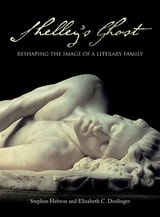
Shelley's Ghost
Reshaping the Image of a Literary FamilyStephen Hebron and Elizabeth C. Denlinger
Bodleian Library Publishing, 2010
It is difficult to think of a family more endowed with literary genius than the Shelley family—from the Romantic poet Percy Bysshe Shelley and his wife, novelist Mary Shelley, to Mary’s parents, William Godwin and Mary Wollstonecraft—all were authors in their own right. Using extensive archival material, Shelley’s Ghost explores the making of this remarkable literary family’s reputation.
Drawing on the Bodleian Library’s outstanding collection of letters, poetry manuscripts, rare printed books, portraits, and other personalia—including Shelley’s working notebooks, Keats’s letters to Shelley, William Godwin’s diary, and the original manuscript of Mary Shelley’s Frankenstein—Stephen Hebron charts the history of this talented yet troubled family. After Percy Bysshe Shelley’s drowning in 1822, Mary published various manuscripts relating to both her husband’s and her father’s lives, and passed this historical legacy to her son, Sir Percy Florence Shelley and his wife, Lady Jane Shelley. As guardians of the archive until they bequeathed it to the Bodleian in 1892, Sir Percy Florence and Lady Jane helped shape the posthumous reputations of these writers. An afterword by Elizabeth Denlinger of the New York Public Library offers an additional perspective, exploring material relating to the Shelley family that slipped beyond the family’s control.
An unparalleled look at one of the most significant families of British Romantic literature, Shelley’s Ghost will be welcomed by scholars and the many fans of this enduring literacy legacy.
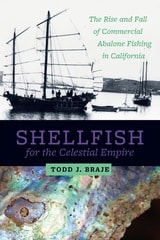
Shellfish for the Celestial Empire
The Rise and Fall of Commercial Abalone Fishing in CaliforniaTodd J. Braje
University of Utah Press, 2016
In the 1800s, when California was captivated by gold fever, a small group of Chinese immigrants recognized the fortune to be made from the untapped resources along the state’s coast, particularly from harvesting the black abalone of southern and Baja California. These immigrants, with skills from humble beginnings in a traditional Chinese fishing province, founded California’s commercial abalone industry, and led its growth and expansion for several decades. By the turn of the twentieth century, however, their successful livelihood was stolen from them through targeted legislation of the U.S. and California governments.
Today, the physical evidence of historical Chinese abalone fishing on the mainland has been erased by development. On California’s Channel Islands, however, remnants of temporary abalone collecting and processing camps lie scattered along the coastlines. These sites hold a treasure trove of information, stories, lifeways, and history. Braje has excavated many of these sites and uses them to explore the history of Chinese abalone fishing, presenting a microcosm of the broader history of Chinese immigrants in America—their struggles, their successes, the institutionalized racism they faced, and the unique ways in which they helped to shape the identity of the United States.

Sherlock Holmes, Esq., and John H. Watson, M.D.
An Encyclopaedia of Their AffairsOrlando Park
Northwestern University Press, 1962