Results by title
728 books match the query 'Economic aspects' and 56 start with s
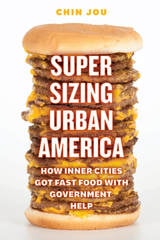
Supersizing Urban America
How Inner Cities Got Fast Food with Government HelpChin Jou
University of Chicago Press, 2017
More than one-third of adults in the United States are obese. The Centers for Disease Control and Prevention estimates that there are over 112,000 obesity-related deaths annually, and for many years, the government has waged a very public war on the problem. Former Surgeon General Richard Carmona warned in 2006 that “obesity is the terror within,” going so far as to call it a threat that will “dwarf 9/11.”
What doesn’t get mentioned in all this? The fact that the federal government helped create the obesity crisis in the first place—especially where it is strikingly acute, among urban African-American communities. Supersizing Urban America reveals the little-known story of how the U.S. government got into the business of encouraging fast food in inner cities, with unforeseen consequences we are only beginning to understand. Chin Jou begins her story in the late 1960s, when predominantly African-American neighborhoods went from having no fast food chain restaurants to being littered with them. She uncovers the federal policies that have helped to subsidize that expansion, including loan guarantees to fast food franchisees, programs intended to promote minority entrepreneurship, and urban revitalization initiatives. During this time, fast food companies also began to relentlessly market to urban African-American consumers. An unintended consequence of these developments was that low-income minority communities were disproportionately affected by the obesity epidemic.
In the first book about the U.S. government’s problematic role in promoting fast food in inner-city America, Jou tells a riveting story of the food industry, obesity, and race relations in America that is essential to understanding health and obesity in contemporary urban America.
[more]

Suq
Geertz on the MarketClifford Geertz
HAU, 2022
A formative ethnography of the relationship between markets and social life, back in print.
Originally published in 1979, Clifford Geertz’s essay on the Moroccan bazaar is a classic ethnographic account of the interplay of economic, social, and religious lives in the bustle of transaction. Drawing on years of fieldwork in the Middle Atlas town of Sefrou, Geertz explores how actors from diverse backgrounds assess the worth and meaning of other people’s wares, words, and ways of doing business. He shows how the search for market information, so central to the theorization of markets by economists, is here based on careful appraisals of social relations, embedded in understandings of the broader institutional environment of the market town and its hinterlands. With a richness of insights procured for generations of readers, Geertz’s essay on the sūq is a model of and for the craft of ethnographic theory. Long out of print, it is republished here in a stand-alone edition introduced by Lawrence Rosen.
Originally published in 1979, Clifford Geertz’s essay on the Moroccan bazaar is a classic ethnographic account of the interplay of economic, social, and religious lives in the bustle of transaction. Drawing on years of fieldwork in the Middle Atlas town of Sefrou, Geertz explores how actors from diverse backgrounds assess the worth and meaning of other people’s wares, words, and ways of doing business. He shows how the search for market information, so central to the theorization of markets by economists, is here based on careful appraisals of social relations, embedded in understandings of the broader institutional environment of the market town and its hinterlands. With a richness of insights procured for generations of readers, Geertz’s essay on the sūq is a model of and for the craft of ethnographic theory. Long out of print, it is republished here in a stand-alone edition introduced by Lawrence Rosen.
[more]
Survival of a Perverse Nation
Morality and Queer Possibility in ArmeniaTamar R. Shirinian
Duke University Press, 2024
In Survival of a Perverse Nation, Tamar R. Shirinian traces two widespread rhetorics of perversion—sexual and moral—in postsocialist Armenia, showing how they are tied to anxieties about the nation’s survival. In her fieldwork with Armenians, Shirinian found that right-wing nationalists’ focus on sexual perversion centers the figure of the homosexual, while questions of moral perversion surround oligarchs and other members of the political-economic elite. While the homosexual is seen as non- or improperly reproductive, the oligarch’s moral deviations from the caring and paternalistic expectations associated with national leadership also endanger Armenia’s survival. Shirinian shows how both figures threaten the nation’s proper social reproduction, a source of great anxiety for a nation whose primary point of identity is surviving genocide. In the existential threat posed by these forms of perversion Shirinian finds paths where nonsurvival might mean the creation of futures that are queerer and more just. Detailing how the language of perversion offers trenchant critiques of capitalism as a perversion of life, Shirinian presents a new queer theory of political economy.
[more]
Sustainable Capitalism
Essential Work for the AnthropoceneEdited by Inara Scott
University of Utah Press, 2024
Capitalism has been linked to climate change, racism and slavery, wealth inequality, and the decline of democracy. At the same time, capitalism may have been instrumental in lifting hundreds of millions of people out of poverty, facilitating vast technological innovations, and improving standards of living across the globe. As climate change accelerates and the world is threatened with existential crises, we must ask: Is capitalism incompatible with sustainability? While this question is as complex and urgent as it is resistant to simple answers, the contributors to this volume make the case that a more sustainable capitalism is within our reach.
Sustainable Capitalism takes on the challenge of sustainability from a uniquely interdisciplinary and diverse perspective, offering both theory and tools for action. Topics range from an analysis of the foundations and definition of capitalism to the specific regulatory mechanisms that may be necessary to rein in its current, unsustainable trajectory. Readers will find nuanced and important analyses of options and potential outcomes that are not available in any other work. This book is essential reading for anyone concerned about the path we are on and how we might improve the lives of people around the globe.
https://www.sustainablecapitalismbook.com/
[more]
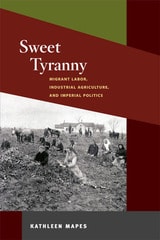
Sweet Tyranny
Migrant Labor, Industrial Agriculture, and Imperial PoliticsKathleen Mapes
University of Illinois Press, 2008
In this innovative grassroots to global study, Kathleen Mapes explores how the sugar beet industry transformed the rural Midwest by introducing large factories, contract farming, and foreign migrant labor. Identifying rural areas as centers for modern American industrialism, Mapes contributes to an ongoing reorientation of labor history from urban factory workers to rural migrant workers. She engages with a full range of individuals, including Midwestern family farmers, industrialists, Eastern European and Mexican immigrants, child laborers, rural reformers, Washington politicos, and colonial interests. Engagingly written, Sweet Tyranny demonstrates that capitalism was not solely a force from above but was influenced by the people below who defended their interests in an ever-expanding imperialist market.
[more]
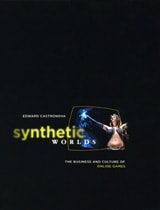
Synthetic Worlds
The Business and Culture of Online GamesEdward Castronova
University of Chicago Press, 2006
From EverQuest to World of Warcraft, online games have evolved from the exclusive domain of computer geeks into an extraordinarily lucrative staple of the entertainment industry. People of all ages and from all walks of life now spend thousands of hours—and dollars—partaking in this popular new brand of escapism. But the line between fantasy and reality is starting to blur. Players have created virtual societies with governments and economies of their own whose currencies now trade against the dollar on eBay at rates higher than the yen. And the players who inhabit these synthetic worlds are starting to spend more time online than at their day jobs.
In Synthetic Worlds, Edward Castronova offers the first comprehensive look at the online game industry, exploring its implications for business and culture alike. He starts with the players, giving us a revealing look into the everyday lives of the gamers—outlining what they do in their synthetic worlds and why. He then describes the economies inside these worlds to show how they might dramatically affect real world financial systems, from potential disruptions of markets to new business horizons. Ultimately, he explores the long-term social consequences of online games: If players can inhabit worlds that are more alluring and gratifying than reality, then how can the real world ever compete? Will a day ever come when we spend more time in these synthetic worlds than in our own? Or even more startling, will a day ever come when such questions no longer sound alarmist but instead seem obsolete?
With more than ten million active players worldwide—and with Microsoft and Sony pouring hundreds of millions of dollars into video game development—online games have become too big to ignore. Synthetic Worlds spearheads our efforts to come to terms with this virtual reality and its concrete effects.
“Illuminating. . . . Castronova’s analysis of the economics of fun is intriguing. Virtual-world economies are designed to make the resulting game interesting and enjoyable for their inhabitants. Many games follow a rags-to-riches storyline, for example. But how can all the players end up in the top 10%? Simple: the upwardly mobile human players need only be a subset of the world's population. An underclass of computer-controlled 'bot' citizens, meanwhile, stays poor forever. Mr. Castronova explains all this with clarity, wit, and a merciful lack of academic jargon.”—The Economist
“Synthetic Worlds is a surprisingly profound book about the social, political, and economic issues arising from the emergence of vast multiplayer games on the Internet. What Castronova has realized is that these games, where players contribute considerable labor in exchange for things they value, are not merely like real economies, they are real economies, displaying inflation, fraud, Chinese sweatshops, and some surprising in-game innovations.”—Tim Harford, Chronicle of Higher Education
“Synthetic Worlds is a surprisingly profound book about the social, political, and economic issues arising from the emergence of vast multiplayer games on the Internet. What Castronova has realized is that these games, where players contribute considerable labor in exchange for things they value, are not merely like real economies, they are real economies, displaying inflation, fraud, Chinese sweatshops, and some surprising in-game innovations.”—Tim Harford, Chronicle of Higher Education
[more]