Results by title
944 books match the query 'Indians of North America' and 70 start with s
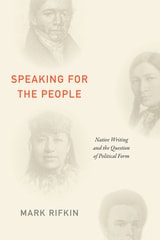
Speaking for the People
Native Writing and the Question of Political FormMark Rifkin
Duke University Press, 2021
Speaking of Indigenous Politics
Conversations with Activists, Scholars, and Tribal LeadersJ. Kehaulani Kauanui
University of Minnesota Press, 2018
“A lesson in how to practice recognizing the fundamental truth that every inch of the Americas is Indigenous territory” —Robert Warrior, from the Foreword
Many people learn about Indigenous politics only through the most controversial and confrontational news: the Standing Rock Sioux Tribe’s efforts to block the Dakota Access Pipeline, for instance, or the battle to protect Bears Ears National Monument in Utah, a site sacred to Native peoples. But most Indigenous activism remains unseen in the mainstream—and so, of course, does its significance. J. Kēhaulani Kauanui set out to change that with her radio program Indigenous Politics. Issue by issue, she interviewed people who talked candidly and in an engaging way about how settler colonialism depends on erasing Native peoples and about how Native peoples can and do resist. Collected here, these conversations speak with clear and compelling voices about a range of Indigenous politics that shape everyday life.
Land desecration, treaty rights, political status, cultural revitalization: these are among the themes taken up by a broad cross-section of interviewees from across the United States and from Canada, Mexico, Chile, Bolivia, Peru, Australia, and New Zealand. Some speak from the thick of political action, some from a historical perspective, others from the reaches of Indigenous culture near and far. Writers, like Comanche Paul Chaat Smith, author of Everything You Know about Indians Is Wrong, expand on their work—about gaming and sovereignty, for example, or protecting Native graves, the reclamation of land, or the erasure of Indian identity. These conversations both inform and engage at a moment when their messages could not be more urgent.
Contributors: Jessie Little Doe Baird (Mashpee Wampanoag), Omar Barghouti, Lisa Brooks (Abenaki), Kathleen A. Brown-Pérez (Brothertown Indian Nation), Margaret “Marge” Bruchac (Abenaki), Jessica Cattelino, David Cornsilk (Cherokee Nation), Sarah Deer (Muskogee Creek Nation), Philip J. Deloria (Dakota), Tonya Gonnella Frichner (Onondaga Nation), Hone Harawira (Ngapuhi Nui Tonu), Suzan Shown Harjo (Cheyenne and Hodulgee Muscogee), Rashid Khalidi, Winona LaDuke (White Earth Ojibwe), Maria LaHood, James Luna (Luiseño), Aileen Moreton-Robinson (Quandamooka), Chief Mutáwi Mutáhash (Many Hearts) Marilynn “Lynn” Malerba (Mohegan), Steven Newcomb (Shawnee/Lenape), Jean M. O’Brien (White Earth Ojibwe), Jonathan Kamakawiwo‘ole Osorio (Kanaka Maoli), Steven Salaita, Paul Chaat Smith (Comanche), Circe Sturm (Mississippi Choctaw descendant), Margo Taméz (Lipan Apache), Chief Richard Velky (Schaghticoke), Patrick Wolfe.
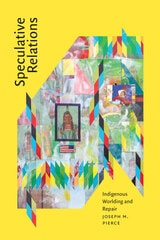
Speculative Relations
Indigenous Worlding and RepairJoseph M. Pierce
Duke University Press, 2025
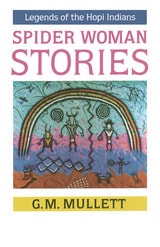
Spider Woman Stories
G. M. Mullett
University of Arizona Press, 1979
"This is a fine introduction to Hopi mythology and values. It recreates an authentic poetic spirit and makes the reader eager to read more Hopi tales." —New Mexico Humanities Review
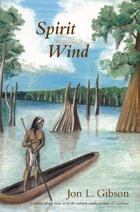
Spirit Wind
Jon L. Gibson
University of Alabama Press, 2009
A coming-of-age story set in the isolated, murky swamps of Louisiana.
When the mighty wind blows through the swamps of southern Louisiana, it changes not only the land, but the inhabitants as well. Just such a wind brought a lone infant into the care of the Chitimacha Indians deep in the Atchafalaya swamp. Raised by the tribal holy man, Storm Rider grows to adolescence as a respected tribal member, steeped in the wisdom and traditions of his adopted people. Their clan competitions, life-cycle rituals, social interactions, and subsistence labors are well explained in this historical novel.
When captured by an enemy raiding party, Storm Rider and his nemesis, the village bully, forge a bond that delivers them from danger and charts their futures. Love, hate, friendship, and loyalty ride the dark bayou waters and converge at the sacred Rain Tree. Swamps, hurricanes, cannibals, and unforgettable characters are interwoven as tightly as one of old Cane Basket's watertight baskets in this anthropologically accurate story of American Indian cultures in conflict.
Spirit of the New England Tribes
Indian History and Folklore, 1620–1984William S. Simmons
University Press of New England, 1986

Spirits of Earth
The Effigy Mound Landscape of Madison and the Four LakesRobert A. Birmingham
University of Wisconsin Press, 2010
State and Reservation
New Perspectives on Federal Indian PolicyEdited by George Pierre Castile and Robert L. Bee
University of Arizona Press, 1992
CONTENTS
Introduction, George Pierre Castile & Robert L. Bee
Part I—Historical Foundations of the Reservation System
An Elusive Institution: The Meanings of Indian Reservations in Gold Rush California, John M. Findlay
Crow Leadership Amidst Reservation Oppression, Frederick E. Hoxie
Part II—The Nonreservation Experience
Utah Indians and the Homestead Laws, Martha C. Knack
The Enduring Reservations of Oklahoma, John H. Moore
Without Reservation: Federal Indian Policy and the Landless Tribes of Washington, Frank W. Porter, III
Part III—Power and Symbols
Riding the Paper Tiger, Robert L. Bee
Indian Sign: Hegemony and Symbolism in Federal Indian Policy, George P. Castile
Part IV—The Resource Base
Primitive Accumulation, Reservations, and the Alaska Native Claims Settlement Act, Lawrence Weiss & David C.Maas
Shortcomings of the Indian Self-Determination Policy, George S. Esber, Jr.
Getting to Yes in the New West: The Negotiation of Policy, Thomas R. McGuire
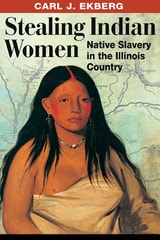
Stealing Indian Women
Native Slavery in the Illinois CountryCarl J. Ekberg
University of Illinois Press, 2009
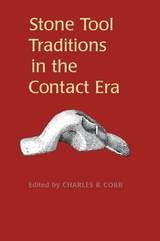
Stone Tool Traditions in the Contact Era
Edited by Charles Richard Cobb
University of Alabama Press, 2003
Explores the impact of European colonization on Native American and Pacific Islander technology and culture
This is the first comprehensive analysis of the partial replacement of flaked stone and ground stone traditions by metal tools in the Americas during the Contact Era. It examines the functional, symbolic, and economic consequences of that replacement on the lifeways of native populations, even as lithic technologies persisted well after the landing of Columbus. Ranging across North America and to Hawai'i, the studies show that, even with wide access to metal objects, Native Americans continued to produce certain stone tool types—perhaps because they were still the best implements for a task or because they represented a deep commitment to a traditional practice.Chapters are ordered in terms of relative degree of European contact, beginning with groups that experienced brief episodes of interaction, such as the Wichita-French meeting on the Arkansas River, and ending with societies that were heavily influenced by colonization, such as the Potawatomi of Illinois. Because the anthology draws comparisons between the persistence of stone tools and the continuity of other indigenous crafts, it presents holistic models that can be used to explain the larger consequences of the Contact Era.
Marvin T. Smith, of Valdosta State University has stated that, “after reading this volume, no archaeologist will ever see the replacement of lithic technology by metal tools as a simple matter of replacement of technologically inferior stone tools with their superior metal counterparts. This is cutting-edge scholarship in the area of contact period studies.”
Stories from the Country of Lost Borders by Mary Austin
Pryse, Marjorie
Rutgers University Press, 1987
In The Land of Little Rain, Austin's attention to natural detail allows her to write prose that is geologically, biologically, and botanically accurate at the same time that it offers metaphorical insight into human emotional and spiritual experience. In Lost Borders, Austin focuses on both white and Indian women's experiences in the desert, looks for the sources of their deprivation, and finds them in the ways life betrays them, usually in the guise of men. She offers several portraits of strong women characters but ultimately identifies herself with the desert, which she personifies as a woman.
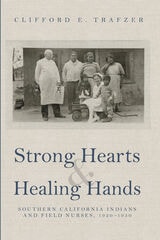
Strong Hearts and Healing Hands
Southern California Indians and Field Nurses, 1920–1950Clifford E. Trafzer
University of Arizona Press, 2021
Over time, field nurses and Native people formed a positive working relationship that resulted in the decline of mortality from infectious diseases. Many Native Americans accepted and used Western medicine to fight pathogens, while also continuing Indigenous medicine ways. Nurses helped control tuberculosis, measles, influenza, pneumonia, and a host of gastrointestinal sicknesses. In partnership with the community, nurses quarantined people with contagious diseases, tested for infections, and tracked patients and contacts. Indians turned to nurses and learned about disease prevention. With strong hearts, Indians eagerly participated in the tuberculosis campaign of 1939–40 to x-ray tribal members living on twenty-nine reservations. Through their cooperative efforts, Indians and health-care providers decreased deaths, cases, and misery among the tribes of Southern California.
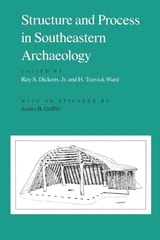
Structure and Process in Southeastern Archaeology
Edited by Roy Dickens Jr and H. Trawick Ward
University of Alabama Press, 1985
A Dan Josselyn Memorial Publication
Within the general structure-and-process theme of this compendium, the authors have focused on either intrasite problems (those dealing with the formation and structure of a site, type of site, or type of feature) or intersite problems (those dealing with behavioral organization and process as developed from comparative site data). These papers, from a broad range of specialists, present a comprehensive study of southeastern archaeology.
Structure and Process in Southeastern Archaeology is a foundational work that reshapes how scholars understand the cultural and social dynamics of prehistoric communities in the Southeastern United States. Roy S. Dickens, Jr. and H. Trawick Ward bring together decades of fieldwork, theoretical insight, and regional expertise to explore how ancient societies organized themselves, interacted, and evolved over time. Rather than focusing solely on artifacts or isolated site reports, this volume emphasizes the broader patterns—both structural and processual—that define the archaeological record of the Southeast.
Through a careful synthesis of settlement data, material culture, and environmental context, the authors reveal how social organization, political structures, and cultural practices were deeply embedded in the landscape. Their approach integrates processual archaeology with a nuanced understanding of regional variation, offering readers a dynamic view of how prehistoric communities adapted to changing conditions and interacted across space and time.
This book is particularly valuable for archaeologists, anthropologists, and historians seeking to move beyond descriptive accounts toward more interpretive frameworks. It provides a model for analyzing archaeological data in ways that illuminate the lived experiences of ancient peoples, making it a vital resource for both academic research and classroom instruction. The authors’ clear writing and thoughtful analysis make complex ideas accessible without sacrificing scholarly rigor.
Whether you're studying Mississippian chiefdoms, Woodland period settlements, or the broader cultural landscapes of the American South, Structure and Process in Southeastern Archaeology offers essential tools for understanding the past. It stands as a testament to the importance of theory-driven, context-rich archaeological interpretation.
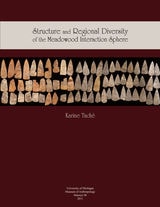
Structure and Regional Diversity in the Meadowood Interaction Sphere
Karine Taché
University of Michigan Press, 2011
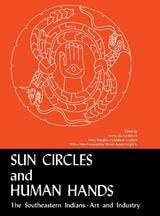
Sun Circles and Human Hands
The Southeastern Indians Art and IndustriesEdited by Emma Lila Fundaburk and Mary Douglass Fundaburk Foreman
University of Alabama Press, 2001
This classic compendium of ancient Indian artifacts from the entire southeastern United States remains an indispensable reference source for professionals and enthusiasts alike.
From utilitarian arrowheads to beautiful stone effigy pipes to ornately-carved shell disks, the photographs and drawings in Sun Circles and Human Hands present the archaeological record of the art and native crafts of the prehistoric southeastern Indians. Painstakingly compiled in the 1950s by two sisters who traveled the eastern United States interviewing archaeologists and collectors and visiting the major repositories, Sun Circles and Human Hands is remarkable for its breadth of illustration of Indian-made artifacts and its comprehensive documentation. Although research over the last 50 years has disproven many of the early theories reported in the text—which were not the editors' theories but those of the archaeologists of the day—the excellent illustrations of objects no longer available for examination have more than validated the lasting worth of this popular book.
Broadly acclaimed when it first appeared, this new printing has the added value of Knight's foreword, which places the work in its proper context. Useful to museums, state and national parks, school libraries, gift stores, archaeological agencies, and private collections, Sun Circles and Human Hands is a rich pictorial survey accessible to anyone interested in early American Indian culture.
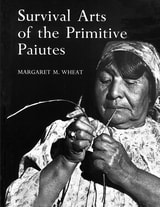
Survival Arts of the Primitive Paiutes
Margaret M. Wheat
University of Nevada Press, 1977
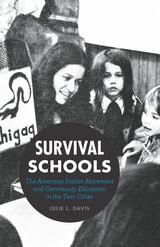
Survival Schools
The American Indian Movement and Community Education in the Twin CitiesJulie L. Davis
University of Minnesota Press, 2013
In the late 1960s, Indian families in Minneapolis and St. Paul were under siege. Clyde Bellecourt remembers, “We were losing our children during this time; juvenile courts were sweeping our children up, and they were fostering them out, and sometimes whole families were being broken up.” In 1972, motivated by prejudice in the child welfare system and hostility in the public schools, American Indian Movement (AIM) organizers and local Native parents came together to start their own community school. For Pat Bellanger, it was about cultural survival. Though established in a moment of crisis, the school fulfilled a goal that she had worked toward for years: to create an educational system that would enable Native children “never to forget who they were.”
While AIM is best known for its national protests and political demands, the survival schools foreground the movement’s local and regional engagement with issues of language, culture, spirituality, and identity. In telling of the evolution and impact of the Heart of the Earth school in Minneapolis and the Red School House in St. Paul, Julie L. Davis explains how the survival schools emerged out of AIM’s local activism in education, child welfare, and juvenile justice and its efforts to achieve self-determination over urban Indian institutions. The schools provided informal, supportive, culturally relevant learning environments for students who had struggled in the public schools. Survival school classes, for example, were often conducted with students and instructors seated together in a circle, which signified the concept of mutual human respect. Davis reveals how the survival schools contributed to the global movement for Indigenous decolonization as they helped Indian youth and their families to reclaim their cultural identities and build a distinctive Native community.
The story of these schools, unfolding here through the voices of activists, teachers, parents, and students, is also an in-depth history of AIM’s founding and early community organizing in the Twin Cities—and evidence of its long-term effect on Indian people’s lives.
Survival This Way
Interviews with American Indian PoetsJoseph Bruchac
University of Arizona Press, 1987
Survivance, Sovereignty, and Story
Teaching American Indian RhetoricsLisa King
Utah State University Press, 2015
Focusing on the importance of discussions about sovereignty and of the diversity of Native American communities, Survivance, Sovereignty, and Story offers a variety of ways to teach and write about indigenous North American rhetorics.
These essays introduce indigenous rhetorics, framing both how and why they should be taught in US university writing classrooms. Contributors promote understanding of American Indian rhetorical and literary texts and the cultures and contexts within which those texts are produced. Chapters also supply resources for instructors, promote cultural awareness, offer suggestions for further research, and provide examples of methods to incorporate American Indian texts into the classroom curriculum.
Survivance, Sovereignty, and Story provides a decolonized vision of what teaching rhetoric and writing can be and offers a foundation to talk about what rhetoric and pedagogical practice can mean when examined through American Indian and indigenous epistemologies and contemporary rhetorics.
Contributors include Joyce Rain Anderson, Resa Crane Bizzaro, Qwo-Li Driskill, Janice Gould, Rose Gubele, Angela Haas, Jessica Safran Hoover, Lisa King, Kimberli Lee, Malea D. Powell, Andrea Riley-Mukavetz, Gabriela Raquel Ríos, and Sundy Watanabe.
Surviving in Two Worlds
Contemporary Native American VoicesBy Lois Crozier-Hogle and Darryl Babe Wilson
University of Texas Press, 1997
Surviving in Two Worlds brings together the voices of twenty-six Native American leaders. The interviewees come from a variety of tribal backgrounds and include such national figures as Oren Lyons, Arvol Looking Horse, John Echohawk, William Demmert, Clifford Trafzer, Greg Sarris, and Roxanne Swentzell.
Their interviews are divided into five sections, grouped around the themes of tradition, history and politics, healing, education, and culture. They take readers into their lives, their dreams and fears, their philosophies and experiences, and show what they are doing to assure the survival of their peoples and cultures, as well as the earth as a whole. Their analyses of the past and present, and especially their counsels for the future, are timely and urgent.