968 books match the query 'Movements' and 55 start with s
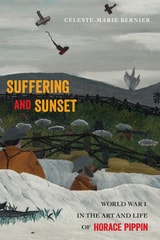
cover of Suffering and Sunset: World War I in the Art and Life of Horace Pippin

Suffering and Sunset

World War I in the Art and Life of Horace Pippin

Celeste-Marie Bernier

Temple University Press, 2017

For self-made artist and soldier Horace Pippin—who served in the 369th all-black infantry in World War I until he was wounded—war provided a formative experience that defined much of his life and work. His ability to transform combat service into canvases of emotive power, psychological depth, and realism showed not only how he viewed the world but also his mastery as a painter. In Suffering and Sunset, Celeste-Marie Bernier painstakingly traces Pippin’s life story of art as a life story of war. 

Illustrated with more than sixty photographs, including works in various mediums—many in full color—this is the first intellectual history and cultural biography of Pippin. Working from newly discovered archives and unpublished materials, Bernier provides an in-depth investigation into the artist’s development of an alternative visual and textual lexicon and sheds light on his work in its aesthetic, social, and political contexts.

Suffering and Sunset illustrates Pippin’s status as a groundbreaking artist as it shows how this African American painter suffered from but also staged many artful resistances to racism in a white-dominated art world.

[more]
cover of Supernatural America: The Paranormal in American Art

Supernatural America

The Paranormal in American Art

Edited by Robert Cozzolino

University of Chicago Press, 2021

America is haunted. Ghosts from its violent history—the genocide of Indigenous peoples, slavery, the threat of nuclear annihilation, and traumatic wars—are an inescapable and unsettled part of the nation’s heritage. Not merely in the realm of metaphor but present and tangible, urgently calling for contact, these otherworldly visitors have been central to our national identity. Through times of mourning and trauma, artists have been integral to visualizing ghosts, whether national or personal, and in doing so have embraced the uncanny and the inexplicable. This stunning catalog, accompanying the first major exhibition to assess the spectral in American art, explores the numerous ways American artists have made sense of their own experiences of the paranormal and the supernatural, developing a rich visual culture of the intangible.

​Featuring artists from James McNeill Whistler and Kerry James Marshall to artist/mediums who made images with spirits during séances, this catalog covers more than two hundred years of the supernatural in American art. Here we find works that explore haunting, UFO sightings, and a broad range of experiential responses to other worldly contact.

[more]
cover of Surreal Geographies: A New History of Holocaust Consciousness

Surreal Geographies

A New History of Holocaust Consciousness

Kathryn L. Brackney

University of Wisconsin Press, 2024

Surreal Geographies recovers a forgotten archive of Holocaust representation. Examining art, literature, and film produced from the immediate postwar period up to the present moment, Kathryn L. Brackney investigates changing portrayals of Jewish victims and survivors. In so doing, she demonstrates that the Holocaust has been understood not only through the documentary realism and postmodern fragmentation familiar to scholars but also through a surreal mode of meaning making. From an otherworldly “Planet Auschwitz” to the spare, intimate spaces of documentary interviews, Brackney shows that the humanity of victims has been produced, undermined, and guaranteed through evolving scripts for acknowledging and mourning mass violence.

Brackney offers a new look at familiar works by authors and artists such as Claude Lanzmann, W. G. Sebald, and Paul Celan, while making surprising connections to contemporary scholars like Timothy Snyder and Donna Haraway, and events such as the Space Race. In the process, she maps out a decades-long process through which transnational conventions of mourning have emerged in Western Europe, North America, and Israel, functioning to constitute Jewish victimization as “grievable life.” Ultimately, she shows how the Holocaust has developed into a figure for the destabilization and reformulation of the category of humanity and the problem of mourning across difference.
[more]
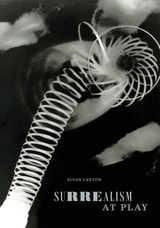
cover of Surrealism at Play

Surrealism at Play

Susan Laxton

Duke University Press, 2019
In Surrealism at Play Susan Laxton writes a new history of surrealism in which she traces the centrality of play to the movement and its ongoing legacy. For surrealist artists, play took a consistent role in their aesthetic as they worked in, with, and against a post-World War I world increasingly dominated by technology and functionalism. Whether through exquisite-corpse drawings, Man Ray’s rayographs, or Joan Miró’s visual puns, surrealists became adept at developing techniques and processes designed to guarantee aleatory outcomes. In embracing chance as the means to produce unforeseeable ends, they shifted emphasis from final product to process, challenging the disciplinary structures of industrial modernism. As Laxton demonstrates, play became a primary method through which surrealism refashioned artistic practice, everyday experience, and the nature of subjectivity.
[more]
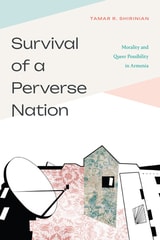
cover of Survival of a Perverse Nation: Morality and Queer Possibility in Armenia

Survival of a Perverse Nation

Morality and Queer Possibility in Armenia

Tamar R. Shirinian

Duke University Press, 2024

In Survival of a Perverse Nation, Tamar R. Shirinian traces two widespread rhetorics of perversion—sexual and moral—in postsocialist Armenia, showing how they are tied to anxieties about the nation’s survival. In her fieldwork with Armenians, Shirinian found that right-wing nationalists’ focus on sexual perversion centers the figure of the homosexual, while questions of moral perversion surround oligarchs and other members of the political-economic elite. While the homosexual is seen as non- or improperly reproductive, the oligarch’s moral deviations from the caring and paternalistic expectations associated with national leadership also endanger Armenia’s survival. Shirinian shows how both figures threaten the nation’s proper social reproduction, a source of great anxiety for a nation whose primary point of identity is surviving genocide. In the existential threat posed by these forms of perversion Shirinian finds paths where nonsurvival might mean the creation of futures that are queerer and more just. Detailing how the language of perversion offers trenchant critiques of capitalism as a perversion of life, Shirinian presents a new queer theory of political economy.
[more]