1185 books match the query 'Travel' and 59 start with s
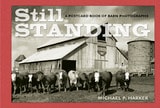
cover of Still Standing: A Postcard Book of Barn Photographs

Still Standing

A Postcard Book of Barn Photographs

Michael P. Harker

University of Iowa Press, 2006
The result of a seven-and-a-half-year undertaking to document Iowa's barns and all they represent, Harker's Barns: Visions of an American Icon featured seventy-five stunning black-and-white photographs by Michael Harker. An impressive and well-received collection, the book helped preserve the glory of one of rural America's most elemental icons. Still Standing, a postcard book of thirty of Harker's barn photographs---some from Harker's Barns, some previously unseen---continues that mission of preservation. Printed on heavy card stock and perforated for easy removal, the cards showcase midwestern barns-from square to round, wood to brick, Dutch to Swedish, occupied or abandoned, all symbolizing a passing way of life that was once the lifeblood of Iowa and the Midwest. As barns continue to disappear, these images will endure. “Barns Again! Celebrating an American Icon,” an exhibit of Harker's barn photos (with text by Loren Horton) sponsored by Humanities Iowa and organized by the Smithsonian Institution's Traveling Exhibition Service and the National Building Museum, with assistance from the National Trust for Historic Preservation, is currently touring Iowa.
[more]
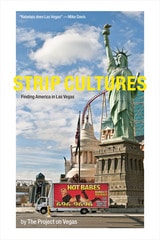
cover of Strip Cultures: Finding America in Las Vegas

Strip Cultures

Finding America in Las Vegas

The Project on Vegas

Duke University Press, 2015

On the Las Vegas Strip, blockbuster casinos burst out of the desert, billboards promise "hot babes," actual hot babes proffer complimentary drinks, and a million happy slot machines ring day and night. It’s loud and excessive, but, as the Project on Vegas demonstrates, the Strip is not a world apart. Combining written critique with more than one hundred photographs by Karen Klugman, Strip Cultures examines the politics of food and water, art and spectacle, entertainment and branding, body and sensory experience. In confronting the ordinary on America’s most famous four-mile stretch of pavement, the authors reveal how the Strip concentrates and magnifies the basic truths and practices of American culture where consumerism is the stuff of life, digital surveillance annuls the right to privacy, and nature—all but destroyed—is refashioned as an element of decor. 
 
[more]
cover of Studies in Outdoor Recreation: Search and Research for Satisfaction

Studies in Outdoor Recreation

Search and Research for Satisfaction

Robert E. Manning

Oregon State University Press, 1999

[more]
cover of Summers Off?: A History of U.S. Teachers' Other Three Months

Summers Off?

A History of U.S. Teachers' Other Three Months

Christine A. Ogren

Rutgers University Press, 2026
Since the nine-month school year became common in the United States during the 1880s, schoolteachers have never really had summers off. Administrators instructed them to rest, as well as to study and travel, in the interest of creating a compliant workforce. Teachers, however, adapted administrators’ directives to pursue their own version of professionalization and to ensure their financial well-being. Summers Off explores teachers’ summer experiences between the 1880s and 1930s in institutes and association meetings; sessions at teachers colleges, Black colleges, and prestigious universities; work for wages or their family; tourism in the U.S. and Europe; and activities intended to be restful. This heretofore untold history reveals how teachers utilized the geographical and psychological distance from the classroom that summer provided, to enhance not only their teaching skills but also their professional and intellectual independence, their membership in the middle class, and, in the cases of women and Black teachers, their defiance of gender and race hierarchies.
[more]
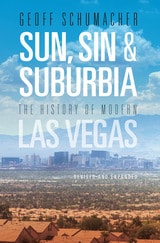
cover of Sun, Sin & Suburbia: The History of Modern Las Vegas, Revised and Expanded

Sun, Sin & Suburbia

The History of Modern Las Vegas, Revised and Expanded

Geoff Schumacher

University of Nevada Press, 2015

More than forty million visitors per year travel to Sin City to visit the gambling mecca of the world. But gambling is only one part of the city’s story. In this carefully documented history, Geoff Schumacher tracks the rise of Las Vegas, including its vital role during World War II; the rise of the Strip in the 1950s; the explosive growth of the 1990s; and the colossal collapse triggered by the real estate bust and economic crisis of the mid-2000s. Schumacher surveys the history of the iconic casinos, debunking myths and highlighting key players such as Howard Hughes, Kirk Kerkorian, and Steve Wynn.
 
Schumacher’s history also profiles the Las Vegas where more than two million people live. He explores the neighborhoods sprawling beyond the Strip’s neon gleam and uncovers a diverse community offering much more than table games, lounge acts, and organized crime. Schumacher discusses contemporary Las Vegas, charting its course from the nation’s fastest-growing metropolis to one of the Great Recession’s most battered victims.
 
Sun, Sin & Suburbia will appeal to tourists looking to understand more than the glitz and glitter of Las Vegas and to newcomers who want to learn about their new hometown. It will also be an essential addition to any longtime Nevadan’s library of local history.
 
First published in 2012 by Stephens Press, this paperback edition is now available from the University of Nevada Press.
[more]
cover of Sundancers and River Demons: Essays on Landscape and Ritual

Sundancers and River Demons

Essays on Landscape and Ritual

Conger Beasley Jr.

University of Arkansas Press, 1990
[more]
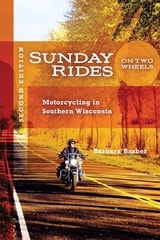
cover of Sunday Rides on Two Wheels: Motorcycling in Southern Wisconsin

Sunday Rides on Two Wheels

Motorcycling in Southern Wisconsin

Barbara Barber

University of Wisconsin Press, 2009
Eighteen unforgettable routes along riverways and ridges, down rustic roads and coulees, and over 1,800 miles of southern Wisconsin’s best rides
[more]
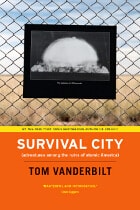
cover of Survival City: Adventures among the Ruins of Atomic America

Survival City

Adventures among the Ruins of Atomic America

Tom Vanderbilt

University of Chicago Press, 2002

On the road to Survival City, Tom Vanderbilt maps the visible and invisible legacies of the cold war, exhuming the blueprints for the apocalypse we once envisioned and chronicling a time when we all lived at ground zero. In this road trip among ruined missile silos, atomic storage bunkers, and secret test sites, a lost battleground emerges amid the architecture of the 1950s, accompanied by Walter Cotten’s stunning photographs. Survival City looks deep into the national soul, unearthing the dreams and fears that drove us during the latter half of the twentieth century.

“A crucial and dazzling book, masterful, and for me at least, intoxicating.”—Dave Eggers


“A genuinely engaging book, perhaps because [Vanderbilt] is skillful at conveying his own sense of engagement to the reader.”—Los Angeles Times


“A retracing of Dr. Strangelove as ordinary life.”—Greil Marcus, Bookforum
[more]
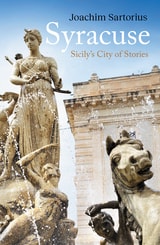
cover of Syracuse: Sicily's City of Stories

Syracuse

Sicily's City of Stories

Joachim Sartorius

Haus Publishing, 2026

A poetic and historical travelogue of Syracuse, Sicily.

Twenty-five hundred years ago, the city of Syracuse on the eastern coast of Sicily was, for the Ancient Greeks, one of the centers of the classical world. It was in Syracuse that Aeschylus premiered his plays, and to Syracuse that Plato would visit from Athens, where the tyrant Dionysius bought Euripides's lyre at auction, and the languishing nymph Arethusa hid in the papyrus grove.

Living in the city, the poet Joachim Sartorius learned that this history and myth are still present today. At Sartorius's side, we walk with nymphs and cyclops through the old town of Ortigia and meet the people of the city: its notables, police officers, artists, and barbers.

Unraveling the depths of Sicilian history and bringing the juxtaposition, superimposition, and commingling of cultures, styles, and attitudes to life, Sartorius shows a city of ancient luminosity, bringing us, through the baroque, to the contemporary world.
[more]