1566 books match the query 'Christianity' and 111 start with s
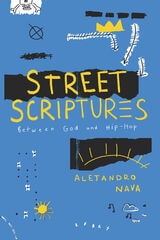
cover of Street Scriptures: Between God and Hip-Hop

Street Scriptures

Between God and Hip-Hop

Alejandro Nava

University of Chicago Press, 2022

This book explores an important aspect of hip-hop that is rarely considered: its deep entanglement with spiritual life.
 
The world of hip-hop is saturated with religion, but rarely is that element given serious consideration. In Street Scriptures, Alejandro Nava focuses our attention on this aspect of the music and culture in a fresh way, combining his profound love of hip-hop, his passion for racial and social justice, and his deep theological knowledge. Street Scriptures offers a refreshingly earnest and beautifully written journey through hip-hop’s deep entanglement with the sacred.
 
Nava reveals a largely unheard religious heartbeat in hip-hop, exploring crosscurrents of the sacred and profane in rap, reggaeton, and Latinx hip-hop today. Ranging from Kendrick Lamar, Chance the Rapper, Lauryn Hill, Cardi B, and Bad Bunny to St. Augustine and William James, Nava examines the ethical-political, mystical-prophetic, and theological qualities in hip-hop, probing the pure sonic and aesthetic signatures of music, while also diving deep into the voices that invoke the spirit of protest. The result is nothing short of a new liberation theology for our time, what Nava calls a “street theology.”
[more]
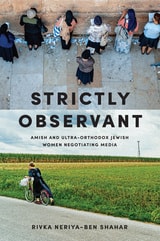
cover of Strictly Observant: Amish and Ultra-Orthodox Jewish Women Negotiating Media

Strictly Observant

Amish and Ultra-Orthodox Jewish Women Negotiating Media

Rivka Neriya-Ben Shahar

Rutgers University Press, 2024

Yonathan Shapiro Best Book Award from the Association for Israel Studies 

The Amish and ultra-Orthodox Jewish communities have typically been associated with strict religious observance, a renunciation of worldly things, and an obedience of women to men. Women’s relationship to media in these communities, however, betrays a more nuanced picture of the boundaries at play and women’s roles in negotiating them.
 
Strictly Observant presents a compelling ethnographic study of the complex dynamic between women in both the Pennsylvanian Old Order Amish and Israeli ultra-Orthodox Jewish communities and contemporary media technologies. These women regularly establish valuable social, cultural, and religious capital through the countless decisions for use and nonuse of media that they make in their daily lives, and in ways that challenge the gender hierarchies of each community. By exhibiting a deep awareness of how media can be managed to increase their social and religious reputations, these women prompt us to reconsider our outmoded understanding of the Amish and ultra-Orthodox Jewish communities, the role that women play in these communities as agents of change, and our own relationship to media today.
 
[more]
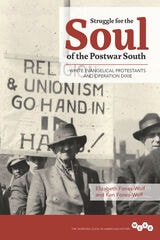
cover of Struggle for the Soul of the Postwar South: White Evangelical Protestants and Operation Dixie

Struggle for the Soul of the Postwar South

White Evangelical Protestants and Operation Dixie

Elizabeth Fones-Wolf and Ken Fones-Wolf

University of Illinois Press, 2015

In 1946, the Congress of Industrial Organizations (CIO) undertook Operation Dixie, an initiative to recruit industrial workers in the American South. Elizabeth and Ken Fones-Wolf plumb rarely used archival sources and rich oral histories to explore the CIO's fraught encounter with the evangelical Protestantism and religious culture of southern whites.
 
The authors' nuanced look at working class religion reveals how laborers across the surprisingly wide evangelical spectrum interpreted their lives through their faith. Factors like conscience, community need, and lived experience led individual preachers to become union activists and mill villagers to defy the foreman and minister alike to listen to organizers. As the authors show, however, all sides enlisted belief in the battle. In the end, the inability of northern organizers to overcome the suspicion with which many evangelicals viewed modernity played a key role in Operation Dixie's failure, with repercussions for labor and liberalism that are still being felt today.
 
Identifying the role of the sacred in the struggle for southern economic justice, and placing class as a central aspect in southern religion, Struggle for the Soul of the Postwar South provides new understandings of how whites in the region wrestled with the options available to them during a crucial period of change and possibility.

[more]
cover of Studies in Josephus and the Varieties of Ancient Judaism: Louis H. Feldman Jubilee Volume

Studies in Josephus and the Varieties of Ancient Judaism

Louis H. Feldman Jubilee Volume

Shaye J. D. Cohen

SBL Press, 2016

Now in paperback!

Former students, colleagues and friends of the eminent classicist and historian Louis H. Feldman are pleased to honor him with a Jubilee volume. While Feldman has long been considered an outstanding scholar of Josephus, his scholarly interests and research interests pertain to almost all aspects of the ancient world and Jews.

Features:

  • Paperback format of an essential Brill resource
  • Articles cover topics such as biblical interpretation, Judaism and Hellenism, Jews and Gentiles, history of the Mishnah and Talmud periods, and Jerusalem
  • Contributors include the most prominent international scholars
[more]
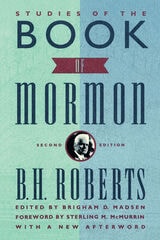
cover of Studies of the Book of Mormon: Foreword by Sterling M. McMurrin

Studies of the Book of Mormon

Foreword by Sterling M. McMurrin

B. H. Roberts

Signature Books, 1992

Available for the first time fifty years after the author’s death, Studies of the Book of Mormon presents this respected church leader’s investigation into Mormonism’s founding scripture. Reflecting his talent for combining history and theology, B. H. Roberts considered the evident parallels between the Book of Mormon and Ethan Smith’s View of the Hebrews, a book that predated the Mormon scripture by seven years. If the Book of Mormon is not historical, but rather a reflection of the misconceptions current in Joseph Smith’s day regarding Indian origins, then its theological claims are suspect as well, Roberts asserted. 

In this and other research, it was Roberts’s proclivity to go wherever the evidence took him, in this case anticipating and defending against potential future problems. Yet the manuscript was so poorly received by fellow church leaders that it was left to Roberts alone to decide whether he had overlooked some important piece of the puzzle or whether the Mormon scripture’s claims were, in fact, illegitimate. Clearly for most of his colleagues, institutional priorities overshadowed epistemological integrity. 

But Roberts’s pathbreaking work has been judged by the editor to be methodologically sound–still relevant today. It shows the work of a keen mind, and illustrates why Roberts was one of the most influential Mormon thinkers of his day. The manuscript is accompanied by a preface and introduction, a history of the documents’ provenances, a biographical essay, correspondence to and from Roberts relating to the manuscript, a bibliography, and an afterword–all of which put the information into perspective. 
[more]
cover of Subversive Habits: Black Catholic Nuns in the Long African American Freedom Struggle

Subversive Habits

Black Catholic Nuns in the Long African American Freedom Struggle

Shannen Dee Williams

Duke University Press, 2022
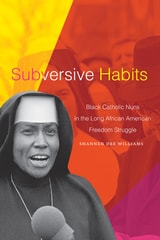
In Subversive Habits, Shannen Dee Williams provides the first full history of Black Catholic nuns in the United States, hailing them as the forgotten prophets of Catholicism and democracy. Drawing on oral histories and previously sealed Church records, Williams demonstrates how master narratives of women’s religious life and Catholic commitments to racial and gender justice fundamentally change when the lives and experiences of African American nuns are taken seriously. For Black Catholic women and girls, embracing the celibate religious state constituted a radical act of resistance to white supremacy and the sexual terrorism built into chattel slavery and segregation. Williams shows how Black sisters—such as Sister Mary Antona Ebo, who was the only Black member of the inaugural delegation of Catholic sisters to travel to Selma, Alabama, and join the Black voting rights marches of 1965—were pioneering religious leaders, educators, healthcare professionals, desegregation foot soldiers, Black Power activists, and womanist theologians. In the process, Williams calls attention to Catholic women’s religious life as a stronghold of white supremacy and racial segregation—and thus an important battleground in the long African American freedom struggle.
[more]
cover of Summa Theologiae, Prima Pars: Volume 1, The One God, QQ 1-26: With the Commentary of Cardinal Cajetan

Summa Theologiae, Prima Pars

Volume 1, The One God, QQ 1-26: With the Commentary of Cardinal Cajetan

Thomas Aquinas

Catholic University of America Press, 2023
When Leo XII promulgated Aeterni Patris in 1879, he stipulated that the “Leonine,” or official, edition of the Summa should always be printed in conjunction with Cajetan’s Commentary. For five hundred years they were studied together. Generations were trained by reading through the Summa article by article with Cajetan’s commentaries in hand. Early printed editions of the Summa typically included them in a Talmudic arrangement, as marginal text running around each article by Aquinas. This edition imitates that example. Recently, serious thinkers of all denominations – and none – have found new reasons to be interested in St. Thomas. His text is deceptively simple, yet important issues are handled in every article, sometimes below the surface. Cajetan extracts these hidden issues, and explains and elaborates on them with remarkable affinity to modern analytical philosophy. Part of that affinity lies in the use of modal logic, a tool whose importance was overlooked between the Renaissance and the twentieth century. The time is ripe for an analytically-inspired translation of Thomas: hence this volume. Never until now has Cajetan’s Commentary been put into English in its entirety. William Marshner’s translation is consistent with fidelity to the technical force of the original. The translator’s footnotes acknowledge what empirical science has made obsolete in the work of St. Thomas, and also make clear how much today’s science would have saved Thomas useless labor. This volume will, for the first time, make Cajetan’s help available to the modern reader.
[more]
cover of Summa Theologiae, Prima Pars: Volume 2, On the Holy Trinity and Creation in General, QQ 27-74: With the Commentary of Cardinal Cajetan

Summa Theologiae, Prima Pars

Volume 2, On the Holy Trinity and Creation in General, QQ 27-74: With the Commentary of Cardinal Cajetan

Thomas Aquinas

Catholic University of America Press, 2023
When Leo XII promulgated Aeterni Patris in 1879, he stipulated that the “Leonine,” or official, edition of the Summa should always be printed in conjunction with Cajetan’s Commentary. For five hundred years they were studied together. Generations were trained by reading through the Summa article by article with Cajetan’s commentaries in hand. Early printed editions of the Summa typically included them in a Talmudic arrangement, as marginal text running around each article by Aquinas. This edition imitates that example. Recently, serious thinkers of all denominations – and none – have found new reasons to be interested in St. Thomas. His text is deceptively simple, yet important issues are handled in every article, sometimes below the surface. Cajetan extracts these hidden issues, and explains and elaborates on them with remarkable affinity to modern analytical philosophy. Part of that affinity lies in the use of modal logic, a tool whose importance was overlooked between the Renaissance and the twentieth century. The time is ripe for an analytically-inspired translation of Thomas: hence this volume. Never until now has Cajetan’s Commentary been put into English in its entirety. William Marshner’s translation is consistent with fidelity to the technical force of the original. The translator’s footnotes acknowledge what empirical science has made obsolete in the work of St. Thomas, and also make clear how much today’s science would have saved Thomas useless labor. This volume will, for the first time, make Cajetan’s help available to the modern reader.
[more]
cover of Summa Theologiae, Prima Pars: Volume 3, Human Beings and God's Governance of Creation, QQ 75-119: With the Commentary of Cardinal Cajetan

Summa Theologiae, Prima Pars

Volume 3, Human Beings and God's Governance of Creation, QQ 75-119: With the Commentary of Cardinal Cajetan

Thomas Aquinas

Catholic University of America Press, 2023
When Leo XII promulgated Aeterni Patris in 1879, he stipulated that the “Leonine,” or official, edition of the Summa should always be printed in conjunction with Cajetan’s Commentary. For five hundred years they were studied together. Generations were trained by reading through the Summa article by article with Cajetan’s commentaries in hand. Early printed editions of the Summa typically included them in a Talmudic arrangement, as marginal text running around each article by Aquinas. This edition imitates that example. Recently, serious thinkers of all denominations – and none – have found new reasons to be interested in St. Thomas. His text is deceptively simple, yet important issues are handled in every article, sometimes below the surface. Cajetan extracts these hidden issues, and explains and elaborates on them with remarkable affinity to modern analytical philosophy. Part of that affinity lies in the use of modal logic, a tool whose importance was overlooked between the Renaissance and the twentieth century. The time is ripe for an analytically-inspired translation of Thomas: hence this volume. Never until now has Cajetan’s Commentary been put into English in its entirety. William Marshner’s translation is consistent with fidelity to the technical force of the original. The translator’s footnotes acknowledge what empirical science has made obsolete in the work of St. Thomas, and also make clear how much today’s science would have saved Thomas useless labor. This volume will, for the first time, make Cajetan’s help available to the modern reader.
[more]
cover of Supper at Emmaus

Supper at Emmaus

Glenn W. Olsen

Catholic University of America Press, 2016
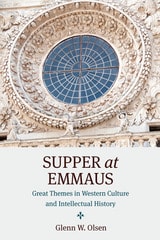
Supper at Emmaus traces various important intellectual topics from the ancient world to the modern period. Generally, as in its treatment of the question of whether the long-standing contrast between cyclical and linear views of history is helpful, it introduces important thinkers who have considered the question. A preoccupation of the book is the appearance and reappearance across the centuries of patterns used to organize temporal and cultural experience. After an opening essay on transcendental truth and cultural relativism, the second chapter traces a distinction, common in historical writings during the past two centuries, between an alleged ancient classical "cyclic" view of time and history, used to describe the claimed repetitiveness of and similarities between historical events ("nothing is new under the sun"), and a contrasting Jewish-Christian linear view, sometimes described as providential in that it moves through a series of unique events to some end intended by God. In the latter, history is "about something," the education of the human race or the redemption of humankind. As in each of the remaining essays, the book then attempts to draw out the limitations of what the current consensus on this topic has become. It does this for such things as our current understanding of religious toleration, humanism, natural law, and teleology. Some of the essays, such as those on debate about Augustine's understanding of marriage or the concluding illustrated essay on the baroque city of Lecce, are published for the first time. Others are based on previously published contributions to the scholarly literature, though generally each of these chapters concludes with a postscript that engages with current scholarly debate on the subject.
[more]
cover of Syriac Christian Culture: Beginnings to Renaissance

Syriac Christian Culture

Beginnings to Renaissance

Aaron Michael Butts

Catholic University of America Press, 2021

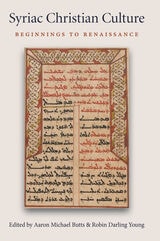
Syriac Christianity developed in the first centuries CE in the Middle East, where it continued to flourish throughout Late Antiquity and the Medieval period, while also spreading widely, as far as India and China. Today, Syriac Christians are found in the Middle East, in India, as well in diasporas scattered across the globe. Over this extended time period and across this vast geographic expanse, Syriac Christians have built impressive churches and monasteries, crafted fine pieces of art, and written and transmitted a sizable body of literature. Though often overlooked, neglected, and even persecuted, Syriac Christianity has been – and continues to be – an important part of the humanistic heritage of the last two millennia. The present volume brings together fourteen studies that offer fresh perspectives on Syriac Christianity, especially its literary texts and authors. The timeframes of the individual studies span from the second-century Syriac translation of the Hebrew Bible up to the thirteenth century with the end of the Syriac Renaissance. Several studies analyze key authors from Late Antiquity, such as Aphrahat, Ephrem, Narsai, and Jacob of Serugh. Others investigate translations into Syriac, both from Hebrew and from Greek, while still others examine hagiography, especially its formation and transmission. Reflecting a growing trend in the field, the volume also devotes significant attention to the Medieval period, during which Syriac Christians lived under Islamic rule. The studies in the volume are united in their quest to explore the richness, diversity, and vibrance of Syriac Christianity.
[more]