Results by title
1787 books match the query 'Literary Collections' and 116 start with s
Strange Attractors
Lives Changed by ChanceEdie Meidav
University of Massachusetts Press, 2019
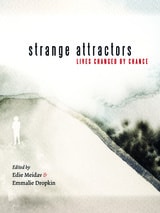
Has a stunning surprise or lucky encounter ever propelled you in an unanticipated direction? Are you doing what you always thought you would be doing with your life or has some unseen magnetism changed your course? And has that redirection come to seem inevitable? Edie Meidav and Emmalie Dropkin asked leading contemporary writers to consider these questions, which they characterize through the metaphor of “the strange attractor,” a scientific theory describing an inevitable occurrence that arises out of chaos. Meidav's introduction and the thirty-five pieces collected here offer imaginative, arresting, and memorable replies to this query, including guidance from a yellow fish, a typewriter repairman, a cat, a moose, a bicycle, and a stranger on a train. Absorbing and provocative, this is nonfiction to be read in batches and bursts and returned to again and again.
Stray Truths
Selected Poems of Euphrase KezilahabiAnnmarie Drury
Michigan State University Press, 2015
Stream
Living in FluxCallum Angus
Northwestern University Press, 2027
A nonfiction work examining a confluence of bodily and worldwide transition
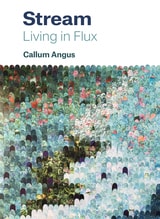
Stream is an exploration of the large- and small-scale changes taking place in a single body and on our planet as a whole. Using a stream as a biological, technological, and psychological metaphor, Angus layers lyric essay, journal entries, and the detritus of a life spent writing about the climate within and without to consider how we remain fluid in a time of constant change. Each section of Stream flows into the next, weaving through thaws, floods, cataracts, and eddies while asking how a melting of rigid categories, from seasons to gender, might help us approach a changing world anew. From winery workers dying in the fields to endangered desert tortoises unable to outrun the flames, Stream is an outpouring of climatological grief toward those who perpetuate inaction, an elegy for those we’ve lost to the heat, and a tribute to the tributaries that help us see the world from other perspectives.
Strung Together
The Cultural Currency of String Theory as a Scientific ImaginarySean Miller
University of Michigan Press, 2013
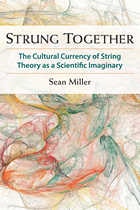
In Strung Together: The Cultural Currency of String Theory as a Scientific Imaginary, Sean Miller examines the cultural currency of string theory, both as part of scientific discourse and beyond it. He demonstrates that the imaginative component of string theory is both integral and indispensable to it as a scientific discourse. While mathematical arguments provide precise prompts for physical intervention in the world, the imaginary that supplements mathematical argument within string theory technical discourse allows theorists to imagine themselves interacting with the cosmos as an abstract space in such a way that strings and branes as phenomena become substantiated and legitimized. And it is precisely this sort of imaginary—which Miller calls a scientific imaginary—duly substantiated and acculturated, that survives the move from string theory technical discourse to popularizations and ultimately to popular and literary discourses. In effect, a string theory imaginary legitimizes the science itself and helps to facilitate a virtual domestication of a cosmos that was heretofore remote, alien, and incomprehensible.

Studies in Criticism and Aesthetics, 1660-1800
Essays in Honor of Samuel Holt MonkHoward Anderson and John S. Shea, Editors
University of Minnesota Press, 1967
Studies in Criticism and Aesthetics, 1660–1800 was first published in 1967. Minnesota Archive Editions uses digital technology to make long-unavailable books once again accessible, and are published unaltered from the original University of Minnesota Press editions.
In this volume nineteen contributors, in as many essays, discuss various aspects of critical and aesthetic development in the late seventeenth and the eighteenth centuries, from the time of Dryden to Wordsworth. This was a period in which traditional literary criticism progressed in important new directions and which saw the rise of aesthetic theory. The book is published in honor of Samuel Holt Monk, professor of English at the University of Minnesota, and distinguished American scholar in the field of eighteenth century English literature, literary criticism, and aesthetics.
The essays, all of which were written for this volume, analyze the literary theories and assumptions of some of the most important artists and critics of the time, as well as the aesthetic theories which influenced painting and literature. During the period under discussion, the progress of social and philosophical thought stimulated an intensive examination of the nature and function of art. Although neoclassical ideals dominated Restoration criticism and continued to influence Pope and later critics like Johnson and Reynolds, other tendencies were gaining ground, and throughout the eighteenth century the effort to reconcile a growing interest in "the pleasing emotions" with the tenets of classicism created criticism and aesthetic theory of extraordinary complexity. These essays illuminate that complexity without oversimplifying it.
The book is illustrated with reproductions of works of art of the period. In addition to the essays, there is a bibliography of Professor Monk's writings.
Studies in English Philology
A Miscellany in Honor of Frederick KlaeberKemp Malone and Martin B. Ruud, Editors
University of Minnesota Press, 1929
Studies in English Philology was first published in 1929. Minnesota Archive Editions uses digital technology to make long-unavailable books once again accessible, and are published unaltered from the original University of Minnesota Press editions.
Studies in Medieval and Renaissance History
Volume 13Joel T. Rosenthal
Arizona Center for Medieval and Renaissance Studies, 2018

Subject/Object and Beyond
Women in Early Modern FranceEdited by Nancy M. Frelick and Edith Benkov
Iter Press, 2023
Subject/Object and Beyond brings together essays by established and emerging scholars to honor the exceptionally rich contributions and career of scholar Colette H. Winn. It also celebrates fifty years of sustained scholarship on early modern women, along with the foundation of Women’s Studies as a recognized academic discipline in North America. The collection comprises seventeen articles that explore multiple perspectives on early modern women, including their writings, translations, reception, and contributions to various fields, including literature, music, politics, religion, and science.
Subjects on Display
Psychoanalysis, Social Expectation, and Victorian FemininityBeth Newman
Ohio University Press, 2004
Subjects on Display explores a recurrent figure at the heart of many nineteenth-century English novels: the retiring, self-effacing woman who is conspicuous for her inconspicuousness. Beth Newman draws upon both psychoanalytic theory and recent work in social history as she argues that this paradoxical figure, who often triumphs over more dazzling, eye-catching rivals, is a response to the forces that made personal display a vexed issue for Victorian women. Chief among these is the changing socioeconomic landscape that made the ideal of the modest woman outlive its usefulness as a class signifier even as it continued to exert moral authority.
This problem cannot be grasped in its full complexity, Newman shows, without considering how the unstable social meanings of display interacted with psychical forces-specifically, the desire to be seen by others that is central to both masculine and feminine subjectivity. This desire raises an issue that feminist theorists have been reluctant to address: the importance of pleasure in being the object of the look. Their reluctance is characteristic of cultural theory, which has tended to equate subjectivity with the position of the observer rather than the observed.
Through a consideration of fiction by Charlotte Brontë, Charles Dickens, George Eliot, and Henry James, Newman shifts the inquiry toward the observed in the experience of being seen. In the process she reopens the question of the gaze and its relation to subjectivity.
Subjects on Display will appeal to scholars and students in several disciplines as it returns psychoanalysis to a central position within literary and cultural studies.
Summers with Juliet
Bill Roorbach
The Ohio State University Press, 2000
Supremely Tiny Acts
A Memoir of a DaySonya Huber
The Ohio State University Press, 2021
“I think we have to get to the real, to catch the facts we have, to hold on to what we see. . . .in this time where lies are currency,” Sonya Huber writes in her book-length essay Supremely Tiny Acts: A Memoir of a Day. On the theory that naming the truths of quotidian experience can counter the dangerous power of lies, she carefully recounts two anxiety-fueled days one fall. On the first, she is arrested as part of a climate protest in Times Square. On the other, she must make it to her court appearance while also finding time to take her son to get his learner's permit. Paying equal attention to minor details, passing thoughts, and larger political concerns around activism and parenting in the Trump-era United States, Huber asks: How can one simultaneously be a good mother, a good worker, and a good citizen? As she reflects on the meaning of protest and on whiteness and other forms of privilege within political activism, Huber offers a wry, self-aware, and stirring testament to the everyday as a seedbed for meaningful change.
Surrealism in Greece
An AnthologyEdited and translated by Nikos Stabakis
University of Texas Press, 2008
In the decades between the two World Wars, Greek writers and artists adopted surrealism both as an avant-garde means of overturning the stifling traditions of their classical heritage and also as a way of responding to the extremely unstable political situation in their country. Despite producing much first-rate work throughout the rest of the twentieth century, Greek surrealists have not been widely read outside of Greece. This volume seeks to remedy that omission by offering authoritative translations of the major works of the most important Greek surrealist writers.
Nikos Stabakis groups the Greek surrealists into three generations: the founders (such as Andreas Embirikos, Nikos Engonopoulos, and Nicolas Calas), the second generation, and the Pali Group, which formed around the magazine Pali. For each generation, he provides a very helpful introduction to the themes and concerns that animate their work, as well as concise biographies of each writer. Stabakis anthologizes translations of all the key surrealist works of each generation—poetry, prose, letters, and other documents—as well as a selection of rarer texts. His introduction to the volume places Greek surrealism within the context of the international movement, showing how Greek writers and artists used surrealism to express their own cultural and political realities.
Surrender (But Don't Give Yourself Away)
Old Cars, Found Hope, and Other Cheap TricksBy Spike Gillespie
University of Texas Press, 2003
Spike Gillespie tells it like it is. Whether she's writing about men, mothering or money, she cuts to the chase, unabashedly recounting the exhilaration and uncertainty she is forever encountering along the odd path that is her life. Gillespie approaches her subjects with a keen eye for curious details and a readiness to ask hard questions and give honest, even brutal, answers. Her willingness to "put it all down—the painful, the funny, the mundane, the embarrassing" has won legions of readers for her print and online columns.
Surrender (But Don't Give Yourself Away) collects forty-six essays, which initially appeared in such publications as the Washington Post, Austin Chronicle, Dallas Morning News, Bust, Gargoyle, and thecommonspace.org. As Gillespie describes them, "There are odes to my good days and bad, to trips I've taken—both real and metaphorical, to holiness found in unexpected places, to men I have not slept with, to learning to live sober. Too, there are miscellaneous ruminations on my alter-ego, my inner-teen, the floor mat in my car, a dead squirrel in the road." Binding these pieces is the thread of hope: there are moments the thread slips out of view only to resurface in some unexpected location. Sometimes it takes awhile, but Gillespie always relocates hope, discovering even in her darkest times that life is full of an embarrassment of riches.
Sustainability
A Love StoryNicole Walker
The Ohio State University Press, 2018
This book is for the burnt-out environmentalist, the lazy environmentalist, the would-be environmentalist. It’s for those who believe the planet is dying. For those who believe they are dying. And for those who question what it means to live and love sustainably, and maybe even with hope.
Swahili Beyond the Boundaries
Literature, Language, and IdentityAlamin Mazrui
Ohio University Press, 2007
Swahili literature is a hybrid that is being reconfigured by a conjuncture of global and local forces. As the interweaving of elements of the colonizer and the colonized, this hybrid formation provides a representation of cultural difference that is said to constitute a “third space,” blurring existing boundaries and calling into question established identitarian categorizations. This cultural dialectic is clearly evident in the Swahili literary experience as it has evolved in the crucible of the politics of African cultural production.
However, Swahili Beyond the Boundaries demonstrates that, from the point of view of Swahili literature, while hybridity evokes endless openness on questions of home and identity, it can simultaneously put closure on specific forms of subjectivity. In the process of this contestation, a new synthesis may be emerging that is poised to subject Swahili literature to new kinds of challenges in the politics of identity, compounded by the dynamics and counterdynamics of post–Cold War globalization.
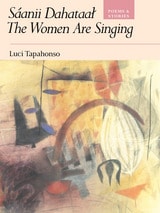
Sáanii Dahataal/The Women Are Singing
Poems and StoriesLuci Tapahonso
University of Arizona Press, 1993
Luci Tapahonso shows how the details of everyday life—whether the tragedy of losing a loved one or the joy of raising children, or simply drinking coffee with her uncle—bear evidence of cultural endurance and continuity. Through her work, readers may come to better appreciate the different perceptions that come from women's lives.