Results by title
1668 books match the query 'Popular culture' and 125 start with s
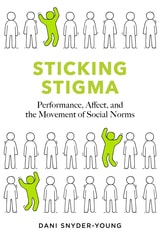
Sticking Stigma
Performance, Affect, and the Movement of Social NormsDani Snyder-Young
Vanderbilt University Press, 2026
Applied theater projects have been used to reduce the stigma related to many health conditions including bipolar disorder, HIV, suicide bereavement, mental illness, autism, and substance use disorder. Beyond this applied theater tradition, theater and performance studies tend not to use the framework or language of stigma very often. Stigma is a more commonly used framework in social science fields such as health and sociology. However, theater and performance regularly attends to the material and affective violence of stigma power: oppression, dispossession, abjection, objectification, expulsion. Snyder-Young examines a set of activist performance projects attempting to use the force of stigma to redistribute and recenter social power.
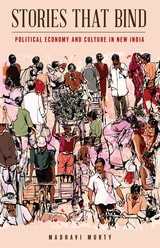
Stories That Bind
Political Economy and Culture in New IndiaMadhavi Murty
Rutgers University Press, 2022
Moving between mediascapes to create an archive of popular culture, Murty advances our understanding of political economy through material that is often seen as inconsequential, namely the popular cultural story. These stories stoke our desires (e.g. for wealth), scaffold our instincts (e.g. for a strong leadership) and shape our values.

Straight Korean Female Fans and Their Gay Fantasies
Jungmin Kwon
University of Iowa Press, 2019
The FANtasy subculture started forming around text-based media, such as yaoi, fan fiction, and U.S. gay-themed dramas (like Will & Grace), and has been influenced by diverse social, political, and economic conditions, such as the democratization of Korea, an open policy toward foreign media products, the diffusion of consumerism, government investment in the culture, the Hollywoodization of the film industry, and the popularity of Korean culture abroad. While much scholarly attention has been paid to female fandom for homoerotic cultural texts in many countries, this book seeks to explore a relatively neglected aspect of the subculture: its location in and influence on Korean society at large.
Streaming at the End of the World
Cinema in the Age of ChaosAlex Sayf Cummings
Rutgers University Press, 2027
Streaming at the End of the World explores the pessimistic and often apocalyptic themes that have pervaded popular culture in the United States and global cinema in the new millennium. The book argues that recent films, from the art-house fare of Melancholia (2011) to the popular science fiction of Annihilation (2018), embody an ambient feeling that continually haunts people in today's capitalist world—an ineluctable impression there is no alternative to the status quo. It seems like nothing is ever really going to change; hence, we are drawn to visions of the end of everything. Written in an accessible, conversational style, this book offers a popular culture spin on the late British philosopher Mark Fisher's maxim that it’s "easier to imagine an end to the world than an end to capitalism."

Street Fight
Mean America and the War on Sesame StreetMichael Davis
Rutgers University Press, 2027
Street Fight is muscularly reported journalism trained on the people and events that shaped Sesame Street from the 1990s to the present. Expanding from Street Gang, Michael Davis’s acclaimed origin story of the series, this revelatory new book probes deeply into the decisions made by Sesame Workshop, the New York-based corporate non-profit that has weathered political and financial storms, all while upholding aspirational values instilled in the late-1960s.
Hundreds of eyewitnesses provide on-the-record recollections of the show’s evolution in the narrative and a series of chapter-ending oral histories.
Interwoven are passages of time-tested alliances, courtships and marriages, the back stories of the artists who provided the show’s melodies and lyrics. That, plus plenty of dish about the performers behind Muppets of Sesame Street, and how Jim Henson, decades after his shocking passing in 1990, is a spectral figure quite powerful in spirit.
Laughter and tears – in equal measure – await readers.
Street Smarts and Critical Theory
Listening to the VernacularThomas McLaughlin
University of Wisconsin Press, 1996
Everybody’s got a theory . . . or do they?
Thomas McLaughlin argues that critical theory—raising serious, sustained questions about cultural practice and ideology—is practiced not only by an academic elite but also by savvy viewers of sitcoms and TV news, by Elvis fans and Trekkies, by labor organizers and school teachers, by the average person in the street.
Like academic theorists, who are trained in a tradition of philosophical and political skepticism that challenges all orthodoxies, the vernacular theorists McLaughlin identifies display a lively and healthy alertness to contradiction and propaganda. They are not passive victims of ideology but active questioners of the belief systems that have power over their lives. Their theoretical work arises from the circumstances they confront on the job, in the family, in popular culture. And their questioning of established institutions, McLaughlin contends, is essential and healthy, for it energizes other theorists who clarify the purpose and strategies of institutions and justify the existence of cultural practices.
Street Smarts and Critical Theory leads us through eye-opening explorations of social activism in the Southern Christian anti-pornography movement, fan critiques in the ‘zine scene, New Age narratives of healing and transformation, the methodical manipulations of the advertising profession, and vernacular theory in the whole-language movement. Emphasizing that theory is itself a pervasive cultural practice, McLaughlin calls on academic institutions to recognize and develop the theoretical strategies that students bring into the classroom.
“This book demystifies the idea of theory, taking it out of the hands of a priestly caste and showing it as the democratic endowment of the people.”—Daniel T. O’Hara, Temple University, author of Radical Parody: American Culture and Critical Agency after Foucault and Lionel Trilling: The Work of Liberation.
“McLaughlin takes seriously the critical and theoretical activity of everyday people and does so in a way that will empower these very populations to take seriously their own activities as theorists. . . . A manifesto that is sure to be heard by the younger generation of thinkers in American cultural studies.”—Henry Jenkins, MIT, author of Textual Poachers: Television Fans and Participatory Culture

Struggle over Identity
The Official and the Alternative "Belarusianness"Nelly Bekus
Central European University Press, 2010
Rejecting the cliché about “weak identity and underdeveloped nationalism,” Bekus argues for the co-existence of two parallel concepts of Belarusianness—the official and the alternative one—which mirrors the current state of the Belarusian people more accurately and allows for a different interpretation of the interconnection between the democratization and nationalization of Belarusian society.
The book describes how the ethno-symbolic nation of the Belarusian nationalists, based on the cultural capital of the Golden Age of the Belarusian past (17th century) competes with the “nation” institutionalized and reified by the numerous civic rituals and social practices under the auspices of the actual Belarusian state.
Comparing the two concepts not only provides understanding of the logic that dominates Belarusian society’s self-description models, but also enables us to evaluate the chances of alternative Belarusianness to win this unequal struggle over identity.
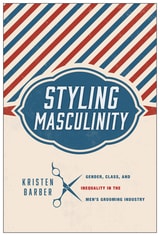
Styling Masculinity
Gender, Class, and Inequality in the Men's Grooming IndustryBarber, Kristen
Rutgers University Press, 2016
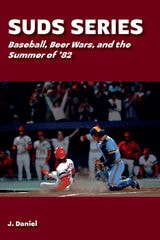
Suds Series
Baseball, Beer Wars, and the Summer of '82J. Daniel
University of Missouri Press, 2023
Even nominal baseball fans will enjoy reading about legendary players, teams, and personalities that emerged in the 1982 season: the year Ricky Henderson stole 130 bases; Reggie Jackson led the league in home runs; and Cal Ripken Jr. began his remarkable playing streak. Readers will also enjoy the cultural references, including the Pac-Man craze, a chart-topping album by Rush, and the “Light Beer Wars” waged by Anheuser-Busch and the Miller Brewing Company through a series of humorous TV commercials featuring well-loved professional sports figures.
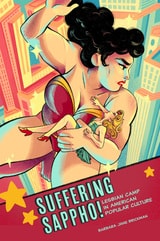
Suffering Sappho!
Lesbian Camp in American Popular CultureBarbara Jane Brickman
Rutgers University Press, 2024
Offering the first major consideration of lesbian camp in American popular culture, Suffering Sappho! traces a larger-than-life lesbian menace across midcentury media forms to propose five prototypical queer icons—the sicko, the monster, the spinster, the Amazon, and the rebel. On the pages of comics and sensational pulp fiction and the dramas of television and drive-in movies, Barbara Jane Brickman discovers evidence not just of campy sexual deviants but of troubling female performers, whose failures could be epic but whose subversive potential could inspire.
Supplemental images of interest related to this title: George and Lomas; Connie Minerva; Cat On Hot Tin; and Beulah and Oriole.



Sundae Best
History of Soda FountainsAnne Cooper Funderburg
University of Wisconsin Press, 2001
The evolution of the soda fountain reflected momentous developments in American history— urbanization, the temperance movement and Prohibition, the Great Depression, technical progress, the decline of Main Street, and the rise of car culture and growth of suburbia. The fountain’s evolution was also closely tied to trends in retailing, food service, lifestyles, and the decorative arts.

Sundanese Print Culture and Modernity in 19th Century West Java
Mikihiro Moriyama
National University of Singapore Press, 2005
Starting with the 'discovery' of Sundanese by Europeans in the early 19th century, Mikihiro Moriyama follows the developments in the ensuing century when a small group of Dutch scholars and colonial officials reshaped the language and its literature over the next one hundred years. Schools taught Sundanese, and printed materials based on western concepts began to influence indigenous writing and oral tradition. The imposition of European standards of literary aesthetics shaped a modernity that rejected traditional knowledge in favour of rational and empirical paradigms. Interest in traditional poetry and its mythologies declined, and new forms of prose, including novels, captured the attention of the reading public. These materials promoted useful knowledge and morality, and encouraged deference and loyalty towards colonial authority.
Early in the 20th century, the establishment of the Commissie voor de Inlandsche School- en Volkslectuur (Committee for Indigenous Schoolbooks and Popular Reading Books), a government-subsidised institution, provided the growing number of literate people in the Indies with 'good' and 'appropriate' reading materials. Its development marked the end of an era when Sundanese writing competed with Western-style schools and publications, and signalled the triumph of the new colonial modernity.
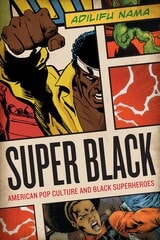
Super Black
American Pop Culture and Black SuperheroesBy Adilifu Nama
University of Texas Press, 2011
Winner, American Book Award, Before Columbus Foundation, 2012
Super Black places the appearance of black superheroes alongside broad and sweeping cultural trends in American politics and pop culture, which reveals how black superheroes are not disposable pop products, but rather a fascinating racial phenomenon through which futuristic expressions and fantastic visions of black racial identity and symbolic political meaning are presented. Adilifu Nama sees the value—and finds new avenues for exploring racial identity—in black superheroes who are often dismissed as sidekicks, imitators of established white heroes, or are accused of having no role outside of blaxploitation film contexts.
Nama examines seminal black comic book superheroes such as Black Panther, Black Lightning, Storm, Luke Cage, Blade, the Falcon, Nubia, and others, some of whom also appear on the small and large screens, as well as how the imaginary black superhero has come to life in the image of President Barack Obama. Super Black explores how black superheroes are a powerful source of racial meaning, narrative, and imagination in American society that express a myriad of racial assumptions, political perspectives, and fantastic (re)imaginings of black identity. The book also demonstrates how these figures overtly represent or implicitly signify social discourse and accepted wisdom concerning notions of racial reciprocity, equality, forgiveness, and ultimately, racial justice.
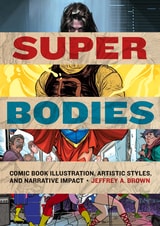
Super Bodies
Comic Book Illustration, Artistic Styles, and Narrative ImpactJeffrey A. Brown
University of Texas Press, 2023
Finalist — San Diego Comic-Con International 2024 Eisner Award in Best Academic/Scholarly Work
2024 MPCA/ACA Best Book for Use in the Classroom, Midwest Popular Culture Association / Midwest American Culture Association (MPCA/ACA)
An examination of the art in superhero comics and how style influences comic narratives.
For many, the idea of comic book art implies simplistic four-color renderings of stiff characters slugging it out. In fact, modern superhero comic books showcase a range of complex artistic styles, with diverse connotations. Leading comics scholar Jeffrey A. Brown assesses six distinct approaches to superhero illustration—idealism, realism, cute, retro, grotesque, and noir—examining how each visually represents the superhero as a symbolic construct freighted with meaning.
Whereas comic book studies tend to focus on text and narrative, Super Bodies gives overdue credit to the artwork, which is not only a principal source of the appeal of comic books but also central to the values these works embody. Brown argues that superheroes are to be taken not as representations of people but as iconic types, and the art conveys this. Even the most realistic comic illustrations are designed to suggest not persons but ideas—ideas about bodies and societies. Thus the appearance of superheroes both directly and indirectly influences the story being told as well as the opinions readers form concerning justice, authority, gender, puberty, sexuality, ethnicity, violence, and other concepts central to political and cultural life.
Superhero Ethics
10 Comic Book Heroes; 10 Ways to Save the World; Which One Do We Need Most Now?Travis Smith
Templeton Press, 2018
Although these outlandish figures—in their capes, masks, and tights, with their unbelievable origins and preternatural powers—are often dismissed as juvenile amusements, they really are profound metaphors for different approaches to shaping one’s character and facing the challenges of life.
But, given the choice, which superhero should we follow today? Who is most worthy of our admiration? Whose goals are most noble? Whose ethics should we strive to emulate?
To decide, Travis Smith takes ten top superheroes and pits them one against another, chapter by chapter. The hero who better exemplifies how we ought to live advances to the final round. By the end of the book, a single superhero emerges victorious and is crowned most exemplary for our times.
How, then, shall we live?
- How can we overcome our beastly nature and preserve our humanity? (The Hulk vs. Wolverine)
- How far can we rely on our willpower and imagination to improve the human condition? (Iron Man vs. Green Lantern)
- What limits must we observe when protecting our neighborhood from crime and corruption? (Batman vs. Spider-Man)
- Will the pursuit of an active life or a contemplative life bring us true fulfillment? (Captain America vs. Mr. Fantastic)
- Should we put our faith in proven tradition or in modern progress to achieve a harmonious society? (Thor vs. Superman)
Superhero Thought Experiments
Comic Book PhilosophyChris Gavaler and Nathaniel Goldberg
University of Iowa Press, 2019

Superheroes and Contemporary Cultures
Cross-Medial Explorations and Societal PerspectivesEdited by Torsten Caeners and Danny Graydon
Intellect Books, 2026
Offering a global and interdisciplinary perspective on the superhero genre across comics, television, and film, this book presents a diverse range of contemporary superhero scholarship. It combines close readings of iconic characters like Batman, Iron Man, and The Watchmen with critical analysis of broader cultural and societal discourses.
The volume explores how superheroes reflect and problematize ideology, the military-industrial complex, and notions of public and private responsibility. Key themes include identity construction through secret identities and masking, as well as cultural and personal grief and trauma in relation to race and politics. Designed for students, scholars, and fans alike, this work reveals the enduring mainstream appeal of superheroes and their complex intersections with global popular culture.
Superman
The Persistence of an American IconGordon, Ian
Rutgers University Press, 2017
Superman: Persistence of an American Icon examines the many iterations of the character in comic books, comic strips, radio series, movie serials, feature films, television shows, animation, toys, and collectibles over the past eight decades. Demonstrating how Superman’s iconic popularity cannot be attributed to any single creator or text, comics expert Ian Gordon embarks on a deeper consideration of cultural mythmaking as a collective and dynamic process. He also outlines the often contentious relationships between the various parties who have contributed to the Superman mythos, including corporate executives, comics writers, artists, nostalgic commentators, and collectors.
Armed with an encyclopedic knowledge of Superman’s appearances in comics and other media, Gordon also digs into comics archives to reveal the prominent role that fans have played in remembering, interpreting, and reimagining Superman’s iconography. Gordon considers how comics, film, and TV producers have taken advantage of fan engagement and nostalgia when selling Superman products. Investigating a character who is equally an icon of American culture, fan culture, and consumer culture, Superman thus offers a provocative analysis of mythmaking in the modern era.
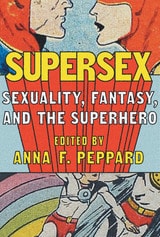
Supersex
Sexuality, Fantasy, and the SuperheroEdited by Anna F. Peppard
University of Texas Press, 2020
2021 Comic Studies Society Prize for Edited Collection
From Superman and Batman to the X-Men and Young Avengers, Supersex interrogates the relationship between heroism and sexuality, shedding new light on our fantasies of both.
From Superman, created in 1938, to the transmedia DC and Marvel universes of today, superheroes have always been sexy. And their sexiness has always been controversial, inspiring censorship and moral panic. Yet though it has inspired jokes and innuendos, accusations of moral depravity, and sporadic academic discourse, the topic of superhero sexuality is like superhero sexuality itself—seemingly obvious yet conspicuously absent. Supersex: Sexuality, Fantasy, and the Superhero is the first scholarly book specifically devoted to unpacking the superhero genre’s complicated relationship with sexuality.
Exploring sexual themes and imagery within mainstream comic books, television shows, and films as well as independent and explicitly pornographic productions catering to various orientations and kinks, Supersex offers a fresh—and lascivious—perspective on the superhero genre’s historical and contemporary popularity. Across fourteen essays touching on Superman, Batman, the X-Men, and many others, Anna F. Peppard and her contributors present superhero sexuality as both dangerously exciting and excitingly dangerous, encapsulating the superhero genre’s worst impulses and its most productively rebellious ones. Supersex argues that sex is at the heart of our fascination with superheroes, even—and sometimes especially—when the capes and tights stay on.
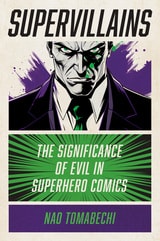
Supervillains
The Significance of Evil in Superhero ComicsNao Tomabechi
Rutgers University Press, 2025
Bringing together different approaches and critical perspectives across disciplines, author Nao Tomabechi troubles overly hero-centered works in comics studies to reconsider the modern American myths of the superheroes. Considering the likes of Lex Luthor, the Joker, Catwoman, Harley Quinn, Loki, Venom, and more, Supervillians explores themes such as gender and sexuality, disability, and many forms of Otherness in relation to the notion of evil as it appears in the superhero genre. The book investigates how supervillains uphold and, at times, trouble dominant ideals expressed by the heroism of our superheroes.

Suspense in the Formula Story
George N. Dove
University of Wisconsin Press, 1989
Swift Viewing
The Popular Life of Subliminal InfluenceCharles R. Acland
Duke University Press, 2012
Swingin' the Dream
Big Band Jazz and the Rebirth of American CultureLewis A. Erenberg
University of Chicago Press, 1998
"Swingin' the Dream is an intelligent, provocative study of the big band era, chiefly during its golden hours in the 1930s; not merely does Lewis A. Erenberg give the music its full due, but he places it in a larger context and makes, for the most part, a plausible case for its importance."—Jonathan Yardley, Washington Post Book World
"An absorbing read for fans and an insightful view of the impact of an important homegrown art form."—Publishers Weekly
"[A] fascinating celebration of the decade or so in which American popular music basked in the sunlight of a seemingly endless high noon."—Tony Russell, Times Literary Supplement
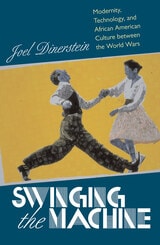
Swinging the Machine
Modernity, Technology, and African American Culture between the World WarsJoel Dinerstein
University of Massachusetts Press, 2003
In any age and any given society, cultural practices reflect the material circumstances of people's everyday lives. According to Joel Dinerstein, it was no different in America between the two World Wars—an era sometimes known as the “machine age”—when innovative forms of music and dance helped a newly urbanized population cope with the increased mechanization of modern life. Grand spectacles such as the Ziegfeld Follies and the movies of Busby Berkeley captured the American ethos of mass production, with chorus girls as the cogs of these fast, flowing pleasure vehicles.
Yet it was African American culture, Dinerstein argues, that ultimately provided the means of aesthetic adaptation to the accelerated tempo of modernity. Drawing on a legacy of engagement with and resistance to technological change, with deep roots in West African dance and music, black artists developed new cultural forms that sought to humanize machines. In “The Ballad of John Henry,” the epic toast “Shine,” and countless blues songs, African Americans first addressed the challenge of industrialization. Jazz musicians drew on the symbol of the train within this tradition to create a set of train-derived aural motifs and rhythms, harnessing mechanical power to cultural forms. Tap dance and the lindy hop brought machine aesthetics to the human body, while the new rhythm section of big band swing mimicked the industrial soundscape of northern cities. In Dinerstein's view, the capacity of these artistic innovations to replicate the inherent qualities of the machine-speed, power, repetition, flow, precision-helps explain both their enormous popularity and social function in American life.
Symbiosis
Popular Culture and Other FieldsRay B. Browne
University of Wisconsin Press, 1988