Results by title
4743 books match the query 'Religion' and 324 start with s
Selected Works
Robert B. Fulgentius
Catholic University of America Press, 1997

Selected Works of Abbot Suger of Saint-Denis
Letters and ChartersEric Abbot Suger of Saint-Denis
Catholic University of America Press, 2025
Self as Nation
Contemporary Hebrew AutobiographyTamar S. Hess
Brandeis University Press, 2016
Self-Determination and Women’s Rights in Muslim Societies
Edited by Chitra Raghavan and James P. Levine
Brandeis University Press, 2012
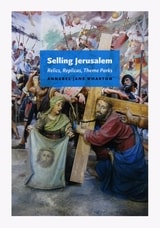
Selling Jerusalem
Relics, Replicas, Theme ParksAnnabel Jane Wharton
University of Chicago Press, 2006
From relics of the True Cross and Templar replicas of the Holy Sepulchre to Franciscan recreations of the Passion to nineteenth-century mass-produced prints and contemporary theme parks, Wharton describes the evolving forms by which the city has been possessed in the West. She also maps those changing embodiments of the Holy City against shifts in the western market. From the gift-and-barter economy of the early Middle Ages to contemporary globalization, both money and the representations of Jerusalem have become progressively incorporeal, abstract, illusionistic, and virtual.
Selling Jerusalem offers a penetrating introduction to the explosive combination of piety and capital at work in religious objects and global politics. It is sure to interest students and scholars of art history, economic history, popular culture, religion, and architecture, as well as those who want to better understand Jerusalem’s problematic place in history.
Semeia 47
Interpretation for LiberationKatie Geneva Cannon
SBL Press, 1989
Semeia 83/84
Slavery in Text and InterpretationAllen Dwight Callahan
SBL Press, 2001
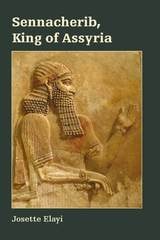
Sennacherib, King of Assyria
Josette Elayi
SBL Press, 2018
A critical resource for students and scholars of the ancient Near East and the Bible
Josette Elayi’s Sennacherib, King of Assyria is the only biography of Sargon II’s famous son. Elayi traces the reign of Sennacherib in context in order to illuminate more fully the life and contributions of this warlord, builder, innovator, and social reformer—a unique figure among the Assyrian kings. Elayi offers both an evaluation of this royal figure and an assessment of the Assyrian Empire by interpreting the historical information surrounding the decisive events of his reign.
Features:
- Exploration of why Sennacherib did not seize Jerusalem or remove Hezekiah from the throne
- An extensive investigation of annals, royal inscriptions, letters, palace reliefs, clay tablets, and excavation reports
- Maps and tables
Sensational Devotion
Evangelical Performance in Twenty-First-Century AmericaJill Stevenson
University of Michigan Press, 2015
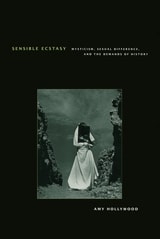
Sensible Ecstasy
Mysticism, Sexual Difference, and the Demands of HistoryAmy Hollywood
University of Chicago Press, 2001
What is particular to these thinkers, Hollywood reveals, is their attention to forms of mysticism associated with women. They regard mystics such as Angela of Foligno, Hadewijch, and Teresa of Avila not as emotionally excessive or escapist, but as unique in their ability to think outside of the restrictive oppositions that continue to afflict our understanding of subjectivity, the body, and sexual difference. Mystics such as these, like their twentieth-century descendants, bridge the gaps between action and contemplation, emotion and reason, and body and soul, offering new ways of thinking about language and the limits of representation.
Sensing World, Sensing Wisdom
The Cognitive Foundation of Biblical MetaphorsNicole L. Tilford
SBL Press, 2017
Examine new insights into the conceptual worldview of biblical wisdom communities
The Bible is full of metaphors. On the surface, these metaphors seem like simple literary flourishes that have been added to the text for artistic effect. This book, however, argues that biblical metaphors reflect more basic, prelinguistic cognitive structures. These conceptual metaphors developed out of common concrete experiences and only gradually developed into the complex metaphors that one finds within biblical texts. This book explores how common sensory activities like seeing, hearing, touching, eating, breathing, and walking developed into the abstract metaphors for wisdom that one finds in Proverbs, Job, and Qohelet. Because it traces the cognitive development of a set of related metaphors across several congruent texts, it provides a model by which scholars can trace the cognitive development of biblical metaphors more generally in the Hebrew Bible and other early Jewish and Christian texts.
Features:
- A synthesis of conceptual metaphor theory that provides a workable theory for examining biblical texts
- An analytical framework for studying sensory experience and sensory metaphors in biblical texts
- Diagrams

Separating Church and State
ROGER WILLIAMS AND RELIGIOUS LIBERTYTimothy L. Hall
University of Illinois Press, 1998
apostle of religious tolerance and a foe of religious establishments.
In Separating Church and State, Timothy Hall combines impressive
historical and legal scholarship to explore Williams's theory of religious
liberty and relate it to current debate. Williams's fierce religious dogmaticism,
Hall argues, is precisely what led to his religious tolerance, making
him one of the most articulate champions of the argument for the necessary
separation of church and state.
"Both timely and provocative. . . . Offers Williams's largely overlooked
but deeply important perspective on the peaceful coexistence of committed
believers of diverse faiths. The book also brings into question crucial
tenets of the United States Supreme Court's First Amendment religion clause
jurisprudence at a time when many are raising questions about it."
-- Marci A. Hamilton, Benjamin N. Cardozo School of Law, New York City
"Hall has the entire Williams corpus under his command, and he plays
the relevant texts like a master organist. He also has the legal corpus
equally at his fingertips. One of the great strengths of his book is that
it bridges the too often separate fields of history and jurisprudence."
-- Edwin Gaustad, author of Liberty of Conscience: Roger Williams in
America

Separation of Church and State
Dina de-Malkhuta Dina in Jewish LawGil Graff
University of Alabama Press, 1985
Exploring the enduring dialogue between Jewish law and the law of the state.
For the Jewish community, the end of the Middle Ages and the emergence of the modern nation-state brought the promise of equal citizenship as well as the possible loss of Jewish corporate identity. The legal maxim dina de-malkhuta dina (the law of the State is law) invoked in Talmidic times to justify the acceptance of the king’s law and qualified in the Middle Ages by Maimonides and Rashbam to include the requirement of consent by the governed underwent further redefinition by Jews in the Napoleonic age. Graff focuses on the struggle between 18th and 19th-century Jewish religious reformers and traditionalists in defining the limits of dina de-malkhuta dina. He traces the motivations of the reformers who, in their zeal to gain equality for the formerly disenfranchised Jewish communities in Western Europe, were prepared to render unto the State compromising authority over Jewish religious life under the rubric of dina de-malkhuta dina was intended to strike a balance between synagogue and state and not to be used as a pretext for the liquidation of the community’s corporate existence.
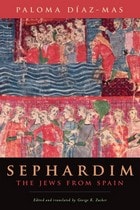
Sephardim
The Jews from SpainPaloma Díaz-Mas
University of Chicago Press, 1992
Sepher Ha-Razim
The Book of MysteriesMichael A. Morgan
SBL Press, 1983
Septuagint Theology and Its Reception
Stellenbosch Congress on the Septuagint, 2022Johann Cook
SBL Press, 2024
In this follow-up to Toward a Theology of the Septuagint: Stellenbosch Congress on the Septuagint, 2018 (2020), contributors demonstrate what a theology of the Septuagint should look like. Essays address questions of methodology, and case studies from different books show the relevance and benefits of a theological approach. Examples are drawn from Exodus, Deuteronomy, Proverbs, Job, Tobit, 1 and 2 Maccabees, Hosea, Ezekiel, Daniel, and Ben Sira. Contributors include Nicholas Peter Legh Allen, Bryan Beeckman, Alma Brodersen, Johann Cook, Beate Ego, Karin Finsterbusch, Pierre Jordaan, Wolfgang Kraus, Jean Maurais, Cynthia L. Miller-Naudé, Mogens Müller, Jacobus A. Naudé, Peter Nagel, Larry Perkins, Martin Rösel, Barbara Schmitz, Frank Ueberschaer, Jan Willem van Henten, and Michael van der Meer.
Serbian Orthodox Fundamentals
The Quest for an Eternal IdentityChristos Mylonas
Central European University Press, 2003
Sermons
Saint Leo the Great
Catholic University of America Press, 1995
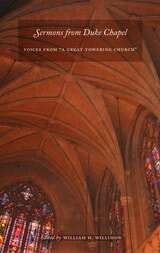
Sermons from Duke Chapel
Voices from "A Great Towering Church"William H. Willimon, ed.
Duke University Press, 2005
Opening with the sermon preached in June 1935 at the dedication of the Chapel and closing with one by Willimon delivered at the beginning of the 2003–04 school year, this volume presents Protestant Christianity at its most eloquent and prophetic. Some sermons are pure meditations on biblical texts; others are period pieces in the best sense of the term, reflecting on such contemporary concerns as civil rights, the assassinations of Martin Luther King Jr. and Robert F. Kennedy, and the wars in Europe, Vietnam, and Iraq. Willimon provides a brief introduction to each sermon, commenting on the work and thought of the preacher. Diverse in subject and style, the sermons collected in this volume are a treasure for those who love fine preaching, a resource for those studying the history of homiletics, and a light to rekindle the memories of those who have worshiped in the Chapel over the years.
Sermons on the Liturgical Seasons
Saint Augustine
Catholic University of America Press, 1959
Sermons, Volume 1 (1–80)
Saint Caesarius of Arles
Catholic University of America Press, 1956
Sermons, Volume 2 (81–186)
Saint Caesarius of Arles
Catholic University of America Press, 1964
Sermons, Volume 3 (187–238)
Saint Caesarius of Arles
Catholic University of America Press, 1973
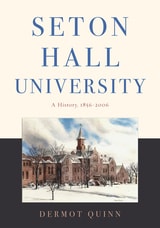
Seton Hall University
A History, 1856–2006Dermot Quinn
Rutgers University Press, 2023
In this vivid and elegantly written history, Dermot Quinn examines how Seton Hall was able to develop as an institution while keeping faith with its founder’s vision. Looking at the men and women who made Seton Hall what it is today, he paints a compelling picture of a university that has enjoyed its share of triumphs but has also suffered tragedy and loss. He shows how it was established in an age of prejudice and transformed in the aftermath of war, while exploring how it negotiated between a distinctly Roman Catholic identity and a mission to include Americans of all faiths.
Seton Hall University not only recounts the history of a great educational institution, it also shares the personal stories of the people who shaped it and were shaped by it: the presidents, the priests, the faculty, the staff, and of course, the students.
Seven Days, Many Voices
Insights into the Biblical Story of CreationRabbi Benjamin David
Central Conference of American Rabbis, 2017
Few stories are as compelling as the Creation story in the Book of Genesis. Our readings of Creation are incredibly diverse. This collection gives us a lens into a wide range of creative and inspiring thinking about Creation. Important thinkers such as Rabbi Arthur Waskow, Dr. Alyssa Gray, Rabbi Aaron Panken, PhD, Rabbi Mira Wasserman, PhD, Rabbi Jill Jacobs, and many others, examine the Creation story through fields of midrash, biblical criticism, literature, theology, climate justice, human rights, history, and science. This diverse collection of some of today's finest thinkers will challenge assumptions and spark new ideas. Great for individual study or community learning!
Seven Exegetical Works
Saint Ambrose
Catholic University of America Press, 1970
Seventh-day Adventism in Crisis
Gender and Sectarian Change in an Emerging ReligionLaura L. Vance
University of Illinois Press, 1999
Tracing the views of the church through its official and unofficial publications and through interviews with dozens of Adventist informants, Laura Vance reveals a significant shift around the turn of the century in women's roles advocated by the church: from active participation in the functioning, spiritual leadership, teaching, and evangelism of Adventism to an insistence on homemaking as a woman's sole proper vocation. These changes in attitude, Vance maintains, are inextricably linked to Adventism's shift from sect to church: in effect, to its maturation as a denomination.
Vance suggests that the reemergence of women in positions of influence within the church in recent decades should be viewed not as a concession to secular feminist developments but rather as a return to Adventism's earlier conception of gender roles. By examining changes in the movement's relationship with the world and with its own history, Seventh-day Adventism in Crisis offers a probing examination of how a sect founded on the leadership of women came to define women's roles in ways that excluded them from active public participation and leadership in the church.
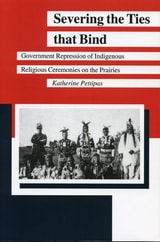
Severing the Ties that Bind
Government Repression of Indigenous Religious Ceremonies on the PrairiesKatherine Pettipas
University of Manitoba Press, 1994
Sex and Religion
Teachings and Taboos in the History of World FaithsDag Ølstein Endsjø
Reaktion Books, 2011
Sex and religion are inevitably and intricately linked. There are few realms of human experience other than sex in which religion has greater reach and influence. The role of religion, of any faith, to prohibit, regulate, condemn, and reward, is unavoidably prominent in questions of sex—namely with whom, when, how, and why. In Sex and Religion, Dag Øistein Endsjø examines the myriad and complex religious attitudes towards sex in cultures throughout the world.
Endsjø reflects on some of the most significantly problematic areas in the relationship between sex and religion—from sex before or outside of marriage to homosexuality. Through many examples from world religions, he outlines what people mean by sex in a religious context, with whom it’s permissible to have sex, how sex can be a directly religious experience, and what consequences there are for deviance, for both the individual and society. As Endsjø explains, while Buddhist monks call attention to gay sex as a holy mystery, the Christian church questions a homosexual’s place in the church. Some religions may believe that promiscuity leads to hurricanes and nuclear war, and in others God condemns interracial marriage. Sex and Religion reveals there is nothing natural or self-evident about the ways in which various religions prescribe or proscribe and bless or condemn different types of sexuality. Whether sex becomes sacred or abhorrent depends entirely on how a religion defines it.
Sex and Religion is a fascinating investigation of mores, meanings, rituals, and rules in many faiths around the globe, and will be of interest to anyone curious about the intersection of these fundamental aspects of human history and experience.
Sex and Virtue
An Introduction to Sexual Ethics (Catholic Moral Thought, Volume 2)John S. Grabowski
Catholic University of America Press, 2003
Sex, Celibacy, and Deviance
The Victorians and the Song of SongsDuc Dau
The Ohio State University Press, 2024
Sex, Celibacy, and Deviance is the first major study to explore the Song of Songs (or Song of Solomon) in Victorian literature and art. As the Bible’s only erotic poem, the Song of Songs is the canonical Judeo-Christian book about love, furnishing the Victorians with an authoritative and literary language for love, marriage, sex, mourning, and religious celibacy.
Duc Dau adopts a queer and feminist lens to consider how Victorians employed and interpreted the Song of Songs in their work. How did writers and artists fashion and, most importantly, challenge the norms of gender, romantic love, and marriage? Spanning the early Victorian era through the first two decades of the twentieth century, Sex, Celibacy, and Deviance considers the works of Charlotte Brontë, Thomas Hardy, Christina Rossetti, John Gray, Michael Field, Edward Burne-Jones, and Simeon Solomon alongside two lesser-known figures: Irish-born Scottish artist Phoebe Anna Traquair and the Catholic religious leader Augusta Theodosia Drane. By addressing the relevance of the Song of Songs in light of shifting and conflicting religious and social contexts, Dau provides a fresh perspective on Victorian literature, religion, and culture.
Sex, Christ, and Embodied Cognition
Paul's Wisdom for CorinthRobert H. von Thaden Jr.
SBL Press, 2017
A sociorhetorical analysis of First Corinthians
Robert H. von Thaden Jr.'s sociorhetorical analysis examines Paul's construction of sexual Christian bodies in First Corinthians by utilizing new insights from conceptual integration (blending) theory about the embodied processes of meaning making. Paul's teaching about proper sexual behavior in this letter is best viewed as an example of early Christian wisdom discourse. This discourse draws upon apocalyptic and priestly cognitive frames to increase the rhetorical force of the argument. Reading Paul's argument through the lens of rhetorical invention, von Thaden demonstrates that Paul first attempts to show the Corinthians why sexual immorality is the worst of all bodily sins before shifting rhetorical focus to explain to them how they can best avoid this infraction against the body of Christ.
Features:
- A programmatic application of conceptual integration theory using a sociorhetorical mode of interpretation
- A vivid account of key aspects of conceptual integration theory and how they function in sociorhetorical interpretation
- A detailed application of these strategies to interpret 1 Corinthians 1-4; 6:12-7:7
Sexual Identity and Faith
Helping Clients Find CongruenceMark A. Yarhouse
Templeton Press, 2019
Christians who struggle with a conflict between their sexual and religious identities have few therapeutic options available to them. ‘Sexual orientation change efforts’ (SOCE) have rightly fallen out of favor and are no longer practiced by most clinicians. At the same time, the common approach of gay affirmative therapy (GAT) can at times present challenges and may not be a good fit when clients hold to conventional religious beliefs and values.
An alternative to these methods is Sexual Identity Therapy (SIT)—an approach that aims to provide individuals with a safe therapeutic space to explore the tension between their sexuality and their faith. Working within the SIT framework, clients are able to resolve their inner conflict to their personal satisfaction and to freely choose a coherent identity that enables them to move forward in life.
SIT has several stages, each designed to enable the client to make meaning out of his or her same-sex sexuality. At no point in the process is the client encouraged to choose one sexual identity over another. The ultimate goal of SIT is congruence. Congruence is achieved when a person freely adopts an identity and lives it out in ways that are in keeping with his or her beliefs and values. The SIT model is brought to life throughout the book with the help of case studies drawn from the author’s 20 years of experience.
Written for both Christian and non-religious clinicians, Sexual Identity and Faith is an informed, respectful, and nuanced guide to help people navigate the difficult conflict between who they are sexually and what they believe religiously.
Sexuality and Authority in the Catholic Church
Monica Migliorino Miller
University of Scranton Press, 1995
If authority is derived from Eucharistic worship, then authority is fundamentally the authority of a covenant. This book shows that this covenant is spoken according to a primordial sexual language rooted in creation itself.
Shades of White Flight
Evangelical Congregations and Urban DepartureMark T. Mulder
Rutgers University Press, 2015
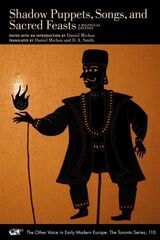
Shadow Puppets, Songs, and Sacred Feasts
Celebrations of the Indo-Portuguese Nuns in the Eighteenth-Century Real Convento de Santa Mónica, Goa, India. A Bilingual EditionEdited by Daniel Michon
Iter Press, 2025
The Entrada de Bonifrate para Festa dos Reis, a shadow puppet play for the feast of the Kings, and the Cartepaço da Muzica, a songbook for the feast of St. John, showcase the imaginative minds of the nuns at the Indo-Portuguese Real Convento de Santa Mónica, Goa, India. Composed for private convent audiences, these texts blend Portuguese and Spanish baroque elements with local Goan traditions. The uncensored verses celebrate convent life, critique local social norms, and affirm the nuns’ community identity, exhibiting the Mónicas’ musical talents and literary sensibilities.
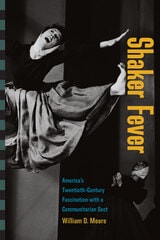
Shaker Fever
America's Twentieth-Century Fascination with a Communitarian SectWilliam D. Moore
University of Massachusetts Press, 2020
This interdisciplinary study places the activities of individuals—including Doris Humphrey, Charles Sheeler, Laura Bragg, Juliana Force, and Edward Deming Andrews—within the larger cultural and historical contexts of nationalism, modernism, and cultural resource management. Taking up previously unexamined primary sources and cultural productions that include the first scholarly studies of the faith, material culture and visual arts, stage performances, and museum exhibitions, Shaker Fever compels a reconsideration of this religious group and its place within American memory. It is sure to delight enthusiasts, public historians, museum professionals, furniture collectors, and anyone interested in the dynamics of cultural appropriation and stewardship.

Shaker Textile Arts
Beverly Gordon
University Press of New England, 1982
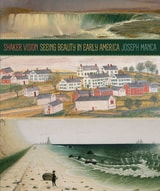
Shaker Vision
Seeing Beauty in Early AmericaJoseph Manca
University of Massachusetts Press, 2019
In Shaker Vision, Joseph Manca explores original texts, especially diaries and travel journals, and material culture to demonstrate that Shakers enjoyed a remarkably deep experience of the visual world. Shakers shared tastes with mainstream Americans and often employed a similar aesthetic vocabulary, but all within a belief system that made them distinct. In addition to their well-known ascetic architecture, furniture, and handicraft styles, they expressed themselves through ornate and detailed spiritual art and in vivid, visionary experiences. Based on firsthand accounts of the believers themselves, this richly illustrated volume will dramatically change how we assess the visual world of this uniquely American religious sect.
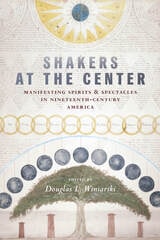
Shakers at the Center
Manifesting Spirits & Spectacles in Nineteenth-Century AmericaEdited by Douglas L. Winiarski
University of Massachusetts Press, 2026
Exploring the theological, social, and cultural dimensions of one of America’s most ambitious prophetic movements
The Shakers’ Era of Manifestations ranks among the most astounding events in American religious history. During the 1840s, members of the United Society of Believers in Christ’s Second Appearing embarked on an audacious project of receiving visions, revelations, and other manifestations from the spirit world and convincing both themselves and the world’s people of their reality. Gifted Shakers known as “instruments” surrendered their bodies to possessing spirits and celestial beings who, in turn, provided the Believers with an unimaginable number of revelatory communications that collapsed time and space, rewrote the Bible, and vastly expanded traditional Protestant beliefs and practices. The fruits of Shaker spiritualism would gain a permanent place in America’s public consciousness.
Hundreds of volumes and thousands of pages of inspired writings, music, and art from the New Era or period of Mother's Work, as the Shakers called it, crowd the shelves of a half dozen major research libraries. The archive is so vast, so extraordinary, so seemingly bizarre that few scholars have dared tackle it in its totality. The authors of this volume, specialists in nineteenth-century American religious studies, have collaborated to produce an extensive analysis of Mother Ann’s Work. They examine a fascinating range of topics: speaking with the dead; the spectacle of Shaker rituals; race, gender, and family life; and the material culture of physical and spiritual things; as well as manuscripts, books, songs, objects, and art produced during the New Era.
Shakers at the Center brings the sprawling elements of the Era of Manifestations together in a single volume. Written for students, scholars, and general readers alike, it will stand for years as the definitive history of the Shakers’ most fascinating and vexing historical period.
Contributors include the volume editor as well as Emily Suzanne Clark, Brett Malcolm Grainger, Sonia Hazard, Dana Logan, Carol Medlicott, Sally M. Promey, Erik R. Seeman, Ryan K. Smith, and David Walker.
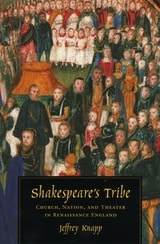
Shakespeare's Tribe
Church, Nation, and Theater in Renaissance EnglandJeffrey Knapp
University of Chicago Press, 2004
To be sure, Renaissance playwrights rarely sermonized in their plays, which seemed preoccupied with sex, violence, and crime. During a time when acting was regarded as a kind of vice, many theater professionals used their apparent godlessness to advantage, claiming that it enabled them to save wayward souls the church could not otherwise reach. The stage, they argued, made possible an ecumenical ministry, which would help transform Reformation England into a more inclusive Christian society.
Drawing on a variety of little-known as well as celebrated plays, along with a host of other documents from the English Renaissance, Shakespeare's Tribe changes the way we think about Shakespeare and the culture that produced him.
Winner of the Best Book in Literature and Language from the Association of American Publishers' Professional/Scholarly division, the Conference on Christianity and Literature Book Award, and the Roland H. Bainton Prize for Literature from the Sixteenth Century Society and Conference.
Shaky Colonialism
The 1746 Earthquake-Tsunami in Lima, Peru, and Its Long AftermathCharles F. Walker
Duke University Press, 2008
Through his ambitious rebuilding plan, the Viceroy sought to assert the power of the colonial state over the Church, the upper classes, and other groups. Agreeing with most inhabitants of the fervently Catholic city that the earthquake-tsunami was a manifestation of God’s wrath for Lima’s decadent ways, he hoped to reign in the city’s baroque excesses and to tame the city’s notoriously independent women. To his great surprise, almost everyone objected to his plan, sparking widespread debate about political power and urbanism. Illuminating the shaky foundations of Spanish control in Lima, Walker describes the latent conflicts—about class, race, gender, religion, and the very definition of an ordered society—brought to the fore by the earthquake-tsunami of 1746.
Shaman, Priest, Practice, Belief
Materials of Ritual and Religion in Eastern North AmericaEdited by Stephen B. Carmody and Casey R. Barrier
University of Alabama Press, 2020
Archaeologists today are interpreting Native American religion and ritual in the distant past in more sophisticated ways, considering new understandings of the ways that Native Americans themselves experienced them. Shaman, Priest, Practice, Belief: Materials of Ritual and Religion in Eastern North America broadly considers Native American religion and ritual in eastern North America and focuses on practices that altered and used a vast array of material items as well as how physical spaces were shaped by religious practices.
Unbound to a single theoretical perspective of religion, contributors approach ritual and religion in diverse ways. Importantly, they focus on how people in the past practiced religion by altering and using a vast array of material items, from smoking pipes, ceremonial vessels, carved figurines, and iconographic images, to sacred bundles, hallucinogenic plants, revered animals, and ritual architecture. Contributors also show how physical spaces were shaped by religious practice, and how rock art, monuments, soils and special substances, and even land- and cityscapes were part of the active material worlds of religious agents.
Case studies, arranged chronologically, cover time periods ranging from the Paleoindian period (13,000–7900 BC) to the late Mississippian and into the protohistoric/contact periods. The geographical scope is much of the greater southeastern and southern Midwestern culture areas of the Eastern Woodlands, from the Central and Lower Mississippi River Valleys to the Ohio Hopewell region, and from the greater Ohio River Valley down through the Deep South and across to the Carolinas.
Contributors
Sarah E. Baires / Melissa R. Baltus / Casey R. Barrier / James F. Bates / Sierra M. Bow / James A. Brown / Stephen B. Carmody / Meagan E. Dennison / Aaron Deter-Wolf / David H. Dye / Bretton T. Giles / Cameron Gokee / Kandace D. Hollenbach / Thomas A. Jennings / Megan C. Kassabaum / John E. Kelly / Ashley A. Peles / Tanya M. Peres / Charlotte D. Pevny / Connie M. Randall / Jan F. Simek / Ashley M. Smallwood / Renee B. Walker / Alice P. Wright
Shamanic Trance in Modern Kabbalah
Jonathan Garb
University of Chicago Press, 2011
Bringing to light a hidden chapter in the history of modern Judaism, Shamanic Trance in Modern Kabbalah explores the shamanic dimensions of Jewish mysticism. Jonathan Garb integrates methods and models from the social sciences, comparative religion, and Jewish studies to offer a fresh view of the early modern kabbalists and their social and psychological contexts.
Through close readings of numerous texts—some translated here for the first time—Garb draws a more complete picture of the kabbalists than previous depictions, revealing them to be as concerned with deeper states of consciousness as they were with study and ritual. Garb discovers that they developed physical and mental methods to induce trance states, visions of heavenly mountains, and transformations into animals or bodies of light. To gain a deeper understanding of the kabbalists’ shamanic practices, Garb compares their experiences with those of mystics from other traditions as well as with those recorded by psychologists such as Milton Erickson and Carl Jung. Finally, Garb examines the kabbalists’ relations with the wider Jewish community, uncovering the role of kabbalistic shamanism in the renewal of Jewish tradition as it contended with modernity.
Shamanism and Vulnerability on the North and South American Great Plains
Kathleen Bolling Lowrey
University Press of Colorado, 2020
The book reveals the various ways in which anthropologists, historians, folklorists, and other writers have often misrepresented indigenous shamanism and revitalization movements by unconsciously projecting ideologies and assumptions derived from modern ‘contract societies’ onto ethnographic and historical realities. Lowrey also provides alternative ways of understanding indigenous American communities and their long histories of interethnic relations with expanding colonial and national states in the Americas. A creative historical and ethnographical reevaluation of the last few decades of scholarship on shamanism, disability, and dependence, Shamanism and Vulnerability on the North and South American Great Plains will be of interest to scholars of North and South American anthropology, indigenous history, American studies, and feminism.
Shaping American Catholicism
Maryland and New York, 1805-1915Robert Emmett Curran
Catholic University of America Press, 2012
Shaping Losses
CULTURAL MEMORY AND THE HOLOCAUSTEdited by Julia Epstein and Lori Hope Lefkovitz
University of Illinois Press, 2001
This eloquent volume examines how memoirs, films, photographs, art, and literature, as well as family conversations and personal remembrances, embody the impulse to preserve what is destroyed. The contributors -- all distinguished women scholars, most of them survivors or daughters of survivors--examine classic memorializations such as Claude Lanzmann's film Shoah and Roman Vishniac's photographs of prewar Jews as well as several less-well-known works. They also address ways in which children of survivors of the Holocaust--and of other catastrophic traumas--struggle with inherited or vicarious memory, striving to come to terms with losses that centrally define them although they experience them only indirectly.
Shaping Losses considers the limitations of Holocaust representations and testimonies that capture shards of the experience but are necessarily selective and reductive. Contributors discuss artistic efforts to "preserve the rawness" of memory, to resist redemptive closure in Holocaust narratives and public memorials, and to prevent the Holocaust from being sealed in "the cold storage of history." The authors probe the nature of memory and of trauma, studying the use of language within and outside a traumatic context such as Auschwitz and pinpointing the qualities that make traumatic memory ineffable, untransmittable, and perhaps unreliable. Within the "haunted terrain of traumatized memory" that all Holocaust testimonies inhabit, the impulse to give form to emptiness--to shape loss--emerges as a necessary betrayal, a vital effort to bridge the gap between history and memory.
Shaping Society through Dance
Mestizo Ritual Performance in the Peruvian AndesZoila S. Mendoza
University of Chicago Press, 2000
In this fluid world, she argues, racial and ethnic identities are shaped more by notions of what is decent, elegant, and modern rather than by skin color or status. As the different troupes vie for the townspeople's recognition as the most "authentic" group, these notions are challenged and reworked. A fascinating look at a rich tradition, this innovative work is also a compelling example of the critical anthropology of performance.
Shared Mission
Religious Education in the Catholic Tradition, Revised EditionLeonardo Franchi
Catholic University of America Press, 2023
Sharing the Journey Gift Edition
The Haggadah for the Contemporary FamilyAlan S. Yoffie
Central Conference of American Rabbis, 2012