Results by title
3703 books match the query '19th Century' and 256 start with s
Sojourner Truth's America
Margaret Washington
University of Illinois Press, 2009
Soldier-Artist of the Great Reconnaissance
John C. Tidball and the 35th Parallel Pacific Railroad SurveyEugene C. Tidball
University of Arizona Press, 2004
Solidarity and Fragmentation
Working People and Class Consciousness in Detroit, 1875-1900Richard Jules Oestreicher
University of Illinois Press, 1985
Some Degree of Power
From Hired Hand to Union Craftsman in the Preindustrial American Printing Trades 1778-1815Mark Lause
University of Arkansas Press, 1991
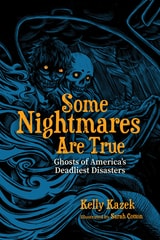
Some Nightmares Are True
Ghosts of America's Deadliest Disastersby Kelly Kazek, illustrated by Sarah Cotton
University of Alabama Press, 2025
Digging up the eerie aftermath of America’s deadliest disasters—where ghost stories take root, history lingers in the shadows, and the past refuses to stay buried.
In this haunting follow-up to Some Nightmares Are Real: The Haunting Truth Behind Alabama’s Supernatural Tales, journalist and storyteller Kelly Kazek investigates supernatural folklore grounded in historical catastrophe. This time, she ventures far beyond Alabama, unearthing the eerie legends born from their aftermath of nine of America’s most infamous disasters. From the strangling suffocation of the Boston Molasses Flood and the terror of Galveston’s notorious Great Storm, to flames blasting from the Triangle Shirtwaist Factory disaster, Some Nightmares Are True examines ghost stories that have haunted communities long after the news headlines stopped.
Each spooky story blends vivid storytelling with meticulous research, connecting real events to the ghostly lore they inspired. Kazek explores not just the moment of disaster, but how grief, resilience, and remembrance shape the way stories live on—through newspaper archives, folklore, and generations of retelling.
With both wry Southern sensibility and journalistic rigor, Kazek explores how moments of tragedy like the Dixie Tornado Outbreak in Alabama, the capsizing of the SS Eastland in Chicago, and the haunting aftermath of the Schoolchildren’s Blizzard in Nebraska leave lasting imprints on generational memory. These sites of devastation become more than historical footnotes; they transform into hallowed grounds where grief lingers, legends remain, and the line between fact and folklore dissolves.
For ghost hunters, or simply those brave enough to follow their curiosity into learning more about the stories’ historical facts, Kazek has compiled a robust appendix that provides context, source materials, and location details, making this a perfect pick to toss in the car for that late-night road trip adventure. But remember, Some Nightmares Are True.
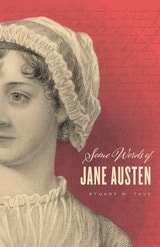
Some Words of Jane Austen
Stuart M. Tave
University of Chicago Press, 2019

Somebody Else
Arthur Rimbaud in Africa 1880-91Charles Nicholl
University of Chicago Press, 1999
In this compelling biography, Charles Nicholl pieces together the shadowy story of Rimbaud's life as a trader, explorer, and gunrunner in Africa. Following his fascinating journey, Nicholl shows how Rimbaud lived out that mysterious pronouncement of his teenage years: "Je est un autre"—I is somebody else.
"Rimbaud's fear of stasis never left him. 'I should like to wander over the face of the whole world,' he told his sister, Isobelle, 'then perhaps I'd find a place that would please me a little.' The tragedy of Rimbaud's later life, superbly chronicled by Nicholl, is that he never really did."—London Guardian
"Nicholl has excavated a mosaic of semi-legendary anecdotes to show that they were an essential part of the poet's journey to become 'somebody else.' Not quite biography, not quite travel book, in the end Somebody Else transcends both genres."—Sara Wheeler, Daily Telegraph
"At the end of Somebody Else Rimbaud is more interesting and more various than before: he is not less mysterious, but he is more real."—Susannah Clapp, Observer Review
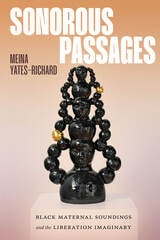
Sonorous Passages
Black Maternal Soundings and the Liberation ImaginaryMeina Yates-Richard
Duke University Press, 2026

Sophia Peabody Hawthorne
A Life, Volume 2, 1848-1871Patricia Dunlavy Valenti
University of Missouri Press, 2015
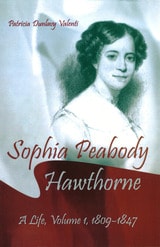
Sophia Peabody Hawthorne
A Life, Volume I, 1809-1847Patricia Dunlavy Valenti
University of Missouri Press, 2004
Sophia was born into an expansive, somewhat chaotic home in which women provided financial as well as emotional sustenance. She was a precocious, eager student whose rigorous education, in her mother’s and her sisters’ schools, began her association with the children of New England’s elite. Sophia aspired to become a professional, self-supporting painter, exhibiting her art and seeking criticism from established mentors. She relished an eighteen-month sojourn in Cuba. Nathaniel’s reclusive family, his reluctant early education, his anonymous pursuit of a career, and his relatively circumscribed life contrast markedly with the experience of the woman who became his wife and the mother of his children. Those differences resulted in a creative abrasion that ignited his fiction during the first years of their marriage.

Sophonisba Breckinridge
Championing Women's Activism in Modern AmericaAnya Jabour
University of Illinois Press, 2019
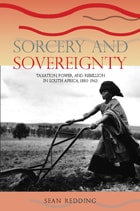
Sorcery and Sovereignty
Taxation, Power, and Rebellion in South Africa, 1880–1963Sean Redding
Ohio University Press, 2006
Rebellions broke out in many areas of South Africa shortly after the institution of white rule in the late nineteenth century and continued into the next century. However, distrust of the colonial regime reached a new peak in the mid-twentieth century, when revolts erupted across a wide area of rural South Africa. All these uprisings were rooted in grievances over taxes. Rebels frequently invoked supernatural powers for assistance and accused government officials of using witchcraft to enrich themselves and to harm ordinary people.
As Sean Redding observes in Sorcery and Sovereignty, beliefs in witchcraft and supernatural powers were part of the political rhetoric; the system of taxation—with all its prescribed interactions between ruler and ruled—was intimately connected to these supernatural beliefs.
In this fascinating study, Redding examines how black South Africans’ beliefs in supernatural powers, along with both economic and social change in the rural areas, resulted in specific rebellions and how gender relations in black South African rural families changed. Sorcery and Sovereignty explores the intersection of taxation, political attitudes, and supernatural beliefs among black South Africans, shedding light on some of the most significant issues in the history of colonized Africa.
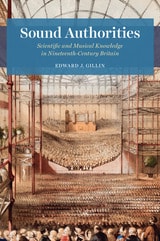
Sound Authorities
Scientific and Musical Knowledge in Nineteenth-Century BritainEdward J. Gillin
University of Chicago Press, 2021
Sound Authorities shows how experiences of music and sound played a crucial role in nineteenth-century scientific inquiry in Britain.
In Sound Authorities, Edward J. Gillin focuses on hearing and aurality in Victorian Britain, claiming that the development of the natural sciences in this era cannot be understood without attending to the study of sound and music.
During this time, scientific practitioners attempted to fashion themselves as authorities on sonorous phenomena, coming into conflict with traditional musical elites as well as religious bodies. Gillin pays attention to sound in both musical and nonmusical contexts, specifically the cacophony of British industrialization. Sound Authorities begins with the place of acoustics in early nineteenth-century London, examining scientific exhibitions, lectures, spectacles, workshops, laboratories, and showrooms. He goes on to explore how mathematicians mobilized sound in their understanding of natural laws and their vision of a harmonious ordered universe. In closing, Gillin delves into the era’s religious and metaphysical debates over the place of music (and humanity) in nature, the relationship between music and the divine, and the tensions between spiritualist understandings of sound and scientific ones.
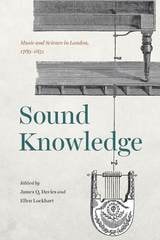
Sound Knowledge
Music and Science in London, 1789-1851Edited by J. Q. Davies and Ellen Lockhart
University of Chicago Press, 2017
Sound Knowledge examines how scientific truth was accrued by means of visual and aural experience, and, in turn, how musical knowledge was located in relation to empirical scientific practice. James Q. Davies and Ellen Lockhart gather work by leading scholars to explore a crucial sixty-year period, beginning with Charles Burney’s ambitious General History of Music, a four-volume study of music around the globe, and extending to the Great Exhibition of 1851, where musical instruments were assembled alongside the technologies of science and industry in the immense glass-encased collections of the Crystal Palace. Importantly, as the contributions show, both the power of science and the power of music relied on performance, spectacle, and experiment. Ultimately, this volume sets the stage for a new picture of modern disciplinarity, shining light on an era before the division of aural and visual knowledge.
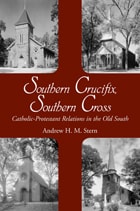
Southern Crucifix, Southern Cross
Catholic-Protestant Relations in the Old SouthAndrew Henry Stern
University of Alabama Press, 2012
In sharp contrast to many long-standing presumptions about mistrust or animosity between these two groups, this study proposes that Catholic and Protestant interactions in the South were characterized more by cooperation than by conflict.
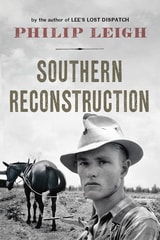
Southern Reconstruction
Philip Leigh
Westholme Publishing, 0
The Reconstruction Era—the years immediately following the Civil War when Congress directed the reintegration of the former Confederate states into the Union—remains, as historian Eric Foner suggests, “America’s unfinished revolution.” But Reconstruction is more than a story of great racial injustice; it has left a complex legacy involving both blacks and whites, Southerners and Northerners, that is reflected today by the fact that many of the states with the highest rates of poverty were part of the former Confederacy. In Southern Reconstruction, Philip Leigh examines Federal wartime legislation in order to broaden our understanding of Reconstruction, revealing how it led to African Americans being used as political pawns, first to ensure continued Republican rule, and finally to be blamed for the South’s hardships in order to draw poor whites away from Populism and back to the aristocratic white Democratic banner.
Civil War laws, such as the Confiscation Acts, Pacific Railroad Acts, Homestead Act, Legal Tender Act, National Banking Act, and Veterans Pensions Acts, transformed America’s banking system, built a railroad web, and launched the Gilded Age in the North and West, but it also created a dubious alliance between banks and government, sparked corruption, purposely depressed Southern industry, trapped Southern farmers—both black and white—in endless annual peonage cycles, and failed to provide lands for freedmen. While Reconstruction was intended to return the South to the Union, it could not be effective with laws that abetted Southern poverty, disfranchised many whites, fostered racial animosity to a point where lynchings and Jim Crow laws erupted, and lined the pockets of wealthy or politically well-connected business leaders outside of the region.
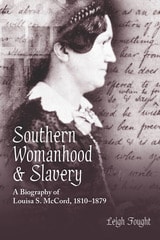
Southern Womanhood and Slavery
A Biography of Louisa S. McCord, 1810-1879Leigh Fought
University of Missouri Press, 2018
Southern Womanhood and Slavery is the first full-length biography of Louisa S. McCord, one of the most intriguing intellectuals in antebellum America. The daughter of South Carolina planter and politician Langdon Cheves, and an essayist in her own right, McCord supported unregulated free trade and the perpetuation of slavery and opposed the advancement of women’s rights. This study examines the origins of her ideas.
Leigh Fought constructs an exciting narrative that follows McCord from her childhood as the daughter of a state representative and president of the Bank of the United States through her efforts to accept her position as wife and mother, her career as an author and plantation mistress, and the Union invasion of South Carolina during the Civil War, to the end of her life in the emerging New South. Fought analyzes McCord’s poetry, letters, and essays in an effort to comprehend her acceptance of slavery and the submission of women. Fought concludes that McCord came to a defense of slavery through her experience with free labor in the North, which also reinforced her faith in the paternalist model for preserving social order.
McCord’s life as a writer on “unfeminine” subjects, her reputation as strong-minded and masculine, her late marriage, her continued ownership of her plantation after marriage, and her position as the matron of a Civil War hospital contradicted her own philosophy that women should remain the quiet force behind their husbands. She lived during a time of social flux in which free labor, slavery, and the role of women underwent dramatic changes, as well as a time that enabled her to discover and pursue her intellectual ambitions. Fought examines the conflict that resulted when those ambitions clashed with McCord’s role as a woman in the society of the South.
McCord’s voice was an interesting, articulate, and necessary feminine addition to antebellum white ideology. Moreover, her story demonstrates the ways in which southern women negotiated through patriarchy without surrendering their sense of self or disrupting the social order. Engaging and very readable, Southern Womanhood and Slavery will be of special interest to students of southern history and women’s studies, as well as to the general reader.
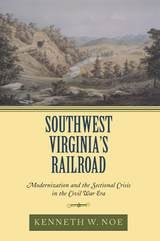
Southwest Virginia's Railroad
Modernization and the Sectional Crisis in the Civil War EraKenneth W. Noe
University of Alabama Press, 2003
A close study of one region of Appalachia that experienced economic vitality and strong sectionalism before the Civil War
This book examines the construction of the Virginia and Tennessee Railroad through southwest Virginia in the 1850s, before the Civil War began. The building and operation of the railroad reoriented the economy of the region toward staple crops and slave labor. Thus, during the secession crisis, southwest Virginia broke with northwestern Virginia and embraced the Confederacy. Ironically, however, it was the railroad that brought waves of Union raiders to the area during the war

Sovereign Fictions
Poetics and Politics in the Age of Russian RealismIlya Kliger
University of Chicago Press, 2024
The nineteenth-century novel is generally assumed to owe its basic social imaginaries to the ideologies, institutions, and practices of modern civil society. In Sovereign Fictions, Ilya Kliger asks what happens to the novel when its fundamental sociohistorical orientation is, as in the case of Russian realism, toward the state. Kliger explores Russian realism’s distinctive construals of sociality through a broad range of texts from the 1830s to the 1870s, including major works by Tolstoy, Dostoevsky, Gogol, Pushkin, Lermontov, Goncharov, and Turgenev, and several lesser-known but influential books of the period, including Alexander Druzhinin’s Polinka Saks (1847), Aleksei Pisemsky’s One Thousand Souls (1858), and Vasily Sleptsov’s Hard Times (1865). Challenging much current scholarly consensus about the social dynamics of nineteenth-century realist fiction, Sovereign Fictions offers an important intervention in socially inflected theories of the novel and in current thinking on representations of power and historical poetics.
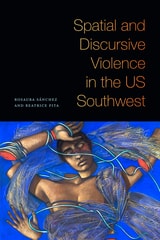
Spatial and Discursive Violence in the US Southwest
Rosaura Sánchez and Beatrice Pita
Duke University Press, 2020
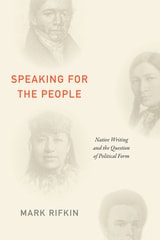
Speaking for the People
Native Writing and the Question of Political FormMark Rifkin
Duke University Press, 2021
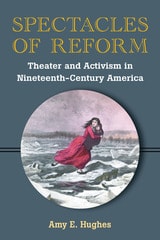
Spectacles of Reform
Theater and Activism in Nineteenth-Century AmericaAmy E. Hughes
University of Michigan Press, 2014
In the nineteenth century, long before film and television arrived to electrify audiences with explosions, car chases, and narrow escapes, it was America's theaters that offered audiences such thrills, with "sensation scenes" of speeding trains, burning buildings, and endangered bodies, often in melodramas extolling the virtues of temperance, abolition, and women's suffrage. In Spectacles of Reform , Amy E. Hughes scrutinizes these peculiar intersections of spectacle and reform, revealing that spectacle plays a crucial role in American activism. By examining how theater producers and political groups harnessed its power and appeal, Hughes suggests that spectacle was—and remains—central to the dramaturgy of reform.
Engaging evidence from lithographs to children's books to typography catalogs, Hughes traces the cultural history of three famous sensation scenes—the drunkard suffering from the delirium tremens, the fugitive slave escaping over a river, and the victim tied to the railroad tracks—assessing how they conveyed, allayed, and denied concerns about the rights and responsibilities of citizenship. These images also appeared in printed propaganda, suggesting that the coup de théâtre was an essential part of American reform culture. Additionally, Hughes argues that today's producers and advertisers continue to exploit the affective dynamism of spectacle, reaching an even broader audience through film, television, and the Internet.
To be attuned to the dynamics of spectacle, Hughes argues, is to understand how we see. Consequently, Spectacles of Reform will interest not only theater historians, but also scholars and students of political, literary, and visual culture who are curious about how U.S. citizens saw themselves and their world during a pivotal period in American history.
Specters, Monsters, and the Damned
Fantastic Threats to the Social Order in Nineteenth-Century Spanish FictionWan Sonya Tang
Vanderbilt University Press, 2024
Tang offers innovative readings of eleven fantastic short stories and one novella as they first appeared, some serialized and others illustrated, in Spanish periodicals from the late 1800s and early 1900s. Drawing on original archival research, she demonstrates how these stories—in which the everyday is suddenly and inexplicably disrupted by the supernatural—often employ gothic imagery (specifically that of the specter, the monster, and the curse) to depict as threatening those who deviate from cultural norms in terms of class, gender, and race. Tang argues, however, that these unsettling, open‑ended narratives likewise allow readers to question how and why certain designated groups are privileged by society. She contends that the fantastic depiction of reality as unstable in these works ultimately facilitates an interrogation of those values that are accepted as natural by the reigning social order, gesturing toward the inhumanity not of the marginalized, but of the dominant group.
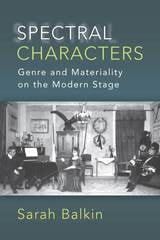
Spectral Characters
Genre and Materiality on the Modern StageSarah Balkin
University of Michigan Press, 2019
Theater’s materiality and reliance on human actors has traditionally put it at odds with modernist principles of aesthetic autonomy and depersonalization. Spectral Characters argues that modern dramatists in fact emphasized the extent to which humans are fictional, made and changed by costumes, settings, props, and spoken dialogue. Examining work by Ibsen, Wilde, Strindberg, Genet, Kopit, and Beckett, the book takes up the apparent deadness of characters whose selves are made of other people, whose thoughts become exteriorized communication technologies, and whose bodies merge with walls and furniture. The ghostly, vampiric, and telepathic qualities of these characters, Sarah Balkin argues, mark a new relationship between the material and the imaginary in modern theater. By considering characters whose bodies respond to language, whose attempts to realize their individuality collapse into inanimacy, and who sometimes don’t appear at all, the book posits a new genealogy of modernist drama that emphasizes its continuities with nineteenth-century melodrama and realism.
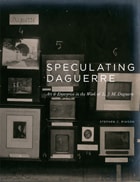
Speculating Daguerre
Art and Enterprise in the Work of L. J. M. DaguerreStephen C. Pinson
University of Chicago Press, 2012
Louis Jacques Mandé Daguerre (1787–1851) was a true nineteenth-century visionary—a painter, printmaker, set designer, entrepreneur, inventor, and pioneer of photography. Though he was widely celebrated beyond his own lifetime for his invention of the daguerreotype, it was his origins as a theatrical designer and purveyor of visual entertainment that paved the way for Daguerre’s emergence as one of the world’s most iconic imagemakers.
In Speculating Daguerre, Stephen C. Pinson reinterprets the story of the man and his time, painting a vivid picture of Daguerre as an innovative artist and savvy impresario whose eventual fame as a photographer eclipsed everything that had come before. Drawing upon previously unpublished correspondence and unplumbed archival sources, Pinson mixes biography with an incisive study of Daguerre’s wide-ranging involvement in visual culture. From his work as a commercial lithographer to his coinvention of the Paris Diorama—a theater in the round in which Daguerre employed natural light and special effects to simulate time and movement in large-scale paintings—here we are given access to Daguerre the artist, whose tireless experimentation, entrepreneurial spirit, and exceptional talent for popular spectacle helped to usher in a new visual age.
Filled with more than one hundred illustrations and including the first complete catalogue of Daguerre’s paintings, works on paper, and daguerreotypes to appear in print, the publication of Speculating Daguerre will be a much-heralded event for anyone with even a passing interest in one of the most fascinating characters in the history of photography.
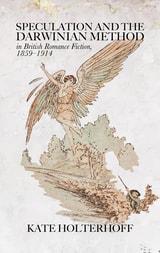
Speculation and the Darwinian Method in British Romance Fiction, 1859-1914
Kate Holterhoff
Ohio University Press, 2025
This study explores how British romance fictions published between 1859 and 1914 absorbed distinctly Darwinian attitudes toward the epistemology of science—one that accorded with scientific speculation. Following the 1859 publication of On the Origin of Species, in which Charles Darwin acknowledged arriving at his thesis by allowing himself “to speculate on the subject” of species transmutation, many romance fiction writers embraced, criticized, and promoted acts of speculating characterized as scientific. The romance fictions discussed in this book recurred to Darwin’s speculative methodology more than to rigorous Baconian empiricism because it permitted them to draw pointedly imaginative conclusions in reasonable ways. Kate Holterhoff’s book examines how romance authors like Grant Allen, H. G. Wells, and Arthur Conan Doyle incorporated Darwinian ideas and speculative thinking into their works to advance their ideological and aesthetic goals. Holterhoff uses five paired genres and methods to analyze this engagement:
- scientific romance and experimentation,
- metaphysical romance and thought experiments,
- anthropological romance and reasoning with imperfect data,
- gothic romance and probability, and
- utopian romance and Malthusian political economy.
By focusing on Darwin’s influence in legitimizing speculative methods in science, the book places the interplay between British science and romance fiction into critical perspective and highlights Darwin’s enduring impact on Western culture.
Speculation
Politics, Ideology, EventGlyn Daly
Northwestern University Press, 2019
Speculation: Politics, Ideology, Event develops Hegel’s radical perspective of speculative thought as a way of reclaiming and revitalizing the sense of the future and its possibilities. Engaging with such figures as Alain Badiou, Quentin Meillassoux, Ernesto Laclau, Slavoj Žižek, and Fredric Jameson, Glyn Daly articulates the distinctness of speculative philosophy and draws its implications for new debates in areas of science, politics, capitalism, ideology, ethics, and the event.
In a confrontation with today’s fatalistic milieu, principal emphasis is given to Hegel’s idea of infinity as the intrinsic dimension of negativity within all finitude. Against the modern era’s paradigmatic tendency to externalize social problems in the form of antagonism and Otherness, Daly argues for a renewal of utopian thought based on Hegelian reconciliation and the affirmation of excess as the essence of all being. On these grounds, he advances a new kind of political imagination that in speculative terms centers on uncompromising notions of truth and reason.
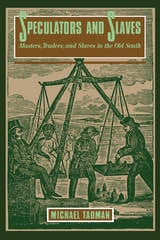
Speculators And Slaves
Masters, Traders, And Slaves In The Old SouthMichael Tadman
University of Wisconsin Press, 1996
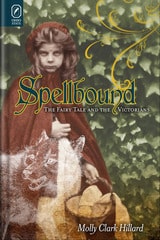
Spellbound
The Fairy Tale and the VictoriansMolly Clark Hillard
The Ohio State University Press, 2014
Through close readings of the novels of Dickens, Eliot, and Charlotte Brontë; the poetry of Tennyson and Christina Rossetti; the visual artistry of Burne-Jones and Punch; and the popular theatricals of dramatists like Planche and Buckingham, Spellbound opens fresh territory into well-traversed titles of the Victorian canon. Hillard demonstrates that these literary forms were all cross-pollenated by the fairy tale and that their authors were—however reluctantly—purveyors of disruptive fairy tale matter over which they had but imperfect control.
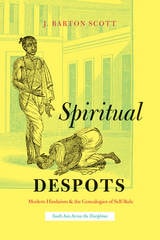
Spiritual Despots
Modern Hinduism and the Genealogies of Self-RuleJ. Barton Scott
University of Chicago Press, 2016
Through this alternative genealogy of the self-ruling subject, Spiritual Despots demonstrates that Hindu reform movements cannot be understood solely within the precolonial tradition, but rather need to be read alongside other movements of their period. The book’s focus moves fluidly between Britain and India—engaging thinkers such as James Mill, Keshub Chunder Sen, Max Weber, Karsandas Mulji, Helena Blavatsky, M. K. Gandhi, and others—to show how colonial Hinduism shaped major modern discourses about the self. Throughout, Scott sheds much-needed light how the rhetoric of priestcraft and practices of worldly asceticism played a crucial role in creating a new moral and political order for twentieth-century India and demonstrates the importance of viewing the emergence of secularism through the colonial encounter.
Spirituals and the Birth of a Black Entertainment Industry
Sandra Jean Graham
University of Illinois Press, 2018
St. Louis and Empire
250 Years of Imperial Quest and Urban CrisisHenry W. Berger
Southern Illinois University Press, 2015
Berger uses a biographical approach to explore the individuals and institutions that played a leading role in St. Louis’s expansionist reach. He shows how St. Louis business leaders, entrepreneurs, politicians, and investors—often driven by personal and ideological motives, as well as the potential betterment of the city and its people—looked to the west, southwest, Latin America, Europe, Asia, and the Pacific to form economic or political partnerships. Among the people and companies Berger profiles are Thomas Hart Benton, who envisioned a western democratic capitalist empire hosted by St. Louis; cotton exporters James Paramore and William Senter, who were involved in empire building in the southwest and Mexico; St. Louis oil tycoon and railroad investor Henry Clay Pierce, who became deeply involved in political intrigue and intervention in Mexican affairs; entrepreneur and politician David R. Francis, who promoted personal and St. Louis interests in Russia; and McDonnell-Douglas and its founder, James S. McDonnell Jr., who were part of the transformation of St. Louis’s political economy during the Cold War.
Many of these attempted imperial activities failed, but even when they succeeded, Berger explains, the economy and the people of St. Louis did not usually benefit. The vision of a democratic capitalist empire embraced by its exponents proved to be both an illusion and a contradiction. By shifting the focus of foreign relations history from the traditional confines of nation-state conduct to city and regional behavior, this innovative study highlights the domestic foundations and content of foreign policy, opening new avenues for study in the field of foreign relations.

Stage Blood
Vampires of the 19th Century StageRoxana Stuart
University of Wisconsin Press, 1994
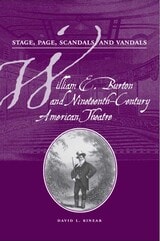
Stage, Page, Scandals, & Vandals
William E. Burton and Nineteenth-Century American TheatreDavid L. Rinear
Southern Illinois University Press, 2004
In this first modern book-length biography of native Englander William E. Burton, theatre historian David L. Rinear explores Burton’s diary, letters, published reviews, and various reminiscences to reveal the tumultuous personal and professional lives of the mid-nineteenth-century actor/manager and his role in American literary history. Stage, Page, Scandals, and Vandals: William E. Burton and Nineteenth-Century American Theatre also provides insight into the cultural and artistic climate of an early period in American history when the country was still forming a national identity.
Burton fled England in 1834 and came to America in the wake of a public scandal caused by his marriage to a sixteen-year-old orphan. Burton was then already married with a ten-year-old son. Settling in Philadelphia, the thirty-two-year-old actor rapidly established himself in the city’s theatrical productions and quickly became an audience favorite.
In 1837, while continuing to act, Burton founded and edited The Gentleman’s Magazine, a monthly literary publication later called Burton’s Gentleman’s Magazine. Burton hired struggling author Edgar Allan Poe as coeditor, and the journal achieved literary acclaim as it first published many of Poe’s short stories and poems.
Burton sold the journal in 1841 and used the money to build a new theatre, which he managed, although the depression of the early 1840s soon drove his venture out of business. After declaring bankruptcy the following year, Burton worked as a touring actor before returning to theatre management in 1845. For the next thirteen years, Burton managed a succession of theatres in Philadelphia, Baltimore, and New York.
Burton’s work as a producer of Shakespearean comedies and romances marks him as the first of the intellectual theatre managers to raise the theatrical experience from mere popular culture to high art. Burton made a fortune in his ventures, amassed the finest private Shakespearean library in the country, and built a grand seaside estate in Glen Cove, Long Island. Shrewd in his personal affairs and in business, Burton also had a violent temper, which led him to viciously attack his competitors. His peculiar domestic relationships marred his brilliant career as an actor, manager, and man of letters; he may have been married to three women at once and lived with two of these women simultaneously.
Fully revealing Burton’s contributions to American culture, Rinear traces Burton’s personal and professional pursuits from his emigration to his death in 1860. Bolstered by twenty-two illustrations, Stage, Page, Scandals, and Vandals sheds light on the history of American entertainment during the antebellum era, exposes the ruthless business practices required to succeed in theatre and literary magazine publishing, and reveals a sense of what constituted celebrity status in mid-nineteenth-century America.
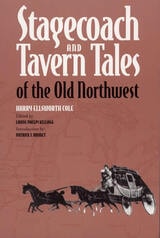
Stagecoach and Tavern Tales of the Old Northwest
Harry Ellsworth Cole. Edited by Louise Phelps Kellogg. Foreword by Patrick J. Brunet
Southern Illinois University Press, 1997
One journalist curious about life in the taverns along the stagecoach lines in Wisconsin and northern Illinois from the early 1800s until the 1880s was Harry Ellsworth Cole. While he could not sample strong ales at all of the taverns he wrote about, Cole did study newspaper accounts, wrote hundreds of letters to families of tavern owners, read widely in regional history, and traveled extensively throughout the territory. The result, according to Brunet, is a "nostalgic, sometimes romantic, well-written, and easily digested social history."
At Cole’s death, historian Louise Phelps Kellogg edited his manuscript, which in this case involved turning his notes and illustrations into a book and publishing it with the Arthur H. Clark Company in 1930.
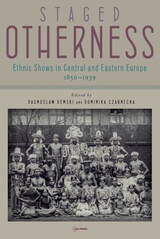
Staged Otherness
Ethnic Shows in Central and Eastern Europe, 1850–1939Dagnoslaw Demski
Central European University Press, 2022
The cultural phenomenon of exhibiting non-European people in front of the European audiences in the 19th and 20th century was concentrated in the metropolises in the western part of the continent. Nevertheless, traveling ethnic troupes and temporary exhibitions of non-European humans took place also in territories located to the east of the Oder river and Austria. The contributors to this edited volume present practices of ethnographic shows in Russia, Poland, Czechia, Slovenia, Hungary, Germany, Romania, and Austria and discuss the reactions of local audiences. The essays offer critical arguments to rethink narratives of cultural encounters in the context of ethnic shows. By demonstrating the many ways in which the western models and customs were reshaped, developed, and contested in Central and Eastern European contexts, the authors argue that the dominant way of characterizing these performances as “human zoos” is too narrow.
The contributors had to tackle the difficult task of finding traces other than faint copies of official press releases by the tour organizers. The original source material was drawn from local archives, museums, and newspapers of the discussed period. A unique feature of the volume is the rich amount of images that complement every single case study of ethnic shows.
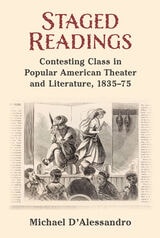
Staged Readings
Contesting Class in Popular American Theater and Literature, 1835-75Michael D’Alessandro
University of Michigan Press, 2022
Based in the historical archive, Staged Readings presents a panoramic display of mid-century leisure and entertainment. It examines best-selling novels, such as Harriet Beecher Stowe’s Uncle Tom’s Cabin and George Lippard’s The Quaker City. But it also analyzes a series of sensational melodramas, parlor theatricals, doomsday speeches, tableaux vivant displays, curiosity museum exhibits, and fake volcano explosions. These oft-overlooked spectacles capitalized on consumers’ previous cultural encounters and directed their social identifications. The book will be particularly appealing to those interested in histories of popular theater, literature and reading, social class, and mass culture.
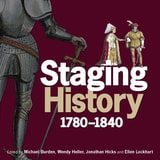
Staging History
1780-1840Edited by Michael Burden, Wendy Heller, Jonathan Hicks, and Ellen Lockhart
Bodleian Library Publishing, 2016
Drawing on copious new research, Staging History reexamines extraordinary theatrical works of the period to show the role they played in shaping popular interpretations of history. Editors Michael Burden, Wendy Heller, Jonathan Hicks, and Ellen Lockhart are joined by other experts in the field in analyzing theatrical documents, including playbills, set designs, and musical scores, as well as paintings, prints, and other illustrations, in order to explore what counted as historical truth for the writers, performers, and audiences of these plays.
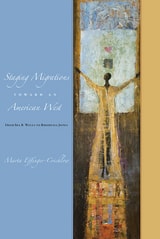
Staging Migrations toward an American West
From Ida B. Wells to Rhodessa JonesMarta Effinger-Crichlow
University Press of Colorado, 2014
Four case studies consider how the featured women—activist Ida B. Wells, singer Sissieretta "Black Patti” Jones, World War II black female defense-industry workers, and performance artist Rhodessa Jones—imagined and experienced the American West geographically and symbolically at different historical moments. Dissecting the varied ways they used migration to survive in the world from the viewpoint of theater and performance theory, Effinger-Crichlow reconceptualizes the migration histories of black women in nineteenth- and twentieth-century America.
This interdisciplinary study expands the understanding of the African American struggle for unconstrained movement and full citizenship in the United States and will interest students and scholars of American and African American history, women and gender studies, theater, and performance theory.
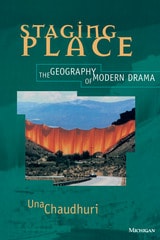
Staging Place
The Geography of Modern DramaUna Chaudhuri
University of Michigan Press, 1997
Chaudhuri starts with a discussion of a "poetics of exile" in early modern drama, where the figure of home is constructed as a locus of two conflicting impulses: the desire to find a stable site for individual identity and the desire to deterritorialize the self. By mid-century, she argues, a new discourse of "failed homecoming" begins to displace this geopathic model and replace the poetics of exile with a grim anti-poetics of immigration. She then employs postmodern and postcolonial theories of place and culture to define the emerging multiculturalism as a creative reworking of the figures of home, homecoming, homelessness, immigration and exile.
"This is a book of real originality. Its treatment of space in modern drama is elegant and powerful. . . ." --William B. Worthen, Northwestern University
"Staging Place is a powerfully written book, deft in its handling of familiar and unfamiliar plays alike and eclectic in its use of theatrical sources." --Essays in Theatre/ Études théâtrales
"This sophisticated and well-written study for graduate students and their teachers explores modern drama's preoccupation with the seemingly irreconcilable discontinuities between the notions of home and homelessness, belonging and exile. . . . The readings of individual plays are fresh and invigorating. . . ." --Choice
Una Chaudhuri is Associate Professor of English, New York University.
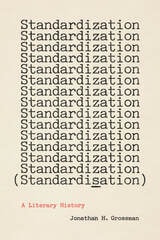
Standardization (Standardisation)
A Literary HistoryJonathan H. Grossman
University of Chicago Press, 2026
An innovative study of the history of standardization that draws on both technical documents and novels.
Jonathan H. Grossman’s elegant analysis of standardization approaches the topic by exploring how institutions create standards. Grossman tracks how published standards documents became the dominant means of homogenizing durable objects during the nineteenth century’s industrialization of manufacturing, including printing. Examining these documents as a genre, he reconstructs the nineteenth-century history of published standards documents and shows how they evolved to produce uniformity across manufactured objects.
Shifting focus from the standardized creation of objects to their use by subjects, Grossman then probes how people reimagined, through print, the ways in which their subjectivity combined with identical, interchangeable manufactured objects. To understand that relation, he looks to nineteenth-century novels by Charles Dickens, Mark Twain, and Elizabeth Gaskell, revealing how these books depicted the interchangeability of the subjects implied by this production of identical objects. The novels do not merely observe the interplay between subjects and standardized objects; they materialize it in the assemblage of readers holding their industrially manufactured, print copy.
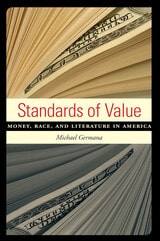
Standards of Value
Money, Race, and Literature in AmericaGermana, Michael
University of Iowa Press, 2010
In Standards of Value, Michael Germana reveals how tectonic shifts in U.S. monetary policy—from the Coinage Act of 1834 to the abolition of the domestic gold standard in 1933–34—correspond to strategic changes by American writers who renegotiated the value of racial difference. Populating the pages of this bold and innovative study are authors as varied as Harriet Beecher Stowe, George Washington Cable, Charles Chesnutt, James Weldon Johnson, Nella Larsen, Jessie Redmon Fauset, and Ralph Ellison—all of whom drew analogies between the form Americans thought the nation's money should take and the form they thought race relations and the nation should take.
A cultural history of race organized around and enmeshed within the theories of literary and monetary value, Standards of Value also recovers a rhetorical tradition in American culture whose echoes can be found in the visual and lyrical grammars of hip hop, the paintings of John W. Jones and Michael Ray Charles, the cinematography of Spike Lee, and many other contemporary forms and texts.
This reconsideration of American literature and cultural history has implications for how we value literary texts and how we read shifting standards of value. In vivid prose, Germana explains why dollars and cents appear where black and white bodies meet in American novels, how U.S. monetary policy gave these symbols their cultural currency, and why it matters for scholars of literary and cultural studies.
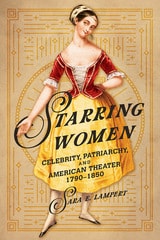
Starring Women
Celebrity, Patriarchy, and American Theater, 1790-1850Sara E. Lampert
University of Illinois Press, 2020
A revealing foray into a lost time, Starring Women returns a generation of performers to their central place in the early history of American theater.

State Formation and Democracy in Latin America, 1810-1900
Fernando López-Alves
Duke University Press, 2000
Breaking with the traditional economic analysis of South American development, López-Alves argues that civil-military relations lay at the core of state building. By comparing three countries in particular—Uruguay, Colombia, and Argentina—during an intense phase of state and regime formation, he shows how war and the collective action of the rural poor contributed to the construction of central armies, the rise of new social classes, and the emergence of civilian organizations. He also examines characteristics unique to each country’s war-formed culture and discusses how coalitions were built during this period. Examples from Paraguay and Venezuela and references to state formation in Europe, the United States, Asia, and the Middle East add to the complexity and richness of the study’s comparative analysis.
Drawing on a vast bibliography of both primary and secondary sources, López-Alves goes beyond providing insights into the particular development of Latin American countries and introduces a comprehensive theory of state formation applicable to other regions. This book will interest Latin Americanists, historians, political scientists, and sociologists studying state formation.
State Formation in the Liberal Era
Capitalisms and Claims of Citizenship in Mexico and PeruEdited by Ben Fallaw and David Nugent
University of Arizona Press, 2020
Mexico and Peru are widely regarded as two great centers of Latin American civilization. In State Formation in the Liberal Era, a diverse group of historians and anthropologists from the United States, the United Kingdom, and Latin America compare how the two countries advanced claims of statehood from the dawning of the age of global liberal capitalism to the onset of the Cold War. Chapters cover themes ranging from foreign banks to road building and labor relations. The introductions serve as an original interpretation of Peru’s and Mexico’s modern histories from a comparative perspective.
Focusing on the tensions between disparate circuits of capital, claims of statehood, and the contested nature of citizenship, the volume spans disciplinary and geographic boundaries. It reveals how the presence (or absence) of U.S. influence shaped Latin American history and also challenges notions of Mexico’s revolutionary exceptionality. The book offers a new template for ethnographically informed comparative history of nation building in Latin America.
State of Ambiguity
Civic Life and Culture in Cuba's First RepublicSteven Palmer, José Antonio Piqueras, Amparo Sánchez Cobos, eds.
Duke University Press, 2014
Contributors. Imilcy Balboa Navarro, Alejandra Bronfman, Maikel Fariñas Borrego, Reinaldo Funes Monzote, Marial Iglesias Utset, Steven Palmer, José Antonio Piqueras Arenas, Ricardo Quiza Moreno, Amparo Sánchez Cobos, Rebecca J. Scott, Robert Whitney

States at War, Volume 1
A Reference Guide for Connecticut, Maine, Massachusetts, New Hampshire, Rhode Island, and Vermont in the Civil WarEdited by Richard F. Miller
University Press of New England, 2013
States at War, Volume 2
A Reference Guide for New York in the Civil WarEdited by Richard F. Miller
University Press of New England, 2014

States at War, Volume 3
A Reference Guide for Pennsylvania in the Civil WarEdited by Richard F. Miller
University Press of New England, 2014
States at War, Volume 4
A Reference Guide for Delaware, Maryland, and New Jersey in the Civil WarEdited by Richard F. Miller
University Press of New England, 2015