Results by title
2728 books match the query 'Education' and 161 start with s

Subject Lessons
The Western Education of Colonial IndiaSanjay Seth
Duke University Press, 2007
Drawing on history, political science, anthropology, and philosophy, Seth interprets the debates and controversies that came to surround western education. Central among these were concerns that Indian students were acquiring western education by rote memorization—and were therefore not acquiring “true knowledge”—and that western education had plunged Indian students into a moral crisis, leaving them torn between modern, western knowledge and traditional Indian beliefs. Seth argues that these concerns, voiced by the British as well as by nationalists, reflected the anxiety that western education was failing to produce the modern subjects it presupposed. This failure suggested that western knowledge was not the universal epistemology it was thought to be. Turning to the production of collective identities, Seth illuminates the nationalists’ position vis-à-vis western education—which they both sought and criticized—through analyses of discussions about the education of Muslims and women.
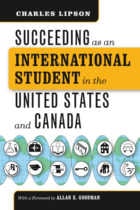
Succeeding as an International Student in the United States and Canada
Charles Lipson
University of Chicago Press, 2008
Succeeding is designed to help students navigate the myriad issues they will encounter—from picking a program to landing a campus job. Based on Lipson’s work with international students as well as extensive interviews with faculty and advisers, Succeeding includes practical suggestions for learning English, participating in class, and meeting with instructors. In addition it explains the rules of academic honesty as they are understood in U.S. and Canadian universities.
Life beyond the classroom is also covered, with handy sections on living on or off campus, obtaining a driver’s license, setting up a bank account, and more. The comprehensive glossary addresses both academic terms and phrases heard while shopping or visiting a doctor. There is even a chapter on the academic calendar and holidays in the United States and Canada.
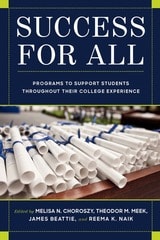
Success for All
Programs to Support Students Throughout Their College ExperienceMelisa N. Choroszy
University of Nevada Press, 2019
Success for All is a strategic guide for administrators and educators that offers methods for advising students through the myriad of challenges they face. Every bit of success contributes to the accomplishment of a larger goal, and this book highlights success at every level. It provides a specific roadmap to the research, services, and programs at the University of Nevada, Reno and Truckee Meadows Community College that support student success in undergraduate and graduate programs regardless of a student’s social, emotional, or prior academic experiences. Contributors discuss how to make students feel welcome in their social and educational environments and how to directly assist them with the timely completion of their degree. Administrators and educators demonstrate how these programs help make a positive contribution to the students and the institutions they serve while implementing practical solutions to increase graduation rates.
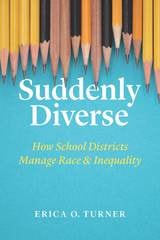
Suddenly Diverse
How School Districts Manage Race and InequalityErica O. Turner
University of Chicago Press, 2020
Suddenly Diverse is an ethnographic account of two school districts in the Midwest responding to rapidly changing demographics at their schools. It is based on observations and in-depth interviews with school board members and superintendents, as well as staff, community members, and other stakeholders in each district: one serving “Lakeside,” a predominately working class, conservative community and the other serving “Fairview,” a more affluent, liberal community. Erica O. Turner looks at district leaders’ adoption of business-inspired policy tools and the ultimate successes and failures of such responses. Turner’s findings demonstrate that, despite their intentions to promote “diversity” or eliminate “achievement gaps,” district leaders adopted policies and practices that ultimately perpetuated existing inequalities and advanced new forms of racism.
While suggesting some ways forward, Suddenly Diverse shows that, without changes to these managerial policies and practices and larger transformations to the whole system, even district leaders’ best efforts will continue to undermine the promise of educational equity and the realization of more robust public schools.

Summers Off?
A History of U.S. Teachers' Other Three MonthsChristine A. Ogren
Rutgers University Press, 2026
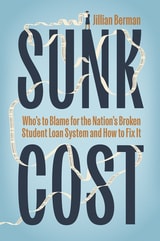
Sunk Cost
Who’s to Blame for the Nation’s Broken Student Loan System and How to Fix ItJillian Berman
University of Chicago Press, 2025
Student-loan horror stories are a dime a dozen. But students today are faced with a seemingly insurmountable paradox: Research consistently shows that the clearest viable option to financial stability is a college degree. But if and when Americans decide to pursue diplomas, student loan payments quickly follow, and even after securing full-time employment, many borrowers struggle to make ends meet for years. In Sunk Cost, journalist Jillian Berman explores how the nation’s student loan program went from a well-intentioned initiative aimed at helping low- and middle-income students afford college to one that traps borrowers in long-term debt.
Berman interviewed dozens of borrowers and policymakers and dug into the archives to unearth the true causes of the student loan problem. A couple of generations ago, policy makers generously subsidized Americans’ college educations because they knew it would be advantageous for the entire country: a more educated population meant better quality of life for all. But today, higher education is viewed as an individual goal, so students and their families are expected to be on the hook for it themselves. Berman explains how this enormous shift happened, which industries benefit from it, and what it means for college-going Americans today. She shares real-life stories of college graduates who are being crushed under some of the harshest consequences of the student loan system. These borrowers pursued higher education in hopes of a better life and yet some have been trapped in debt for decades, making it difficult to put food on the table, much less imagine a life beyond debt.
By connecting personal accounts to the policy history of student loans, Berman makes clear that if American society continues to push students toward higher education, but fails to truly subsidize it, the financial strain will become unbearable for all but the most privileged. The current system is broken, but Berman proposes that significant changes are possible, and will require political will from state lawmakers and Congress, along with a philosophical shift, to tackle one of the largest consumer finance challenges of our time.
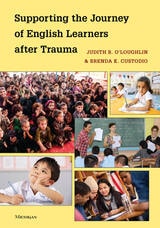
Supporting the Journey of English Learners after Trauma
Judith B. O'Loughlin and Brenda K. Custodio
University of Michigan Press, 2021
This book is designed to provide a practical resource to help educators better understand the possible traumatic backgrounds of their students and how that could be affecting their academic, social, and emotional lives. It also focuses on how school personnel can create a safe environment in schools and classrooms to help students recognize, nurture, and expand the internal resilience that has enabled them to weather past situations and that will allow them to continue the healing process.
One chapter is devoted to the topic of self-care for educators who are working so hard to help students be resilient. An appendix features a list of recommended books on the topics of personal migration and resilience.
Surveying the Landscape
Arts Integration at Research Universities: A Review of Best Practices and Challenges for Arts Integration in Higher EducationBruce M. Mackh, PhD
Michigan Publishing Services, 2015
This study presents “best practices in the integration of arts practice in U.S. research universities . . . , fulfill[ing] the need for a document that articulates models, obstacles, implementation strategies, costs, and impact on students and faculty as well as on research, practice, and teaching in other knowledge areas” (ArtsEngine). Rather than providing a detailed set of instructions, this document maps the landscape of arts integration at 30 partner institutions in the Alliance for the Arts in Research Universities (a2ru) and at 16 other institutions. It highlights aspirational models and presents an overall guide to current practices linking the arts to other learning areas.
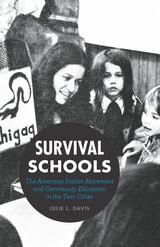
Survival Schools
The American Indian Movement and Community Education in the Twin CitiesJulie L. Davis
University of Minnesota Press, 2013
In the late 1960s, Indian families in Minneapolis and St. Paul were under siege. Clyde Bellecourt remembers, “We were losing our children during this time; juvenile courts were sweeping our children up, and they were fostering them out, and sometimes whole families were being broken up.” In 1972, motivated by prejudice in the child welfare system and hostility in the public schools, American Indian Movement (AIM) organizers and local Native parents came together to start their own community school. For Pat Bellanger, it was about cultural survival. Though established in a moment of crisis, the school fulfilled a goal that she had worked toward for years: to create an educational system that would enable Native children “never to forget who they were.”
While AIM is best known for its national protests and political demands, the survival schools foreground the movement’s local and regional engagement with issues of language, culture, spirituality, and identity. In telling of the evolution and impact of the Heart of the Earth school in Minneapolis and the Red School House in St. Paul, Julie L. Davis explains how the survival schools emerged out of AIM’s local activism in education, child welfare, and juvenile justice and its efforts to achieve self-determination over urban Indian institutions. The schools provided informal, supportive, culturally relevant learning environments for students who had struggled in the public schools. Survival school classes, for example, were often conducted with students and instructors seated together in a circle, which signified the concept of mutual human respect. Davis reveals how the survival schools contributed to the global movement for Indigenous decolonization as they helped Indian youth and their families to reclaim their cultural identities and build a distinctive Native community.
The story of these schools, unfolding here through the voices of activists, teachers, parents, and students, is also an in-depth history of AIM’s founding and early community organizing in the Twin Cities—and evidence of its long-term effect on Indian people’s lives.
Sustaining Interdisciplinary Collaboration
A Guide for the AcademyRegina Bendix
University of Illinois Press, 2017

Swimming Against the Tide
African American Girls and Science EducationSandra L. Hanson
Temple University Press, 2009
“They looked at us like we were not supposed to be scientists,” says one young African American girl, describing one openly hostile reaction she encountered in the classroom. In this significant study, Sandra Hanson explains that although many young minority girls are interested in science, the racism and sexism in the field discourage them from pursuing it after high school. Those girls that remain highly motivated to continue studying science must “swim against the tide.”
Hanson examines the experiences of African American girls in science education using multiple methods of quantitative and qualitative research, including a web survey and vignette techniques. She understands the complex interaction between race and gender in the science domain and, using a multicultural and feminist framework of analysis, addresses the role of agency and resistance that encourages and sustains interest in science in African American families and communities.