Results by title
2817 books match the query 'Nature' and 165 start with s
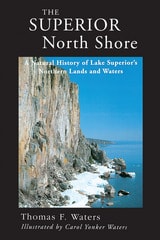
Superior North Shore
A Natural History of Lake Superior’s Northern Lands and WatersThomas F. Waters
University of Minnesota Press, 1999

Superstorm Sandy
The Inevitable Destruction and Reconstruction of the Jersey ShoreBates, Diane C
Rutgers University Press, 2015
Diane C. Bates offers a wide-ranging look at the Jersey Shore both before and after Sandy, examining the many factors—such as cultural attachment, tourism revenues, and governmental regulation—that combined to create a highly vulnerable coastal region. She explains why the Shore is so important to New Jerseyans, acting as a key cultural touchstone in a state that lacks a central city or even a sports team to build a shared identity among the state’s residents. She analyzes post-Sandy narratives about the Jersey Shore that trumpeted the dominance of human ingenuity over nature (such as the state’s “Stronger than the Storm” advertising campaign) or proclaimed a therapeutic community (“Jersey Strong”)—narratives rooted in emotion and iconography, waylaying any thought of the near-certainty of future storms. The book also examines local business owners, politicians, real estate developers, and residents who have vested interests in the region, explaining why the Shore was developed intensively prior to Sandy, and why restoration became an imperative in the post-storm period.
Engagingly written and insightful, Superstorm Sandy highlights the elements that compounded the disaster on the Shore, providing a framework for understanding such catastrophes and preventing them in the future.

Surface Encounters
Thinking with Animals and ArtRon Broglio
University of Minnesota Press, 2011
What it is like to be an animal? Ron Broglio wants to know from the inside, from underneath the fur and feathers. In examining this question, he bypasses the perspectives of biology or natural history to explore how one can construct an animal phenomenology, to think and feel as an animal other—or any other.
Until now phenomenology has grappled with how humans are embedded in their world. According to philosophical tradition, animals do not practice the self-reflexive thought that provides humans with depth of being. Without human interiority, philosophers have believed, animals live on the surface of things. But, Broglio argues, the surface can be a site of productive engagement with the world of animals, and as such he turns to humans who work with surfaces: contemporary artists.
Taking on the negative claim of animals living only on the surface and turning the premise into a positive set of possibilities for human–animal engagement, Broglio considers artists—including Damien Hirst, Carolee Schneemann, Olly and Suzi, and Marcus Coates—who take seriously the world of the animal on its own terms. In doing so, these artists develop languages of interspecies expression that both challenge philosophy and fashion new concepts for animal studies.

Surviving Climate Change
The Struggle to Avert Global CatastropheEdited by David Cromwell and Mark Levene
Pluto Press, 2007
Governments and business keep reassuring the public they are going to fix the problem. This book brings together some leading activists who disagree. They expose the inertia, denial, deception -- even threats to our civil liberties -- which comprise mainstream responses from civil and military policy makers, and from opinion formers in the media, corporations and academia.
An epochal change is called for in the way we all engage with the climate crisis. Key to that change is Aubrey Meyer's proposed Contraction and Convergence framework for limiting global carbon emissions. This book, which also includes contributions by Mayer Hillman and George Marshall, is a powerful and vital guide to how mass mobilisation can avert the looming catastrophe.
Sustainability for the Forgotten
Gary E. Machlis
University of Utah Press, 2024
Sustainability for the Forgotten is an incendiary book that confronts the history, policies, and practices of sustainability. It interrogates the usefulness of current sustainability approaches for the poorest of the poor, the chronic underclass, victims of natural disasters, refugees, the oppressed, and asks, how can we do better? With examples that range from the coffeelands of El Salvador to the coal country of American Appalachia, from the streets of Detroit to refugee camps in Greece and the upscale metro centers of the affluent, sustainability is examined with a critical eye and with an emphasis on insuring that the forgotten are heard.
At once well-researched and passionate, wide-ranging and sharply focused, Sustainability for the Forgotten is unlike any other book on the sustainability movement. Written with a distinctive voice that is reasoned, unflinching, and often poetic, the book challenges the sustainability movement to follow "a just and necessary path." The result is a provocative statement on the future of sustainability and a call to action that is ultimately hopeful.
Sustainability
A Philosophy of Adaptive Ecosystem ManagementBryan G. Norton
University of Chicago Press, 2005
Emphasizing cooperation and adaptation through social learning, Norton provides a practical framework that encourages an experimental approach to language clarification and problem formulation, as well as an interdisciplinary approach to creating solutions. By moving beyond the scientific arena to acknowledge the importance of public discourse, Sustainability offers an entirely novel approach to environmentalism.
Sustainable Failures
Environmental Policy and Democracy in a Petro-dependent WorldSherry Cable
Temple University Press, 2012
Environmental policies fail in conspicuous and egregious ways to sustain the natural resource base and protect citizens from production-generated risky exposures. In her engaging study, Sustainable Failures, Sherry Cable asks, why does environmental policy seem to be a contributing cause rather than a partial solution to environmental problems?
Melding a biophysical science perspective of environmental processes with sociological insights into human behavior, Cable examines the people, policies, and issues of petrochemical dependence and broader environment questions. She insists that our present policies around the manufacture and use of petroleum products violate rudimentary ecological principles—and do so in complicated ways.
Sustainable Failures is a blistering wake-up call to what is at stake not only regarding the failure of policy outcomes and grievous natural resource depletion and pollution, but also concerning democracy and ecological survival, and eventually, potentially, the existence of our species.
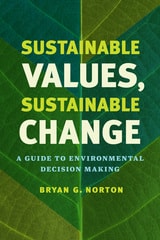
Sustainable Values, Sustainable Change
A Guide to Environmental Decision MakingBryan G. Norton
University of Chicago Press, 2015
While economists, philosophers, and ecologists argue about what in nature is valuable, and why, Norton here offers an action-oriented, pragmatic response to the disconnect between public and academic discourse around sustainability. Looking to the arenas in which decisions are made—and the problems that are driving these decisions—Norton reveals that the path to sustainability cannot be guided by fixed, utopian objectives projected into the future; sustainability will instead be achieved through experimentation, incremental learning, and adaptive management. Drawing inspiration from Aldo Leopold’s famed metaphor of “thinking like a mountain” for a spatially explicit, pluralistic approach to evaluating environmental change, Norton replaces theory-dependent definitions with a new decision-making process guided by deliberation and negotiation across science and philosophy, encompassing all stakeholders and activists and seeking to protect as many values as possible. Looking across scales to today’s global problems, Norton urges us to learn to think like a planet.
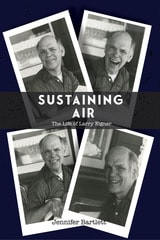
Sustaining Air
The Life of Larry EignerJennifer Bartlett
University of Alabama Press, 2023
The biography of a poet seminal to postwar American poetry
The poet Larry Eigner (1927–1996) was a key figure in New American poetry, which grew out of the Black Mountain School and San Francisco Renaissance, and a major influence on the Language poets. Eigner also had cerebral palsy as the result of an accident at birth. It is fortuitous that the poet lived his life in two locations vibrant in both poetics and disability activism. Except for brief periods attending camp and school, he lived with his parents in Swampscott, Massachusetts, until the age of 51. Later, he moved to Berkeley, California, at the height of the disability rights movement. In the 1950s, Eigner attended Camp Jened, which later became famous in the film Crip Camp.
Bartlett’s biography covers every significant phase of Eigner’s life: his childhood and young adulthood when he began typing poems with one finger on the manual typewriter that was a bar mitzvah gift; his first publications and the maturation of his poetic interests through correspondence with poets of the era; and after his move to Berkeley, the ever-expanding circle of friends, poets, caretakers, and collaborators he established there. The result is a deeply insightful account of an utterly distinctive voice whose influence widens and deepens with each new generation that encounters him.
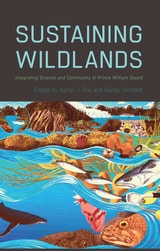
Sustaining Wildlands
Integrating Science and Community in Prince William SoundEdited by Aaron J. Poe and Randy Gimblett
University of Arizona Press, 2017
Nearly three decades later, changes in recreation use run counter to what was initially expected. Instead of avoiding Prince William Sound, tourists and visitors flock there. Economic revitalization efforts have resulted in increased wilderness access as new commercial enterprises offer nature tourism in remote bays and fjords. This increased visitation has caused concerns that the wilderness may again be threatened—not by oil but rather by the very humans seeking those wilderness experiences.
In Sustaining Wildlands, scientists and managers, along with local community residents, address what has come to be a central paradox in public lands management: the need to accommodate increasing human use while reducing the environmental impact of those activities. This volume draws on diverse efforts and perspectives to dissect this paradox, offering an alternative approach where human use is central to sustaining wildlands and recovering a damaged ecosystem like Prince William Sound.
Contributors:
Brad A. Andres, Chris Beck, Nancy Bird, Dale J. Blahna, Harold Blehm, Sara Boario, Bridget A. Brown, Courtney Brown, Greg Brown, Milo Burcham, Kristin Carpenter, Ted Cooney, Patience Andersen Faulkner, Maryann Smith Fidel, Jessica B. Fraver, Jennifer Gessert, Randy Gimblett, Michael I. Goldstein, Samantha Greenwood, Lynn Highland, Marybeth Holleman, Shay Howlin, Tanya Iden, Robert M. Itami, Lisa Jaeger, Laura A. Kennedy, Spencer Lace, Nancy Lethcoe, Kate McLaughlin, Rosa H. Meehan, Christopher Monz, Karen A. Murphy, Lisa Oakley, Aaron J. Poe, Chandra B. Poe, Karin Preston, Jeremy Robida, Clare M. Ryan, Gerry Sanger, Bill Sherwonit, Lowell H. Suring, Paul Twardock, Sarah Warnock, and Sadie Youngstrom

Swamplife
People, Gators, and Mangroves Entangled in the EvergladesLaura A. Ogden
University of Minnesota Press, 2010
Today, the many visions of the Everglades—protectionist, ecological, commercial, historical—have become a tangled web of contradictory practices and politics for conservation and for development. Yet within this entanglement, the place of people remains highly ambivalent. It is the role of people in the Everglades that interests Ogden, as she seeks to reclaim the landscape’s long history as a place of human activity and, in doing so, discover what it means to be human through changing relations with other animals and plant life.
Ogden tells this story through the lives of poor rural whites, gladesmen, epitomized in tales of the Everglades’ most famous outlaws, the Ashley Gang. With such legends and lore on one side, and outsized efforts at drainage and development on the other, Swamplife strikes a rare balance, offering a unique insight into the hidden life of the Everglades—and into how an appreciation of oppositional culture and social class operates in our understanding of wilderness in the United States.
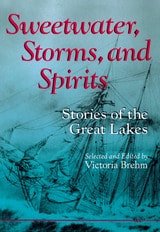
Sweetwater, Storms, and Spirits
Stories of the Great LakesSelected and Edited by Victoria Brehm
University of Michigan Press, 1991
Native American legends, shipping tales, folklore, and myths spanning the last 150 years are gathered together for the first time in this collection. The presence of Native American culture, the unpredictable climate, the dangerous closeness of the shoreline, and the bloody history of shipping on the Lakes contribute greatly to the uniqueness of maritime literature on the Lakes.
Sweetwater, Storms, and Spirits will appeal to those interested in both Native American literature and history and Great Lakes maritime history, and to those who simply enjoy a good maritime tale. The collection is a seabag of different kinds of stories, myths, and tales that together create a picture of life as it has been lived on the Great Lakes.
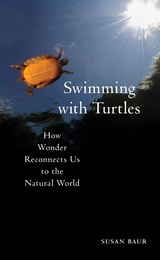
Swimming with Turtles
How Wonder Reconnects Us to the Natural WorldSusan Baur
University of Massachusetts Press, 2026
A memoir of discovery, loss, and wonder that shows us how to slow down
When psychologist and author Susan Baur first slipped into a Cape Cod pond with a snorkel, she wasn’t looking for transformation, just a swim. But beneath the surface, she discovered something extraordinary: minnows hiding among water lilies; fresh-water jellies like jewels and—most striking of all—painted, musk, and snapping turtles. Whether the turtles were buried in mud, teetering on a submerged branch, or drifting like ancient astronauts, they pulled her into a mysterious happiness she could not explain.
Learning to move slowly enough to see them became both her new discipline and her greatest joy. Each dive required patience, curiosity, and humility, and she learned to read the water, follow a subtle shadow, and anticipate the turtles’ rhythms without disturbing their world. As she mastered the art of swimming with turtles, Baur also fell in love with an older man whose companionship deepened her connection to the natural world. When he passed away, grief drove her deeper into the water. There, among the turtles, she found solace and purpose: a reason to keep diving, looking, and learning.
Over nearly two decades, Baur became a self-taught naturalist, children’s author (of The Turtle Sisters series), and unlikely environmental advocate, founding Old Ladies Against Underwater Garbage to protect the ponds she had grown to love. With humor, heart, and vivid observation, Baur shows that wonder isn’t reserved for the young or the lucky—it waits beneath the surface for anyone willing to slow down, look closely, and stay a while.
Swimming with Turtles
How Wonder Reconnects Us to the Natural WorldWritten by Susan Baur. Narrated by Moe Egan
University of Massachusetts Press, 2026
A memoir of discovery, loss, and wonder that shows us how to slow down
When psychologist and author Susan Baur first slipped into a Cape Cod pond with a snorkel, she wasn’t looking for transformation, just a swim. But beneath the surface, she discovered something extraordinary: minnows hiding among water lilies; fresh-water jellies like jewels and—most striking of all—painted, musk, and snapping turtles. Whether the turtles were buried in mud, teetering on a submerged branch, or drifting like ancient astronauts, they pulled her into a mysterious happiness she could not explain.
Learning to move slowly enough to see them became both her new discipline and her greatest joy. Each dive required patience, curiosity, and humility, and she learned to read the water, follow a subtle shadow, and anticipate the turtles’ rhythms without disturbing their world. As she mastered the art of swimming with turtles, Baur also fell in love with an older man whose companionship deepened her connection to the natural world. When he passed away, grief drove her deeper into the water. There, among the turtles, she found solace and purpose: a reason to keep diving, looking, and learning.
Over nearly two decades, Baur became a self-taught naturalist, children’s author (of The Turtle Sisters series), and unlikely environmental advocate, founding Old Ladies Against Underwater Garbage to protect the ponds she had grown to love. With humor, heart, and vivid observation, Baur shows that wonder isn’t reserved for the young or the lucky—it waits beneath the surface for anyone willing to slow down, look closely, and stay a while.
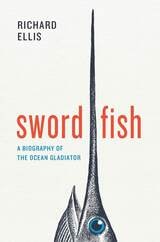
Swordfish
A Biography of the Ocean GladiatorRichard Ellis
University of Chicago Press, 2013