Results by title
3703 books match the query '19th Century' and 256 start with s

States at War, Volume 5
A Reference Guide for Ohio in the Civil WarEdited by Richard F. Miller
University Press of New England, 2015

States at War, Volume 6
The Confederate States Chronology and a Reference Guide for South Carolina in the Civil WarEdited by Richard F. Miller
University Press of New England, 2018
Stations in the Field
A History of Place-Based Animal Research, 1870-1930Raf De Bont
University of Chicago Press, 2015
Raf De Bont’s Stations in the Field focuses on the early history of biological field stations and the role these played in the rise of zoological place-based research. Beginning in the 1870s, a growing number of biological field stations were founded—first in Europe and later elsewhere around the world—and thousands of zoologists received their training and performed their research at these sites. Through case studies, De Bont examines the material and social context in which field stations arose, the actual research that was produced in these places, the scientific claims that were developed there, and the rhetorical strategies that were deployed to convince others that these claims made sense. From the life of parasitic invertebrates in northern France and freshwater plankton in Schleswig-Holstein, to migratory birds in East Prussia and pest insects in Belgium, De Bont’s book is fascinating tour through the history of studying nature in nature.
Stealing the Gila
The Pima Agricultural Economy and Water Deprivation, 1848-1921David H. DeJong
University of Arizona Press, 2009
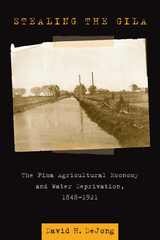
This economic vitality did not last, however. As immigrants settled upstream from the Pima villages, they deprived the Indians of the water they needed to sustain their economy. DeJong traces federal, territorial, and state policies that ignored Pima water rights even though some policies appeared to encourage Indian agriculture. This is a particularly egregious example of a common story in the West: the flagrant local rejection of Supreme Court rulings that protected Indian water rights. With plentiful maps, tables, and illustrations, DeJong demonstrates that maintaining the spreading farms and growing towns of the increasingly white population led Congress and other government agencies to willfully deny Pimas their water rights.
Had their rights been protected, DeJong argues, Pimas would have had an economy rivaling the local and national economies of the time. Instead of succeeding, the Pima were reduced to cycles of poverty, their lives destroyed by greed and disrespect for the law, as well as legal decisions made for personal gain.

Steam & Cinders
The Advent of Railroads in WisconsinAxel Lorenzsonn
Wisconsin Historical Society Press, 2009
Steam City
Railroads, Urban Space, and Corporate Capitalism in Nineteenth-Century BaltimoreDavid Schley
University of Chicago Press, 2020
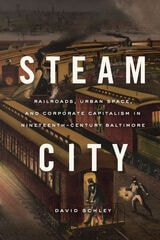
Steam City tells the story of corporate capitalism starting from the street and moving outward, looking at how the rise of the railroad altered the fabric of everyday life in the United States. The B&O’s founders believed that their new line would remap American economic geography, but no one imagined that the railroad would also dramatically reshape the spaces of its terminal city. As railroad executives wrangled with city officials over their use of urban space, they formulated new ideas about the boundaries between public good and private profit. Ultimately, they reinvented the B&O as a private enterprise, unmoored to its home city. This bold reconception had implications not only for the people of Baltimore, but for the railroad industry as a whole. As David Schley shows here, privatizing the B&O helped set the stage for the rise of the corporation as a major force in the post-Civil War economy.
Steam City examines how the birth and spread of the American railroad—which brought rapid communications, fossil fuels, and new modes of corporate organization to the city—changed how people worked, where they lived, even how they crossed the street. As Schley makes clear, we still live with the consequences of this spatial and economic order today.

Steam-Powered Knowledge
William Chambers and the Business of Publishing, 1820-1860Aileen Fyfe
University of Chicago Press, 2012
With the overwhelming amount of new information that bombards us each day, it is perhaps difficult to imagine a time when the widespread availability of the printed word was a novelty. In early nineteenth-century Britain, print was not novel—Gutenberg’s printing press had been around for nearly four centuries—but printed matter was still a rare and relatively expensive luxury. All this changed, however, as publishers began employing new technologies to astounding effect, mass-producing instructive and educational books and magazines and revolutionizing how knowledge was disseminated to the general public.
Steamboat Modernity
Travel, Transport, and Social Transformation on the Lower Danube, 1830–1860Constantin Ardeleanu
Central European University Press, 2024
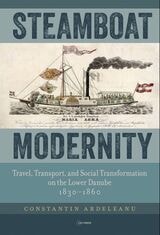
Through a skillful combination of economic and cultural history, this book describes the impact on Moldavia and Wallachia of steam navigation on the Danube. The Danube route integrated the two principalities into a dense network of European roads and waterways. From the 1830s to the 1860s, steamboat transport transformed time and space for the areas that benefited from regular services. River traffic accelerated urban development along the Lower Danube and contributed directly to institutional modernization in one of Europe’s peripheries.
Beyond technological advances and the transportation of goods on a trans-imperial waterway, steamboat travel revolutionized human interactions, too. The book offers a fascinating insight into the social and cultural milieu of the nineteenth century, drawing on first-hand accounts of Danube cruising. Describing the story of travelers who interacted, met, and visited the places they stopped, Constantin Ardeleanu creates a transnational history of travel up and down the Danube from Vienna to Constantinople. The pleasures and sometimes the travails of the travelers unfold against a backdrop of technical and economic transformation in the crucial period of modernization.

Steaming to the North
The First Summer Cruise of the US Revenue Cutter Bear, Alaska and Chukotka, Siberia, 1886Katherine C. Donahue and David C. Switzer
University of Alaska Press, 2014
Steaming to the North follows the Bear from May to October 1886 as it takes its first summer cruise from San Francisco up to Point Barrow and back again. This is the first book to exhibit the photographs taken by 3rd Lt. Charles Kennedy of New Bedford, introducing rarely seen photos of the last sail-and-steam whaling ships, capturing early interactions of Natives with white whalemen and explorers, and showing lives otherwise lost to time. Essays follow the logbook of the cruise and allow readers to vividly ride alongside the crew on a history-making voyage.

Stepchildren of Nature
Krafft-Ebing, Psychiatry, and the Making of Sexual IdentityHarry Oosterhuis
University of Chicago Press, 2000
But in this powerful new cultural history Harry Oosterhuis invites us to reconsider the quality and extent of Krafft-Ebing's influence. Revisiting the case studies on which Krafft-Ebing based his findings, and thus drawing on the voices of his patients and informants, Oosterhuis finds that Krafft-Ebing was not the harsh judge of perversions that we think he was. He argues that Krafft-Ebing had a deep appreciation of the psyche, and that his work reveals an attempt to separate sexual deviancies from ideas of immorality. In the tradition of Freud, then, Krafft-Ebing should stand not as a villain, but as a contributor to more modern notions of sexual identity.

Stephen A. Douglas
Robert W. Johannsen
University of Illinois Press, 1997
For the quarter-century before 1860 Stephen A. Douglas was a dominant
figure on the American political scene, far outshadowing Abraham Lincoln.
This first paperback printing of Robert Johannsen's authoritative biography
features a new preface.
"At once a work of enormous scholarship and of deep insight. Here,
for the first time, is the full story of a great career, told with such
skill that we can now understand why Abraham Lincoln found the 'Little
Giant' the most formidable political rival he ever faced." -- David
H. Donald, author of Lincoln and two-time winner of the Pulitzer
Prize
"Well-organized and marvelously detailed. . . . The book demonstrates
the virtues of large-scale, straightforward narrative biography at its
best. Its completeness and objectivity will make it the standard authority
for many years to come." -- Richard N. Current, The New York Times
Book Review
"Superb. . . . Will doubtless stand as the definitive biography
of Stephen A. Douglas for this generation." -- Hans L. Trefousse,
The Journal of American History
"An impressive work--impressive in scope, in research, and in maturity
of understanding. . . . Johannsen has constructed a biography that is
rich in detail and full of conviction." -- James Z. Rabun, The
Journal of Southern History
"Should take its place in the tradition of magisterial biographies
. . . in which so much of the best writing on American history is to be
found." -- Harry V. Jaffa, National Review
"The research is amazingly exhaustive and the writing is unusually
readable. . . . Outstanding biography of a quality not often matched."
-- LeRoy H. Fischer, Manuscripta
Supported by the Dickerson Fund of the University of Illinois at Urbana-Champaign
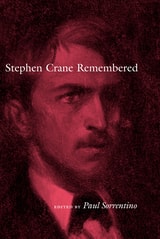
Stephen Crane Remembered
Edited by Paul Sorrentino
University of Alabama Press, 2006
Revealing episodes in the life of the elusive writer, as told by acquaintances
This book collects reminiscences by contemporaries, friends, and associates of Stephen Crane that illuminate the life of this often misunderstood and misrepresented writer. Although Crane is widely regarded as a major American author, conclusions about his life, work, and thought remain obscure due to the difficulties in separating fact from fiction. His first biographer recorded mostly vague impressions and, to mythologize his subject, invented a multitude of the episodes and letters used in his account of Crane’s life. Subsequent biographies were either cursory summations or compendiums of verifiable facts. Crane himself was both reclusive and mercurial, protective of his inner life while projecting a variety of personae to suit others.
A flamboyant personality and close friend of writers such as William Dean Howells, Henry James, and Joseph Conrad, Crane made telling impressions on his contemporaries. They often constitute the best assessments of Crane’s own personality and work. The 90 reminiscences gathered here offer a much-needed account of Crane’s life from a variety of viewpoints, as well as important information about the contributors themselves.
Steppin' Out
New York Nightlife and the Transformation of American CultureLewis A. Erenberg
University of Chicago Press, 1984

Still the Arena of Civil War
Violence and Turmoil in Reconstruction Texas, 1865-1874Kenneth W. Howell
University of North Texas Press, 2012
Stories of Tonality in the Age of François-Joseph Fétis
Thomas Christensen
University of Chicago Press, 2019
Storm of Words
Science, Religion, and Evolution in the Civil War EraMonte Harrell Hampton
University of Alabama Press, 2014
A study of the ways that southern Presbyterians in the wake of the Civil War contended with a host of cultural and theological questions
Southern Presbyterian theologians enjoyed a prominent position in antebellum southern culture. Respected for both their erudition and elite constituency, these theologians identified the southern society as representing a divine, Biblically ordained order. Beginning in the 1840s, however, this facile identification became more difficult to maintain, colliding first with antislavery polemics, then with Confederate defeat and reconstruction, and later with women’s rights, philosophical empiricism, literary criticisms of the Bible, and that most salient symbol of modernity, natural science.
As Monte Harrell Hampton shows in Storm of Words, modern science seemed most explicitly to express the rationalistic spirit of the age and threaten the Protestant conviction that science was the faithful “handmaid” of theology. Southern Presbyterians disposed of some of these threats with ease. Contemporary geology, however, posed thornier problems. Ambivalence over how to respond to geology led to the establishment in 1859 of the Perkins Professorship of Natural Science in Connexion with Revealed Religion at the seminary in Columbia, South Carolina. Installing scientist-theologian James Woodrow in this position, southern Presbyterians expected him to defend their positions.
Within twenty-five years, however, their anointed expert held that evolution did not contradict scripture. Indeed, he declared that it was in fact God’s method of creating. The resulting debate was the first extended evolution controversy in American history. It drove a wedge between those tolerant of new exegetical and scientific developments and the majority who opposed such openness. Hampton argues that Woodrow believed he was shoring up the alliance between science and scripture—that a circumscribed form of evolution did no violence to scriptural infallibility. The traditionalists’ view, however, remained interwoven with their identity as defenders of the Lost Cause and guardians of southern culture.
The ensuing debate triggered Woodrow’s dismissal. It also capped a modernity crisis experienced by an influential group of southern intellectuals who were grappling with the nature of knowledge, both scientific and religious, and its relationship to culture—a culture attempting to define itself in the shadow of the Civil War and Reconstruction.
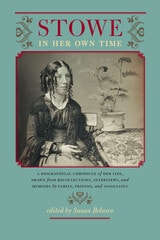
Stowe in Her Own Time
A Biographical Chronicle of Her Life, Drawn from Recollections, Interviews, and Memoirs by Family, FSusan Belasco
University of Iowa Press, 2009
One of the first celebrity authors, Harriet Beecher Stowe (1811–1896) became famous almost overnight when Uncle Tom’s Cabin—which sold more than 300,000 copies in its first year of publication—appeared in 1852. Known by virtually all famous writers in the United States and many in England and regarded by many women writers as a role model because of her influence in the literary marketplace, Stowe herself was the subject of many books, articles, essays, and poems during her lifetime.
This volume brings together for the first time a range of primary materials about Stowe’s private and public life written by family members, friends, and fellow writers who knew or were influenced by her before and after Uncle Tom’s Cabin catapulted her to fame. Included are periodical articles by Fanny Fern and Charles Dudley Warner; biographical essays by Sarah Josepha Hale and Rose Terry Cooke; letters by Oliver Wendell Holmes, Elizabeth Barrett Browning, and Harriet Jacobs; recollections by Frederick Douglass, Annie Adams Fields, Isabella Beecher Hooker, and Charles Beecher; and poems by Paul Laurence Dunbar and John Greenleaf Whittier. An introduction at the beginning of each essay connects it to its historical and cultural context, explanatory notes provide information about people and places, and the book includes a detailed introduction and a chronology of Stowe’s life.
The thirty-eight recollections gathered in Stowe in Her Own Time form a biographical narrative designed to provide several perspectives on the famous author, sometimes in conflict and sometimes in agreement but always perceptive. The figure who emerges from this insightful, analytical collection is far more complex than the image she helped construct in her lifetime.
Strained Sisterhood
Gender and Class in the Boston Female Anti-Slavery SocietyDebra Gold Hansen
University of Massachusetts Press, 1993
Debra Gold Hansen explores the origins of the equality-versus-difference debate by examining the Boston Female Anti-Slavery Society, which disbanded in 1840 over this very issue. After establishing a historical framework for women's lives in early nineteenth-century Boston, Hansen analyzes the membership of the Society along the lines of race, religion, and socioeconomic status. Through her findings, she concludes that many of the issues that estranged female abolitionists in antebellum Boston continue to divide women today, testifying not to the strength of the bonds between women but to the fragility of those ties.
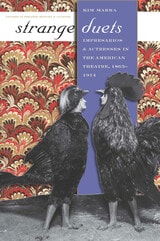
Strange Duets
Impresarios and Actresses in the American Theatre, 1865-1914Kim Marra
University of Iowa Press, 2006
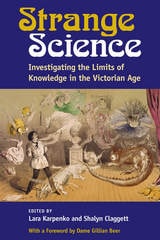
Strange Science
Investigating the Limits of Knowledge in the Victorian AgeEdited by Lara Karpenko and Shalyn Claggett
University of Michigan Press, 2017

Strata
William Smith’s Geological MapsEdited by the Oxford University Museum of Natural History
University of Chicago Press, 2020
This sumptuous volume begins with an introduction by Douglas Palmer that places Smith’s work in the context of earlier, concurrent, and subsequent ideas regarding the structure and natural processes of the earth, geographical mapping, and biostratigraphical theories. The book is then organized into four parts, each beginning with four sheets from Smith’s hand-colored, 1815 strata map, accompanied by related geological cross-sections and county maps, and followed by fossil illustrations by Smith contemporary James Sowerby, all organized by strata. Essays between each section explore the aims of Smith’s work and its application in the fields of mining, agriculture, cartography and hydrology. Strata concludes with reflections on Smith’s later years as an itinerant geologist and surveyor, plagiarism by a rival, receipt of the first Wollaston Medal in recognition of his achievements, and the influence of his geological mapping and biostratigraphical theories on the sciences—all of which culminated in the establishment of the modern geological timescale.
Featuring a foreword by Robert Macfarlane, Strata is a glorious testament to the lasting geological and illustrative genius of William Smith, a collection as colossal and awe-inspiring as the layers of the Earth themselves.
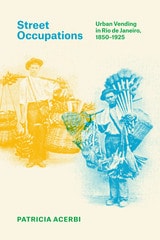
Street Occupations
Urban Vending in Rio de Janeiro, 1850–1925By Patricia Acerbi
University of Texas Press, 2017
Winner, Warren Dean Memorial Prize, Conference on Latin American History (CLAH), 2018
Street vending has supplied the inhabitants of Rio de Janeiro with basic goods for several centuries. Once the province of African slaves and free blacks, street commerce became a site of expanded (mostly European) immigrant participation and shifting state regulations during the transition from enslaved to free labor and into the early post-abolition period. Street Occupations investigates how street vendors and state authorities negotiated this transition, during which vendors sought greater freedom to engage in commerce and authorities imposed new regulations in the name of modernity and progress.
Examining ganhador (street worker) licenses, newspaper reports, and detention and court records, and considering the emergence of a protective association for vendors, Patricia Acerbi reveals that street sellers were not marginal urban dwellers in Rio but active participants in a debate over citizenship. In their struggles to sell freely throughout the Brazilian capital, vendors asserted their citizenship as urban participants with rights to the city and to the freedom of commerce. In tracing how vendors resisted efforts to police and repress their activities, Acerbi demonstrates the persistence of street commerce and vendors’ tireless activity in the city, which the law eventually accommodated through municipal street commerce regulation passed in 1924.
A focused history of a crucial era of transition in Brazil, Street Occupations offers important new perspectives on patron-client relations, slavery and abolition, policing, the use of public space, the practice of free labor, the meaning of citizenship, and the formality and informality of work.

Streets, Railroads, and the Great Strike of 1877
David O. Stowell
University of Chicago Press, 1999
Whereas most historians treat the event solely as a massive labor strike that targeted the railroads, David O. Stowell examines America's predicament more broadly to uncover the roots of this rebellion. He studies the urban origins of the Strike in three upstate New York cities—Buffalo, Albany, and Syracuse. He finds that locomotives rumbled through crowded urban spaces, sending panicked horses and their wagons careening through streets. Hundreds of people were killed and injured with appalling regularity. The trains also disrupted street traffic and obstructed certain forms of commerce. For these reasons, Stowell argues, The Great Strike was not simply an uprising fueled by disgruntled workers. Rather, it was a grave reflection of one of the most direct and damaging ways many people experienced the Industrial Revolution.
"Through meticulously crafted case studies . . . the author advances the thesis that the strike had urban roots, that in substantial part it represented a community uprising. . . .A particular strength of the book is Stowell's description of the horrendous accidents, the toll in human life, and the continual disruption of craft, business, and ordinary movement engendered by building railroads into the heart of cities."—Charles N. Glaab, American Historical Review
Strindberg's Letters
August Strindberg
University of Chicago Press, 1992
Strindberg's plays, novels, and short stories, which influenced film and theatre artists from Artaud and the German Expressionists to Ingmar Bergman and Woody Allen, chart an artistic evolution from Naturalism to the revolt against realism that issued in Expressionist drama. These letters help to explain Strindberg's seminal force and testify to the broad range of his interests, energies, and imaginative instincts. An essential part of their author's oeuvre, the letters provide invaluable insight into Strindberg the artist, the political thinker, and the person, and were regarded by Strindberg himself as an integral component of his autobiographical project.
The letters, some of them published here for the first time, have been meticulously edited and are supported by an extensive introduction and notes.
Strindberg's Letters, Volume 1
1862-1892August Strindberg
University of Chicago Press, 1992
Strindberg's Letters, Volume 2
1892-1912August Strindberg
University of Chicago Press, 1992
Strong on Music
The New York Music Scene in the Days of George Templeton Strong, Volume 1: Resonances, 1836-1849Vera Brodsky Lawrence
University of Chicago Press, 1995
Formerly a concert pianist, Vera Brodsky Lawrence spent the last third of her life as a historian of American music (she died in 1996). She was editor of The Piano Works of Louis Moreau Gottschalk and The Complete Works of Scott Joplin.
On Volume 1: "A marvelous book. There is nothing like it in the literature of American music."—Harold C. Schonberg, New York Times Book Review
On Volume 2: "A monumental achievement."—Victor Fell Yellin, Opera Quarterly
Strong on Music
The New York Music Scene in the Days of George Templeton Strong, Volume 2: Reverberations, 1850-1856Vera Brodsky Lawrence
University of Chicago Press, 1995
Each chapter presents one year in the musical life of New York City, with Lawrence's extensive commentary enriched both by excerpts from Strong's diaries and a lavish selection of little-known music criticism and comment from the period. The reviews, written by an often truculent, sometimes venal tribe of music journalists, cover the entire world of music—from opera to barrel organ, salon to saloon.
In this New York, operas performed by renowned artists are parodied by blackface minstrels; performances of the Philharmonic Society are drowned by the raucous chatter of flirtatious adolescents, who turn concerts into a noisy singles' hangout; and irate critics trash the first performances of Verdi operas, calling the plots indecent and the scores noisy and unmelodic. In this volatile atmosphere, a native musical culture is born; its whose first faltering efforts are dubiously received, and the first American composers begin to emerge.
Strong on Music
The New York Music Scene in the Days of George Templeton Strong, Volume 3: Repercussions, 1857-1862Vera Brodsky Lawrence
University of Chicago Press, 1999
Among the many striking scenes vividly portrayed in Repercussions are the rapturous reception of Verdi's Ballo in maschera in 1861; the impact of the Civil War on New York's music scene, from theaters closing as their musicians enlisted to the performance of "The Star-Spangled Banner" at every possible occasion; and open-air concerts in the developing Central Park. Throughout, Lawrence mines a treasure trove of primary source materials including daily newspapers, memoirs, city directories, and architectural drawings.
Indispensable for scholars, Repercussions will also fascinate music fans with its witty writing and detailed descriptions of the cultural life of America's first metropolis.
Formerly a concert pianist, Vera Brodsky Lawrence spent the last third of her life as a historian of American music (she died in 1996). She was editor of The Piano Works of Louis Moreau Gottschalk and The Complete Works of Scott Joplin.
On Volume 1: "A marvelous book. There is nothing like it in the literature of American music."—Harold C. Schonberg, New York Times Book Review
On Volume 2: "A monumental achievement."—Victor Fell Yellin, Opera Quarterly

Struggle for the Gulf Borderlands
The Creek War and the Battle of New Orleans, 1812-1815Frank L. Owsley
University of Alabama Press, 2000
Examination of the Creek War which integrates that struggle into the larger conflict that broke out in 1812 between Great Britain and the United States.
Using American, British, and Spanish documents, many previously unknown, Frank Owsley’s study establishes the Creek War and the struggle to control the Gulf borderlands as integral parts of the War of 1812. The war between the United States and a large part of the Creek nation is usually studied as local or regional history. These documentary sources, however, show the larger picture. They show Spain to have been a major influence in the Creek War and indicate the extent to which the British were aiding the Indians and using them to redirect American troops. On the other hand, Andrew Jackson, in charge of the American forces on the Gulf Coast, emerged from the conflict as a first-rate military commander. His victories on the Gulf gave the West a leader and aided in shifting political power from the eastern seaboard to the South and West.
Owsley concludes that the victories in the Gulf region were of sufficient magnitude to justify the claim that the War of 1812 was not a draw but a decisive American victory and that had there been a general of Jackson's caliber on the northern frontier, the United States might have had a clear-cut victory there.
As a result of the war, the United States held its claim on Louisiana, annexed the Mobile district, forced Spain out of Florida, and broke the power of the southern Indians, thus opening vast lands for settlement from the new nation on the eastern seaboard.
Studying Wisconsin
The Life of Increase Lapham, early chronicler of plants, rocks, rivers, mounds and all things WisconsinMartha Bergland
Wisconsin Historical Society Press, 2014
With masterful storytelling, Bergland and Hayes demonstrate how Lapham blended his ravenous curiosity with an equable temperament and a passion for detail to create a legacy that is still relevant today.
—John Gurda
In this long overdue tribute to Wisconsin’s first scientist, authors Martha Bergland and Paul G. Hayes explore the remarkable life and achievements of Increase Lapham (1811–1875). Lapham’s ability to observe, understand, and meticulously catalog the natural world marked all of his work, from his days as a teenage surveyor on the Erie Canal to his last great contribution as state geologist.
Self-taught, Lapham mastered botany, geology, archaeology, limnology, mineralogy, engineering, meteorology, and cartography. A prolific writer, his 1844 guide to the territory was the first book published in Wisconsin. Asked late in life which field of science was his specialty, he replied simply, “I am studying Wisconsin.”
Lapham identified and preserved thousands of botanical specimens. He surveyed and mapped Wisconsin’s effigy mounds. He was a force behind the creation of the National Weather Service, lobbying for a storm warning system to protect Great Lakes sailors. Told in compelling detail through Lapham’s letters, journals, books, and articles, Studying Wisconsin chronicles the life and times of Wisconsin’s pioneer citizen-scientist.

Style and Music
Theory, History, and IdeologyLeonard B. Meyer
University of Chicago Press, 1997
Meyer devotes the latter part of his book to a sketch-history of nineteenth-century music. He shows explicitly how the beliefs and attitudes of Romanticism influenced the choices of composers from Beethoven to Mahler and into our own time.
"A monumental work. . . . Most authors concede the relation of music to its cultural milieu, but few have probed so deeply in demonstrating this interaction."—Choice
"Probes the foundations of musical research precisely at the joints where theory and history fold into one another."—Kevin Korsyn, Journal of American Musicological Society
"A remarkably rich and multifaceted, yet unified argument. . . . No one else could have brought off this immense project with anything like Meyer's command."—Robert P. Morgan, Music Perception
"Anyone who attempts to deal with Romanticism in scholarly depth must bring to the task not only musical and historical expertise but unquenchable optimism. Because Leonard B. Meyer has those qualities in abundance, he has been able to offer fresh insight into the Romantic concept."—Donal Henahan, New York Times
Style and Seduction
Jewish Patrons, Architecture, and Design in Fin de Siècle ViennaElana Shapira
Brandeis University Press, 2016
Subject Lessons
The Western Education of Colonial IndiaSanjay Seth
Duke University Press, 2007
Drawing on history, political science, anthropology, and philosophy, Seth interprets the debates and controversies that came to surround western education. Central among these were concerns that Indian students were acquiring western education by rote memorization—and were therefore not acquiring “true knowledge”—and that western education had plunged Indian students into a moral crisis, leaving them torn between modern, western knowledge and traditional Indian beliefs. Seth argues that these concerns, voiced by the British as well as by nationalists, reflected the anxiety that western education was failing to produce the modern subjects it presupposed. This failure suggested that western knowledge was not the universal epistemology it was thought to be. Turning to the production of collective identities, Seth illuminates the nationalists’ position vis-à-vis western education—which they both sought and criticized—through analyses of discussions about the education of Muslims and women.
Subjects on Display
Psychoanalysis, Social Expectation, and Victorian FemininityBeth Newman
Ohio University Press, 2004
Subjects on Display explores a recurrent figure at the heart of many nineteenth-century English novels: the retiring, self-effacing woman who is conspicuous for her inconspicuousness. Beth Newman draws upon both psychoanalytic theory and recent work in social history as she argues that this paradoxical figure, who often triumphs over more dazzling, eye-catching rivals, is a response to the forces that made personal display a vexed issue for Victorian women. Chief among these is the changing socioeconomic landscape that made the ideal of the modest woman outlive its usefulness as a class signifier even as it continued to exert moral authority.
This problem cannot be grasped in its full complexity, Newman shows, without considering how the unstable social meanings of display interacted with psychical forces-specifically, the desire to be seen by others that is central to both masculine and feminine subjectivity. This desire raises an issue that feminist theorists have been reluctant to address: the importance of pleasure in being the object of the look. Their reluctance is characteristic of cultural theory, which has tended to equate subjectivity with the position of the observer rather than the observed.
Through a consideration of fiction by Charlotte Brontë, Charles Dickens, George Eliot, and Henry James, Newman shifts the inquiry toward the observed in the experience of being seen. In the process she reopens the question of the gaze and its relation to subjectivity.
Subjects on Display will appeal to scholars and students in several disciplines as it returns psychoanalysis to a central position within literary and cultural studies.

Subsurface
Karen Pinkus
University of Minnesota Press, 2023
A bold new consideration of climate change between narratives of the Earth’s layers and policy of the present
Long seen as a realm of mystery and possibility, the subsurface beneath our feet has taken on all-too-real import in the era of climate change. Can reading narratives of the past that take imaginative leaps under the surface better attune us to our present knowledge of a warming planet?
In Subsurface, Karen Pinkus looks below the surface of texts by Edgar Allan Poe, Arthur Conan Doyle, George Sand, E. T. A. Hoffmann, and Jules Verne to find the buried origins of capitalist fantasies in which humans take what they want from the earth. Putting such texts into conversation with narrative theory, critical theory, geology, and climate policy, she shows that the subsurface has been, in our past, a place of myth and stories of male voyages down to gain knowledge—but it is also now the realm of fossil fuels. How do these two modes intertwine?
A highly original take on evocative terms such as extraction, burial, fossils, deep time, and speculative futurity, Subsurface questions the certainty of comfortable narrative arcs. It asks us to read literature with and against the figure of the geological column, with and against fossil fuels and the emissions warming our planet. As we see our former selves move into the distance, what new modes of imagination might we summon?

Suburban Plots
Men at Home in Nineteenth-Century American Print CultureMaura D'Amore
University of Massachusetts Press, 2014
In Suburban Plots, Maura D'Amore explores how Henry David Thoreau, Henry Ward Beecher, Donald Grant Mitchell, Nathaniel Hawthorne, Nathaniel Parker Willis, and others utilized the pen to plot opportunities for a new sort of male agency grounded, literarily and spatially, in a suburbanized domestic landscape. D'Amore uncovers surprising narratives that do not fit easily into standard critical accounts of midcentury home life. Taking men out of work spaces and locating them in the domestic sphere, these writers were involved in a complex process of portraying men struggling to fulfill fantasies outside of their professional lives, in newly emerging communities. These representations established the groundwork for popular conceptions of suburban domestic life that remain today.
Subversives and Mavericks in the Muslim Mediterranean
A Subaltern HistoryEdited by Odile Moreau and Stuart Schaar; preface by Edmund Burke III
University of Texas Press, 2016
Subaltern studies, the study of non-elite or underrepresented people, have revolutionized the writing of Middle Eastern history. Subversives and Mavericks in the Muslim Mediterranean represents the next step in this transformation. The book explores the lives of eleven nonconformists who became agents of political and social change, actively organizing new forms of resistance—against either colonial European regimes or the traditional societies in which they lived—that disrupted the status quo, in some cases, with dramatic results. These case studies highlight cross-border connections in the Mediterranean world, exploring how these channels were navigated.
Chapters in the book examine the lives of subversives and mavericks, such as Tawhida ben Shaykh, the first Arab woman to receive a medical degree; Mokhtar al-Ayari, a radical Tunisian labor leader; Nazli Hanem, Kmar Bayya, and Khiriya bin Ayyad, three aristocractic women who resisted the patriarchal structures of their societies by organizing and participating in intellectual salons for men and women and advocating social reform; Qaid Najim al-Akhsassi, an ex-slave and military officer, who fought against French and Spanish colonial expansion; and Boubeker al-Ghandjawi, a nearly illiterate trader who succeeded, though his diverse connections, in establishing important relations between the Moroccan sultan and the representative of the British government. Although based on individual and local perspectives, Subversives and Mavericks in the Muslim Mediterranean reveals new and unrecognized trans-local connections across the Muslim world, illuminating our understanding of these societies beyond narrow elite circles.

Success Depends on the Animals
Emigrants, Livestock, and Wild Animals on the Overland Trails, 1840–1869Diana L. Ahmad
University of Nevada Press, 2016
Between 1840 and 1869, thousands of people crossed the American continent looking for a new life in the West. Success Depends on the Animals explores the relationships and encounters that these emigrants had with animals, both wild and domestic, as they traveled the Overland Trail. In the longest migration of people in history, the overlanders were accompanied by thousands of work animals such as horses, oxen, mules, and cattle. These travelers also brought dogs and other companion animals, and along the way confronted unknown wild animals.
Ahmad’s study is the first to explore how these emigrants became dependent upon the animals that traveled with them, and how, for some, this dependence influenced a new way of thinking about the human-animal bond. The pioneers learned how to work with the animals and take care of them while on the move. Many had never ridden a horse before, let alone hitched oxen to a wagon. Due to the close working relationship that the emigrants were forced to have with these animals, many befriended the domestic beasts of burden, even attributing human characteristics to them.
Drawing on primary sources such as journals, diaries, and newspaper accounts, Ahmad explores how these new experiences influenced fresh ideas about the role of animals in pioneer life. Scholars and students of western history and animal studies will find this a fascinating and distinctive analysis of an understudied topic.

Sudden Deaths in St. Louis
Coroner Bias in the Gilded AgeSarah E. Lirley
Southern Illinois University Press, 2024
Honorable Mention, 2025 Society of Midland Authors Award in History!
A social history of death investigations in the urban Midwest
The scene of myriad grisly deaths, late nineteenth-century St. Louis was a hotbed for homicide, suicide, alcoholism, abortion, and workplace accidents. The role of the city’s Gilded Age coroners has not been fully examined, contextualized, or interrogated until now. Sarah E. Lirley investigates the process in which these outcomes were determined, finding coroners’ rulings were not uniform, but rather varied by who was conducting the inquest. These fascinating case studies explore the lives of the deceased, as well as their families, communities, press coverage of the events, and the coroners themselves.
Sudden Deaths in St. Louis is a study of 120 coroners’ inquests conducted between 1875 and 1885. Each chapter analyzes the typical versus the atypical in verdicts of death. At the time, inaccurate findings and cursory investigations fueled criticisms of coroner’s offices for employing poorly trained laymen. The coroners featured in this book had the power to shape public perception of the deceased, and they often relied on preexisting reputations to determine cause of death. For instance, women who worked as prostitutes were likely to be ruled as suicides, whether or not that was actually the case, and women who were respected members of their communities, particularly mothers, frequently received rulings of suicide caused by insanity. Verdicts also depended in part on availability of witnesses, including family members, to determine whether another person could be held liable for the death. Lirley’s book highlights the stories of ordinary men and women whose lives were tragically cut short, and the injustice they received even after death.
Sugarcane and Rum
The Bittersweet History of Labor and Life on the Yucatán PeninsulaJohn R. Gust and Jennifer P. Mathews
University of Arizona Press, 2020
While the Yucatán Peninsula of Mexico may conjure up images of vacation getaways and cocktails by the sea, these easy stereotypes hide a story filled with sweat and toil. The story of sugarcane and rum production in the Caribbean has been told many times. But few know the bittersweet story of sugar and rum in the jungles of the Yucatán Peninsula during the nineteenth century. This is much more than a history of coveted commodities. The unique story that unfolds in John R. Gust and Jennifer P. Mathews’s new history Sugarcane and Rum is told through the lens of Maya laborers who worked under brutal conditions on small haciendas to harvest sugarcane and produce rum.
Gust and Mathews weave together ethnographic interviews and historical archives with archaeological evidence to bring the daily lives of Maya workers into focus. They lived in a cycle of debt, forced to buy all of their supplies from the company store and take loans from the hacienda owners. And yet they had a certain autonomy because the owners were so dependent on their labor at harvest time. We also see how the rise of cantinas and distilled alcohol in the nineteenth century affected traditional Maya culture and that the economies of Cancún and the Mérida area are predicated on the rum-influenced local social systems of the past. Sugarcane and Rum brings this bittersweet story to the present and explains how rum continues to impact the Yucatán and the people who have lived there for millennia.
Sui Sin Far / Edith Maude Eaton
A Literary BiographyAnnette White-Parks; Foreward by Roger Daniels
University of Illinois Press, 1995
Annette White-Parks offers the first full-length biography of the woman now remembered as North America's first published Asian writer. White-Parks reveals an author who defied the in vogue style of "yellow peril" literature to show Chinatowns and their inhabitants as complex, feeling human beings. Her insider's sympathy focused in particular on Chinese American women and children. Confronted with social divisions and discrimination, Sui Sin Far experimented with trickster characters and irony, sharing the coping mechanisms used by other writers who struggled to overcome the marginalization forced on them because of their race, gender, or class.

Sukeroku’s Double Identity
The Dramatic Structure of Edo KabukiBarbara E. Thornbury
University of Michigan Press, 1982
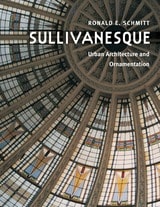
Sullivanesque
Urban Architecture and OrnamentationRonald E. Schmitt
University of Illinois Press, 2001
Sundays at Sinai
A Jewish Congregation in ChicagoTobias Brinkmann
University of Chicago Press, 2012
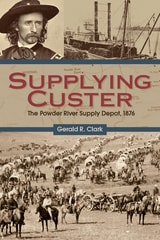
Supplying Custer
The Powder River Supply Depot, 1876Gerald R. Clark
University of Utah Press, 2014
The book details the items recovered archaeologically, including ale and soda bottles, cartridges, packing crates, and a horseshoe and ceramic doll. It also addresses the army’s knowledge of this area and how the supply depot fit into the broader military campaign. This book connects archaeology and history to explore how the American military planned, maneuvered, and operated on the northern plains from the end of the Civil War through 1876.
Surprised by Shame
Dostoevsky's Liars and Narrative ExposureDeborah A. Martinsen
The Ohio State University Press, 2003
In Surprised by Shame, Deborah A. Martinsen combines shame studies and literary criticism. She begins with a discussion of shame dynamics, including the tendency of those who witness shame to feel shame themselves. Because Dostoevsky identified shame as a fundamental source of lying, Martinsen focuses on scenes when liars are exposed. She argues that by making readers witness such scandal scenes, Dostoevsky surprises them with shame, thereby collapsing the distance between readers and characters and viscerally involving them in his message of human interconnection.
Treating Dostoevsky’s liars as case studies, Surprised by Shame discusses varieties of shame and shamelessness; it also illustrates how Dostoevsky uses lying to indicate and expose subconscious processes. In addition, Martinsen demonstrates how Dostoevsky plucks shame from the realm of character trait and plot motive and embeds it in the narrative dynamics of The Idiot, Demons, and The Brothers Karamazov, thereby plunging readers into fictional experience and ethically transforming them.
By focusing on shame, this book uncovers new perspectives on Dostoevsky as writer and psychologist. By exposing how shame dynamics implicate readers in texts’ ethical actions, it enriches understanding of his tremendous influence on twentieth-century thinkers and writers. Finally, reading Dostoevsky as a prophet of shame-begotten violence reveals his universal relevance in a twenty-first century already scarred by acts of violence.

Surveillance and Spies in the Civil War
Exposing Confederate Conspiracies in America’s HeartlandStephen E. Towne
Ohio University Press, 2015
Surveying in Early America
The Point of Beginning, An Illustrated HistoryDan Patterson; Clinton Terry
Ohio University Press, 2020
Published by the University of Cincinnati Press
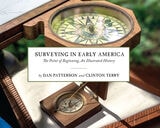
In Surveying in Early America: The Point of Beginning, An Illustrated History, award-winning photographer Dan Patterson and American historian Clinton Terry vividly examine the profession of surveying in the eighteenth century. Retracing the steps Washington and other surveyors took to map the Ohio River Valley, readers are immersed in historically accurate details of early surveying techniques and practices. Terry's narrative describes the practice of land and survey measurement—methods that did not substantially change until the invention of GPS technology 200 years later. Over 100 full color photographs exclusively shot for the book depict authentic and historically accurate reproductions of tools along with early American reenactors to provide an interpretive look at surveying as a primary means to building the American nation. Working with the Department of the Geographer, Patterson restages actual expeditions, brilliantly displaying the techniques and instruments Washington would have employed 260 years ago. Through the lens of Patterson's camera and Terry's accompanying narrative, readers see what Washington saw as he learned his trade, explored the vast American wilderness, and occasionally laid personal claim to great expanses of land along the way.
Surviving Southampton
African American Women and Resistance in Nat Turner's CommunityVanessa M. Holden
University of Illinois Press, 2021
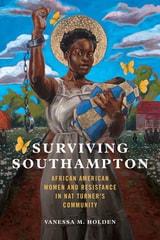
The 1831 Southampton Rebellion led by Nat Turner involved an entire community. Vanessa M. Holden rediscovers the women and children, free and enslaved, who lived in Southampton County before, during, and after the revolt. Mapping the region's multilayered human geography, Holden draws a fuller picture of the inhabitants, revealing not only their interactions with physical locations but also their social relationships in space and time. Her analysis recasts the Southampton Rebellion as one event that reveals the continuum of practices that sustained resistance and survival among local Black people. Holden follows how African Americans continued those practices through the rebellion’s immediate aftermath and into the future, showing how Black women and communities raised children who remembered and heeded the lessons absorbed during the calamitous events of 1831.
A bold challenge to traditional accounts, Surviving Southampton sheds new light on the places and people surrounding Americas most famous rebellion against slavery.