Results by title
2706 books match the query 'European' and 204 start with s
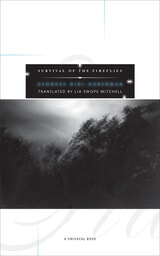
Survival of the Fireflies
Georges Didi-Huberman
University of Minnesota Press, 2018
Seeking out the minor lights of friendship in a time of fascism
Dante once spoke, in his Divine Comedy, of the miniscule lights, in the twenty-sixth canto of the Inferno, who, contrary to the great lights that shined bright within the sublime circles of Paradise, frailly wandered in the somber pockets of glimmering light within the darkness. Pliny the Elder was once preoccupied by a type of fly named pyrallis or pyrotocon, which was only able to fly within fire: “as long as it remains in the fire, it can fly; when its flight takes it out too far a distance, it dies.”
Through his readings of Dante, Pasolini, Walter Benjamin, and others, Georges Didi-Huberman seeks again to understand this strange, minor light, the signals of small beings in search of love and friendship. Their flickering presence serves as a counterforce to the blinding sovereign power that Giorgio Agamben calls The Kingdom and the Glory, that artificial brilliance that once surrounded dictators and today emanates from every screen. In this timely reflection, much needed in our time of excessive light, Didi-Huberman’s Survival of the Fireflies offers a humble yet powerful image of individual hope and desire: the firefly-image.
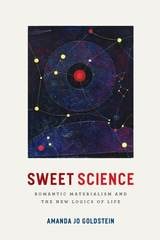
Sweet Science
Romantic Materialism and the New Logics of LifeAmanda Jo Goldstein
University of Chicago Press, 2017
Goldstein puts apparently literary projects, such as William Blake’s poetry of embryogenesis, Goethe’s journals On Morphology, and Percy Shelley’s “poetry of life,” back into conversation with the openly poetic life sciences of Erasmus Darwin, J. G. Herder, Jean-Baptiste Lamarck, and Étienne Geoffroy Saint-Hilaire. Such poetic sciences, Goldstein argues, share in reviving Lucretius’s De rerum natura to advance a view of biological life as neither self-organized nor autonomous, but rather dependent on the collaborative and symbolic processes that give it viable and recognizable form. They summon De rerum natura for a logic of life resistant to the vitalist stress on self-authorizing power and to make a monumental case for poetry’s role in the perception and communication of empirical realities. The first dedicated study of this mortal and materialist dimension of Romantic biopoetics, Sweet Science opens a through-line between Enlightenment materialisms of nature and Marx’s coming historical materialism.
Symmetry and Sense
The Poetry of Sir Philip SidneyBy Robert L. Montgomery
University of Texas Press, 1961
Few Elizabethans left the image of their personalities cut so deeply into the Renaissance imagination as did Sir Philip Sidney. Widely admired in his own time, Sidney must seem to the modern reader almost universally accomplished. His talents as courtier, diplomat, soldier, scholar, novelist, and poet are history.
Almost immediately after Sidney's death in battle against the Spaniards in the Low Countries, the process of legend began, and the legend has survived, sometimes obscuring the facts. The versatile "Renaissance man" has become, in the eyes of some critics, the romantic lover whose frustrations and despair found release in the "confessional" form of the sonnet sequence, Astrophel and Stella, and in other poems. To show these poems to be consciously constructed works of art, not simply passionate outbursts of romantic emotion, is one aim of this study.
The author examines Sidney as poet and critic, concentrating his study on rhetorical technique and poetic rhythm and form. He shows Sidney experimenting with the symmetrical possibilities of rhythm and phrase; practicing the ornateness current and acceptable in his day. He examines Sidney's comment on such a style in The Defense of Poesy and the ways in which the poet's own work agreed with or departed from his expressed opinions. He also balances Sidney's poetry against the powerful tradition of Petrarchan love literature and the equally powerful Renaissance impulse to subject passion to the rule of reason. Finally, in an extended analysis of Astrophel and Stella, he shows Sidney as the master of a plainer, wittier, more subtly fashioned style and a complex, more dramatically immediate form. What emerges from the study is not the personality of the poet, but the principles of his art and the value of his achievement in the mainstream of English Renaissance verse.
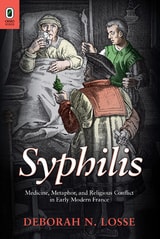
Syphilis
Medicine, Metaphor, and Religious Conflict in Early Modern FranceDeborah N. Losse
The Ohio State University Press, 2015
Losse provides close readings of a range of genres, moving between polemical poetry, satirical narratives, dialogical colloquies, travel literature, and the personal essay. With chapters featuring Erasmus, Rabelais, Montaigne, Léry, and Agrippa d’Aubigné, this study compares literary descriptions of syphilis with medical descriptions. In the first full-length study of Renaissance writers’ engagement with syphilis, Deborah Losse charts a history from the most vehement rhetoric of the pox to a tenuous resolution of France’s conflicts, when both sides called for a return to order.