Results by title
3703 books match the query '19th century' and 256 start with s
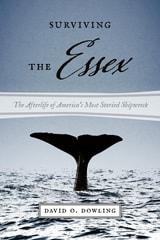
Surviving the Essex
The Afterlife of America's Most Storied ShipwreckDavid O. Dowling
University Press of New England, 2016
Surviving the “Essex” tells the captivating story of a ship’s crew battered by whale attack, broken by four months at sea, and forced—out of necessity—to make meals of their fellow survivors. Exploring the Rashomon-like Essex accounts that complicate and even contradict first mate Owen Chase’s narrative, David O. Dowling examines the vital role of viewpoint in shaping how an event is remembered and delves into the ordeal’s submerged history—the survivors’ lives, ambitions, and motives, their pivotal actions during the desperate moments of the wreck itself, and their will to reconcile those actions in the short- and long-term aftermath of this storied event. Mother of all whale tales, Surviving the “Essex” acts as a sequel to Nathaniel Philbrick’s In the Heart of the Sea, while probing deeper into the nature of trauma and survival accounts, an extreme form of notoriety, and the impact that the story had on Herman Melville and the writing of Moby-Dick.
[more]
Susanna Rowson
Sentimental Prophet of Early American LiteratureSteven Epley
Northwestern University Press, 2016
Susanna Rowson: Sentimental Prophet of Early American Literature opens the early American writer’s works to new, provocative interpretations based on the theory that her responses to social issues incorporate notions of righteousness, justice, accountability, and loyalty drawn from prophets in the Hebrew Bible. Steven Epley argues that Rowson’s sentimentalism—a literary mode that portrays characters undergoing strong emotions and evokes similar responses from readers—reflects the rhetorical style of the Bible’s first prophet, Moses, and its understanding of the “heart” not just as a metaphor for human kindness and tenderness but also as a source of wickedness. Epley relocates the widespread introduction of Jewish values into American discourse from the height of Jewish immigration (roughly 1890 to 1940) to the early republic, given Rowson’s vast audience and influence on American letters. Her novel Charlotte Temple outsold every other American work of fiction until Harriet Beecher Stowe’s Uncle Tom’s Cabin in the 1850s.
[more]
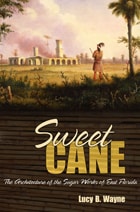
Sweet Cane
The Architecture of the Sugar Works of East FloridaLucy B. Wayne
University of Alabama Press, 2010
A look at the antebellum history and architecture of the little-known sugar industry of East Florida
From the late eighteenth century to early 1836, the heart of the Florida sugar industry was concentrated in East Florida, between the St. Johns River and the Atlantic Ocean. Producing the sweetest sugar, molasses, and rum, at least 22 sugar plantations dotted the coastline by the 1830s. This industry brought prosperity to the region—employing farm hands, slaves, architects, stone masons, riverboats and their crews, shop keepers, and merchant traders. But by January 1836, Native American attacks of the Second Seminole War, intending to rid the Florida frontier of settlers, devastated the whole sugar industry.
Although sugar works again sprang up in other Florida regions just prior to the Civil War, the competition from Louisiana and the Caribbean blocked a resurgence of sugar production for the area. The sugar industry would never regain its importance in East Florida—only two of the original sugar works were ever rebuilt. Today, remains of this once thriving industry are visible in a few parks. Some are accessible but others lie hidden, slowly disintegrating and almost forgotten. Archaeological, historical, and architectural research in the last decade has returned these works to their once prominent place in Florida’s history, revealing the beauty, efficiency of design, as well as early industrial engineering. Equally important is what can be learned of the lives of those associated with the sugar works and the early plantation days along the East Florida frontier
[more]
Sweet Science
Romantic Materialism and the New Logics of LifeAmanda Jo Goldstein
University of Chicago Press, 2017
Today we do not expect poems to carry scientifically valid information. But it was not always so. In Sweet Science, Amanda Jo Goldstein returns to the beginnings of the division of labor between literature and science to recover a tradition of Romantic life writing for which poetry was a privileged technique of empirical inquiry.
Goldstein puts apparently literary projects, such as William Blake’s poetry of embryogenesis, Goethe’s journals On Morphology, and Percy Shelley’s “poetry of life,” back into conversation with the openly poetic life sciences of Erasmus Darwin, J. G. Herder, Jean-Baptiste Lamarck, and Étienne Geoffroy Saint-Hilaire. Such poetic sciences, Goldstein argues, share in reviving Lucretius’s De rerum natura to advance a view of biological life as neither self-organized nor autonomous, but rather dependent on the collaborative and symbolic processes that give it viable and recognizable form. They summon De rerum natura for a logic of life resistant to the vitalist stress on self-authorizing power and to make a monumental case for poetry’s role in the perception and communication of empirical realities. The first dedicated study of this mortal and materialist dimension of Romantic biopoetics, Sweet Science opens a through-line between Enlightenment materialisms of nature and Marx’s coming historical materialism.
Goldstein puts apparently literary projects, such as William Blake’s poetry of embryogenesis, Goethe’s journals On Morphology, and Percy Shelley’s “poetry of life,” back into conversation with the openly poetic life sciences of Erasmus Darwin, J. G. Herder, Jean-Baptiste Lamarck, and Étienne Geoffroy Saint-Hilaire. Such poetic sciences, Goldstein argues, share in reviving Lucretius’s De rerum natura to advance a view of biological life as neither self-organized nor autonomous, but rather dependent on the collaborative and symbolic processes that give it viable and recognizable form. They summon De rerum natura for a logic of life resistant to the vitalist stress on self-authorizing power and to make a monumental case for poetry’s role in the perception and communication of empirical realities. The first dedicated study of this mortal and materialist dimension of Romantic biopoetics, Sweet Science opens a through-line between Enlightenment materialisms of nature and Marx’s coming historical materialism.
[more]

Swing Low, Sweet Chariot
The Mortality Cost of Colonizing Liberia in the Nineteenth CenturyAntonio McDaniel
University of Chicago Press, 1995
In the early nineteenth century, thousands of emancipated and freeborn blacks from the United States returned to Africa to colonize the area now known as Liberia. In this, the first systematic study of the demographic impact of this move on the migrants, Antonio McDaniel finds that the health of migrant populations depends on the adaptability of the individuals in the group, not on their race.
McDaniel compares the mortality rates of the emigrants to those of other migrants to tropical areas. He finds that, contrary to popular belief, black immigrants during this period died at unprecedented rates. Moreover, he shows that though the emigrant's mortality levels were exceptionally high, their mortality patterns were consistent with those of other populations.
McDaniel concludes that the greater the variance between the environment left and the environment entered, the higher the probability of contracting a new disease, and, in some cases, of death from these diseases. Additionally, a migrant's health can be affected by dietary changes, differences in local pathogens, inappropriate immunities, and increased risk of accidents due to unfamiliar surroundings.
[more]
Symptoms of the Self
Tuberculosis and the Making of the Modern StageRoberta Barker
University of Iowa Press, 2022
2023 Le Prix Ann Saddlemyer Award, Winner
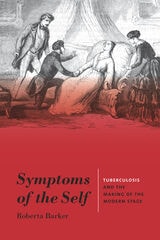
Symptoms of the Self offers the first full study of the stage consumptive. In the nineteenth and early twentieth centuries in France, Britain, and North America, tuberculosis was a leading killer. Its famous dramatic and operatic victims—Marguerite Gautier in La Dame aux Camélias and her avatar Violetta in La Traviata, Mimì in La Bohème, Little Eva in Uncle Tom’s Cabin, and Edmund Tyrone in Long Day’s Journey into Night, to name but a few—are among the most iconic figures of the Western stage. Its classic symptoms, the cough and the blood-stained handkerchief, have become global performance shorthand for life-threatening illness.
The consumptive character became a vehicle through which standards of health, beauty, and virtue were imposed; constructions of class, gender, and sexuality were debated; the boundaries of nationhood were transgressed or maintained; and an exceedingly fragile whiteness was held up as a dominant social ideal. By telling the story of tuberculosis on the transatlantic stage, Symptoms of the Self uncovers some of the wellsprings of modern Western theatrical practice—and of ideas about the self that still affect the way human beings live and die.
[more]