4743 books match the query 'Religion' and 324 start with s
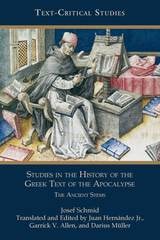
cover of Studies in the History of the Greek Text of the Apocalypse: The Ancient Stems

Studies in the History of the Greek Text of the Apocalypse

The Ancient Stems

Josef Schmid

SBL Press, 2018

Now available in English

Josef Schmid's landmark publication, Studien zur Geschichte des Griechischen Apokalypse-Textes, has been the standard work for understanding Revelation's Greek manuscript tradition and textual history for more than sixty years. Despite the fact that most major studies on the book are based on Schmid's work, the work itself has long been out of print, making it difficult for the broader scholarly community to reassess Schmid's conclusions in light of recent manuscript discoveries and technological advances. This new translation of the work makes Schmid's detailed review of the history of textual scholarship; his comprehensive examination of the origin, history, and development of the Greek manuscripts of the book of Revelation; and his assessment of John's peculiar linguistic writing style accessible to a new generation of scholars.

Features

  • A critical introduction that places Schmid's work in its historical and theoretical context
  • Definitions and explanations of Schmid's text-critical terms and categories used in his construction of Revelation's Greek manuscript tradition
  • The latest available information used to correct, update, and supplement Schmid's Greek manuscript data and historical and text-critical conclusions
[more]
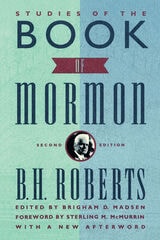
cover of Studies of the Book of Mormon: Foreword by Sterling M. McMurrin

Studies of the Book of Mormon

Foreword by Sterling M. McMurrin

B. H. Roberts

Signature Books, 1992

Available for the first time fifty years after the author’s death, Studies of the Book of Mormon presents this respected church leader’s investigation into Mormonism’s founding scripture. Reflecting his talent for combining history and theology, B. H. Roberts considered the evident parallels between the Book of Mormon and Ethan Smith’s View of the Hebrews, a book that predated the Mormon scripture by seven years. If the Book of Mormon is not historical, but rather a reflection of the misconceptions current in Joseph Smith’s day regarding Indian origins, then its theological claims are suspect as well, Roberts asserted. 

In this and other research, it was Roberts’s proclivity to go wherever the evidence took him, in this case anticipating and defending against potential future problems. Yet the manuscript was so poorly received by fellow church leaders that it was left to Roberts alone to decide whether he had overlooked some important piece of the puzzle or whether the Mormon scripture’s claims were, in fact, illegitimate. Clearly for most of his colleagues, institutional priorities overshadowed epistemological integrity. 

But Roberts’s pathbreaking work has been judged by the editor to be methodologically sound–still relevant today. It shows the work of a keen mind, and illustrates why Roberts was one of the most influential Mormon thinkers of his day. The manuscript is accompanied by a preface and introduction, a history of the documents’ provenances, a biographical essay, correspondence to and from Roberts relating to the manuscript, a bibliography, and an afterword–all of which put the information into perspective. 
[more]
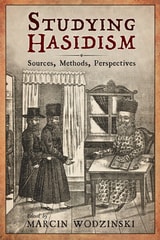
cover of Studying Hasidism: Sources, Methods, Perspectives

Studying Hasidism

Sources, Methods, Perspectives

Marcin Wodzinski

Rutgers University Press, 2019
Hasidism, a Jewish religious movement that originated in Poland in the eighteenth century, today counts over 700,000 adherents, primarily in the U.S., Israel, and the UK. Popular and scholarly interest in Hasidic Judaism and Hasidic Jews is growing, but there is no textbook dedicated to research methods in the field, nor sources for the history of Hasidism have been properly recognized. Studying Hasidism, edited by Marcin Wodziński, an internationally recognized historian of Hasidism, aims to remedy this gap. The work’s thirteen chapters each draws upon a set of different sources, many of them previously untapped, including folklore, music, big data, and material culture to demonstrate what is still to be achieved in the study of Hasidism. Ultimately, this textbook presents research methods that can decentralize the role community leaders play in the current literature and reclaim the everyday lives of Hasidic Jews.
[more]
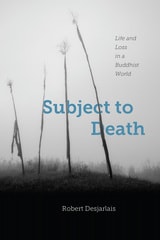
cover of Subject to Death: Life and Loss in a Buddhist World

Subject to Death

Life and Loss in a Buddhist World

Robert Desjarlais

University of Chicago Press, 2016
If any anthropologist living today can illuminate our dim understanding of death’s enigma, it is Robert Desjarlais. With Subject to Death, Desjarlais provides an intimate, philosophical account of death and mourning practices among Hyolmo Buddhists, an ethnically Tibetan Buddhist people from Nepal. He studies the death preparations of the Hyolmo, their specific rituals of grieving, and the practices they use to heal the psychological trauma of loss. Desjarlais’s research marks a major advance in the ethnographic study of death, dying, and grief, one with broad implications. Ethnologically nuanced, beautifully written, and twenty-five years in the making, Subject to Death is an insightful study of how fundamental aspects of human existence—identity, memory, agency, longing, bodiliness—are enacted and eventually dissolved through social and communicative practices.
 
[more]
cover of Subjectivity, Objectivity, and Intersubjectivity: A New Paradigm for Religion and Science

Subjectivity, Objectivity, and Intersubjectivity

A New Paradigm for Religion and Science

Joseph A. Bracken

Templeton Press, 2009

During the Middle Ages, philosophers and theologians argued over the extramental reality of universal forms or essences. In the early modern period, the relation between subjectivity and objectivity, the individual self and knowledge of the outside world, was a rich subject of debate. Today, there is considerable argument about the relation between spontaneity and determinism within the evolutionary process, whether a principle of spontaneous self-organization as well as natural selection is at work in the aggregation of molecules into cells and the development of primitive forms of life into complex organisms. In Subjectivity, Objectivity and Intersubjectivity, Joseph A. Bracken proposes that what is ultimately at stake here is the age-old problem of the relationship between the One and the Many, universality and particularity on different levels of existence and activity within nature.
Bracken rejects traditional models of this relationship, wherein either the One or the Many is presupposed to have priority over the other. He instead suggests that a new social ontology—one that is grounded in a theory of universal intersubjectivity—protects both the concrete particularity of individual entities in their specific relations to one another and their enduring corporate reality as a stable community or environment within Nature.
 
What emerges is a bold reimagining of the sometimes strained relationship between religion and science. Bracken's clear writing, sophisticated philosophical analysis, and exemplary scholarship will lend this new work an enthusiastic appreciation by readers with deep interests in philosophy and philosophical theology.


[more]
cover of Subversive Habits: Black Catholic Nuns in the Long African American Freedom Struggle

Subversive Habits

Black Catholic Nuns in the Long African American Freedom Struggle

Shannen Dee Williams

Duke University Press, 2022
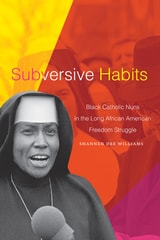
In Subversive Habits, Shannen Dee Williams provides the first full history of Black Catholic nuns in the United States, hailing them as the forgotten prophets of Catholicism and democracy. Drawing on oral histories and previously sealed Church records, Williams demonstrates how master narratives of women’s religious life and Catholic commitments to racial and gender justice fundamentally change when the lives and experiences of African American nuns are taken seriously. For Black Catholic women and girls, embracing the celibate religious state constituted a radical act of resistance to white supremacy and the sexual terrorism built into chattel slavery and segregation. Williams shows how Black sisters—such as Sister Mary Antona Ebo, who was the only Black member of the inaugural delegation of Catholic sisters to travel to Selma, Alabama, and join the Black voting rights marches of 1965—were pioneering religious leaders, educators, healthcare professionals, desegregation foot soldiers, Black Power activists, and womanist theologians. In the process, Williams calls attention to Catholic women’s religious life as a stronghold of white supremacy and racial segregation—and thus an important battleground in the long African American freedom struggle.
[more]
cover of Sufi Networks, Fulbe Itinerancy: A History of Islam in Senegambia, c. 1803–1996

Sufi Networks, Fulbe Itinerancy

A History of Islam in Senegambia, c. 1803–1996

Assan Sarr

Michigan State University Press, 2026

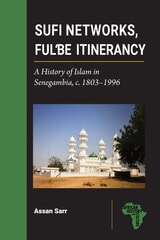
This book traces the development and expansion of a network of itinerant Fulbe clerics in southern Senegambia who forged solidarity under the banner of Islam. Beginning with a marabout named Cherno Muhammadu Jallow (c. 1803–1883)—who expanded the Umarian branch of the Tijaniyya sect into remote parts of the region—Assan Sarr demonstrates that some Fulbe groups were not drawn into Islam until the late nineteenth and early twentieth centuries. He argues that by creating a series of villages that served as educational centers during a tumultuous period, the itinerant scholars who are at the heart of this book not only spread Islam throughout the land of the Firdu, Saloum, and parts of the Gambia region but also played a pivotal role in establishing a widely shared Muslim identity among the Fulbe people.
[more]
cover of Summa Theologiae, Prima Pars: Volume 1, The One God, QQ 1-26: With the Commentary of Cardinal Cajetan

Summa Theologiae, Prima Pars

Volume 1, The One God, QQ 1-26: With the Commentary of Cardinal Cajetan

Thomas Aquinas

Catholic University of America Press, 2023
When Leo XII promulgated Aeterni Patris in 1879, he stipulated that the “Leonine,” or official, edition of the Summa should always be printed in conjunction with Cajetan’s Commentary. For five hundred years they were studied together. Generations were trained by reading through the Summa article by article with Cajetan’s commentaries in hand. Early printed editions of the Summa typically included them in a Talmudic arrangement, as marginal text running around each article by Aquinas. This edition imitates that example. Recently, serious thinkers of all denominations – and none – have found new reasons to be interested in St. Thomas. His text is deceptively simple, yet important issues are handled in every article, sometimes below the surface. Cajetan extracts these hidden issues, and explains and elaborates on them with remarkable affinity to modern analytical philosophy. Part of that affinity lies in the use of modal logic, a tool whose importance was overlooked between the Renaissance and the twentieth century. The time is ripe for an analytically-inspired translation of Thomas: hence this volume. Never until now has Cajetan’s Commentary been put into English in its entirety. William Marshner’s translation is consistent with fidelity to the technical force of the original. The translator’s footnotes acknowledge what empirical science has made obsolete in the work of St. Thomas, and also make clear how much today’s science would have saved Thomas useless labor. This volume will, for the first time, make Cajetan’s help available to the modern reader.
[more]
cover of Summa Theologiae, Prima Pars: Volume 2, On the Holy Trinity and Creation in General, QQ 27-74: With the Commentary of Cardinal Cajetan

Summa Theologiae, Prima Pars

Volume 2, On the Holy Trinity and Creation in General, QQ 27-74: With the Commentary of Cardinal Cajetan

Thomas Aquinas

Catholic University of America Press, 2023
When Leo XII promulgated Aeterni Patris in 1879, he stipulated that the “Leonine,” or official, edition of the Summa should always be printed in conjunction with Cajetan’s Commentary. For five hundred years they were studied together. Generations were trained by reading through the Summa article by article with Cajetan’s commentaries in hand. Early printed editions of the Summa typically included them in a Talmudic arrangement, as marginal text running around each article by Aquinas. This edition imitates that example. Recently, serious thinkers of all denominations – and none – have found new reasons to be interested in St. Thomas. His text is deceptively simple, yet important issues are handled in every article, sometimes below the surface. Cajetan extracts these hidden issues, and explains and elaborates on them with remarkable affinity to modern analytical philosophy. Part of that affinity lies in the use of modal logic, a tool whose importance was overlooked between the Renaissance and the twentieth century. The time is ripe for an analytically-inspired translation of Thomas: hence this volume. Never until now has Cajetan’s Commentary been put into English in its entirety. William Marshner’s translation is consistent with fidelity to the technical force of the original. The translator’s footnotes acknowledge what empirical science has made obsolete in the work of St. Thomas, and also make clear how much today’s science would have saved Thomas useless labor. This volume will, for the first time, make Cajetan’s help available to the modern reader.
[more]
cover of Summa Theologiae, Prima Pars: Volume 3, Human Beings and God's Governance of Creation, QQ 75-119: With the Commentary of Cardinal Cajetan

Summa Theologiae, Prima Pars

Volume 3, Human Beings and God's Governance of Creation, QQ 75-119: With the Commentary of Cardinal Cajetan

Thomas Aquinas

Catholic University of America Press, 2023
When Leo XII promulgated Aeterni Patris in 1879, he stipulated that the “Leonine,” or official, edition of the Summa should always be printed in conjunction with Cajetan’s Commentary. For five hundred years they were studied together. Generations were trained by reading through the Summa article by article with Cajetan’s commentaries in hand. Early printed editions of the Summa typically included them in a Talmudic arrangement, as marginal text running around each article by Aquinas. This edition imitates that example. Recently, serious thinkers of all denominations – and none – have found new reasons to be interested in St. Thomas. His text is deceptively simple, yet important issues are handled in every article, sometimes below the surface. Cajetan extracts these hidden issues, and explains and elaborates on them with remarkable affinity to modern analytical philosophy. Part of that affinity lies in the use of modal logic, a tool whose importance was overlooked between the Renaissance and the twentieth century. The time is ripe for an analytically-inspired translation of Thomas: hence this volume. Never until now has Cajetan’s Commentary been put into English in its entirety. William Marshner’s translation is consistent with fidelity to the technical force of the original. The translator’s footnotes acknowledge what empirical science has made obsolete in the work of St. Thomas, and also make clear how much today’s science would have saved Thomas useless labor. This volume will, for the first time, make Cajetan’s help available to the modern reader.
[more]
cover of Summoned: Identification and Religious Life in a Jewish Neighborhood

Summoned

Identification and Religious Life in a Jewish Neighborhood

Iddo Tavory

University of Chicago Press, 2016

On a typical weekday, men of the Beverly-La Brea Orthodox community wake up early, beginning their day with Talmud reading and prayer at 5:45am, before joining Los Angeles’ traffic. Those who work “Jewish jobs”—teachers, kosher supervisors, or rabbis—will stay enmeshed in the Orthodox world throughout the workday. But even for the majority of men who spend their days in the world of gentiles, religious life constantly reasserts itself. Neighborhood fixtures like  Jewish schools and synagogues are always after more involvement; evening classes and prayers pull them in; the streets themselves seem to remind them of who they are. And so the week goes, culminating as the sabbatical observances on Friday afternoon stretch into Saturday evening. Life in this community, as Iddo Tavory describes it, is palpably thick with the twin pulls of observance and sociality.

In Summoned, Tavory takes readers to the heart of the exhilarating—at times exhausting—life of the Beverly-La Brea Orthodox community. Just blocks from West Hollywood’s nightlife, the Orthodox community thrives next to the impure sights, sounds, and smells they encounter every day. But to sustain this life, as Tavory shows, is not simply a moral decision they make. To be Orthodox is to be constantly called into being. People are reminded of who they are as they are called upon by organizations, prayer quorums, the nods of strangers, whiffs of unkosher food floating through the street, or the rarer Anti-Semitic remarks. Again and again, they find themselves summoned both into social life and into their identity as Orthodox Jews. At the close of Tavory’s fascinating ethnography, we come away with a better understanding of the dynamics of social worlds, identity, interaction and self—not only in Beverly-La Brea, but in society at large.
[more]
cover of Sundays at Sinai: A Jewish Congregation in Chicago

Sundays at Sinai

A Jewish Congregation in Chicago

Tobias Brinkmann

University of Chicago Press, 2012
First established 150 years ago, Chicago Sinai is one of America’s oldest Reform Jewish congregations. Its founders were upwardly mobile and civically committed men and women, founders and partners of banks and landmark businesses like Hart Schaffner & Marx, Sears & Roebuck, and the giant meatpacking firm Morris & Co. As explicitly modern Jews, Sinai’s members supported and led civic institutions and participated actively in Chicago politics. Perhaps most radically, their Sunday services, introduced in 1874 and still celebrated today, became a hallmark of the congregation.
In Sundays at Sinai, Tobias Brinkmann brings modern Jewish history, immigration, urban history, and religious history together to trace the roots of radical Reform Judaism from across the Atlantic to this rapidly growing American metropolis.  Brinkmann shines a light on the development of an urban reform congregation, illuminating Chicago Sinai’s practices and history, and its contribution to Christian-Jewish dialogue in the United States. Chronicling Chicago Sinai’s radical beginnings in antebellum Chicago to the present, Sundays at Sinai is the extraordinary story of a leading Jewish Reform congregation in one of America’s great cities.
[more]
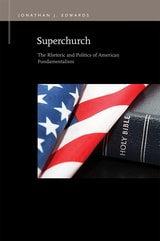
cover of Superchurch: The Rhetoric and Politics of American Fundamentalism

Superchurch

The Rhetoric and Politics of American Fundamentalism

Jonathan J. Edwards

Michigan State University Press, 2015
Christian Fundamentalism is a doctrine and a discourse in tension. Fundamentalists describe themselves as both marginal and a majority. They announce the imminent end of the world while building massive megachurches and political lobbying organizations. They speak of the need for purity and separation from the outside world while continually innovating in their search for more effective and persuasive ways to communicate with and convert outsiders. To many outsiders, Fundamentalist speech seems contradictory, irrational, intolerant, and dangerously antidemocratic. To understand the complexity of Fundamentalism, we have to look inside the tensions and the paradoxes. We have to take seriously the ways in which Fundamentalists describe themselves to themselves, and to do that, we must begin by exploring the central role of “the church” in Fundamentalist rhetoric and politics. Drawing on five fascinating case studies, Superchurch blends a complex yet readable treatment of rhetorical and political theory with a sophisticated approach to Fundamentalism that neither dismisses its appeal nor glosses over its irresolvable tensions. Edwards challenges theories of rhetoric, counterpublics, deliberation, and civility while offering critical new insights into the evolution and continuing influence of one of the most significant cultural and political movements of the past century.
[more]
cover of Supplement to Introduction to Classical and New Testament Greek

Supplement to Introduction to Classical and New Testament Greek

Michael Boler

Catholic University of America Press, 2024
More than a simple answer key, this supplemental guide is designed to guide both instructors and those using this book for self-study. Understanding Greek is to understand that there is never a single “correct translation.” Multiple translations are given for each sentence along with commentary on the pros and cons of each translation. By introducing the reader to different philosophies of translation, this volume gives the “why" behind different translations and encourages the reader to think of translation as a way to better understand the intricacies of the original language. This supplementary volume contains an introduction, multiple translations and commentary on the sentences in the 40 chapters, as well as answers to the supplementary exercises.
[more]
cover of Supplementation and the Study of the Hebrew Bible

Supplementation and the Study of the Hebrew Bible

Saul M. Olyan

SBL Press, 2018

Explore the role supplementation played in the development of the Hebrew Bible

This new volume includes ten original essays that demonstrate clearly how common, varied, and significant the phenomenon of supplementation in the Hebrew Bible is. Contributors examine instances of supplementation ranging from minor additions to aid pronunciation, to fill in abbreviations, or to clarify ambiguous syntax to far more elaborate changes, such as interpolations within a work of prose, in a prophetic text, or in a legal text. Scholars also examine supplementation by the addition of an introduction, a conclusion, or an introductory and concluding framework to a particular lyrical, legal, prophetic, or narrative text.

Features:
  • A contribution to the further development of a panbiblical compositional perspective
  • Examples from Psalms, the pentateuchal narratives, the Deuteronomistic History, the Latter Prophets, and legal texts
  • [more]
    cover of Surpassing Wonder: The Invention of the Bible and the Talmuds

    Surpassing Wonder

    The Invention of the Bible and the Talmuds

    Donald Harman Akenson

    University of Chicago Press, 2001
    Elegant and inventive, Surpassing Wonder uncovers how the ancient Hebrew scriptures, the Christian New Testament, and the Talmuds of the Rabbis are related and how, collectively, they make up the core of Western consciousness. Donald Harman Akenson provides an incisive critique of how religious scholars have distorted the holy books and argues that it was actually the inventor of the Hebrew scriptures who shaped our concept of narrative history—thereby founding Western culture.
    [more]
    cover of Surviving Lamentations: Catastrophe, Lament, and Protest in the Afterlife of a Biblical Book

    Surviving Lamentations

    Catastrophe, Lament, and Protest in the Afterlife of a Biblical Book

    Tod Linafelt

    University of Chicago Press, 2000

    Most contemporary interpretations of the biblical book of Lamentations focus on the figure of the "suffering man" as a role model for submission in the face of God's punishment for sin. Yet such a model offers small consolation to survivors of the Holocaust or other mass atrocities and also ignores chapters 1 and 2 of Lamentations, in which the personification of Zion laments her sufferings and demands a response on behalf of her dying children.

    In Surviving Lamentations, Tod Linafelt offers an alternative reading of Lamentations in light of the "literature of survival" (works written by survivors of catastrophe) as well as literary and philosophical reflections on "the survival of literature." He refocuses attention on the figure of Zion as a manifestation of a basic need to give voice to suffering, and traces the afterlife of Lamentations in Jewish literature, in which text after text attempts to provide the response to Zion's lament that is lacking in Lamentations itself.

    Seen through Linafelt's eyes, Lamentations emerges as uncannily relevant to contemporary discourse on survival.
    [more]
    cover of Susanna Rowson: Sentimental Prophet of Early American Literature

    Susanna Rowson

    Sentimental Prophet of Early American Literature

    Steven Epley

    Northwestern University Press, 2016
    Susanna Rowson: Sentimental Prophet of Early American Literature opens the early American writer’s works to new, provocative interpretations based on the theory that her responses to social issues incorporate notions of righteousness, justice, accountability, and loyalty drawn from prophets in the Hebrew Bible. Steven Epley argues that Rowson’s sentimentalism—a literary mode that portrays characters undergoing strong emotions and evokes similar responses from readers—reflects the rhetorical style of the Bible’s first prophet, Moses, and its understanding of the “heart” not just as a metaphor for human kindness and tenderness but also as a source of wickedness. Epley relocates the widespread introduction of Jewish values into American discourse from the height of Jewish immigration (roughly 1890 to 1940) to the early republic, given Rowson’s vast audience and influence on American letters. Her novel Charlotte Temple outsold every other American work of fiction until Harriet Beecher Stowe’s Uncle Tom’s Cabin in the 1850s.
    [more]
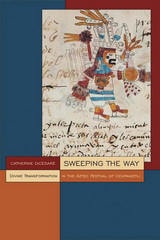
    cover of Sweeping the Way: Divine Transformation in the Aztec Festival of Ochpaniztli

    Sweeping the Way

    Divine Transformation in the Aztec Festival of Ochpaniztli

    Catherine DiCesare

    University Press of Colorado, 2022
    Many disasters originate from a force of nature, such as an earthquake, cyclone, tsunami, volcanic eruption, drought, or flood. But that is only half of the story; decisions of people and their particular cultural lifeways are the rest. Sociocultural fact
    [more]
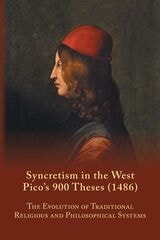
    cover of Syncretism in the West: Pico's 900 Theses (1486) With Text, Translation, and Commentary

    Syncretism in the West

    Pico's 900 Theses (1486) With Text, Translation, and Commentary

    Edited by S. A. Farmer

    Arizona Center for Medieval and Renaissance Studies, 2016

    This is the 2016 paperback printing of the 2008 edition of the popular text, translation, and commentary by S. A. Farmer. (The 2008 edition was a revised edition of the 1998 original publication).

    Published by ACMRS (Arizona Center for Medieval and Renaissance Studies) in Tempe, Arizona as part of the MRTS (Medieval and Renaissance Texts and Studies) Series, this book -- previously available only in hardcover and otherwise out-of-print since 2014 -- is now available in its entirety in paperback format.
    [more]
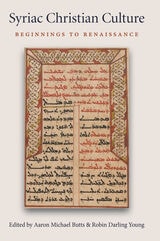
    cover of Syriac Christian Culture: Beginnings to Renaissance

    Syriac Christian Culture

    Beginnings to Renaissance

    Aaron Michael Butts

    Catholic University of America Press, 2021
    Syriac Christianity developed in the first centuries CE in the Middle East, where it continued to flourish throughout Late Antiquity and the Medieval period, while also spreading widely, as far as India and China. Today, Syriac Christians are found in the Middle East, in India, as well in diasporas scattered across the globe. Over this extended time period and across this vast geographic expanse, Syriac Christians have built impressive churches and monasteries, crafted fine pieces of art, and written and transmitted a sizable body of literature. Though often overlooked, neglected, and even persecuted, Syriac Christianity has been – and continues to be – an important part of the humanistic heritage of the last two millennia. The present volume brings together fourteen studies that offer fresh perspectives on Syriac Christianity, especially its literary texts and authors. The timeframes of the individual studies span from the second-century Syriac translation of the Hebrew Bible up to the thirteenth century with the end of the Syriac Renaissance. Several studies analyze key authors from Late Antiquity, such as Aphrahat, Ephrem, Narsai, and Jacob of Serugh. Others investigate translations into Syriac, both from Hebrew and from Greek, while still others examine hagiography, especially its formation and transmission. Reflecting a growing trend in the field, the volume also devotes significant attention to the Medieval period, during which Syriac Christians lived under Islamic rule. The studies in the volume are united in their quest to explore the richness, diversity, and vibrance of Syriac Christianity.
    [more]
    cover of Systematic Theology, Volume 1

    Systematic Theology, Volume 1

    Paul Tillich

    University of Chicago Press, 1951

    This is the first part of Paul Tillich's three-volume Systematic Theology, one of the most profound statements of the Christian message ever composed and the summation and definitive presentation of the theology of the most influential and creative American theologian of the twentieth century.

    In this path-breaking volume Tillich presents the basic method and statement of his system—his famous "correlation" of man's deepest questions with theological answers. Here the focus is on the concepts of being and reason. Tillich shows how the quest for revelation is integral to reason itself. In the same way a description of the inner tensions of being leads to the recognition that the quest for God is implied in finite being.

    Here also Tillich defines his thought in relation to philosophy and the Bible and sets forth his famous doctrine of God as the "Ground of Being." Thus God is understood not as a being existing beside other beings, but as being-itself or the power of being in everything. God cannot be made into an object; religious knowledge is, therefore, necessarily symbolic.
    [more]
    cover of Systematic Theology, Volume 2

    Systematic Theology, Volume 2

    Paul Tillich

    University of Chicago Press, 1957
    In this volume, the second of his three-volume reinterpretation of Christian theology, Paul Tillich comes to grips with the central idea of his system—the doctrine of the Christ. Man's predicament is described as the state of "estrangement" from himself, from his world, and from the divine ground of his self and his world. This situation drives man to the quest for a new state of things, in which reconciliation and reunion conquer estrangement. This is the quest for the Christ.
    [more]
    cover of Systematic Theology, Volume 3

    Systematic Theology, Volume 3

    Paul Tillich

    University of Chicago Press, 1963

    In this volume, the third and last of his Systematic Theology, Paul Tillich sets forth his ideas of the meaning of human life, the doctrine of the Spirit and the church, the trinitarian symbols, the relation of history to the Kingdom of God, and the eschatological symbols. He handles this subject matter with powerful conceptual ability and intellectual grace.

    The problem of life is ambiguity. Every process of life has its contrast within itself, thus driving man to the quest for unambiguous life or life under the impact of the Spritual Presence. The Spritual Presence conquers the negativities of religion, culture, and morality, and the symbols anticipating Eternal Life present the answer to the problem of life.
    [more]