Results by title
4127 books match the query 'Science' and 313 start with s
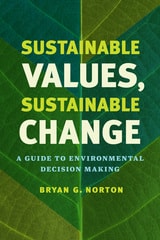
Sustainable Values, Sustainable Change
A Guide to Environmental Decision MakingBryan G. Norton
University of Chicago Press, 2015
While economists, philosophers, and ecologists argue about what in nature is valuable, and why, Norton here offers an action-oriented, pragmatic response to the disconnect between public and academic discourse around sustainability. Looking to the arenas in which decisions are made—and the problems that are driving these decisions—Norton reveals that the path to sustainability cannot be guided by fixed, utopian objectives projected into the future; sustainability will instead be achieved through experimentation, incremental learning, and adaptive management. Drawing inspiration from Aldo Leopold’s famed metaphor of “thinking like a mountain” for a spatially explicit, pluralistic approach to evaluating environmental change, Norton replaces theory-dependent definitions with a new decision-making process guided by deliberation and negotiation across science and philosophy, encompassing all stakeholders and activists and seeking to protect as many values as possible. Looking across scales to today’s global problems, Norton urges us to learn to think like a planet.
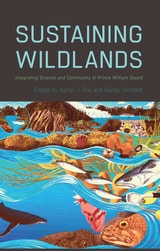
Sustaining Wildlands
Integrating Science and Community in Prince William SoundEdited by Aaron J. Poe and Randy Gimblett
University of Arizona Press, 2017
Nearly three decades later, changes in recreation use run counter to what was initially expected. Instead of avoiding Prince William Sound, tourists and visitors flock there. Economic revitalization efforts have resulted in increased wilderness access as new commercial enterprises offer nature tourism in remote bays and fjords. This increased visitation has caused concerns that the wilderness may again be threatened—not by oil but rather by the very humans seeking those wilderness experiences.
In Sustaining Wildlands, scientists and managers, along with local community residents, address what has come to be a central paradox in public lands management: the need to accommodate increasing human use while reducing the environmental impact of those activities. This volume draws on diverse efforts and perspectives to dissect this paradox, offering an alternative approach where human use is central to sustaining wildlands and recovering a damaged ecosystem like Prince William Sound.
Contributors:
Brad A. Andres, Chris Beck, Nancy Bird, Dale J. Blahna, Harold Blehm, Sara Boario, Bridget A. Brown, Courtney Brown, Greg Brown, Milo Burcham, Kristin Carpenter, Ted Cooney, Patience Andersen Faulkner, Maryann Smith Fidel, Jessica B. Fraver, Jennifer Gessert, Randy Gimblett, Michael I. Goldstein, Samantha Greenwood, Lynn Highland, Marybeth Holleman, Shay Howlin, Tanya Iden, Robert M. Itami, Lisa Jaeger, Laura A. Kennedy, Spencer Lace, Nancy Lethcoe, Kate McLaughlin, Rosa H. Meehan, Christopher Monz, Karen A. Murphy, Lisa Oakley, Aaron J. Poe, Chandra B. Poe, Karin Preston, Jeremy Robida, Clare M. Ryan, Gerry Sanger, Bill Sherwonit, Lowell H. Suring, Paul Twardock, Sarah Warnock, and Sadie Youngstrom
Swarm Intelligence
Applications, Volume 3Ying Tan
The Institution of Engineering and Technology, 2018
Swarm Intelligence
Innovation, new algorithms and methods, Volume 2Ying Tan
The Institution of Engineering and Technology, 2018
Swarm Intelligence
Principles, current algorithms and methods, Volume 1Ying Tan
The Institution of Engineering and Technology, 2018
Sweet Science
Romantic Materialism and the New Logics of LifeAmanda Jo Goldstein
University of Chicago Press, 2017
Goldstein puts apparently literary projects, such as William Blake’s poetry of embryogenesis, Goethe’s journals On Morphology, and Percy Shelley’s “poetry of life,” back into conversation with the openly poetic life sciences of Erasmus Darwin, J. G. Herder, Jean-Baptiste Lamarck, and Étienne Geoffroy Saint-Hilaire. Such poetic sciences, Goldstein argues, share in reviving Lucretius’s De rerum natura to advance a view of biological life as neither self-organized nor autonomous, but rather dependent on the collaborative and symbolic processes that give it viable and recognizable form. They summon De rerum natura for a logic of life resistant to the vitalist stress on self-authorizing power and to make a monumental case for poetry’s role in the perception and communication of empirical realities. The first dedicated study of this mortal and materialist dimension of Romantic biopoetics, Sweet Science opens a through-line between Enlightenment materialisms of nature and Marx’s coming historical materialism.

Swimming Against the Tide
African American Girls and Science EducationSandra L. Hanson
Temple University Press, 2009
“They looked at us like we were not supposed to be scientists,” says one young African American girl, describing one openly hostile reaction she encountered in the classroom. In this significant study, Sandra Hanson explains that although many young minority girls are interested in science, the racism and sexism in the field discourage them from pursuing it after high school. Those girls that remain highly motivated to continue studying science must “swim against the tide.”
Hanson examines the experiences of African American girls in science education using multiple methods of quantitative and qualitative research, including a web survey and vignette techniques. She understands the complex interaction between race and gender in the science domain and, using a multicultural and feminist framework of analysis, addresses the role of agency and resistance that encourages and sustains interest in science in African American families and communities.
Swimming Science
Optimizing Training and PerformanceEdited by G. John Mullen
University of Chicago Press, 2018
Writing to competitive and novice swimmers alike, contributors to this volume break down every aspect of the sport. Swimming Science covers physiology, psychology, and safety, as well as hydrodynamics, nutrition, and technique. Each chapter examines these topics through a series of practical questions. What are the forces acting on you when you swim, and how do your muscles best generate propulsion against those forces? How much protein, salt, and iron should a swimmer consume, and how does energy from carbohydrates compare to energy from fats? How important is the “swimmer’s physique” in competitive swimming, and is technique or strength more necessary for generating speed? These questions are examined with the aid of explanatory diagrams and illustrations, and the book can be used to search for particular topics, or read straight through for a comprehensive overview.
Whether you are a competitive swimmer looking to optimize your performance or just beginning to dip a toe into the sport, Swimming Science is a must-read.
Swordfish
A Biography of the Ocean GladiatorRichard Ellis
University of Chicago Press, 2013
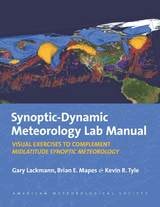
Synoptic-Dynamic Meteorology Lab Manual
Visual Exercises to Complement Midlatitude Synoptic MeteorologyGary Lackmann, Brian E. Mapes, and Kevin R. Tyle
American Meteorological Society, 2017
One of the greatest challenges facing atmospheric science instructors is helping students link theoretical and mathematical concepts to the real atmosphere. The past decade has been characterized by remarkable advances in meteorological observation, computing techniques, and data-visualization technology. However, the benefit of these advances can only be fully realized with the introduction of a systematic, applied approach to meteorological education that allows well-established theoretical concepts to be used with modernized observational and numerical datasets.
This lab manual is a tool designed just for this purpose; it links theoretical concepts with groundbreaking visualization to elucidate concepts taught in the companion textbook by Gary Lackmann, Midlatitude Synoptic Meteorology, the most current text available on modern weather forecasting techniques. When used in concert with Lackmann’s book and its companion CD of lecture slides, this lab manual will guide students in using contemporary observational and visualization techniques to provide in-depth understanding of fundamental concepts and serve as a catalyst for student-led innovation and application. With topics considered in an order that reinforces and builds upon new knowledge in meteorological observation and analysis, these materials will help students to deepen their understanding of synoptic-dynamic meteorology, synoptically-driven mesoscale phenomena, numerical weather prediction, ensemble prediction, and more, and put this understanding into practice.
Synthesizing Hope
Matter, Knowledge, and Place in South African Drug DiscoveryAnne Pollock
University of Chicago Press, 2019
Consideration of this case exposes the limitations of global health frameworks that implicitly posit rich countries as the only sites of knowledge production. Analysis of iThemba identifies the problems inherent in global north/south divides at the same time as it highlights what is at stake in who makes knowledge and where. It also provides a concrete example for consideration of the contexts and practices of postcolonial science, its constraints, and its promise.
Synthesizing Hope explores the many legacies that create conditions of possibility for South African drug discovery, especially the specific form of settler colonialism characterized by apartheid and resource extraction. Paying attention to the infrastructures and laboratory processes of drug discovery underscores the materiality of pharmaceuticals from the perspective of their makers, and tracing the intellectual and material infrastructures of South African drug discovery contributes new insights about larger social, political, and economic orders.
Synthetic
How Life Got MadeSophia Roosth
University of Chicago Press, 2017
In Synthetic: How Life Got Made, cultural anthropologist Sophia Roosth reveals how synthetic biologists make new living things in order to understand better how life works. The first book-length ethnographic study of this discipline, Synthetic documents the social, cultural, rhetorical, economic, and imaginative transformations biology has undergone in the post-genomic age. Roosth traces this new science from its origins at MIT to start-ups, laboratories, conferences, and hackers’ garages across the United States—even to contemporary efforts to resurrect extinct species. Her careful research reveals that rather than opening up a limitless new field, these biologists’ own experimental tactics circularly determine the biological features, theories, and limits they fasten upon. Exploring the life sciences emblematic of our time, Synthetic tells the origin story of the astonishing claim that biological making fosters biological knowing.
Systematics and Conservation of African Plants
Proceedings of the 18th AETFAT Congress, Yaoundé, CameroonEdited by Xander van der Burgt
Royal Botanic Gardens, Kew, 2010
An edited volume based on the proceedings of the eighteenth Association for the Taxonomic Study of the Flora of Tropical Africa Congress held in Yaoundé, Cameroon, Systematics and Conservation of African Plants includes one hundred research papers in separate sections on taxonomy, phytogeography, ethnobotany, and the conservation and sustainable use of African plants. Topics covered include recent advances in reproductive biology, vegetation, and Podostometaceae in Africa. A separate section on African floras reflects the present state of knowledge and progress towards our understanding and documentation of the plants of Africa.