Results by title
101 books match the query '1933-1945' and 27 start with t
Tempting All the Gods
Joseph P. Kennedy, Ambassador to Great Britain, 1938–1940Jane Karoline Vieth
Michigan State University Press, 2021

The Brown Plague
Travels in Late Weimar and Early Nazi GermanyDaniel Guérin
Duke University Press, 1994
Guérin’s travels took him across the countryside and into the cities of Germany. He describes with extraordinary clarity, for example, his encounters with large groups of unemployed workers in Berlin and the spectacle of Goering presiding over the Reichstag. Staying in youth hostels, Guérin met individuals representing a range of various groups and movements, including the Wandervögel, leftist brigades, Hitler Youth, and the strange, semicriminal sexual underground of the Wild-frei. Devoting particular attention to the cultural politics of fascism and the lure of Nazism for Germany’s disaffected youth, he describes the seductive rituals by which the Nazis were able to win over much of the population. As Robert Schwartzwald makes clear in his introduction, Guérin’s interest in Germany at this time was driven, in part, by a homoerotic component that could not be stated explicitly in his published material. This excellent companion essay also places The Brown Plague within a broad historical and literary context while drawing connections between fascism, aesthetics, and sexuality.
Informed by an epic view of class struggle and an admiration for German culture, The Brown Plague, a notable primary source in the literature of modern Europe, provides a unique view onto the rise of Nazism.
The Communist Party of the United States
From the Depression to World War IIOttanelli, Fraser
Rutgers University Press, 1991
The Conquest of Ruins
The Third Reich and the Fall of RomeJulia Hell
University of Chicago Press, 2019
Hell examines centuries of European empire-building—from Charles V in the sixteenth century and Napoleon’s campaigns of the late seventeenth and early eighteenth centuries to the atrocities of Mussolini and the Third Reich in the 1930s and ’40s—and sees a similar fascination with recreating the Roman past in the contemporary image. In every case—particularly that of the Nazi regime—the ruins of Rome seem to represent a mystery to be solved: how could an empire so powerful be brought so low? Hell argues that this fascination with the ruins of greatness expresses a need on the part of would-be conquerors to find something to ward off a similar demise for their particular empire.
The Forgotten Generation
American Children and World War IILisa L. Ossian
University of Missouri Press, 2021
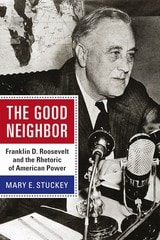
The Good Neighbor
Franklin D. Roosevelt and the Rhetoric of American PowerMary E. Stuckey
Michigan State University Press, 2013
No modern president has had as much influence on American national politics as Franklin D. Roosevelt. During FDR’s administration, power shifted from states and localities to the federal government; within the federal government it shifted from Congress to the president; and internationally, it moved from Europe to the United States. All of these changes required significant effort on the part of the president, who triumphed over fierce opposition and succeeded in remaking the American political system in ways that continue to shape our politics today. Using the metaphor of the good neighbor, Mary E. Stuckey examines the persuasive work that took place to authorize these changes. Through the metaphor, FDR’s administration can be better understood: his emphasis on communal values; the importance of national mobilization in domestic as well as foreign affairs in defense of those values; his use of what he considered a particularly democratic approach to public communication; his treatment of friends and his delineation of enemies; and finally, the ways in which he used this rhetoric to broaden his neighborhood from the limits of the United States to encompass the entire world, laying the groundwork for American ideological dominance in the post–World War II era.
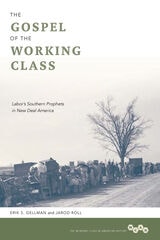
The Gospel of the Working Class
Labor's Southern Prophets in New Deal AmericaErik S. Gellman and Jarod Roll
University of Illinois Press, 2011
In this exceptional dual biography and cultural history, Erik S. Gellman and Jarod Roll trace the influence of two southern activist preachers, one black and one white, who used their ministry to organize the working class in the 1930s and 1940s across lines of gender, race, and geography. Owen Whitfield and Claude Williams, along with their wives Zella Whitfield and Joyce Williams, drew on their bedrock religious beliefs to stir ordinary men and women to demand social and economic justice in the eras of the Great Depression, New Deal, and Second World War.
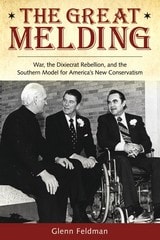
The Great Melding
War, the Dixiecrat Rebellion, and the Southern Model for America's New ConservatismGlenn Feldman
University of Alabama Press, 2015
CHOICE OUTSTANDING ACADEMIC TITLE
Tracing the Southern Origins of Modern American Conservatism.
Audacious in its scope, subtle in its analysis, and persuasive in its arguments, The Great Melding is the second book in Glenn Feldman’s magisterial recounting of the South’s transformation from a Reconstruction-era citadel of Democratic Party inertia to a cauldron of GOP agitation. In this pioneering study, Feldman shows how the transitional years after World War II, the Dixiecrat episode, and the early 1950s formed a pivotal sequence of events that altered America’s political landscape in profound, fundamental, and unexpected ways.
Feldman’s landmark work The Irony of the Solid South dismantled the myth of the New Deal consensus, proving it to be only a fleeting alliance of fissiparous factions; The Great Melding further examines how the South broke away from that consensus. Exploring issues of race and white supremacy, Feldman documents and explains the roles of economics, religion, and emotive appeals to patriotism in southern voting patterns. His probing and original analysis includes a discussion of the limits of southern liberalism and a fresh examination of the Dixiecrat Revolt of 1948.
Feldman convincingly argues that the Dixiecrats—often dismissed as a transitory footnote in American politics—served as a template for the modern conservative movement. Now a predictable Republican stronghold, Alabama at the time was viewed by national political strategists as a battleground and bellwether. Masterfully synthesizing a vast range of sources, Feldman shows that Alabama was then one of the few states where voters made unpredictable choices between the competing ideologies of the Democrats, Republicans, and Dixiecrats.
Writing in his lively and provocative style, Feldman demonstrates that the events he recounts in Alabama between 1942 and Dwight Eisenhower’s 1952 election encapsulate a rare moment of fluidity in American politics, one in which the New Deal consensus shattered and the Democratic and Republican parties fought off a third-party revolt only to find themselves irrevocably altered by their success. The Great Melding will fascinate historians, political scientists, political strategists, and readers of political nonfiction.
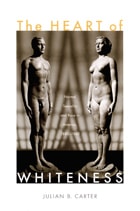
The Heart of Whiteness
Normal Sexuality and Race in America, 1880–1940Julian B. Carter
Duke University Press, 2007
Carter builds her intricate argument from detailed readings of an array of popular texts, focusing on how sex education for children and marital advice for adults provided significant venues for the dissemination of the new ideal of normality. She concludes that because its overt concerns were love, marriage, and babies, normality discourse facilitated white evasiveness about racial inequality. The ostensible focus of “normality” on matters of sexuality provided a superficially race-neutral conceptual structure that whites could and did use to evade engagement with the unequal relations of power that continue to shape American life today.
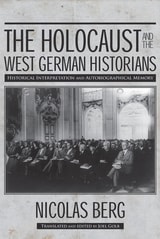
The Holocaust and the West German Historians
Historical Interpretation and Autobiographical MemoryNicolas Berg, Translated and edited by Joel Golb
University of Wisconsin Press, 2015
This English-language translation is also a shortened and reorganized edition, which includes a new introduction by Berg reviewing and commenting on the response to the German editions. Notably, in this American edition, discussion of historian Joseph Wulf and his colleague and fellow Holocaust survivor Léon Poliakov has been united in one chapter. And special care has been taken to make clear to English speakers the questions raised about German historiographical writing. Translator Joel Golb comments, "From 1945 to the present, the way historians have approached the Holocaust has posed deep-reaching problems regarding choice of language. . . . This book is consequently as much about language as it is about facts."
The Insider
How the Kiplinger Newsletter Bridged Washington and Wall StreetRob Wells
University of Massachusetts Press, 2022
When Willard M. Kiplinger launched the groundbreaking Kiplinger Washington Letter in 1923, he left the sidelines of traditional journalism to strike out on his own. With a specialized knowledge of finance and close connections to top Washington officials, Kiplinger was uniquely positioned to tell deeper truths about the intersections between government and business. With careful reporting and insider access, he delivered perceptive analysis and forecasts of business, economic, and political news to busy business executives, and the newsletter’s readership grew exponentially over the coming decades.
More than just a pioneering business journalist, Kiplinger emerged as a quiet but powerful link between the worlds of Presidents Hoover and Roosevelt, and used his Letter to play a little-known but influential role in the New Deal. Part journalism history, part biography, and part democratic chronicle, The Insider offers a well-written and deeply researched portrayal of how Kiplinger not only developed a widely read newsletter that launched a business publishing empire but also how he forged a new role for the journalist as political actor.
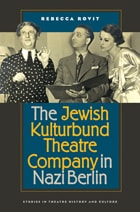
The Jewish Kulturbund Theatre Company in Nazi Berlin
Rebecca Rovit
University of Iowa Press, 2012
The Kulturbund’s directors were repeatedly caught between escalating demands from their Nazi overseers and from their own Jewish constituents. By examining why and how an all-Jewish repertory theatre could coexist with the Nazi regime, Rovit raises broader questions about the nature of art in an environment of coercion and isolation, artistic integrity and adaptability, and community and identity.
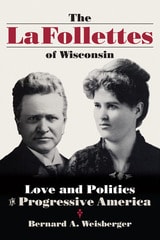
The La Follettes of Wisconsin
Love and Politics in Progressive AmericaBernard A. Weisberger
University of Wisconsin Press, 2013
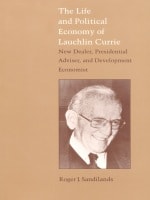
The Life and Political Economy of Lauchlin Currie
New Dealer, Presidential Advisor, and Development EconomistRoger J. Sandilands
Duke University Press, 1990
His involvement in U.S. policymaking in China, where he directed Lend-Lease operations from 1941-1943, was one of the factors leading to his confrontation with Senator Joseph McCarthy. In 1949 he directed the first World Bank mission to Colombia.
Roger Sandilands had access to Currie’s own papers and to previously unpublished material. In this biography he provides the reader with a critical evaluation of Currie’s contribution to the literature on the theory and practice of economic development in general, together with an analysis of how his concepts were shaped during the New Deal and in post-World War II Colombia.
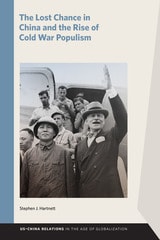
The Lost Chance in China and the Rise of Cold War Populism
Stephen J. Hartnett
Michigan State University Press, 2025
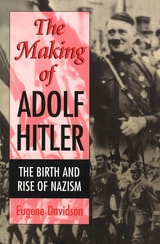
The Making of Adolf Hitler
The Birth and Rise of NazismEugene Davidson
University of Missouri Press, 1997
The harsh Armistice terms of 1918, the short-lived Weimar Republic, Hindenburg's senile vacillations, and behind-the-scene power plays form the backbone of this excellent study covering German history during the first three-and-a-half decades of the century.
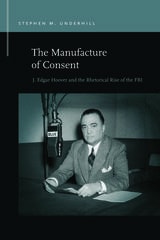
The Manufacture of Consent
J. Edgar Hoover and the Rhetorical Rise of the FBIStephen M. Underhill
Michigan State University Press, 2020
The Mortal Storm
Phyllis Bottome
Northwestern University Press, 1998
The Nazi Olympics
Sport, Politics, and Appeasement in the 1930sEdited by Arnd Krüger and William Murray
University of Illinois Press, 2003
The 1936 Olympic Games played a key role in the development of both Hitler’s Third Reich and international sporting competition. The Nazi Olympics gathers essays by modern scholars from prominent participating countries and lays out the issues--sporting as well as political--surrounding the involvement of individual nations.
The volume opens with an analysis of Germany’s preparations for the Games and the attempts by the Nazi regime to allay the international concerns about Hitler’s racist ideals and expansionist ambitions. Essays follow on the United States, Great Britain, and France--top-tier Olympian nations with misgivings about participation--as well as Germany's future Axis partners Italy and Japan. Other contributions examine the issues involved for Finland, Sweden, Norway, Denmark, and the Netherlands. Throughout, the authors reveal the high political stakes surrounding the Games and how the Nazi Olympics distilled critical geopolitical issues of the time into a spectacle of sport.

The Nazi Symbiosis
Human Genetics and Politics in the Third ReichSheila Faith Weiss
University of Chicago Press, 2010
The Faustian bargain—in which an individual or group collaborates with an evil entity in order to obtain knowledge, power, or material gain—is perhaps best exemplified by the alliance between world-renowned human geneticists and the Nazi state. Under the swastika, German scientists descended into the moral abyss, perpetrating heinous medical crimes at Auschwitz and at euthanasia hospitals. But why did biomedical researchers accept such a bargain?
The Nazi Symbiosis offers a nuanced account of the myriad ways human heredity and Nazi politics reinforced each other before and during the Third Reich. Exploring the ethical and professional consequences for the scientists involved as well as the political ramifications for Nazi racial policies, Sheila Faith Weiss places genetics and eugenics in their larger international context. In questioning whether the motives that propelled German geneticists were different from the compromises that researchers from other countries and eras face, Weiss extends her argument into our modern moment, as we confront the promises and perils of genomic medicine today.
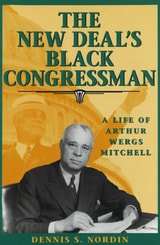
The New Deal's Black Congressman
A Life of Arthur Wergs MitchellDennis S. Nordin
University of Missouri Press, 1997
In this fascinating biography, Dennis S. Nordin chronicles the life of Arthur Wergs Mitchell, the first black Democrat to be elected to Congress. Although he is now one of history's forgotten figures, Mitchell was once almost as well known among black college students as Jesse Owens and Joe Louis. Nordin, however, shows that Mitchell's achievements and thus his fame were the direct result of his dishonorable deeds.
Mitchell's life began humbly in rural Alabama in 1883. After a memorable boyhood, he studied briefly at Tuskegee Institute, which had a major effect on Mitchell's outlook. He went on to study law in Washington, D.C., and thereafter became involved in politics when the Republicans sent him to Chicago in 1928 to campaign for Herbert Hoover. Impressed by Chicago's ward system and patronage politics, he returned to the city and made a bid for a congressional seat, changing political parties in an effort to oust black Republican Congressman Oscar DePriest. To accomplish this, Mitchell resorted to "Uncle Tomming," ingratiating himself with the white bosses of the Chicago Machine.
Within five years a Machine nomination was in hand, and Mitchell found himself owing his political success and thus his loyalty to the Chicago Machine. Because he was under strict orders from Chicago Mayor Ed Kelly not to cause problems or be confrontational, Mitchell rarely, if ever, supported the interests of his constituents.
It was only in the later years of his political career that Mitchell began to show opposition to his Machine backing. He had been an opponent of the NAACP in his first years in Congress, but later became a strong supporter of an NAACP antilynching bill. In 1937, Mitchell sued three railroad companies for not offering equal treatment and accommodations for all passengers. The case went to the Supreme Court, which gave Mitchell a favorable ruling. As a result of these "confrontational" acts, the Chicago Machine quickly decided not to endorse Mitchell in the elections of 1942.
In his research, Nordin relies on such primary sources as manuscripts, newspapers, and court records, as well as information from interviews with Mitchell's friends, neighbors, colleagues, political rivals, and widow. Woven tightly together, these sources form a narrative that reveals a most complex and intriguing individual, a man whose political and moral views and acts were strongly linked to the goals of the great Chicago political Machine.
The Sovereigns
A Jewish Family in the German CountrysideEric Lucas
Northwestern University Press, 2001
But anti-Semites, under the protection of the Nazi regime, began to settle old scores, and targeted the economically successful rural Jews. New laws stripped Jewish meat dealers of their rights, and Aryan competitors eagerly forced them aside. That was only the beginning. In the Holocaust that followed, some members of the family escaped. Others did not.

The Thousand-Year Flood
The Ohio-Mississippi Disaster of 1937David Welky
University of Chicago Press, 2011
In the early days of 1937, the Ohio River, swollen by heavy winter rains, began rising. And rising. And rising. By the time the waters crested, the Ohio and Mississippi had climbed to record heights. Nearly four hundred people had died, while a million more had run from their homes. The deluge caused more than half a billion dollars of damage at a time when the Great Depression still battered the nation.
Timed to coincide with the flood's seventy-fifth anniversary, The Thousand-Year Flood is the first comprehensive history of one of the most destructive disasters in American history. David Welky first shows how decades of settlement put Ohio valley farms and towns at risk and how politicians and planners repeatedly ignored the dangers. Then he tells the gripping story of the river's inexorable rise: residents fled to refugee camps and higher ground, towns imposed martial law, prisoners rioted, Red Cross nurses endured terrifying conditions, and FDR dispatched thousands of relief workers. In a landscape fraught with dangers—from unmoored gas tanks that became floating bombs to powerful currents of filthy floodwaters that swept away whole towns—people hastily raised sandbag barricades, piled into overloaded rowboats, and marveled at water that stretched as far as the eye could see. In the flood's aftermath, Welky explains, New Deal reformers, utopian dreamers, and hard-pressed locals restructured not only the flood-stricken valleys, but also the nation's relationship with its waterways, changes that continue to affect life along the rivers to this day.
A striking narrative of danger and adventure—and the mix of heroism and generosity, greed and pettiness that always accompany disaster—The Thousand-Year Flood breathes new life into a fascinating yet little-remembered American story.
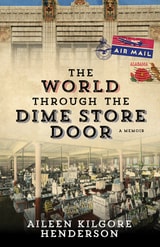
The World through the Dime Store Door
A MemoirAileen Kilgore Henderson
University of Alabama Press, 2020
A coming-of-age memoir evoking farm, mining, and small-town life in Alabama’s Tuscaloosa County as the world transitions from the Great Depression to World War II.
In the 1930s, the rural South was in the throes of the Great Depression. Farm life was monotonous and hard, but a timid yet curious teenager thought it worth recording. Aileen Kilgore Henderson kept a chronicle of her family’s daily struggles in Tuscaloosa County alongside events in the wider world she gleaned from shortwave radio and the occasional newspaper. She wrote about Howard Hughes’s round-the-world flight and her horror at the rise to power in Germany of a bizarre politician named Adolf Hitler. Henderson longed to join the vast world beyond the farm, but feared leaving the refuge of her family and beloved animals.
Yet, with her father’s encouragement, she did leave, becoming a clerk in the Kress dime store in downtown Tuscaloosa. Despite long workdays and a lengthy bus commute, she continued to record her observations and experiences in her diary, for every day at the dime store was interesting and exciting for an observant young woman who found herself considering new ideas and different points of view.
Drawing on her diary entries from the 1930s and early 1940s, Henderson recollects a time of sweeping change for Tuscaloosa and the South. The World through the Dime Store Door is a personal and engaging account of a Southern town and its environs in transition told through the eyes of a poor young woman with only a high school education but gifted with a lively mind and an openness to life.
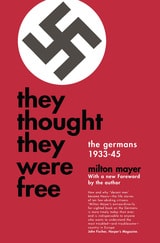
They Thought They Were Free
The Germans, 1933-45Milton Mayer
University of Chicago Press, 1966
“What happened here was the gradual habituation of the people, little by little, to being governed by surprise; to receiving decisions deliberated in secret; to believing that the situation was so complicated that the government had to act on information which the people could not understand, or so dangerous that, even if the people could not understand it, it could not be released because of national security. And their sense of identification with Hitler, their trust in him, made it easier to widen this gap and reassured those who would otherwise have worried about it.”--from Chapter 13, “But Then It Was Too Late”
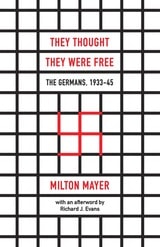
They Thought They Were Free
The Germans, 1933–45Milton Mayer
University of Chicago Press, 2017
“When this book was first published it received some attention from the critics but none at all from the public. Nazism was finished in the bunker in Berlin and its death warrant signed on the bench at Nuremberg.”
That’s Milton Mayer, writing in a foreword to the 1966 edition of They Thought They Were Free. He’s right about the critics: the book was a finalist for the National Book Award in 1956. General readers may have been slower to take notice, but over time they did—what we’ve seen over decades is that any time people, across the political spectrum, start to feel that freedom is threatened, the book experiences a ripple of word-of-mouth interest.
They Thought They Were Free is an eloquent and provocative examination of the development of fascism in Germany. Mayer’s book is a study of ten Germans and their lives from 1933-45, based on interviews he conducted after the war when he lived in Germany. Mayer had a position as a research professor at the University of Frankfurt and lived in a nearby small Hessian town which he disguised with the name “Kronenberg.” “These ten men were not men of distinction,” Mayer noted, but they had been members of the Nazi Party; Mayer wanted to discover what had made them Nazis. His discussions with them of Nazism, the rise of the Reich, and mass complicity with evil became the backbone of this book, an indictment of the ordinary German that is all the more powerful for its refusal to let the rest of us pretend that our moment, our society, our country are fundamentally immune.
A new foreword to this edition by eminent historian of the Reich Richard J. Evans puts the book in historical and contemporary context. We live in an age of fervid politics and hyperbolic rhetoric. They Thought They Were Free cuts through that, revealing instead the slow, quiet accretions of change, complicity, and abdication of moral authority that quietly mark the rise of evil.

Travels in the Reich, 1933-1945
Foreign Authors Report from GermanyEdited by Oliver Lubrich
University of Chicago Press, 2010
“Even now,” wrote Christopher Isherwood in his Berlin Diary of 1933, “I can’t altogether believe that any of this has really happened.” Three years later, W. E. B. DuBois described Germany as “silent, nervous, suppressed; it speaks in whispers.” In contrast, a young John F. Kennedy, in the journal he kept on a German tour in 1937, wrote, “The Germans really are too good—it makes people gang against them for protection.”
Drawing on such published and unpublished accounts from writers and public figures visiting Germany, Travels in the Reich creates a chilling composite portrait of the reality of life under Hitler. Written in the moment by writers such as Virginia Woolf, Isak Dinesen, Samuel Beckett, Jean-Paul Sartre, William Shirer, Georges Simenon, and Albert Camus, the essays, letters, and articles gathered here offer fascinating insight into the range of responses to Nazi Germany. While some accounts betray a distressing naivete, overall what is striking is just how clearly many of the travelers understood the true situation—and the terrors to come.
Through the eyes of these visitors, Travels in the Reich offers a new perspective on the quotidian—yet so often horrifying—details of German life under Nazism, in accounts as gripping and well-written as a novel, but bearing all the weight of historical witness.