Results by title
64 books match the query '1960-' and 12 start with t

The Culture of Inequality
Michael Lewis
University of Massachusetts Press, 1993
Why do America’s wars against poverty turn out to be wards against the poor? Why does a nation so committed to fighting crime show such a bad record of combatting it and so morbid a fascination with it? Why is American racism so deeply rooted?
These and other questions are answered in this milestone study. Its central thesis is that the national faith in individual initiative and free opportunity has become a breeding ground for guilt about our own limited successes and prejudice against all who exhibit signs of failure.
The New Religious Image of Urban America, Second Edition
The Shopping Mall as Ceremonial CenterIra G. Zepp, Jr.
University Press of Colorado, 1997

The Political Economy of Turkey
Zulkuf Aydin
Pluto Press, 2005
The Politics of Custom
Chiefship, Capital, and the State in Contemporary AfricaEdited by John L. Comaroff and Jean Comaroff
University of Chicago Press, 2018
This pathbreaking volume, edited by anthropologists John L. Comaroff and Jean Comaroff, explores the reasons behind the increasingly assertive politics of custom in many corners of Africa. Chiefs come in countless guises—from university professors through cosmopolitan businessmen to subsistence farmers–but, whatever else they do, they are a critical key to understanding the tenacious hold that “traditional” authority enjoys in the late modern world. Together the contributors explore this counterintuitive chapter in Africa’s history and, in so doing, place it within the broader world-making processes of the twenty-first century.
The Politics of the Welfare State in Turkey
How Social Movements and Elite Competition Created a Welfare StateErdem Yörük
University of Michigan Press, 2022
The Postcolonial State in Africa
Fifty Years of Independence, 1960–2010Crawford Young
University of Wisconsin Press, 2012
Young identifies three cycles of hope and disappointment common to many of the African states (including those in North Africa) over the last half-century: initial euphoria at independence in the 1960s followed by disillusionment with a lapse into single-party autocracies and military rule; a period of renewed confidence, radicalization, and ambitious state expansion in the 1970s preceding state crisis and even failure in the disastrous 1980s; and a phase of reborn optimism during the continental wave of democratization beginning around 1990. He explores in depth the many African civil wars—especially those since 1990—and three key tracks of identity: Africanism, territorial nationalism, and ethnicity.
Only more recently, Young argues, have the paths of the fifty-three African states begun to diverge more dramatically, with some leading to liberalization and others to political, social, and economic collapse—outcomes impossible to predict at the outset of independence.
“This book is the best volume to date on the politics of the last 50 years of African independence.”—International Affairs
“The book shares Young’s encyclopedic knowledge of African politics, providing in a single volume a comprehensive rendering of the first 50 years of independence. The book is sprinkled with anecdotes from his vast experience in Africa and that of his many students, and quotations from all of the relevant literature published over the past five decades. Students and scholars of African politics alike will benefit immensely from and enjoy reading The Postcolonial State in Africa.”—Political Science Quarterly
“The study of African politics will continue to be enriched if practitioners pay homage to the erudition and the nobility of spirit that has anchored the engagement of this most esteemed doyen of Africanists with the continent.”—African History Review
“The book’s strongest attribute is the careful way that comparative political theory is woven into historical storytelling throughout the text. . . . Written with great clarity even for all its detail, and its interwoven use of theory makes it a great choice for new students of African studies.”—Australasian Review of African Studies
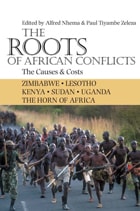
The Roots of African Conflicts
The Causes and CostsAlfred Nhema
Ohio University Press, 2007
“Africa is no more prone to violent conflicts than other regions. Indeed, Africa’s share of the more than 180 million people who died from conflicts and atrocities in the twentieth century is relatively modest.… This is not to underestimate the immense impact of violent conflicts on Africa; it is merely to emphasize the need for more balanced debate and commentary.”
—From the introduction by Paul Tiyambe Zeleza
Violent conflicts have exacted a heavy toll on Africa’s societies, polities, and economies. This book presents African scholars’ views of why conflicts start in their continent. The causes of conflict are too often examined by scholars from the countries that run the proxy wars and sell the arms to fuel them. This volume offers theoretically sophisticated, empirically grounded, and compelling analyses of the roots of African conflicts.
The State, Ethnicity, and Gender in Africa
Intellectual Legacies of Crawford YoungEdited by Scott Straus and Aili Mari Tripp
University of Wisconsin Press, 2024
Written in honor of Crawford Young, a foundational figure in the study of African politics, the essays reflect the breadth and intellectual legacy of this towering scholar and illustrate the vast impact Young had, and continues to have, on the field. The book’s themes build from his seminal publications, and the essays were written by leading scholars who were trained by Young.

The Third World
A Vital New Force in International AffairsPeter Worsley
University of Chicago Press, 1970
In this work Peter Worsley analyzes the unique political forms that have evolved as a result of these two basic conditions. In his view the third world has rejected both of the great ideologies of today. Their new solutions are unique in world history, being based on populism, socialism, and, often, the one-party state, which, although anathema to the Western liberal, is a natural development in societies united by the common enemy of colonialism.
"No one seriously concerned with the greatest problem of our time, the division of the world between the developed, industrialized, 'affluent' countries and les nations prolétaires, can afford to miss this book. . . . Professor Worsley has succeeded in giving us more solid information about underdeveloped parts of the world than can be found in any other book of comparable length."—The Times Literary Supplement
"Peter Worsley . . . has written an excellent descriptive analysis of the evolution and present state of a third force in world politics. Africa, Asia, and the Middle East have . . . given society not only a new philosophy with new goals but charismatic philosophers who have the potential to make the philosophy of the third world a vital presence to be reckoned with. . . . a brilliant book."—Peter Schwab, Journal of Modern African Studies
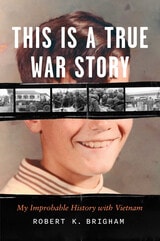
This Is a True War Story
My Improbable History with VietnamRobert K. Brigham
University of Chicago Press, 2026
Robert K. Brigham has had a substantial career as a historian of the Vietnam War, with a hand in nine books, a documentary, public history projects, and more. While many a historian has felt compelled at some point to write about a subject close to them personally, Brigham did not think he was doing that. But, at age fifty-eight, Brigham, who had long known he was adopted, discovered that he’d improbably and unknowingly been studying and talking about his biological father for decades. That man, Bruce Atwell, was a Marine Corps photographer who took some of that war’s most indelible and widely reproduced pictures. Brigham had used those images over and over again in decades’ worth of classes and public lectures, never knowing the truth.
Both Brigham and Atwell were products of the American foster care and adoption system, and both were defined professionally by Vietnam. In a story shot through with echoes and shadows, Brigham not only reveals his own history as an adoptee but opens a startlingly fresh vantage on the fragility of American families; the power of social norms and taboos to shape lives; and the forces that inequitably disrupt families, not least of them war. The result is an accessible and moving book that is at once both a powerful personal story and an illuminating social critique.
Trading Down
Africa, Value Chains, And The Global EconomyPeter Gibbon and Stefano Ponte
Temple University Press, 2005

Two NATO Allies at the Threshold of War
Parker T. Hart
Duke University Press, 1990
Hart has relied on his own papers from the period, as well as on United Nations sources from the Lyndon B. Johnson Presidential Library, and on the papers of the other key participants in the Crisis, Ambassador to Greece Phillips Talbot, Ambassador to Cyprus Taylor G. Belcher, and Cyrus Vance, to provide a rare play-by-play analysis of the crisis and its resolution.