Results by title
3703 books match the query '19th century' and 853 start with t
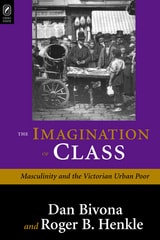
THE IMAGINATION OF CLASS
MASCULINITY AND THE VICTORIAN URBAN POORDan Bivona and Roger B. Henkle
The Ohio State University Press, 2006
Through carefully nuanced discussions of a variety of Victorian novelists, journalists, and sociological investigators (some well known, like Dickens, and others less well known, like Masterman and Greenwood), the book offers new insight into the role played by the imagination of the urban poor in the construction of Victorian middle class masculinity. Whereas many scholars have discussed the feminization of the poor, virtually no one has addressed how the poor have served as a site at which middle class men fashioned their own class and gender identity.
THE NOVEL AND THE MENAGERIE
TOTALITY, ENGLISHNESS, AND EMPIREKURT KOENIGSBERGER
The Ohio State University Press, 2007
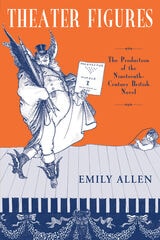
THEATER FIGURES
The Production of the Nineteenth-Century British NovelEmily Allen
The Ohio State University Press, 2003

Tableaux Vivants of the Russian Empire
Yelena Severina
University of Wisconsin Press, 2027
The practice of tableaux vivants, or “living pictures,” involves arranging people and objects into a motionless scene, often re-creating a work of art. After emerging in France, this dramatic art form quickly burst national boundaries, becoming a popular pastime. It took strong root in Russia toward the end of the eighteenth century, traversing the social and political scene, from its debut as an aristocratic parlor game to common street performance; from the inner circles of the tsarist court to agitprop theater and cinema; and from political meetings to public schools and city parades.
In this book, the first English-language history of tableaux vivants in Russia, Yelena Severina traces the development of this art form from the late eighteenth into the early twentieth century. She links its introduction, rise, influence on later entertainments like photography and film, and ultimate decline to concomitant changes in Russian society, politics, and technology, arguing that while this art form may now be nearly forgotten, it should be remembered and studied for its critical role in Imperial Russian culture.
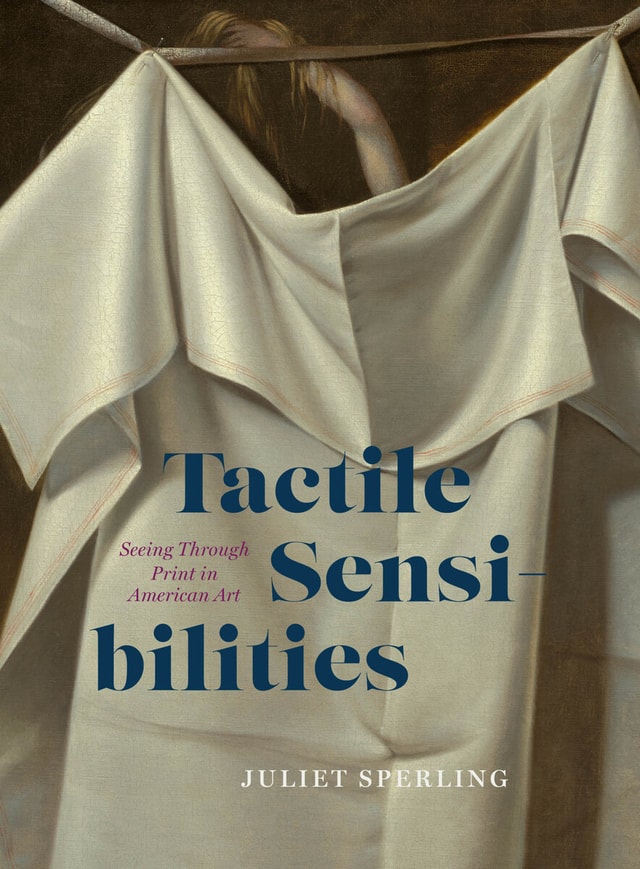
Tactile Sensibilities
Seeing Through Print in American ArtJuliet Sperling
University of Chicago Press, 0
A print-driven history of American art in the long nineteenth century.
Juliet Sperling’s Tactile Sensibilities uses interactive printed objects to uncover culturally instilled ideas about touch’s role in perception and shows how these frameworks were integral to ways of making and appreciating even seemingly untouchable works of painting and sculpture. Crucial to Sperling’s argument is a genre of paper constructions designed to engage the hand and eye in tandem: multilayered and lift-the-flap book plates, pull-tab engravings, foldable playbills, and spinning paper wheels that built expectations of touch as a trained, focused process into their structure and material. Intimately scaled and portable, tactile prints cut across multiple spheres of experience, including spaces in which people learned to view, understand, and create art.
Sperling reverses standard procedures for integrating prints into art history. Rather than working her way outward from canonical artworks toward ephemeral sources within the artist’s orbit, she uses previously unstudied printed materials to open period discourses of tactile sensibility that ultimately lead to art objects, unlocking new meanings behind works of painting and sculpture by artists including Raphaelle Peale, Hiram Powers, William Sidney Mount, and Winslow Homer. In treating sidelined materials as dedicated objects of study in their own right, Tactile Sensibilities reveals that in the long nineteenth century, print was an intellectually dense and powerfully connective medium, vital in mediating the tactile sensibilities that shaped ways of making and appreciating art.
Taking Christianity to China
Alabama Missionaries in the Middle Kingdom, 1850–1950Wayne Flynt and Gerald W. Berkley
University of Alabama Press, 2017
A study of faith, cultural exchange, and the Alabama missionaries who helped shape the story of Christianity in modern China.
Beginning early in the 19th century, the American missionary movement made slow headway in China. Alabamians became part of that small beachhead. After 1900 both the money and personnel rapidly expanded, peaking in the early 1920s. By the 1930s many American denominations became confused and divided over the appropriateness of the missionary endeavor. Secular American intellectuals began to criticize missionaries as meddling do-gooders trying to impose American Evangelicalism on a proud, ancient culture.
By examining the lives of 47 Alabama missionaries who served in China between 1850 and 1950, Flynt and Berkley reach a different conclusion. Although Alabama missionaries initially fit the negative description of Americans trying to superimpose their own values and beliefs on "heathen," they quickly learned to respect Chinese civilization. The result was a new synthesis, neither entirely southern nor entirely Chinese. Although previous works focus on the failure of Christianity to change China, this book focuses on the degree to which their service in China changed Alabama missionaries. And the change was profound.
In their consideration of 47 missionaries from a single state--their call to missions, preparation for service in China, living, working, contacts back home, cultural clashes, political views, internal conflicts, and gender relations--the authors suggest that the efforts by Baptist, Methodist, and Presbyterian missionaries from Alabama were not the failure judged by many historians. In fact, the seeds sown in the hundred years before the Communist revolution in 1950 seem to be reaping a rich harvest in the declining years of the 20th century, when the number of Chinese Christians is estimated by some to be as high as one hundred million.
Taking the Land to Make the City
A Bicoastal History of North AmericaBy Mary P. Ryan
University of Texas Press, 2019
The history of the United States is often told as a movement westward, beginning at the Atlantic coast and following farmers across the continent. But cities played an equally important role in the country’s formation. Towns sprung up along the Pacific as well as the Atlantic, as Spaniards and Englishmen took Indian land and converted it into private property. In this reworking of early American history, Mary P. Ryan shows how cities—specifically San Francisco and Baltimore—were essential parties to the creation of the republics of the United States and Mexico.
Baltimore and San Francisco share common roots as early trading centers whose coastal locations immersed them in an international circulation of goods and ideas. Ryan traces their beginnings back to the first human habitation of each area, showing how the juggernaut toward capitalism and nation-building could not commence until Europeans had taken the land for city building. She then recounts how Mexican ayuntamientos and Anglo American city councils pioneered a prescient form of municipal sovereignty that served as both a crucible for democracy and a handmaid of capitalism. Moving into the nineteenth century, Ryan shows how the citizens of Baltimore and San Francisco molded landscape forms associated with the modern city: the gridded downtown, rudimentary streetcar suburbs, and outlying great parks. This history culminates in the era of the Civil War when the economic engines of cities helped forge the East and the West into one nation.
Tales of Two Cities
Race and Economic Culture in Early Republican North and South AmericaBy Camilla Townsend
University of Texas Press, 2000
With a common heritage as former colonies of Europe, why did the United States so outstrip Latin America in terms of economic development in the nineteenth century? In this innovative study, Camilla Townsend challenges the traditional view that North Americans succeeded because of better attitudes toward work—the Protestant work ethic—and argues instead that they prospered because of differences in attitudes towards workers that evolved in the colonial era.
Townsend builds her study around workers' lives in two very similar port cities in the 1820s and 1830s. Through the eyes of the young Frederick Douglass in Baltimore, Maryland, and an Indian woman named Ana Yagual in Guayaquil, Ecuador, she shows how differing attitudes towards race and class in North and South America affected local ways of doing business. This empirical research significantly clarifies the relationship between economic culture and racial identity and its long-term effects.
Tariff Wars and the Politics of Jacksonian America
William K. Bolt
Vanderbilt University Press, 2016
The spreading of democracy caused by the tariff evoked bitter sectional controversy among Americans. Northerners claimed they needed a tariff to protect their industries and also their wages. Southerners alleged the tariff forced them to buy goods at increased prices. Having lost the argument against the tariff on its merits, in the 1820s, southerners began to argue the Constitution did not allow Congress to enact a protective tariff. In this fight, we see increased tensions between northerners and southerners in the decades before the Civil War began.
As Tariff Wars reveals, this struggle spawned a controversy that placed the nation on a path that would lead to the early morning hours of Charleston Harbor in April of 1861.
Tarpleywick
A Century of Iowa FarmingHenry C. Taylor
University of Iowa Press, 0
(Tarpleywick description) “When Tarpley Early Taylor came of age on August 2, 1858, his father gave him a horse, a saddle, and a bridle and wished him well…His first independent move was to go on horseback to Louisiana, Missouri, to visit his maternal grandparents, the Zumwalts. He stayed with them for some time, probably through the winter…We do not know what he did from the spring of 1859 to the spring of 1860 except that he had been earning money and saving it. We do know that he had returned to Van Buren County by Juy 24, 1860, because on that date he paid $800 for sixty acres of land a mile south of his father’s house…This was the beginning of Tarpleywick.” Born in Iowa in 1873, he was 96 years old when he died in May 1969. Taylor received his undergraduate training from Drake University and Iowa State University, his M.S. degree from Iowa State, and his Ph.D. degree from the University of Wisconsin. He was the first professor of agricultural economics in a land grant institution, the author of the first American textbook dealing with the principles of agricultural economics, the organizer and first Chief of the Bureau of Agricultural Economics in the USDA, and the first Managing Director of the Farm Foundation.
Tasting Freedom
Octavius Catto and the Battle for Equality in Civil War AmericaDaniel R. Biddle
Temple University Press, 2017
Octavius Valentine Catto was an orator who shared stages with Frederick Douglass, a second baseman on Philadelphia’s best black baseball team, a teacher at the city’s finest black school and an activist who fought in the state capital and on the streets for equal rights. With his racially-charged murder, the nation lost a civil rights pioneer—one who risked his life a century before Selma and Birmingham.
In Tasting Freedom Murray Dubin and Pulitzer Prize winner Dan Biddle painstakingly chronicle the life of this charismatic black leader—a “free” black whose freedom was in name only. Born in the American south, where slavery permeated everyday life, he moved north where he joined the fight to be truly free—free to vote, go to school, ride on streetcars, play baseball and even participate in July 4th celebrations.
Catto electrified a biracial audience in 1864 when he proclaimed, “There must come a change,” calling on free men and women to act and educate the newly freed slaves. With a group of other African Americans who called themselves a “band of brothers,” they challenged one injustice after another. Tasting Freedom presents the little-known stories of Catto and the men and women who struggled to change America.
Teachers of the People
Political Education in Rousseau, Hegel, Tocqueville, and MillDana Villa
University of Chicago Press, 2017
In Teachers of the People, Dana Villa takes us back to the moment in history when “the people” first appeared on the stage of modern European politics. That moment—the era just before and after the French Revolution—led many major thinkers to celebrate the dawning of a new epoch. Yet these same thinkers also worried intensely about the people’s seemingly evident lack of political knowledge, experience, and judgment. Focusing on Rousseau, Hegel, Tocqueville, and Mill, Villa shows how reformist and progressive sentiments were often undercut by skepticism concerning the political capacity of ordinary people. They therefore felt that “the people” needed to be restrained, educated, and guided—by laws and institutions and a skilled political elite. The result, Villa argues, was less the taming of democracy’s wilder impulses than a pervasive paternalism culminating in new forms of the tutorial state.
Ironically, it is the reliance upon the distinction between “teachers” and “taught” in the work of these theorists which generates civic passivity and ignorance. And this, in turn, creates conditions favorable to the emergence of an undemocratic and illiberal populism.
Teaching Children Science
Hands-On Nature Study in North America, 1890-1930Sally Gregory Kohlstedt
University of Chicago Press, 2010
In the early twentieth century, a curriculum known as nature study flourished in major city school systems, streetcar suburbs, small towns, and even rural one-room schools. This object-based approach to learning about the natural world marked the first systematic attempt to introduce science into elementary education, and it came at a time when institutions such as zoos, botanical gardens, natural history museums, and national parks were promoting the idea that direct knowledge of nature would benefit an increasingly urban and industrial nation.
The definitive history of this once pervasive nature study movement, TeachingChildren Science emphasizes the scientific, pedagogical, and social incentives that encouraged primarily women teachers to explore nature in and beyond their classrooms. Sally Gregory Kohlstedt brings to vivid life the instructors and reformers who advanced nature study through on-campus schools, summer programs, textbooks, and public speaking. Within a generation, this highly successful hands-on approach migrated beyond public schools into summer camps, afterschool activities, and the scouting movement. Although the rich diversity of nature study classes eventually lost ground to increasingly standardized curricula, Kohlstedt locates its legacy in the living plants and animals in classrooms and environmental field trips that remain central parts of science education today.
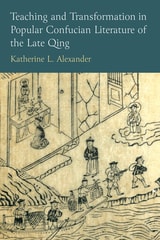
Teaching and Transformation in Popular Confucian Literature of the Late Qing
Katherine L. Alexander
University of Michigan Press, 2025
Yu’s works complicate the picture of socio-moral reform, particularly the Confucian mission of jiaohua (teaching and transformation). Though he viewed the disasters of the late Qing as the natural consequence of jiaohua’s failure to compete against socially disruptive media, such as vernacular fiction and theatrical productions, he also wanted reformers to engage closely with these genres. Yu became a vocal advocate of teaching with moral vernacular literature that he believed met commoners at their level. He emphasized the hope that by writing, printing, and performing such texts, every member of his audience could be transformed into teachers themselves, restoring society from the bottom up.
Teaching with Digital Humanities
Tools and Methods for Nineteenth-Century American LiteratureJennifer Travis, Jessica DeSpain
University of Illinois Press, 2018
Travis and DeSpain curate conversations on the value of project-based, collaborative learning; examples of real-world assignments where students combine close, collaborative, and computational reading; how digital humanities aids in the consideration of marginal texts; the ways in which an ethics of care can help students organize artifacts; and how an activist approach affects debates central to the study of difference in the nineteenth century.
A supplemental companion website with substantial appendixes of syllabi and assignments is now available for readers of Teaching with Digital Humanities.
Technical Knowledge in American Culture
Science, Technology, and Medicine Since the Early 1800sEdited by Hamilton Cravens, Alan I Marcus, and David M. Katzman
University of Alabama Press, 1996
Addresses the relationships between what modern-day experts say to each other and to their constituencies
Technical Knowledge in American Culture is an interdisciplinary volume that brings together leading historians to investigate how science, technology, and medicine have shaped—and been shaped by—American intellectual and cultural traditions since the early nineteenth century. Rather than treating science and technology simply as products of social forces, the contributors examine them as forms of knowledge with their own internal logics, debates, and authority structures. The book asks a central question: how do experts—scientists, engineers, physicians—communicate with one another and with broader audiences, and how does that communication influence American society?
The volume is organized into three major sections, each anchored in a distinct historical moment: Part I: The Rise of Democratic Culture, 1800–1870; Part II: The Age of Hierarchy, 1870–1920; and Part III: Toward an Infinity of Dimensions (20th Century). Across its essays, the book argues that technical knowledge is not just a tool of progress—it is a cultural force shaped by communication, interpretation, and authority. By focusing on case studies rather than sweeping narratives, the volume reveals how expertise operates in practice and how it influences broader debates about science, society, and public trust.
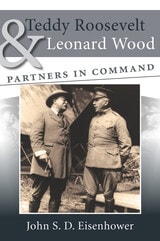
Teddy Roosevelt and Leonard Wood
Partners in CommandJohn S. D. Eisenhower
University of Missouri Press, 2013
Theodore Roosevelt was a man of wide interests, strong opinions, and intense ambition for both himself and his country. When he met Leonard Wood in 1897, he recognized a kindred spirit. Moreover, the two men shared a zeal for making the United States an imperial power that would challenge Great Britain as world leader. For the remainder of their lives, their careers would intertwine in ways that shaped the American nation.
When the Spanish American War came, both men seized the opportunity to promote the goals of American empire. Roosevelt resigned as assistant secretary of the navy in William McKinley’s administration to serve as a lieutenant colonel of the Rough Riders, a newly organized volunteer cavalry. Wood, then a captain in the medical corps and physician to McKinley, was promoted to colonel and given charge of the unit.
Roosevelt later took over command of the Rough Riders. In the Battle of San Juan Hill, he led it in a charge up Kettle Hill that would end in victory for the American troops and make their daring commander a household name, a war hero, and, eventually, president of the United States.
At the Treaty of Paris in 1898, Spain ceded Cuba, Puerto Rico, Guam, and the Philippines to the United States. The next year, Wood became military governor of Cuba. He remained in the post until 1902. By that time Roosevelt was president. One of the major accomplishments of his administration was reorganization of the War Department, which the war with Spain had proved disastrously outdated. In 1909, when William Howard Taft needed a strong army chief of staff to enforce the new rules, he appointed Leonard Wood.
Both Wood and Roosevelt were strong proponents of preparedness, and when war broke out in Europe in August 1914, Wood, retired as chief of staff and backed by Roosevelt, established the “Plattsburg camps,” a system of basic training camps. When America entered the Great War, the two men’s foresight was justified, but their earlier push for mobilization had angered Woodrow Wilson, and both were denied the command positions they sought in Europe.
Roosevelt died in 1919 while preparing for another presidential campaign. Wood made a run in his place but was never taken seriously as a candidate. He retired from the army and spent the last seven years of his life as civilian governor of the Philippines.
It was a quiet end for two men who had been giants of their time. While their modernization of the army is widely admired, they were not without their critics. Roosevelt and Wood saw themselves as bold leaders but were regarded by some as ruthless strivers. And while their shared ambitions for the United States were tempered by a strong sense of duty, they could, in their certainty and determination, trample those who stood in their path. Teddy Roosevelt and Leonard Wood: Partners in Command is a revealing and long overdue look at the dynamic partnership of this fascinating pair and will be welcomed by scholars and military history enthusiasts alike.
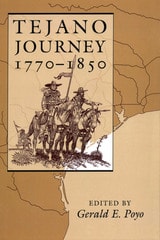
Tejano Journey, 1770-1850
Edited by Gerald E. Poyo
University of Texas Press, 1996
A century before the arrival of Stephen F. Austin's colonists, Spanish settlers from Mexico were putting down roots in Texas. From San Antonio de Bexar and La Bahia (Goliad) northeastward to Los Adaes and later Nacogdoches, they formed communities that evolved their own distinct "Tejano" identity.
In Tejano Journey, 1770-1850, Gerald Poyo and other noted borderlands historians track the changes and continuities within Tejano communities during the years in which Texas passed from Spain to Mexico to the Republic of Texas and finally to the United States. The authors show how a complex process of accommodation and resistance—marked at different periods by Tejano insurrections, efforts to work within the political and legal systems, and isolation from the mainstream—characterized these years of changing sovereignty.
While interest in Spanish and Mexican borderlands history has grown tremendously in recent years, the story has never been fully told from the Tejano perspective. This book complements and continues the history begun in Tejano Origins in Eighteenth-Century San Antonio, which Gerald E. Poyo edited with Gilberto M. Hinojosa.
Telling Complexions
The Nineteenth-Century English Novel and the BlushMary Ann O Farrell
Duke University Press, 1997
Although the blush was used to tell the truth of character and body, O’Farrell shows how it is actually undermined as a stable indicator of character in novels such as Pride and Prejudice, Persuasion, North and South, and David Copperfield. She reveals how these writers then moved on in search of other bodily indicators of mortification and desire, among them the swoon, the scar, and the blunder. Providing unique and creative insights into the constructedness of the body and its semiotic play in literature and in culture, Telling Complexions includes parallel examples of the blush in contemporary culture and describes ways that textualized bodies are sometimes imagined to resist the constraints imposed by such construction.
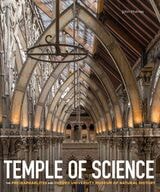
Temple of Science
The Pre-Raphaelites and Oxford University Museum of Natural HistoryJohn Holmes
Bodleian Library Publishing, 2020
Tenderfoot in Colorado
Richard Baxter Townshend
University Press of Colorado, 1968
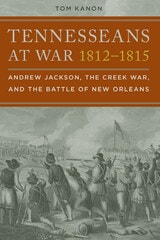
Tennesseans at War, 1812–1815
Andrew Jackson, the Creek War, and the Battle of New OrleansTom Kanon
University of Alabama Press, 2014
Although frequently discussed as separate military conflicts, the War of 1812 against Great Britain and the Creek War against Native Americans in the territory that would become Alabama were part of the same forceful projection of growing American power. Success in both wars won for America security against attack from abroad and vast tracks of new land in “the Old Southwest.” In Tennesseans at War, 1812–1815, Tom Kanon explains the role Tennesseans played in these changes and how they remade the south.
Because it was a landlocked frontier state, Tennessee’s economy and security depended heavily upon the river systems that traversed the region; some, like the Tennessee River, flowed south out of the state and into Native American lands. Tennesseans of the period perceived that gaining mastery of these waterways formed an urgent part of their economic survival and stability.
The culmination of fifteen years’ research, Kanon’s work draws on state archives, primary sources, and eyewitness accounts, bringing the information in these materials together for first time. Not only does he narrate the military campaigns at the heart of the young nation’s expansion, but he also deftly recalls the economic and social pressures and opportunities that encouraged large numbers of Tennesseans to leave home and fight. He expertly weaves these themes into a cohesive narrative that culminates in the vivid military victories of the War of 1812, the Creek War, and the legendary Battle of New Orleans—the victory that catapulted Tennessee’s citizen-soldier Andrew Jackson to the presidency.
Expounding on the social roles and conditions of women, slaves, minorities, and Native Americans in Tennessee, Kanon also brings into focus the key idea of the “home front” in the minds of Tennesseans doing battle in Alabama and beyond. Kanon shows how the goal of creating, strengthening, and maintaining an ordered society permeated the choices and actions of the American elites on the frontiers of the young nation.
Much more than a history of Tennesseans or the battles they fought in Alabama, Tennesseans at War, 1812–1815, is the gripping story of a pivotal turning point in the history of the young American republic.
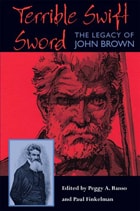
Terrible Swift Sword
The Legacy of John BrownPeggy A. Russo
Ohio University Press, 2005
More than two centuries after his birth and almost a century and a half after his death, the legendary life and legacy of John Brown go marching on. Variously deemed martyr, madman, monster, terrorist, and saint, he remains one of the most controversial figures in America’s history. Brown’s actions in Kansas and in Harpers Ferry, West Virginia, were major catalysts for the American Civil War, and continue today to evoke praise or condemnation.
Through the prisms of history, literature, psychology, criminal justice, oral history, African American studies, political science, film studies, and anthropology, Terrible Swift Sword offers insights not only into John Brown’s controversial character and motives but also into the nature of a troubled society before, during, and after the Civil War. The contributors discuss reasons why Brown’s contemporaries supported him, analyze Brown’s behavior and his depiction in literature, and examine the iconography and mythology surrounding him.
The interdisciplinary focus brought by editors Peggy A. Russo and Paul Finkelman makes this collection unique. Terrible Swift Sword: The Legacy of John Brown will appeal to a broad audience of readers interested in this turbulent moment in American history.
Territorial Ambition
Land and Society in Arkansas, 1800-1840S. Charles Bolton
University of Arkansas Press, 2020
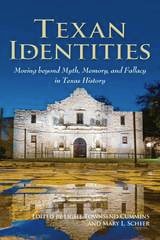
Texan Identities
Moving beyond Myth, Memory, and Fallacy in Texas HistoryLight Townsend Cummins
University of North Texas Press, 2016
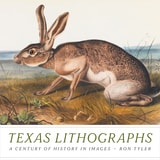
Texas Lithographs
A Century of History in ImagesRon Tyler
University of Texas Press, 2023
2024 Ewell L. Newman Book Award, American Historical Print Collectors Society
2024 Kate Broocks Bates Award for Historical Research, Texas State Historical Association
2024 TCU Texas Book Prize, Friends of the TCU Library and the TCU Press
2024 Kempner Family Book Prize—Nonfiction,The Philosophical Society of Texas
A stunning and comprehensive collection of lithographs from 1818 to 1900 Texas.
Westward expansion in the United States was deeply intertwined with the technological revolutions of the nineteenth century, from telegraphy to railroads. Among the most important of these, if often forgotten, was the lithograph. Before photography became a dominant medium, lithography—and later, chromolithography—enabled inexpensive reproduction of color illustrations, transforming journalism and marketing and nurturing, for the first time, a global visual culture. One of the great subjects of the lithography boom was an emerging Euro-American colony in the Americas: Texas.
The most complete collection of its kind—and quite possibly the most complete visual record of nineteenth-century Texas, period—Texas Lithographs is a gateway to the history of the Lone Star State in its most formative period. Ron Tyler assembles works from 1818 to 1900, many created by outsiders and newcomers promoting investment and settlement in Texas. Whether they depict the early French colony of Champ d’Asile, the Republic of Texas, and the war with Mexico, or urban growth, frontier exploration, and the key figures of a nascent Euro-American empire, the images collected here reflect an Eden of opportunity—a fairy-tale dream that remains foundational to Texans’ sense of self and to the world’s sense of Texas.
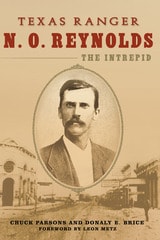
Texas Ranger N. O. Reynolds, the Intrepid
Chuck Parsons
University of North Texas Press, 2014
Texas in the Confederacy
An Experiment in Nation BuildingClayton E. Jewett
University of Missouri Press, 2002

Text/Politics in Island Southeast Asia
Essays in InterpretationD.M. Roskies
Ohio University Press, 1993
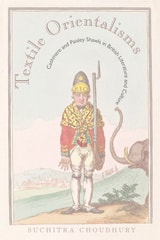
Textile Orientalisms
Cashmere and Paisley Shawls in British Literature and CultureSuchitra Choudhury
Ohio University Press, 2023
Thackeray
The Sentimental CynicLambert Ennis
Northwestern University Press, 1950
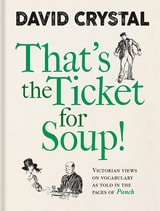
That’s the Ticket for Soup!
Victorian Views on Vocabulary as Told in the Pages of PunchDavid Crystal
Bodleian Library Publishing, 2020
The vocabulary of the past is always intriguing, especially when it is no longer used in modern English. Many of the words and phrases that were popular in Victorian England may sound foreign today, but looking to original sources and texts can yield fascinating insight, especially when we see how vocabulary was pilloried by the satirists of the day.
In That’s the Ticket for Soup!, the renowned language expert David Crystal returns to the pages of Punch magazine, England’s widely read satirical publication. Crystal has pored through the pages of Punch between its first issue in 1841 and the death of Queen Victoria in 1901 and extracted the articles and cartoons that poked fun at the jargon of the day. Here we have Victorian high and low society, with its fashionable and unfashionable slang, its class awareness on display in the vocabulary of steam engines, motor cars, and other products of the Industrial Revolution. Then, as now, people had strong feelings about the flood of new words entering English. Swearing, new street names, and the many borrowings from French provoked continual irritation and mockery, as did the Americanisms increasingly encountered in the British press. In addition to these entertaining examples, Crystal includes commentary on the context of the times and informative glossaries. This original and amusing collection reveals how many present-day feelings about words can be traced to the satire of a century ago.

The "Counterfeit" Man
The True Story of the Boorn-Colvin Murder CaseGerald W. McFarland
University of Massachusetts Press, 1993
The "Vanity of the Philosopher"
From Equality to Hierarchy in Post-Classical EconomicsSandra J. Peart and David M. Levy
University of Michigan Press, 2005
Here, Peart and Levy tackle the issues of racism, eugenics, hierarchy, and egalitarianism in classical economics and take a broad view of classical economics' doctrine of human equality. Responding to perennial accusations from the left and the right that the market economy has created either inequality or too much equality, the authors trace the role of the eugenics movement in pulling economics away from the classical economist's respect for the individual toward a more racist view at the turn of the century.
The "Vanity of the Philosopher" reveals the consequences of hierarchy in social science. It shows how the "vanity of the philosopher" has led to recommendations that range from the more benign but still objectionable "looking after" paternalism, to overriding preferences, and, in the extreme, to eliminating purportedly bad preferences. The authors suggest that an approach that abstracts from difference and presumes equal competence is morally compelling.
"People in the know on intellectual history and economics await the next book from Peart and Levy with much the same enthusiasm that greets a new Harry Potter book in the wider world. This book delivers the anticipated delights big time!"
-William Easterly, Professor of Economics and Africana Studies, NYU, and non-resident Senior Fellow, Center for Global Development
"In their customary idiosyncratic manner, Sandra Peart and David Levy reexamine the way in which the views of classical economists on equality and hierarchy were shifted by contact with scholars in other disciplines, and the impact this had on attitudes towards race, immigration, and eugenics. This is an imaginative and solid work of scholarship, with an important historical message and useful lessons for scholars today."
-Stanley Engerman, John Munro Professor of Economics and Professor of History, University of Rochester
Sandra J. Peart, Professor of Economics at Baldwin-Wallace College, has published articles on utilitarianism, the methodology of J. S. Mill, and the transition to neoclassicism. This is her fourth book. David M. Levy is Professor of Economics at George Mason University and Director of the Center for Study of Public Choice. This is his third book.
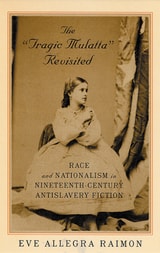
The 'Tragic Mulatta' Revisited
Race and Nationalism in Nineteenth-Century Antislavery FictionEve Allegra Raimon
Rutgers University Press, 2004
Since its inception, the United States has been intensely preoccupied with interracialism. The concept is embedded everywhere in our social and political fabric, including our sense of national identity. And yet, in both its quantitative and symbolic forms, interracialism remains an extremely elusive phenomenon, causing policy makers and census boards to wrangle over how to delineate it and, on an emblematic level, stirring intense emotions from fear to fascination.
In The “Tragic Mulatta” Revisited, Eve Allegra Raimon focuses on the mixed-race female slave in literature, arguing that this figure became a symbolic vehicle for explorations of race and nation—both of which were in crisis in the mid-nineteenth century. At this time, judicial, statutory, social, and scientific debates about the meaning of racial difference (and intermixture) coincided with disputes over frontier expansion, which were never merely about land acquisition but also literally about the “complexion” of that frontier. Embodying both northern and southern ideologies, the “amalgamated” mulatta, the author argues, can be viewed as quintessentially American, a precursor to contemporary motifs of “hybrid” and “mestizo” identities.
Where others have focused on the gendered and racially abject position of the “tragic mulatta,” Raimonreconsiders texts by such central antislavery writers as Lydia Maria Child, William Wells Brown, Harriet Beecher Stowe, and Harriet Wilson to suggest that the figure is more usefully examined as a way of understanding the volatile and shifting interface of race and national identity in the antebellum period.
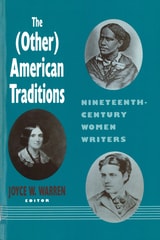
The (Other) American Traditions
Nineteenth-Century Women WritersWarren, Joyce W
Rutgers University Press, 1993
The American literary canon has been the subject of debate and change for at least a decade. As women writers and writers of color are being rediscovered and acclaimed, the question of whether they are worthy of inclusion remains open.
The (Other) American Traditions brings together for the first time in one place, essays on individual writers and traditions that begin to ask the harder questions. How do we talk about these writers once we get beyond the historical issues? How is their work related to their male counterparts? How is it similar: how is it different? Are differences related to gender or race or class? How has the selection of books in the literary canon (Melville, Hawthorne, Emerson, and James) led to a definition of the American tradition that was calculated to exclude women? Do we need a new critical vocabulary to discuss these works? Should we stop talking about a tradition and begin to talk about many traditions? How did black American women writers develop strategies for speaking out when they were doubly in jeopardy of being ignored as blacks and as women? The volume offers irrefutable proof that the writers, the critics who work on their texts, all these questions, and the expansion of the canon matter very much indeed.
Contributors: Nina Baym, Deborah Carlin, Joanne Dobson, Josephine Donovan, Judith Fetterley, Frances Smith Foster, Susan K. Harris, Karla F.C. Holloway, Paul Lauter, Diane Lichtenstein, Carla L. Peterson, Carol J. Singley, Jane Tompkins, Joyce W. Warren and Sandra A. Zagarell.
The Absent Man
The Narrative Craft of Charles W. ChesnuttCharles Duncan
Ohio University Press, 1998
As the first African-American fiction writer to achieve a national reputation, Ohio native Charles W. Chesnutt (1858–1932) in many ways established the terms of the black literary tradition now exemplified by such writers as Toni Morrison, Alice Walker, and Charles Johnson.
Following the highly autobiographical nonfiction produced by Frederick Douglass, Harriet Jacobs, and other slave narrative writers, Chesnutt’s complex, multi-layered short fiction transformed the relationship between African-American writers and their readers. But despite generous praise from W. D. Howells and other important critics of his day, and from such prominent readers as William L. Andrews, Henry Louis Gates, Jr., and Eric Sundquist in ours, Chesnutt occupies a curiously ambiguous place in American literary history.
In The Absent Man, Charles Duncan demonstrates that Chesnutt’s uneasy position in the American literary tradition can be traced to his remarkable narrative subtlety. Profoundly aware of the delicacy of his situation as a black intellectual at the turn of the century, Chesnutt infused his work with an intricate, enigmatic artistic vision that defies monolithic or unambiguously political interpretation, especially with regard to issues of race and identity that preoccupied him throughout his career.
In this first book-length study of the innovative short fiction, Duncan devotes particular attention to elucidating these sophisticated narrative strategies as the grounding for Chesnutt’s inauguration of a tradition of African-American fiction.
The Accidental Diarist
A History of the Daily Planner in AmericaMolly A. McCarthy
University of Chicago Press, 2013
The Afric-American Picture Gallery
William J. Wilson's Speculative Museum of Black ArtBritt Rusert
Duke University Press, 2026
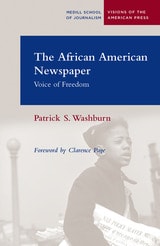
The African American Newspaper
Voice of FreedomPatrick S. Washburn
Northwestern University Press, 2006
In March of 1827 the nation's first black newspaper appeared in New York City—to counter attacks on blacks by the city's other papers. From this signal event, The African American Newspaper traces the evolution of the black newspaper—and its ultimate decline--for more than 160 years until the end of the twentieth century.
The book chronicles the growth of the black press into a powerful and effective national voice for African Americans during the period from 1910 to 1950--a period that proved critical to the formation and gathering strength of the civil rights movement that emerged so forcefully in the following decades. In particular, author Patrick S. Washburn explores how the Pittsburgh Courier and the Chicago Defender led the way as the two most influential black newspapers in U.S. history, effectively setting the stage for the civil rights movement's successes. Washburn also examines the numerous reasons for the enormous decline of black newspapers in influence and circulation in the decades immediately following World War II. His book documents as never before how the press's singular accomplishments provide a unique record of all areas of black history and a significant and shaping affect on the black experience in America.
The African Transformation of Western Medicine and the Dynamics of Global Cultural Exchange
David Baronov
Temple University Press, 2010
The book analyzes biomedicine as a complex and dynamic sociocultural form, the conceptual premises of which make it necessarily subject to ongoing change and development as it travels the globe. David Baronov captures the complexities of this cultural exchange by using world-systems analysis in a way that places global cultural processes on equal footing with political and economic processes. In doing so, he both allows the story of Africa’s transformation of “Western” biomedicine to be told and offers new insights into the capitalist world system.
The Afterlife of Sympathy
Reading American Literary Realism in the Wake of "Uncle Tom’s Cabin"Faye Halpern
University of Massachusetts Press, 2024
Literary realism rose to prominence in postbellum America with what the realists heralded as artful and accurate depictions of the world. Realism is thought to have replaced sentimentality—an earlier mode of writing the realists disparaged, which has often been seen as antithetical to realism. Literary scholar Faye Halpern challenges this apparent binary by uncovering how and why William Dean Howells, Mark Twain, Henry James, Constance Fenimore Woolson, and Charles Chesnutt incorporated sentimental elements into their most famous works.
With its distinctively narratological approach, The Afterlife of Sympathy offers a more rhetorical way to understand sentimentality and assess the ethical complexity of sympathy. Halpern demonstrates how sentimentality enables authors to form intimate relationships between their characters and readers to supplement the critical distance that realist writers otherwise celebrate and that has remained a key value in literary studies today. In reassessing American literary realism, Halpern seeks not only to understand why these writers adopted sentimental techniques but to provide insight into contemporary arguments in literary studies about critical distance and sympathetic identification.
The Afterlives of Specimens
Science, Mourning, and Whitman's Civil WarLindsay Tuggle
University of Iowa Press, 2017
Grounded in archival discoveries, Afterlives traces the origins of nineteenth-century America’s preservation compulsion, illuminating the influences of botanical, medical, spiritualist, and sentimental discourses on Whitman’s work. Tuggle unveils previously unrecognized connections between Whitman and the leading “medical men” of his era, such as the surgeon John H. Brinton, founding curator of the Army Medical Museum, and Silas Weir Mitchell, the neurologist who discovered phantom limb syndrome. Remains from several amputee soldiers whom Whitman nursed in the Washington hospitals became specimens in the Army Medical Museum.
Tuggle is the first scholar to analyze Whitman’s role in medically memorializing the human cadaver and its abandoned parts.
The Age and Stage of George L. Fox, 1825-1877
1825-1877Laurence Senelick
University of Iowa Press, 1999
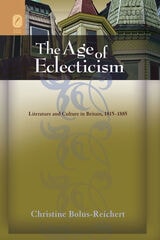
The Age of Eclecticism
Literature and Culture in Britain, 1815–1885Christine Bolus-Reichert
The Ohio State University Press, 2009
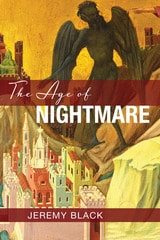
The Age of Nightmare
The Gothic and British Culture, 1750–1900Jeremy Black
St. Augustine's Press, 2022
Black's understanding of the Gothic writer is a remarkable contribution to the legacy of British literature and the novel at large. Once again, in Black thoroughness meets fidelity and the reader is overcome with his own insights into the period on the merit of Black's efforts.
In The Weight of Words Series, Black is devoted to the preservation of the memory of British literary genius, and in so doing he is carving out a niche for himself. As in the Gothic novel where landscapes give quarter to influences that seem to interact with the human fates that freely wander in, reading Black is an experience of suddenly finding oneself in possession of an education, and his allure takes a cue from the horrific Gothic tempt.
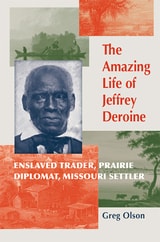
The Amazing Life of Jeffrey Deroine
Enslaved Trader, Prairie Diplomat, and Missouri SettlerGreg Olson
University of Missouri Press, 2026
Though scraps of his life are still present in the historical record, specifics have proven elusive. Still, it is important to tell Deroine’s life story, as it gives us a look both into the life of an enslaved man and the struggles of a free person of color in pre-Civil War Missouri. His life spanned a critical point in the history of the state, and he seems to have spent most of it at the very heart of the action.
Though not well known, the story of Jeffrey Deroine is significant because it illustrates the nuanced intersectionality of lives on the American frontier. Deroine was a man of both French and African descent who lived much of his life among Indigenous people. Born into slavery, he became a free person of color who was a businessman, owned property, and enslaved others. His life defied expectations and stereotypes, and a consideration of it allows us to better understand the history of Missouri and the West.
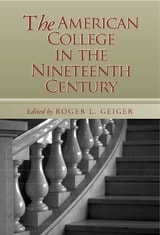
The American College in the Nineteenth Century
Roger L. Geiger
Vanderbilt University Press, 2000
At the end of the eighteenth century, just eighteen colleges existed in the United States, with an average enrollment of fewer than seventy. One hundred years later, over 450 American colleges and universities boasted enrollments up more than one hundredfold. The role of educational institutions in the life of the nation had been utterly transformed.
As the bridge between the two eras, the nineteenth-century college has been among the most controversial subjects in the history of American higher education. While earlier historians portrayed the "old-time" college as an impediment to modernization, later scholars affirmed the broad role of the colleges in the education of the American people.
The American College in the Nineteenth Century combines the best recent scholarship with an interpretive introduction to provide a fresh view of the development of American colleges. The contributors consider these institutions within four new contexts: first, the dramatic transformation in the college students' experience from oppressive discipline to relative freedom; second, the regional variations among the developing American colleges (for example, a South dominated by state colleges, a Midwest by denominational schools); third, the revolution in the century's third quarter as colleges became multipurpose institutions; and fourth, universities that became dominant by the end of the century, incorporating rather than displacing the colleges.
Innovative in its examination of the nature and function of these uniquely American institutions, The American College in the Nineteenth Century is a vital addition to the scholarship of the period.
Contributors: David B. Potts, Leon Jackson, Julie Ann Bubolz, Michael Sugrue, James Findlay, Margaret A. Nash, Peter Dobkin Hall, James Turner, Paul Bernard, and Willard J. Pugh.
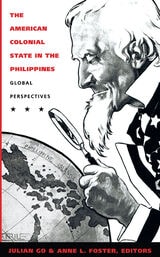
The American Colonial State in the Philippines
Global PerspectivesJulian Go and Anne L. Foster, eds.
Duke University Press, 2003
Written by social scientists and historians, these essays investigate various aspects of American colonial government through comparison with and contextualization within colonial regimes elsewhere in the world—from British Malaysia and Dutch Indonesia to Japanese Taiwan and America's other major overseas colony, Puerto Rico. Contributors explore the program of political education in the Philippines; constructions of nationalism, race, and religion; the regulation of opium; connections to politics on the U.S. mainland; and anticolonial resistance. Tracking the complex connections, circuits, and contests across, within, and between empires that shaped America's colonial regime, The American Colonial State in the Philippines sheds new light on the complexities of American imperialism and turn-of-the-century colonialism.
Contributors. Patricio N. Abinales, Donna J. Amoroso, Paul Barclay, Vince Boudreau, Anne L. Foster, Julian Go, Paul A. Kramer