Results by title
8642 books match the query '20th Century' and 1764 start with t
THE ECONOMICS OF FANTASY
RAPE IN TWENTIETH-CENTURY LITERATURESharon Stockton
The Ohio State University Press, 2006
It is important to make clear that the genre of rape story studied here presumes a white masculine subject and a white feminine object. Stockton makes the case that the aestheticized rape narrative reveals particular things about the way white masculinity represents itself. Plotting violent sexual fantasy on the grid of economic concerns locates masculine agency in relation to an explicitly contingent material system of power, value, and order. It is in this way that The Economics of Fantasy discloses the increased desperation with which the body has been made to carry ideology under systems of advanced capitalism.
THE NOVEL AND THE MENAGERIE
TOTALITY, ENGLISHNESS, AND EMPIREKURT KOENIGSBERGER
The Ohio State University Press, 2007
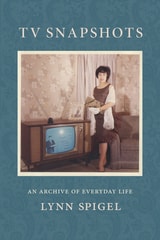
TV Snapshots
An Archive of Everyday LifeLynn Spigel
Duke University Press, 2022
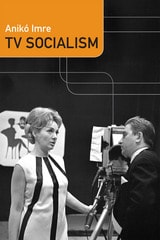
TV Socialism
Anikó Imre
Duke University Press, 2016
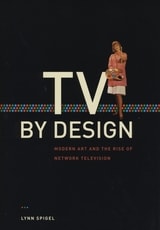
TV by Design
Modern Art and the Rise of Network TelevisionLynn Spigel
University of Chicago Press, 2008
Whereas most histories of television focus on the way older forms of entertainment were recycled for the new medium, Lynn Spigel shows how TV was instrumental in introducing the public to the latest trends in art and design. Abstract expressionism, pop art, art cinema, modern architecture, and cutting-edge graphic design were all mined for staging techniques, scenic designs, and an ever-growing number of commercials. As a result, TV helped fuel the public craze for trendy modern products, such as tailfin cars and boomerang coffee tables, that was vital to the burgeoning postwar economy. And along with influencing the look of television, many artists—including Eero Saarinen, Ben Shahn, Saul Bass, William Golden, and Richard Avedon—also participated in its creation as the networks put them to work designing everything from their corporate headquarters to their company cufflinks.
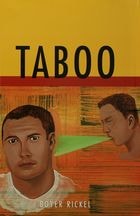
Taboo
Boyer Rickel
University of Wisconsin Press, 1999
An impressionistic memoir offers images of a life in progress, including scenes from Boyer Rickel’s rural Tempe, Arizona, childhood in the 1950s; his relationship with a physically shrinking father; his eccentric teenage friendships; his growing awareness of his sexuality among young, Hispanic gays; and a trip through Italy with his lover. A personal book, but also wholly universal, Taboo investigates the way one breaks through taboos and becomes a self-realized adult.
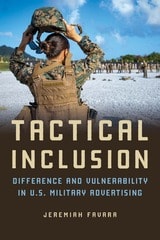
Tactical Inclusion
Difference and Vulnerability in U.S. Military AdvertisingJeremiah Favara
University of Illinois Press, 2024
Compelling and eye-opening, Tactical Inclusion combines original analysis with personal experience to chart advertising’s role in building the all-volunteer military.

Take Two
Adapting the Contemporary American Novel to FilmBarbara Tepa Lupack
University of Wisconsin Press, 1994
Different in its complexities from the classic novels of Dickens, London, and Tolstoy to which earlier filmmakers turned, the contemporary American novel poses a real challenge to the filmmaker, who must translate its occasionally unfilmable essence for a new audience. Take Two closely analyzes the adaptations of ten such works: Catch-22, One Flew over the Cuckoo's Nest, Slaughterhouse-Five, Being There, The World According to Garp, Sophie’s Choice, The Color Purple, Ironweed, Tough Guys Don't Dance, and Billy Bathgate.
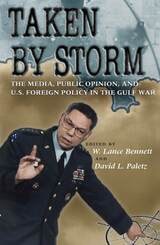
Taken by Storm
The Media, Public Opinion, and U.S. Foreign Policy in the Gulf WarEdited by W. Lance Bennett and David L. Paletz
University of Chicago Press, 1994
Tracing the flow of news, public opinion, and policy decisions from Sadam Hussein's rise to power in 1979, to the Iraqi invasion of Kuwait, through the outbreak and conclusion of the war, the contributors look at how the media have become key players in the foreign policy process. They examine the pre-war media debate, news coverage during and after the war, how the news-gathering process shaped the content of the coverage, and the media's effect on public opinion and decision makers. We see what goes on behind the scenes in the high tech world of political communication, and are confronted by troubling questions about the ways the government managed coverage of the war and captured journalists at their own news game.
Taken by Storm also examines more general patterns in post-Cold war journalism and foreign policy, particularly how contemporary journalistic practices determine whose voices and what views are heard in foreign policy coverage. At stake are the reactions of a vast media audience and the decision of government officials who see both the press and the public and key elements of the policy game.
The first book to fully integrate our understanding of the news business, public opinion, and government action, Taken by Storm transcends the limits of the Gulf War to illuminate the complex relationship between the media, the public, and U.S. foreign policy in the late twentieth century.
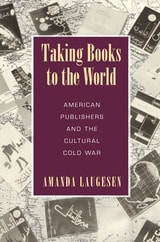
Taking Books to the World
American Publishers and the Cultural Cold WarAmanda Laugesen
University of Massachusetts Press, 2017
In Taking Books to the World, Amanda Laugesen tells the story of this purposeful enterprise, demonstrating the mix of goodwill and political drive behind its efforts to create modern book industries in developing countries. Examining the project through a clarifying lens, she reveals the ways Franklin's work aligned with cultural currents, exposing the imperial beliefs, charitable hopes, and intellectual reasoning behind this global experiment.
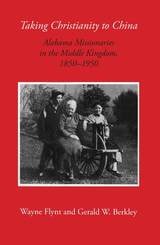
Taking Christianity to China
Alabama Missionaries in the Middle Kingdom, 1850–1950Wayne Flynt and Gerald W. Berkley
University of Alabama Press, 2017
A study of faith, cultural exchange, and the Alabama missionaries who helped shape the story of Christianity in modern China.
Beginning early in the 19th century, the American missionary movement made slow headway in China. Alabamians became part of that small beachhead. After 1900 both the money and personnel rapidly expanded, peaking in the early 1920s. By the 1930s many American denominations became confused and divided over the appropriateness of the missionary endeavor. Secular American intellectuals began to criticize missionaries as meddling do-gooders trying to impose American Evangelicalism on a proud, ancient culture.
By examining the lives of 47 Alabama missionaries who served in China between 1850 and 1950, Flynt and Berkley reach a different conclusion. Although Alabama missionaries initially fit the negative description of Americans trying to superimpose their own values and beliefs on "heathen," they quickly learned to respect Chinese civilization. The result was a new synthesis, neither entirely southern nor entirely Chinese. Although previous works focus on the failure of Christianity to change China, this book focuses on the degree to which their service in China changed Alabama missionaries. And the change was profound.
In their consideration of 47 missionaries from a single state--their call to missions, preparation for service in China, living, working, contacts back home, cultural clashes, political views, internal conflicts, and gender relations--the authors suggest that the efforts by Baptist, Methodist, and Presbyterian missionaries from Alabama were not the failure judged by many historians. In fact, the seeds sown in the hundred years before the Communist revolution in 1950 seem to be reaping a rich harvest in the declining years of the 20th century, when the number of Chinese Christians is estimated by some to be as high as one hundred million.
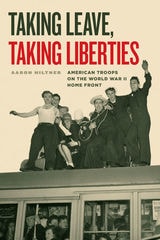
Taking Leave, Taking Liberties
American Troops on the World War II Home FrontAaron Hiltner
University of Chicago Press, 2020
With unsettling clarity, Aaron Hiltner reveals what American troops really did on the home front. While GIs are imagined to have spent much of the war in Europe or the Pacific, before the run-up to D-Day in the spring of 1944 as many as 75% of soldiers were stationed in US port cities, including more than three million who moved through New York City. In these cities, largely uncontrolled soldiers sought and found alcohol and sex, and the civilians living there—women in particular—were not safe from the violence fomented by these de facto occupying armies. Troops brought their pocketbooks and demand for “dangerous fun” to both red-light districts and city centers, creating a new geography of vice that challenged local police, politicians, and civilians. Military authorities, focused above all else on the war effort, invoked written and unwritten legal codes to grant troops near immunity to civil policing and prosecution.
The dangerous reality of life on the home front was well known at the time—even if it has subsequently been buried beneath nostalgia for the “greatest generation.” Drawing on previously unseen military archival records, Hiltner recovers a mostly forgotten chapter of World War II history, demonstrating that the war’s ill effects were felt all over—including by those supposedly safe back home.

Taking Part
A Twentieth-Century LifeRobert Josephy
University of Iowa Press, 1993
Taking Their Word
Literature and the Signs of Central AmericaArturo Arias
University of Minnesota Press, 2007
Central Americans are one of the largest Latino population groups in the United States. Yet, Arturo Arias argues, the cultural production of Central Americans remains little known to North Americans.
In Taking Their Word, Arias complicates notions of the cultural production of Central America, from Mexico in the North to Panama in the South. He charts the literature of Central America’s liberation struggles of the 1970s and 1980s, its transformation after peace treaties were signed, the emergence of a new Maya literature that decenters Latin American literature written in Spanish, and the rise and fall of testimonio. Arias demonstrates that Central America and its literature are marked by an indigenousness that has never before been fully theorized or critically grasped. Never one to avoid controversy, Arias proffers his views of how the immigration of Central Americans to North America has changed the cultural topography of both zones.
With this groundbreaking work, Arias establishes the importance of Central American literature and provides a frame for future studies of the region’s culture.
Arturo Arias is director of Latin American studies at the University of Redlands. He is the author of six novels in Spanish and editor of The Rigoberta Menchú Controversy (Minnesota, 2001).

Taking the Risk Out of Democracy
Corporate Propaganda versus Freedom and LibertyAlex Carey
University of Illinois Press, 1995
Tales Out of School
Selected InterviewsRobert Creeley
University of Michigan Press, 1994
Tales of Forgotten Chicago
Richard C. Lindberg
Southern Illinois University Press, 2020
Tales of Forgotten Chicago contains twenty-one fascinating, little-known stories about a great city and its people. Richard C. Lindberg has dug deeply to reveal lost historical events and hidden gems from Chicago’s past.
Spanning the Civil War through the 1960s, the volume showcases forgotten crimes, punishments, and consequences: poisoned soup that nearly killed three hundred leading citizens, politicians, and business and religious leaders; a woman in showbiz and her street-thug husband whose checkered lives inspired a 1955 James Cagney movie; and the first police woman in Chicago, hired as a result of the senseless killing of a young factory girl in a racially tinged case of the 1880s.
Also included are tales of industry and invention, such as America’s first automobile race, the haunting of a wealthy Gilded Age manufacturer’s mansion, and the identity of the telephone’s rightful inventor. Chapters on the history of early city landmarks spotlight the fight to save Lakefront Park and how “Lucky” Charlie Weeghman’s north side baseball park became Wrigley Field. Other chapters explore civic, cultural, and political happenings: the great Railroad Fairs of 1948 and 1949; Richard J. Daley’s revival of the St. Patrick’s Day parade; political disrupter Lar “America First” Daly; and the founding of the Special Olympics in Chicago by Anne Burke and others. Finally, some are just wonderful tales, such asa touching story about the sinking of Chicago's beloved Christmas tree ship.
Engrossing and imaginative, this collection opens new windows into the past of the Windy City.
Tales of Southeast Asia’s Jazz Age
Filipinos, Indonesians and Popular Culture, 1920-1936Peter Keppy
National University of Singapore Press, 2019
This artistic era was marked by experimentation and adaption, and this was reflected in both Borromeo’s and Riboet’s styles. They were pioneering cultural brokers who dealt in hybrids. They were adept at combining high art and banal entertainment, tradition and modernity, and the foreign and the local.
Leaning on cultural studies and the work on cosmopolitanism and modernity by Henry Jenkins and Joel Kahn, Peter Keppy examines pop culture at this time as a contradictory social phenomenon. He challenges notions of Southeast Asia’s popular culture as lowbrow entertainment created by elites and commerce to manipulate the masses, arguing instead that audiences seized on this popular culture to channel emancipatory activities, to articulate social critique, and to propagate an inclusive nationalism without being radically anticolonial.
Tales of Violence
Dutch Management of Information in the Indonesian War of Independence, 1945-1949Remco Raben
Amsterdam University Press, 2027
How were the violence of war and the numerous excesses between 1945-1949 discussed, concealed, passed on, manipulated, and used politically? What did Dutch, colonial, and Indonesian politicians and administrators know about the nature of the actions of their own and enemy troops?
Why did investigations into specific scandals grind to a halt or were their outcomes hidden from the public? What did those in charge do with their knowledge and how did communications influence public support for warfare? The authors argue that the way the war in Indonesia has long been viewed has its origins partly in the language and manipulation of information during the conflict.
Tales of an Eastern Port
The Singapore Novellas of Joseph ConradJoseph Conrad
National University of Singapore Press, 2023
In the 1880s, Joseph Conrad spent three extended stints in the colonial port city of Singapore, while working on ships around the region. Over the next thirty years, he would return to this place many times in his writing. Singapore is the principal, if sometimes obscured, port of call in Conrad’s fiction; it is the center of overlapping networks, colonial and commercial, religious and literary. His characters travel to upriver Borneo and to Bangkok, to Shanghai and to Sydney, and yet they tend to return to Singapore.
This volume pairs for the first time two Conrad novellas that start in Singapore: The End of the Tether and The Shadow-Line.Together they provide a fleeting portrait of the developing city, through narrators who are uneasy with the trappings and workings of the colonial enterprise. These stories have renewed relevance as part of global modernist and oceanic literatures, and reading them now helps recall one chapter in Singapore’s long history as a vital site of cultural exchange, one that harbors and inspires distinctive storytelling traditions.
Talk about Sex
How Sex Ed Battles Helped Ignite the RightJanice M. Irvine
Temple University Press, 2023
“Must reading for scholars, sexuality researchers, activists, and public policy and public health planners engaged in efforts to promote education on sex, sexually transmitted diseases, and HIV infection prevention for adolescents in schools.”—JAMA
Talk about Sex is a rich social history about the political transformations, cultural dynamics, and emotional rhetorical strategies that helped the right wing manufacture controversies on the local and national levels in the United States. Although the emergence of a politicized Christian Right is commonly dated at the mid-seventies, with the founding of groups like the Moral Majority, Talk about Sex tells the story of a powerful right-wing Christian presence in politics a full decade earlier. These activists used inflammatory sexual rhetoric—oftentimes deceptive and provocative—to capture the terms of public debate, galvanize voters, and reshape the culture according to their own vision.
This 20th Anniversary Edition includes a new preface and epilogue by the author that examines current controversies over public education on sexuality, gender, and race.
Demonstrating how the right wing draws on the cultural power of sexual shame and fear to build a political movement, Talk about Sex explores the complex entanglements of sexual knowledge, politics, and discourses.
Talking All Morning
Robert Bly
University of Michigan Press, 1980

Talking History
Seminar Culture at the Institute of Historical Research, 1921–2021Edited by David Manning
University of London Press, 2024
Talking History provides a defence of the seminar as a central element in historians' teaching, research and sense of community. Covering a range of the IHR’s long-running seminar series, which are differentiated by historical period, region and/or theme, the book presents the seminars as a local, national and international hub for scholarship that emerges from and is sustained by the ongoing learning practices of historians as scholars and people. Talking History bears witness to a seminar culture of evolving, multifarious synergies between teaching, researching and learning, historiography and participation — intertextual, interpersonal, intergenerational and intercultural. Viewed as such, the seminars constitute a living tradition, stimulating and incorporating dynamic change over time to contribute not just to the development of historiography but intellectual life more generally, often in conversation with major political events and cultural phenomena.
This original and significant book therefore reflects upon, and gives further expression to, the ongoing evolution of historical research and its role in wider society today.
Talking Together
Letters of David Ignatow, 1946-1990David Ignatow; Selected, Edited and Introduced by Gary Pacernick
University of Alabama Press, 1992
The letters of David Ignatow reveal the poet in “company” with a community of writers as he shares with them the details and nuances of his everyday existence: the key acts of friendship and enmity, of good news and bad, of struggle, work, success, and failure that comprise a life devoted to making art. The letters also serve as a vehicle for Ignatow to express his views on a whole range of issues from writing, teaching, and editing poetry, to his visions of the self, death and the cosmos. But the key is “company”—the support system that helps sustain the poet and that enables him to help others.
One of the many things we may learn from the letters of David Ignatow is the power of the individual to affect another’s life, to help sustain and even change it.
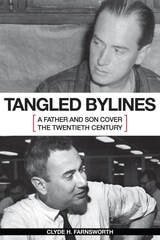
Tangled Bylines
A Father and Son Cover the Twentieth CenturyClyde H. Farnsworth
University of Missouri Press, 2017
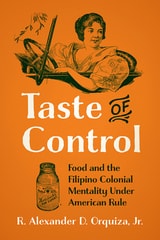
Taste of Control
Food and the Filipino Colonial Mentality under American RuleR. Alexander D. Orquiza, Jr.
Rutgers University Press, 2020
Winner of the 2021 Gourmand Awards, Asian Section & Culinary History Section
Filipino cuisine is a delicious fusion of foreign influences, adopted and transformed into its own unique flavor. But to the Americans who came to colonize the islands in the 1890s, it was considered inferior and lacking in nutrition. Changing the food of the Philippines was part of a war on culture led by Americans as they attempted to shape the islands into a reflection of their home country.
Taste of Control tells what happened when American colonizers began to influence what Filipinos ate, how they cooked, and how they perceived their national cuisine. Food historian René Alexander D. Orquiza, Jr. turns to a variety of rare archival sources to track these changing attitudes, including the letters written by American soldiers, the cosmopolitan menus prepared by Manila restaurants, and the textbooks used in local home economics classes. He also uncovers pockets of resistance to the colonial project, as Filipino cookbooks provided a defense of the nation’s traditional cuisine and culture.
Through the topic of food, Taste of Control explores how, despite lasting less than fifty years, the American colonial occupation of the Philippines left psychological scars that have not yet completely healed, leading many Filipinos to believe that their traditional cooking practices, crops, and tastes were inferior. We are what we eat, and this book reveals how food culture served as a battleground over Filipino identity.
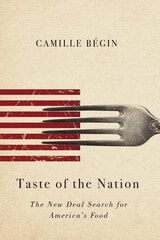
Taste of the Nation
The New Deal Search for America's FoodCamille Bégin
University of Illinois Press, 2016
Camille Begin shapes a cultural and sensory history of New Deal-era eating from the FWP archives. From "ravioli, the diminutive derbies of pastries, the crowns stuffed with a well-seasoned paste" to barbeque seasoning that integrated "salt, black pepper, dried red chili powder, garlic, oregano, cumin seed, and cayenne pepper" while "tomatoes, green chili peppers, onions, and olive oil made up the sauce", Begin describes in mouth-watering detail how Americans tasted their food. They did so in ways that varied, and varied widely, depending on race, ethnicity, class, and region. Begin explores how likes and dislikes, cravings and disgust operated within local sensory economies that she culls from the FWP’s vivid descriptions, visual cues, culinary expectations, recipes and accounts of restaurant meals. She illustrates how nostalgia, prescriptive gender ideals, and racial stereotypes shaped how the FWP was able to frame regional food cultures as "American."
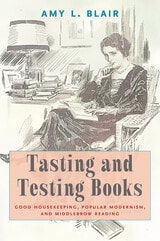
Tasting and Testing Books
Good Housekeeping, Popular Modernism, and Middlebrow ReadingAmy L. Blair
University of Massachusetts Press, 2024
A CHOICE 2025 Outstanding Academic Title
Honorable Mention, 2023-2024 Research Society of American Periodicals Book Prize
In its February 1926 issue, Good Housekeeping magazine introduced a column for its approximately one million subscribers called “Tasting and Testing Books.” The column’s author, Emily Newell Blair, would go on to produce ninety-one reading advice columns for the magazine between 1926 and 1934. During this period, Good Housekeeping became the most widely circulated periodical in the United States, doubling its circulation to over two million copies. Much of its popularity stemmed from its intensive promotion of its Seal of Approval for a variety of products, which brought consumers to it for utilitarian purposes. With her focus on regular books, Blair distinguished herself from highbrow literary critics, many of whom have been objects of study as High Modernists. She offered advice to help middle-class women readers make their own choices about the best books in which to invest time and money, rather than dictating what they should or should not read. She aligns herself with the average subscriber, outside the book publishing and reviewer industries, focusing on books that would now be termed middlebrow reading.
Blair’s time at Good Housekeeping covers the era from the heights of the “Roaring Twenties” to the depths of the Great Depression, and her recommendations offer a window into the uses of middlebrow reading during this period of dramatic economic and social shifts. Tasting and Testing Books argues that the consumer-first message of Good Housekeeping infused Blair’s advice column and validated a new attitude of proudly middlebrow pleasure reading in the mid-twentieth century. These columns shed new light on the reading lives of too-often overlooked women, often living outside of urban centers and away from elite literary circles, and present Emily Newell Blair, who strongly identified with her readers as a truly democratic tastemaker.
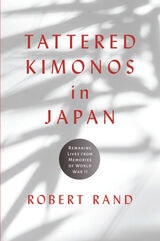
Tattered Kimonos in Japan
Remaking Lives from Memories of World War IIRobert Rand
University of Alabama Press, 2024
Examines Japan’s war generation—Japanese men and women who survived World War Two and rebuilt their lives from memories of that conflict.
Since John Hersey’s Hiroshima—the classic account, published in 1946, of the aftermath of the atomic bombing of that city—very few books have examined the meaning and impact of World War II through the eyes of Japanese men and women who survived that conflict. Tattered Kimonos in Japan does just that: It is an intimate journey into contemporary Japan from the perspective of the generation of Japanese soldiers and civilians who survived World War II, by a writer whose American father and Japanese father-in-law fought on opposite sides of the conflict.
The author, a former NPR senior editor, is Jewish, and he approaches the subject with the sensibilities of having grown up in a community of Holocaust survivors. Mindful of the power of victimhood, memory, and shared suffering, he travels across Japan, including Hiroshima and Nagasaki, meeting a compelling group of men and women whose lives, even now, are defined by the trauma of war, and by lingering questions of responsibility and repentance for Japan’s wartime aggression.
The image of a tattered kimono from Hiroshima is the thread that drives the narrative arc of this emotional story about a writer’s encounter with history, inside the Japan of his father’s generation, on the other side of his father’s war. This is a book about history with elements of family memoir. It offers a fresh and truly unique perspective for readers interested in World War II, Japan, or Judaica; readers seeking cross-cultural journeys; and readers intrigued by Japanese culture, particularly the kimono.
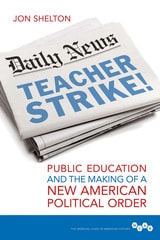
Teacher Strike!
Public Education and the Making of a New American Political OrderJon Shelton
University of Illinois Press, 2017
As Shelton shows, many working- and middle-class whites sided with corporate interests in seeing themselves as society's only legitimate, productive members. This alliance increasingly argued that public employees and the urban poor took but did not give. Drawing on a wealth of research ranging from school board meetings to TV news reports, Shelton puts readers in the middle of fraught, intense strikes in Newark, St. Louis, and three other cities where these debates and shifting attitudes played out. He also demonstrates how the labor actions contributed to the growing public perception of unions as irrelevant or even detrimental to American prosperity. Foes of the labor movement, meanwhile, tapped into cultural and economic fears to undermine not just teacher unionism but the whole of liberalism.
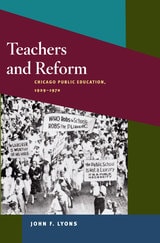
Teachers and Reform
Chicago Public Education, 1929-70John F. Lyons
University of Illinois Press, 2007
Examining teachers' unions and public education from the bottom up, Lyons shows how the CTU and its members sought rigorous reforms. A combination of political action, public relations campaigns, and community alliances helped the CTU to achieve better salaries and benefits, increased school budgets, reformed curricula, and greater equality for women within the public education system. But its agenda was also constrained by internal divisions over race and gender and by ongoing external disputes with the school administration, politicians, and business and civic organizations.
Detailed and informed by rich interviews, Teachers and Reform: Chicago Public Education, 1929-1970 tells the story of how committed union members effected changes to public education and to local politics that still benefit Chicago teachers, students, and the city today.
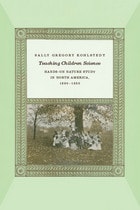
Teaching Children Science
Hands-On Nature Study in North America, 1890-1930Sally Gregory Kohlstedt
University of Chicago Press, 2010
In the early twentieth century, a curriculum known as nature study flourished in major city school systems, streetcar suburbs, small towns, and even rural one-room schools. This object-based approach to learning about the natural world marked the first systematic attempt to introduce science into elementary education, and it came at a time when institutions such as zoos, botanical gardens, natural history museums, and national parks were promoting the idea that direct knowledge of nature would benefit an increasingly urban and industrial nation.
The definitive history of this once pervasive nature study movement, TeachingChildren Science emphasizes the scientific, pedagogical, and social incentives that encouraged primarily women teachers to explore nature in and beyond their classrooms. Sally Gregory Kohlstedt brings to vivid life the instructors and reformers who advanced nature study through on-campus schools, summer programs, textbooks, and public speaking. Within a generation, this highly successful hands-on approach migrated beyond public schools into summer camps, afterschool activities, and the scouting movement. Although the rich diversity of nature study classes eventually lost ground to increasingly standardized curricula, Kohlstedt locates its legacy in the living plants and animals in classrooms and environmental field trips that remain central parts of science education today.
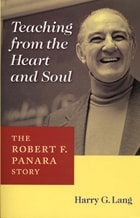
Teaching from the Heart and Soul
The Robert F. Panara StoryHarry G. Lang
Gallaudet University Press, 2007
The Sixth Volume in the Deaf Lives Series
Robert F. Panara lost his hearing from spinal meningitis in 1931 at the age of ten. However, he could read and write, and with his friends’ help, Bob (as he was known), made it through high school. His new solitude created a new passion – reading, reading, and reading. The stage was set for the emergence of one of the great deaf educators in modern time, a life fully captured in Harry G. Lang’s Teaching from the Heart and Soul: The Robert F. Panara Story.
Bob Panara’s many achievements began after his discovery of Gallaudet College in the 1940s. There, he wrote “The Significance of the Reading Problem,” which first expressed his belief that teaching “comes from the heart and soul.” The article secured him his first job at the New York School for the Deaf in White Plains. Bob returned to teach at Gallaudet College from 1948 until 1965, when he left to help found the National Technical Institute for the Deaf (NTID) and the National Theatre of the Deaf (NTD) — all in the same year. He continued to expand arts and literature at NTID until his retirement in 1987.
Bob Panara’s genius resides in the people he inspired with his vivacious teaching style. He believed ardently in involving students, that they should “be the book.” Former students tell story after story about his fabulous interpretations of drama and poetry, a legacy confirmed by his own story in Teaching from the Heart and Soul.
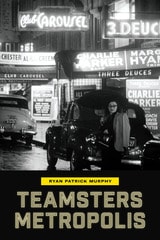
Teamsters Metropolis
Ryan Patrick Murphy
University of Michigan Press, 2025
Teamsters Metropolis argues that the union achieved unprecedented organizing success in the immediate postwar period precisely because its members defied bourgeois cultural standards. They wore overly flamboyant clothes, instigated jarringly violent confrontations, used aliases, extorted money, flouted the law, and often blended friendship, sex, and love in a way that challenged the boundaries of heteronormativity. Perhaps no one exemplified this freedom more than Jimmy Hoffa, who delivered better pay and worker conditions to marginal workers while also using coercive tactics, embezzling money, and colluding with the Mafia. Rather than impeding the union’s growth, unruly organizing, illicit business techniques, and dissident cultural practices appealed to prospective members and offered an opportunity to circumvent some of the suburban regulations, helping the International Brotherhood of Teamsters become the largest U.S. union of the mid-twentieth century.
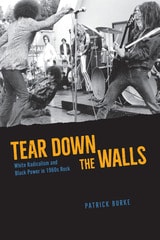
Tear Down the Walls
White Radicalism and Black Power in 1960s RockPatrick Burke
University of Chicago Press, 2021
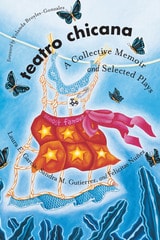
Teatro Chicana
A Collective Memoir and Selected PlaysEdited by Laura E. Garcia, Sandra M. Gutierrez, and Felicitas Nuñez
University of Texas Press, 2008
Winner, Susan Koppelman Award, Best Edited Volume in Women's Studies in Popular and American Culture, 2008
The 1970s and 1980s saw the awakening of social awareness and political activism in Mexican-American communities. In San Diego, a group of Chicana women participated in a political theatre group whose plays addressed social, gender, and political issues of the working class and the Chicano Movement. In this collective memoir, seventeen women who were a part of Teatro de las Chicanas (later known as Teatro Laboral and Teatro Raíces) come together to share why they joined the theatre and how it transformed their lives. Teatro Chicana tells the story of this troupe through chapters featuring the history and present-day story of each of the main actors and writers, as well as excerpts from the group's materials and seven of their original short scripts.
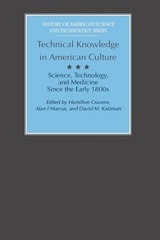
Technical Knowledge in American Culture
Science, Technology, and Medicine Since the Early 1800sEdited by Hamilton Cravens, Alan I Marcus, and David M. Katzman
University of Alabama Press, 1996
Addresses the relationships between what modern-day experts say to each other and to their constituencies
Technical Knowledge in American Culture is an interdisciplinary volume that brings together leading historians to investigate how science, technology, and medicine have shaped—and been shaped by—American intellectual and cultural traditions since the early nineteenth century. Rather than treating science and technology simply as products of social forces, the contributors examine them as forms of knowledge with their own internal logics, debates, and authority structures. The book asks a central question: how do experts—scientists, engineers, physicians—communicate with one another and with broader audiences, and how does that communication influence American society?
The volume is organized into three major sections, each anchored in a distinct historical moment: Part I: The Rise of Democratic Culture, 1800–1870; Part II: The Age of Hierarchy, 1870–1920; and Part III: Toward an Infinity of Dimensions (20th Century). Across its essays, the book argues that technical knowledge is not just a tool of progress—it is a cultural force shaped by communication, interpretation, and authority. By focusing on case studies rather than sweeping narratives, the volume reveals how expertise operates in practice and how it influences broader debates about science, society, and public trust.
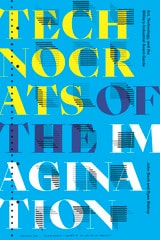
Technocrats of the Imagination
Art, Technology, and the Military-Industrial Avant-GardeJohn Beck and Ryan Bishop
Duke University Press, 2020
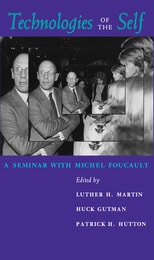
Technologies of the Self
A Seminar with Michel FoucaultLuther H. Martin
University of Massachusetts Press, 1988
Shortly before his death in 1984, Michel Foucault spoke of an idea for a new book on “technologies of the self.” He described it as “composed of different papers about the self. . . . about the role of reading and writing in constituting the self. . . . and so on.” The book Foucault envisioned was based on a faculty seminar on “Technologies of the Self,” originally presented at the University of Vermont in the fall of 1982. This volume is a partial record of that seminar.
In many ways, Foucault's project on the self was the logical conclusion to his historical inquiry over twenty-five years into insanity, deviancy, criminality, and sexuality. Because Foucault died before he completed the revisions of his seminar presentations, this volume includes a careful transcription instead...as a prolegomenon to that unfinished task.
Foucault was a French philosopher, historian of ideas, social theorist, philologist and literary critic.
This volume was edited by Luther H. Martin, Huck Gutman, and Patrick H. Hutton.
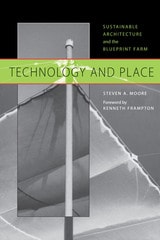
Technology and Place
Sustainable Architecture and the Blueprint FarmBy Steven A. Moore
University of Texas Press, 2001
Developing "sustainable" architectural and agricultural technologies was the intent behind Blueprint Farm, an experimental agricultural project designed to benefit farm workers displaced by the industrialization of agriculture in the Rio Grande Valley of Texas. Yet, despite its promise, the very institutions that created Blueprint Farm terminated the project after just four years (1987-1991).
In this book, Steven Moore demonstrates how the various stakeholders' competing definitions of "sustainability," "technology," and "place" ultimately doomed Blueprint Farm. He reconstructs the conflicting interests and goals of the founders, including Jim Hightower and the Texas Department of Agriculture, Laredo Junior College, and the Center for Maximum Potential Building Systems, and shows how, ironically, they unwittingly suppressed the self-determination of the very farm workers the project sought to benefit. From the instructive failure of Blueprint Farm, Moore extracts eight principles for a regenerative architecture, which he calls his "nonmodern manifesto."
Technology and the Historian
Transformations in the Digital AgeAdam Crymble
University of Illinois Press, 2021
Historians have seen their field transformed by the digital age. Research agendas, teaching and learning, scholarly communication, the nature of the archive—all have undergone a sea change that in and of itself constitutes a fascinating digital history. Yet technology's role in the field's development remains a glaring blind spot among digital scholars.
Adam Crymble mines private and web archives, social media, and oral histories to show how technology and historians have come together. Using case studies, Crymble merges histories and philosophies of the field, separating issues relevant to historians from activities in the broader digital humanities movement. Key themes include the origin myths of digital historical research; a history of mass digitization of sources; how technology influenced changes in the curriculum; a portrait of the self-learning system that trains historians and the problems with that system; how blogs became a part of outreach and academic writing; and a roadmap for the continuing study of history in the digital era.
Technomodern Poetics
The American Literary Avant-Garde at the Start of the Information AgeTodd F. Tietchen
University of Iowa Press, 2018
After the second World War, the term “technology” came to signify both the anxieties of possible annihilation in a rapidly changing world and the exhilaration of accelerating cultural change. Technomodern Poetics examines how some of the most well-known writers of the era described the tensions between technical, literary, and media cultures at the dawn of the Digital Age. Poets and writers such as Allen Ginsberg, Charles Olson, Jack Kerouac, and Frank O’Hara, among others, anthologized in Donald Allen’s iconic The New American Poetry, 1945–1960, provided a canon of work that has proven increasingly relevant to our technological present. Elaborating on the theories of contemporaneous technologists such as Norbert Wiener, Claude Shannon, J. C. R. Licklider, and a host of noteworthy others, these artists express the anxieties and avant-garde impulses they wrestled with as they came to terms with a complex array of issues raised by the dawning of the nuclear age, computer-based automation, and the expansive reach of electronic media. As author Todd Tietchen reveals, even as these writers were generating novel forms and concerns, they often continued to question whether such technological changes were inherently progressive or destructive.
With an undeniable timeliness, Tietchen’s book is sure to appeal to courses in modern English literature and American studies, as well as among fans of Beat writers and early Cold War culture.
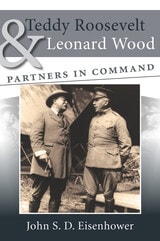
Teddy Roosevelt and Leonard Wood
Partners in CommandJohn S. D. Eisenhower
University of Missouri Press, 2013
Theodore Roosevelt was a man of wide interests, strong opinions, and intense ambition for both himself and his country. When he met Leonard Wood in 1897, he recognized a kindred spirit. Moreover, the two men shared a zeal for making the United States an imperial power that would challenge Great Britain as world leader. For the remainder of their lives, their careers would intertwine in ways that shaped the American nation.
When the Spanish American War came, both men seized the opportunity to promote the goals of American empire. Roosevelt resigned as assistant secretary of the navy in William McKinley’s administration to serve as a lieutenant colonel of the Rough Riders, a newly organized volunteer cavalry. Wood, then a captain in the medical corps and physician to McKinley, was promoted to colonel and given charge of the unit.
Roosevelt later took over command of the Rough Riders. In the Battle of San Juan Hill, he led it in a charge up Kettle Hill that would end in victory for the American troops and make their daring commander a household name, a war hero, and, eventually, president of the United States.
At the Treaty of Paris in 1898, Spain ceded Cuba, Puerto Rico, Guam, and the Philippines to the United States. The next year, Wood became military governor of Cuba. He remained in the post until 1902. By that time Roosevelt was president. One of the major accomplishments of his administration was reorganization of the War Department, which the war with Spain had proved disastrously outdated. In 1909, when William Howard Taft needed a strong army chief of staff to enforce the new rules, he appointed Leonard Wood.
Both Wood and Roosevelt were strong proponents of preparedness, and when war broke out in Europe in August 1914, Wood, retired as chief of staff and backed by Roosevelt, established the “Plattsburg camps,” a system of basic training camps. When America entered the Great War, the two men’s foresight was justified, but their earlier push for mobilization had angered Woodrow Wilson, and both were denied the command positions they sought in Europe.
Roosevelt died in 1919 while preparing for another presidential campaign. Wood made a run in his place but was never taken seriously as a candidate. He retired from the army and spent the last seven years of his life as civilian governor of the Philippines.
It was a quiet end for two men who had been giants of their time. While their modernization of the army is widely admired, they were not without their critics. Roosevelt and Wood saw themselves as bold leaders but were regarded by some as ruthless strivers. And while their shared ambitions for the United States were tempered by a strong sense of duty, they could, in their certainty and determination, trample those who stood in their path. Teddy Roosevelt and Leonard Wood: Partners in Command is a revealing and long overdue look at the dynamic partnership of this fascinating pair and will be welcomed by scholars and military history enthusiasts alike.
Teenage Dreams
Girlhood Sexualities in the U.S. Culture WarsCharlie Jeffries
Rutgers University Press, 2022
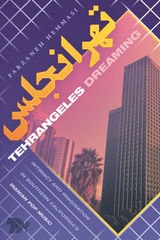
Tehrangeles Dreaming
Intimacy and Imagination in Southern California's Iranian Pop MusicFarzaneh Hemmasi
Duke University Press, 2020
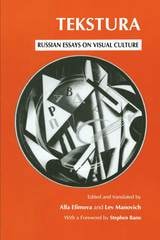
Tekstura
Russian Essays on Visual CultureEdited by Alla Efimova and Lev Manovich
University of Chicago Press, 1993
Taking its title from a Russian word that can refer to the 'texture" of life, painting, or writing, this anthology assembles thirteen key essays in art history and cultural theory by Russian-language writers. The essays erase boundaries between high and low, official and dissident, avant-garde and socialist realism, art and everyday life. Everything visual is deemed worthy of analysis, whether painting or propaganda banners, architecture or candy wrappers, mass celebrations or urban refuse.
Most of the essays appear here in English for the first time. The editors have selected works of the past twenty years by philosophers, literary critics, film scholars, and art historians. Also included are influential earlier essays by Mikhail Bakhtin, V. N. Voloshinov, and Sergei Eisenstein. Compiled for general readers and specialists alike, Tekstura is a valuable resource for anyone interested in Russian and Soviet cultural history or in new theoretical approaches to the visual.
Telecommunications and Empire
Jill Hills
University of Illinois Press, 2007
Jill Hills picks up from her pathbreaking study The Struggle for Control of Global Communication: The Formative Century to continue her examination of the political, technological, and economic forces at work in the global telecommunications market from World War II to the World Trade Organization agreement of 1997. In the late twentieth century, focus shifted from the creation and development of global communication markets to their intense regulation. The historical framework behind this control--where the market was regulated, by what institution, controlled by what power, and to whose benefit--masterfully complements Hills's analysis of power relations within the global communications arena.
Hills documents attempts by governments to direct, replace, and bypass international telecommunications institutions. As she shows, the results have offered indirect control over foreign domestic markets, government management of private corporations, and government protection of its own domestic communication market. Hills reveals that the motivation behind these powerful, regulatory efforts on person-to-person communication lies in the unmatched importance of communication in the world economy.
As ownership of communications infrastructure becomes more valuable, governments have scrambled to shape international guidelines. Hills provides insight into struggles between U.S. policymakers and the rest of the world, illustrating the conflict between a growing telecommunications empire and sovereign states that are free to implement policy changes. Freshly detailing the interplay between U.S. federal regulation and economic power, Hills fosters a deep understanding of contemporary systems of power in global communications.
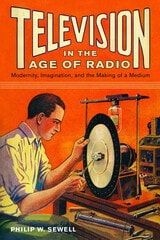
Television in the Age of Radio
Modernity, Imagination, and the Making of a MediumSewell, Philip W
Rutgers University Press, 2014
Television existed for a long time before it became commonplace in American homes. Even as cars, jazz, film, and radio heralded the modern age, television haunted the modern imagination. During the 1920s and 1930s, U.S. television was a topic of conversation and speculation. Was it technically feasible? Could it be commercially viable? What would it look like? How might it serve the public interest? And what was its place in the modern future? These questions were not just asked by the American public, but also posed by the people intimately involved in television’s creation. Their answers may have been self-serving, but they were also statements of aspiration. Idealistic imaginations of the medium and its impact on social relations became a de facto plan for moving beyond film and radio into a new era.
In Television in the Age of Radio, Philip W. Sewell offers a unique account of how television came to be—not just from technical innovations or institutional struggles, but from cultural concerns that were central to the rise of industrial modernity. This book provides sustained investigations of the values of early television amateurs and enthusiasts, the fervors and worries about competing technologies, and the ambitions for programming that together helped mold the medium.
Sewell presents a major revision of the history of television, telling us about the nature of new media and how hopes for the future pull together diverse perspectives that shape technologies, industries, and audiences.

Television, History, and American Culture
Feminist Critical EssaysMary Beth Haralovich and Lauren Rabinovitz, eds.
Duke University Press, 1999
The essays collected here focus on women in front of, behind, and on the TV screen, as producers, viewers, and characters. Using feminist and historical criticism, the contributors investigate how television has shaped our understanding of gender, power, race, ethnicity, and sexuality from the 1950s to the present. The topics range from the role that women broadcasters played in radio and early television to the attempts of Desilu Productions to present acceptable images of Hispanic identity, from the impact of TV talk shows on public discourse and the politics of offering viewers positive images of fat women to the negotiation of civil rights, feminism, and abortion rights on news programs and shows such as I Spy and Peyton Place.
Innovative and accessible, this book will appeal to those interested in women’s studies, American studies, and popular culture and the critical study of television.
Contributors. Julie D’Acci, Mary Desjardins, Jane Feuer, Mary Beth Haralovich, Michele Hilmes, Moya Luckett, Lauren Rabinovitz, Jane M. Shattuc, Mark Williams
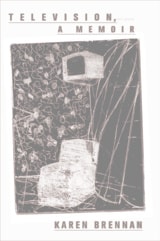
Television, a memoir
Karen Brennan
Four Way Books, 2022
Television, a memoir is a hybrid collection of autobiographical pieces, tragi-comic in spirit, that depict a woman’s life evolving through time and culture in fragmentary glimpses. Indeterminate in genre, Television is a fluid text that sometimes reads as poetry, sometimes as prose, while exploring classism, ableism, and feminism in a world defined by the advent of new media and, for the author, a privilege that often felt suffocating. Working structurally and thematically, television creates conceptual mileposts in the memoir, with certain programs and cultural references corresponding to specific eras in the author’s past, but it also gestures at an existential modality — the experience of a televisual life, the performative arrangements of nuclear families and neighborhoods, the periodic events and dramas of an adolescence watched from outside oneself.