Results by title
51 books match the query 'Agency' and 8 start with t
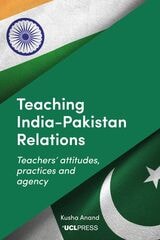
Teaching India–Pakistan Relations
Teachers' Attitudes, Practices and AgencyKusha Anand
University College London, 2023
The rivalry between India and Pakistan began with the British withdrawal from the British Indian Empire in 1947 and the sudden partition of India immediately afterward. Seventy-five years later, it remains powerful. While the countries share a long history and considerable socio-cultural affinity, relations since Partition have been marked by three wars, constant border skirmishes, and a deep distrust that permeates both societies. In each, teaching about those relations is weighted with political and cultural significance, and research shows that curricula have been used deliberately to shape the understanding of new generations.
This book explores the attitudes and pedagogical decision-making of teachers in India and Pakistan when teaching India–Pakistan relations. Situating teachers in the context of reformed textbooks and curriculums in both countries that explicitly advocate critical thinking and social cohesion, Kusha Anand explores how far teachers have enacted these changes in their classrooms. What she finds is that while there is progress towards the stated goals, teachers in both countries face pressures from the interests of school and state, and often miss opportunities to engage with multiple perspectives and stereotypes in their classrooms.
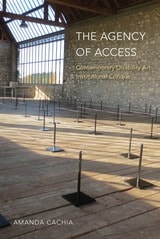
The Agency of Access
Contemporary Disability Art & Institutional CritiqueAmanda Cachia
Temple University Press, 2025
Showcasing artwork by contemporary disabled artists Corban Walker, Christine Sun Kim, and Carmen Papalia, among others, The Agency of Access inscribes contemporary disability art in the broad canon of contemporary art, where the artistic past is regarded differently.
Cachia is an outspoken advocate for artists living with sensory disabilities. She understands disabled artists’ experiences in both the world and the gallery. The artists she has curated make bold, astonishing, and compelling statements about interdependency, care, and the ways in which our environment affects disabled, ill, and immunocompromised bodies.

The Fear of Child Sexuality
Young People, Sex, and AgencySteven Angelides
University of Chicago Press, 2019
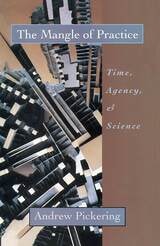
The Mangle of Practice
Time, Agency, and ScienceAndrew Pickering
University of Chicago Press, 1995
Andrew Pickering offers a new approach to the unpredictable nature of change in science, taking into account the extraordinary number of factors—social, technological, conceptual, and natural—that interact to affect the creation of scientific knowledge. In his view, machines, instruments, facts, theories, conceptual and mathematical structures, disciplined practices, and human beings are in constantly shifting relationships with one another—"mangled" together in unforeseeable ways that are shaped by the contingencies of culture, time, and place.
Situating material as well as human agency in their larger cultural context, Pickering uses case studies to show how this picture of the open, changeable nature of science advances a richer understanding of scientific work both past and present. Pickering examines in detail the building of the bubble chamber in particle physics, the search for the quark, the construction of the quarternion system in mathematics, and the introduction of computer-controlled machine tools in industry. He uses these examples to address the most basic elements of scientific practice—the development of experimental apparatus, the production of facts, the development of theory, and the interrelation of machines and social organization.
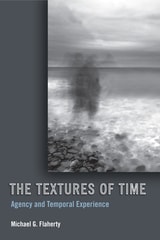
The Textures of Time
Agency and Temporal ExperienceAuthored by Michael G. Flaherty
Temple University Press, 2010
What do we mean when we say, "I made the time pass more quickly," or, "I’m creating some ‘me’ time"? InThe Textures of Time, Michael Flaherty examines how we alter or customize our experience of time. His detailed analysis reveals different strategies we use to try to manipulate time, further describing and defining those strategies within six discrete time categories: Duration, Frequency, Sequence, Timing, Allocation, and Taking Time.
Using in-depth interviews and analyzing responses through a sociological lens, Flaherty unearths folk theories and practices, which he calls "time work," that construct circumstances in order to provoke desired forms of temporal experience. As such, time is not justinflicted on us; rather, its various textures result from our intervention, and/or from our efforts to create different forms of temporal experience. These first-person accounts also highlight ongoing tensions between agency and determinism in social groups. Ultimately, in keeping with his central thesis, Flaherty's lucid prose make this book a quick read, and the strategies he describes reveal the profound and inventive ways we "manage the clock."
These Kids
Identity, Agency, and Social Justice at a Last Chance High SchoolKysa Nygreen
University of Chicago Press, 2013
Time for Childhoods
Young Poets and Questions of AgencyRachel Conrad
University of Massachusetts Press, 2020
Time for Childhoods presents a selection of striking twentieth-and twenty-first-century American poetry written by young people, and highlights how young poets imagined and shaped time for their own poetic purposes. Through close engagement with archival materials, as well as select interviews and correspondence with adult mentors, Conrad discerns how young writers figured social realities and political and racial injustices, and discusses what important advocates such as Gwendolyn Brooks and June Jordan can teach us about supporting the agency of young poets. This essential study demonstrates that young poets have much to contribute to ongoing conversations about time and power.

Tropicopolitans
Colonialism and Agency, 1688–1804Srinivas Aravamudan
Duke University Press, 1999
“Tropicalization” is the central metaphor of this analysis, a term that incorporates both the construction of various dynamic tropes by which the colonized are viewed and the site of the study, primarily the tropics. Tropicopolitans, then, are those people who bear and resist the representations of colonialist discourse. In readings that expose new relationships between literary representation and colonialism in the eighteenth century, Aravamudan considers such texts as Behn’s Oroonoko, Defoe’s Robinson Crusoe and Captain Singleton, Addison’s Cato, and Swift’s Gulliver’s Travels and The Drapier’s Letters. He extends his argument to include analyses of Johnson’s Rasselas, Beckford’s Vathek, Montagu’s travel letters, Equiano’s autobiography, Burke’s political and aesthetic writings, and Abbé de Raynal’s Histoire des deux Indes. Offering a radical approach to literary history, this study provides new mechanisms for understanding the development of anticolonial agency.
Introducing eighteenth-century studies to a postcolonial hermeneutics, Tropicopolitans will interest scholars engaged in postcolonial studies, eighteenth-century literature, and literary theory.