Results by title
87 books match the query 'Aging' and 18 start with t
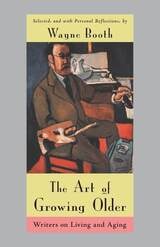
The Art of Growing Older
Writers on Living and AgingEdited by Wayne C. Booth
University of Chicago Press, 1996
"Funny . . . profound. . . . It is hard to resist the closing chapters, which celebrate the freedom from constraint and ambition, the permission to be crotchety, the joy of memory and perspective that come with age."—William March, Tampa Tribune
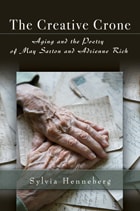
The Creative Crone
Aging and the Poetry of May Sarton and Adrienne RichSylvia Henneberg
University of Missouri Press, 2010
The Economic Effects of Aging in the United States and Japan
Edited by Michael D. Hurd and Naohiro Yashiro
University of Chicago Press, 1997
The most obvious effects will be on social programs such as public pension systems and the provision for medical needs of the elderly. But, the contributors demonstrate, aging will also affect markets for labor, capital, housing, and health care services. It will affect firms through their participation in the demand side of the labor market and through their provisions for pensions. And aging will influence saving rates, the rate of return on assets, the balance of payments, and, most likely, economic growth.
This volume will interest scholars and policy makers concerned with the economics of aging.
The Economics of Aging
Edited by David A. Wise
University of Chicago Press, 1988
The Economics of Aging presents results from an ongoing National Bureau of Economic Research project. Contributors consider the housing mobility and living arrangements of the elderly, their labor force participation and retirement, the economics of their health care, and their financial status. The goal of the research is to further our understanding both of the factors that determine the well-being of the elderly and of the consequences that follow from an increasingly older population with longer individual life spans. Each paper is accompanied by critical commentary.
The Essential Guide to Aging in the Twenty-First Century
Mind, Body, and BehaviorDonald H. Kausler, Barry C. Kausler & Jill A. Krupsaw
University of Missouri Press, 2007
For more than a decade, The Graying of America has helped thousands of middle-aged and senior citizens find their way through the thickets and thorns of growing old. Now greatly revised and expanded to include information gleaned from studies of the past five years, this third edition has been retitled to stress its ongoing purpose: conveying a wealth of commonsense information for general readers in nontechnical language.
The book is a storehouse of concise, useful information on the effects of aging on health, the mind, and behavior. Its 588 entries (including 172 new and 150 substantially revised) cover a broad spectrum of topics—from adjusting to retirement to grandparenting, sleep disorders to Alzheimer’s disease. All are directed to the average reader; all stress successful aging and how to accomplish it.
New entries cover such topics as the incidence and causes of frailty, the cognitive benefits of diversified activity, and findings of the Women’s Health Initiative. There is new information on matters like the effects of untreated hearing impairment on spouses and the impact of insufficient exposure to sunlight on sleep, plus new insight into what to look for in searching for a quality nursing home for a loved one.
Also included are results of recent studies on interventions that help to reduce age-related declines in mental and physical health, among them revelations that reports on age-related declines in memory have been skewed by testing errors. And with memory a concern for seniors fearful of declining mental agility, the book tells how to bypass memory problems—such as how to remember where you parked your car—and how physical exercise and challenging mental games can help reduce the risk of dementia. Other “how to avoid” entries offer ways to protect against eye fatigue in computer use, hip fractures when falling, and back injuries while lifting heavy objects.
No other book is so specifically geared to the challenges of how to reduce or even eliminate many of the problems associated with growing old. Aging in the Twenty-First Century can help seniors come to grips with their own aging process—and help younger adults understand what is happening to older family members.
The Evolution of Retirement
An American Economic History, 1880-1990Dora L. Costa
University of Chicago Press, 1998

The Graying of America
An Encyclopedia of Aging, Health, Mind, and Behavior (2d ed.)Donald H. Kausler and Barry C. Kausler
University of Illinois Press, 2001
Featuring nontechnical language, user-friendly indexes, and more than 150 new entries, the second edition covers new topics such as acupuncture, wheelchairs, adjusting to bifocals, preparing for traveling, improving communication with physicians, and avoiding eye strain in computer use. Among other updates are more detailed coverage of health problems including arthritis, diabetes, osteoporosis, and various kinds of cancer, as well as advice on reducing the stress of caring for a family member with Alzheimer's disease. In addition to discussing hundreds of common ailments and conditions, Kausler and Kausler provide constructive guidance on regular physical activity, mental stimulation, and other behaviors that promote "successful aging."
The Healing Body
Creative Responses to Illness, Aging, and AfflictionDrew Leder
Northwestern University Press, 2024
As we grapple with the impacts of an aging population, the millions who struggle with chronic pain and illness, and the unknown number of COVID survivors dealing with long-term impairment, our individual and collective trust in our bodies is shaken. How to adapt? And how to live well, even when medical cure is unavailable? In The Healing Body: Creative Responses to Illness, Aging, and Affliction, philosopher and medical doctor Drew Leder shows how the phenomenology of lived embodiment makes available a variety of existential healing responses to bodily breakdown. Leder also turns to socially marginalized groups—people who have been incarcerated and those deemed “elderly”—to explore how individuals creatively cope with societal as well as physical challenges.
This book forwards current phenomenological research on the body, pain and suffering, disability, and aging. It deeply engages with the legacies of continental philosophy while also drawing insights from the traditions of Hinduism, Buddhism, and Taoism. The Healing Body is a uniquely creative and refreshingly innovative contribution to contemporary philosophy, demonstrating the importance of the philosophical method to the wider culture.
The Long and the Short of It
The Science of Life Span and AgingJonathan Silvertown
University of Chicago Press, 2013
With The Long and the Short of It, biologist and writer Jonathan Silvertown offers readers a witty and fascinating tour through the scientific study of longevity and aging. Dividing his daunting subject by theme—death, life span, aging, heredity, evolution, and more—Silvertown draws on the latest scientific developments to paint a picture of what we know about how life span, senescence, and death vary within and across species. At every turn, he addresses fascinating questions that have far-reaching implications: What causes aging, and what determines the length of an individual life? What changes have caused the average human life span to increase so dramatically—fifteen minutes per hour—in the past two centuries? If evolution favors those who leave the most descendants, why haven’t we evolved to be immortal? The answers to these puzzles and more emerge from close examination of the whole natural history of life span and aging, from fruit flies, nematodes, redwoods, and much more.
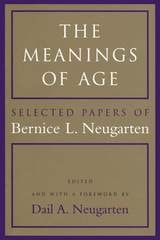
The Meanings of Age
Selected PapersBernice L. Neugarten
University of Chicago Press, 1996
Carefully edited by Dail Neugarten, each chapter presents the reader with Bernice Neugarten's original formulations on topics such as age norms and age constraints, the changing meanings of age, and age neutral social policy. Including four previously unpublished papers, The Meanings of Age will be of interest to scholars, students, and practitioners of psychology, education, law, medicine, social policy, and gerontology.
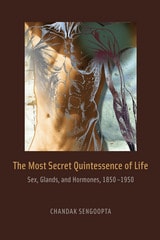
The Most Secret Quintessence of Life
Sex, Glands, and Hormones, 1850-1950Chandak Sengoopta
University of Chicago Press, 2006
Through a series of case studies drawn from Central Europe, the United States, and Britain, The Most Secret Quintessence of Life explores how the notion of sex hormones enabled scientists to remap the human body, encouraging hopes that glandular interventions could cure ills, malfunctions, and even social deviance in ways inconceivable to previous generations. Many of these dreams failed, but their history, Chandak Sengoopta shows, takes us into the very heart of scientific medicine, revealing how even its most arcane concerns are shaped by cultural preoccupations and anxieties.
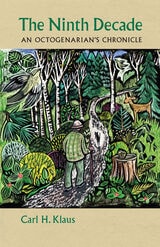
The Ninth Decade
An Octogenarian’s ChronicleKlaus, Carl H.
University of Iowa Press, 2021
The multi-year scope of his chronicle reveals the numerous physical and mental problems that arise during octogenarian life and how eighty-year-olds have dealt with those challenges. The Ninth Decade is a unique, first-hand source of information for anyone in their sixties, seventies, or eighties, as well as for persons devoted to care of the aged. Though the challenges of octogenarian life often require specialized care, The Ninth Decade also shows the pleasures of it to be so special as to have inspired Lillian Hellman’s paradoxical description of “longer life” as “the happy problem of our time.”
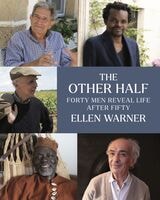
The Other Half
Forty Men Reveal Life After FiftyEllen Warner
Brandeis University Press, 2026
An insightful and intimate look at aging and masculinity that includes interviews and portraits of men from around the world.
What do men really think? From a taxi driver to a prince, a fishmonger to a professional boxer, The Other Half reveals the inner thoughts of men over fifty from different nationalities and different walks of life in their own words, illuminated by their portraits. Author and photojournalist Ellen Warner traveled the world to find out what men really think about love, work, and aging, speaking with well-known figures like film director James Ivory and journalist Bill Keller, as well as a philosopher, a chess grandmaster, a hair stylist, a financier, and more. Interviewing men from Colombia, Greece, Saudi Arabia, Sierra Leone, Sweden, and everywhere in between, Warner assembles a moving portrait of their reflections, insights, challenges, and hard-won triumphs.
A companion to The Second Half: Forty Women Reveal Life After Fifty, Warner’s latest book shares the diverse, vibrant experiences of men over fifty.
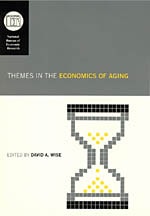
Themes in the Economics of Aging
Edited by David A. Wise
University of Chicago Press, 2001
This volume begins by looking at the implications of private and public personal retirement plans, focusing in particular on the impact of 401(k) programs on retirement strategies in light of potential social security reform and factors such as annuitization and on asset accumulation. Next, the often-observed relationship between health and wealth is dissected from two different perspectives and correlated with striking increases in health-care spending over the past two decades, despite the improved health of older populations. The volume concludes with an investigation of the retirement effects of various social security provisions in both U.S. and German systems.
This carefully developed collection expands the current investigative focus and broadens the dialogue on a rapidly growing area of social and economic concern.
There Was an Old Woman
Reflections on These Strange, Surprising, Shining YearsAndrea Carlisle
Oregon State University Press, 2023
In these personal essays, Carlisle looks for new ways to bring herself more fully to this time of life, such as daily walks with other women and connecting to the natural world that surrounds her houseboat on an Oregon river at the foot of a forest. She writes about experiences shared with many, if not most, older women: wondering at her body’s transformation, discovering new talents, caregiving, facing loss, tuning in to life patterns and drawing strength through understanding them, letting go (or not) of pieces of the past, and facing other changes large and small. Those curious about, approaching, or living in old age will find wisdom and insight in her unique perspective.
In a voice that rings with clarity, humor, humility, Carlisle shows us that Old Age is not another country where we can expect to find The Old Woman grimly waiting, but is instead an expansion of the borders in the country we’re most familiar with: ourselves.
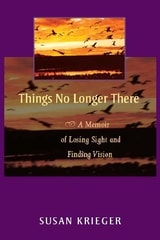
Things No Longer There
A Memoir of Losing Sight and Finding VisionSusan Krieger
University of Wisconsin Press, 2005
Krieger's touching memoir explores the ways that outer landscapes may change and sight may be lost, but inner visions persist, giving meaning, jarring the senses with a very different picture than what appears before the eyes. This book will reward both the general reader and those interested in disability studies, feminist ethnography, and lesbian studies.
Through Japanese Eyes
Thirty Years of Studying Aging in AmericaYohko Tsuji
Rutgers University Press, 2021
Through Japanese Eyes offers an ethnography of aging in America from a cross-cultural perspective based on a lengthy period of research. It illustrates how older Americans cope with the gap between the ideal (e.g., independence) and the real (e.g., needing assistance) of growing older, and the changes the author observed over thirty years of research.
Topics in the Economics of Aging
Edited by David A. Wise
University of Chicago Press, 1992