Results by title
61 books match the query 'Agribusiness' and 16 start with t

The American Farmer and the Export Market
Austin Dowell
University of Minnesota Press, 1934
The Cassava Transformation
Africa's Best-Kept SecretFelix I. Nweke
Michigan State University Press, 2002
Cassava is Africa's "poverty fighter" and second most important food crop. This book discusses Cassava's real role and traces research over the past 65 years. The "Cassava transformation" that is now underway in Africa has changed this traditional, reserve crop to a high-yield cash crop. However, Cassava is being neglected by governments and donor agencies because of myths and half-truths about its nutritional value and role in farm systems.
The City Man’s Guide to the Farm Problem
Willard W. Cochrane
University of Minnesota Press, 1965
The City Man's Guide to the Farm Problem was first published in 1965. Minnesota Archive Editions uses digital technology to make long-unavailable books once again accessible, and are published unaltered from the original University of Minnesota Press editions.
Few domestic questions are so controversial as the farm problem, yet the average city man finds it difficult to understand the basic issues involved. In this book Professor Cochrane describes for the layman the nature and causes of the commercial farm problem and the rural poverty problem and provides the basis for making informed judgments about these problems and their possible solutions. He analyzes the economic and political forces which are at work in the farm economy, explains the organization of modern agriculture, showing the unique structure of farming, and draws a vivid picture of the revolutionary developments which have taken place in agriculture. He discusses behavior patterns of farmers and consumers as they relate to the farm economy, and the role of government in the farm industry and in the lives of farmers.
The analysis and discussion make clear the reasons why the government is so deeply involved in farm issues and point up what will be needed in order to make some headway toward solutions of the problems. Professor Cochrane emphasizes that there is no perfect solution to the farm problem but he provides the information and analyses from which the reader can gain a better understanding of the issues.
Sixteen photographic illustrations show old and new methods of farming and types of equipment. There are also a number of charts, graphs, and tables.
Willard W. Cochrane is dean of international programs and a professor of agricultural economics at the University of Minnesota. He was director of agricultural economics in the U.S. Department of Agriculture and economic adviser to the Secretary of Agriculture from 1961 to 1964, and served as agricultural adviser to John F. Kennedy during the 1960 presidential campaign. He is the author also of Farm Prices: Myth and Reality.

The Collectivization of Agriculture in Communist Eastern Europe
Comparison and EntanglementsConstantin Iordachi
Central European University Press, 2014

The Cow with Ear Tag #1389
Kathryn Gillespie
University of Chicago Press, 2018
The Economics of Food Price Volatility
Edited by Jean-Paul Chavas, David Hummels, and Brian D. Wright
University of Chicago Press, 2014
The researchers who contributed to The Economics of Food Price Volatility address these and other questions. They examine the forces driving both recent and historical patterns in food price volatility, as well as the effects of various public policies in affecting this volatility. The chapters include studies of the links between food and energy markets, the impact of biofuel policy on the level and variability of food prices, and the effects of weather-related disruptions in supply. The findings shed light on the way price volatility affects the welfare of farmers, traders, and consumers.
The Intended and Unintended Effects of U.S. Agricultural and Biotechnology Policies
Edited by Joshua S. Graff Zivin and Jeffrey M. Perloff
University of Chicago Press, 2012
Using economic models and empirical analysis, this volume examines a wide range of agricultural and biofuel policy issues and their effects on American agricultural and related agrarian insurance markets. Beginning with a look at the distribution of funds by insurance programs—created to support farmers but often benefiting crop processors instead—the book then examines the demand for biofuel and the effects of biofuel policies on agricultural price uncertainty. Also discussed are genetically engineered crops, which are assuming an increasingly important role in arbitrating tensions between energy production, environmental protection, and the global food supply. Other contributions discuss the major effects of genetic engineering on worldwide food markets. By addressing some of the most challenging topics at the intersection of agriculture and biotechnology, this volume informs crucial debates.
The Marketing of Farm Products
Studies in the Organization of the Twin Cities MarketH. Price
University of Minnesota Press, 1927

The Master Cheesemakers of Wisconsin
James Norton and Becca Dilley
University of Wisconsin Press, 2009
Certification as a Master Cheesemaker typically takes almost fifteen years. An applicant must hold a cheesemaking license for at least ten years, create one or two chosen varieties of cheese for at least five years, take more than two years of university courses, consent to constant testing of their cheese and evaluation of their plant, and pass grueling oral and written exams to be awarded the prestigious title.
James Norton and Becca Dilley interviewed these dairy artisans, listened to their stories, tasted their cheeses, and explored the plants where they work. They offer here profiles of forty-three active Master Cheesemakers of Wisconsin, as well as a glossary of cheesemaking terms, suggestions of operations that welcome visitors for tours, tasting notes and suggested food pairings, and tasty nuggets (shall we say curds?) of information on everything to do with cheese.
The Nature of the Future
Agriculture, Science, and Capitalism in the Antebellum NorthEmily Pawley
University of Chicago Press, 2020
The nostalgic mist surrounding farms can make it hard to write their history, encrusting them with stereotypical rural virtues and unrealistically separating them from markets, capitalism, and urban influences. The Nature of the Future dispels this mist, focusing on a place and period of enormous agricultural vitality—antebellum New York State—to examine the largest, most diverse, and most active scientific community in nineteenth-century America. Emily Pawley shows how “improving” farmers practiced a science where conflicting visions of the future landscape appeared and evaporated in quick succession. Drawing from US history, environmental history, and the history of science, and extensively mining a wealth of antebellum agricultural publications, The Nature of the Future reveals how improvers transformed American landscapes and American ideas of expertise, success, and exploitation from the ground up.
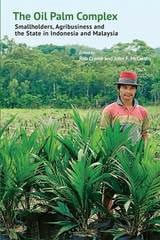
The Oil Palm Complex
Smallholders, Agribusiness and the State in Indonesia and MalaysiaEdited by Robert Cramb and John F. McCarthy
National University of Singapore Press, 2016
Based on detailed studies of specific communities and plantations and an analysis of the regional political economy of oil palm, this book unpicks the dominant policy narratives, business strategies, models of land acquisition, and labour-processes. It presents the oil palm industry in Malaysia and Indonesia as a complex system in which land, labour and capital are closely interconnected. Understanding this complex is a prerequisite to developing better strategies to harness the oil palm boom for a more equitable and sustainable pattern of rural development.

The Profit of the Earth
The Global Seeds of American AgricultureCourtney Fullilove
University of Chicago Press, 2017
Organized into three thematic parts, The Profit of the Earth is a narrative history of the collection, circulation, and preservation of seeds. Fullilove begins with the political economy of agricultural improvement, recovering the efforts of the US Patent Office and the nascent US Department of Agriculture to import seeds and cuttings for free distribution to American farmers. She then turns to immigrant agricultural knowledge, exploring how public and private institutions attempting to boost midwestern wheat yields drew on the resources of willing and unwilling settlers. Last, she explores the impact of these cereal monocultures on biocultural diversity, chronicling a fin-de-siècle Ohio pharmacist’s attempt to source Purple Coneflower from the diminishing prairie. Through these captivating narratives of improvisation, appropriation, and loss, Fullilove explores contradictions between ideologies of property rights and common use that persist in national and international development—ultimately challenging readers to rethink fantasies of global agriculture’s past and future.
The Soybean Industry
With Special Reference to the Competitive Position of the Minnesota Producer and ProcessorRay A. Goldberg
University of Minnesota Press, 1952
The Soybean Industry was first published in 1952. Minnesota Archive Editions uses digital technology to make long-unavailable books once again accessible, and are published unaltered from the original University of Minnesota Press editions.
The rapid development of the soybean industry in the United States is reflected in the growth of the industry in Minnesota, a state that now ranks sixth in total production. This state was one of the last to develop a soybean crop, but in the decade from 1940 to 1950 the dollar value of its crop rose from $76,000 to $37,000,000.
Because the industry is a new and important one on the agricultural front, producers and processors in the industry, as well as members of the grain trade and agricultural economists, are faced with the problem of ascertaining the probably future trends of the industry. This study provides a factual basis for the industry's future planning in Minnesota and in other major soybean-producing and processing states.
Since the total picture of supply and demand and the operation of the industry within a single state are interrelated and interdependent, the study describes the elements of production, utilization, and processing on international, national, and state levels. These factors are then correlated with significant aspects of transportation, storage, commodity markets, and price formulation for an analysis of the competitive position of the industry in Minnesota. In conclusion, the future of the industry as a whole as well as specifically in Minnesota is estimated.
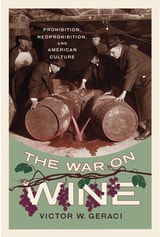
The War on Wine
Prohibition, Neoprohibition, and American CultureVictor W. Geraci
University of Nevada Press, 2023
The development of an American wine ethos.
The history of wine is a tale of capitalist production and consumer experience, and early Americans embraced the idea of having their own wine culture. But many began to believe that excessive alcohol consumption had become a moral, ethical, economic, political, social, and health conundrum. The result was a national on-again, off-again relationship with the concept of an American wine culture.
Citizens struggled to build a wine culture patterned after their diasporic European custom of wine as a moderating beverage that was part of a healthy diet. Yet, as America grew, untold attempts to create a wine culture failed due to climate, pests, diseases, wars, and depressions, resulting in some people considering the nation an alcoholic republic. Thus began an anti-alcohol culture war aimed at restricting or prohibiting alcoholic beverages.
With the passage of the Eighteenth Amendment (Prohibition), a culture war started between wet and dry proponents. After the repeal of Prohibition, the decimated wine industry responded by forming the Wine Institute to rebrand wine’s role in American society, after which neoprohibitionists attempted to restrict alcohol availability and consumption. To confront these aggressive actions, the Wine Institute hired politically trained John A. De Luca to navigate the new attacks and pushed for rebranding wine as a cultural spirit with health benefits.

Transforming Masculine Rule
Agriculture and Rural Development in the European UnionElisabeth Prügl
University of Michigan Press, 2011
"The premise of mainstreaming gender is to bring equality concerns into every aspect of policy-making, and this brave book offers a close look at how feminists have taken up the challenge to transform the hidden dynamics of male domination in agricultural policy in Europe. In contrast to the automatic assumption that (neo)liberal policy always works against women’s interests, Prügl demonstrates the potential for feminist ju-jitsu to take advantage of multiple levels of governance to empower women in some circumstances. Although feminists were not always successful, the story of their efforts to remake agricultural policy should encourage activists to look for points of leverage in this and other contested and changing multilevel power systems."
---Myra Marx Ferree, University of Wisconsin
"Information on policy development, conflicts about improving the status of farm women, and using rural development policies to foster gender equality is hard to access in English and extremely useful for researchers concerned with the specifics of gender equality policy in the EU."
---Alison Woodward, Institute for European Studies, Vrije Universiteit Brussel
"This book is a must-read for scholars interested in the gendered process of global restructuring. Elisabeth Prügl succeeds superbly in teasing out the power politics involved in European agricultural policy. Through the lens of a feminist-constructivist approach, she makes visible the multiple mechanisms of gendered power within the state. This very lucid narrative is a milestone in a new generation of feminist theoretical scholarship."
---Brigitte Young, University of Muenster, Germany
Taking West and East Germany as case studies, Elisabeth Prügl shows how European agricultural policy has cemented long-standing gender-based inequalities and how feminists have used liberalization as an opportunity to challenge such inequalities. Through a comparison of the EU’s rural development program known as LEADER as it played out in the Altmark region in the German East and in the Danube/Bavarian Forest region in the West, Prügl provides a close-up view of the power politics involved in government policies and programs.
In identifying mechanisms of power (refusal, co-optation, compromise, normalization, and silencing of difference), Prügl illustrates how these mechanisms operate in arguments over gender relations within the state. Her feminist-constructivist approach to global restructuring as a gendered process brings into view multiple levels of governance and the variety of gender constructions operating in different societies. Ultimately, Prügl offers a new understanding of patriarchy as diverse, contested, and in flux.
Jacket photograph: © iStockphoto.com/Wojtek Kryczka
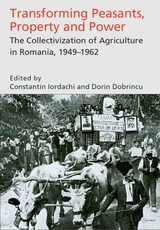
Transforming Peasants, Property and Power
The Collectivization of Agriculture in Romania, 1949–1962Dorin Dobrincu
Central European University Press, 2009