106 books match the query 'Alternative & Renewable' and 4 start with t
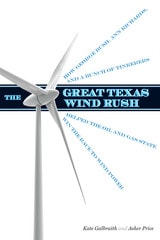
cover of The Great Texas Wind Rush: How George Bush, Ann Richards, and a Bunch of Tinkerers Helped the Oil and Gas State Win the Race to Wind Power

The Great Texas Wind Rush

How George Bush, Ann Richards, and a Bunch of Tinkerers Helped the Oil and Gas State Win the Race to Wind Power

By Kate Galbraith and Asher Price

University of Texas Press, 2013

In the late 1990s, West Texas was full of rundown towns and pumpjacks, aging reminders of the oil rush of an earlier era. Today, the towns are thriving as 300-foot-tall wind turbines tower above those pumpjacks. Wind energy has become Texas’s latest boom, with the Lone Star State now leading the nation. How did this dramatic transformation happen in a place that fights federal environmental policies at every turn? In The Great Texas Wind Rush, environmental reporters Kate Galbraith and Asher Price tell the compelling story of a group of unlikely dreamers and innovators, politicos and profiteers.

The tale spans a generation and more, and it begins with the early wind pioneers, precocious idealists who saw opportunity after the 1970s oil crisis. Operating in an economy accustomed to exploiting natural resources and always looking for the next big thing, their ideas eventually led to surprising partnerships between entrepreneurs and environmentalists, as everyone from Enron executives to T. Boone Pickens, as well as Ann Richards, George W. Bush and Rick Perry, ended up backing the new technology. In this down-to-earth account, the authors explain the policies and science that propelled the “windcatters” to reap the great harvest of Texas wind. They also explore what the future holds for this relentless resource that is changing the face of Texas energy.
[more]
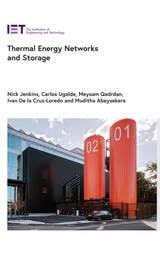
cover of Thermal Energy Networks and Storage

Thermal Energy Networks and Storage

Nick Jenkins

The Institution of Engineering and Technology, 2026

Scientists and policymakers worldwide recognise that continuing to use fossil fuels (coal, oil and gas) to produce useful energy with the inevitable emissions of CO2 and other greenhouse gasses is leading to changes in the world's climate with potentially catastrophic consequences. Both mitigation of the emissions of greenhouse gases as well as adaptation to the changing environment are urgently required to manage the worst effects of climate change.
[more]
cover of Tidal Power

Tidal Power

A.C. Baker

The Institution of Engineering and Technology, 1991
The tides, generated by the revolution of the earth in the gravitational fields of the sun and moon, are an enormous resource of renewable energy. Moreover, the times and heights of tides can be accurately predicted well into the future. However, tidal ranges in the oceans vary from 50cm or less to over 10 m, and it is the largest tides that represent the best energy source. This book describes how large tides develop in particular places and how the energy could be extracted by building suitable barrages. The principal features of a barrage and possible methods of operation are described in detail. Although a tidal power barrage would be non-polluting, the resulting changes in the tidal regime would have important environmental effects. These are discussed together with the economics of tidal power. Methods of assessing the likely cost of electricity from any site are set out and applied to possible sites around the world.
[more]
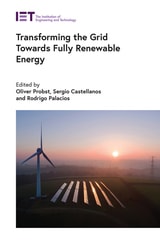
cover of Transforming the Grid Towards Fully Renewable Energy

Transforming the Grid Towards Fully Renewable Energy

Oliver Probst

The Institution of Engineering and Technology, 2020

The need for a deep decarbonization of the energy sector and the associated opportunities are now increasingly recognized, with fossil fuel projects simultaneously becoming more risky business propositions. With large-scale wind and solar generation now being the cheapest options in many parts of the world, a deeply renewable electricity sector is predestined to become the main driver of this transition. Yet, misconceptions abound. In part, this can be traced back to the complexity of the electricity sector and the processes involved in its transformation, located at the intersection between grid design and operation, markets and regulations.
[more]