Results by title
51 books match the query 'American Sign Language' and 7 start with t
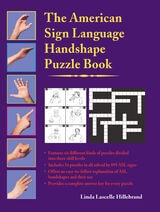
The American Sign Language Handshape Puzzle Book
Linda Lascelle Hillebrand
Gallaudet University Press, 2005
The American Sign Language Handshape Puzzle Book features 54 different puzzles to help students learn, review, and strengthen their signing vocabulary. Inspired by the bestselling dictionary, this unique workbook offers a variety of puzzles at three different levels — easy, medium, and difficult. Author Linda Lascelle Hillebrand provides a concise explanation of the basic handshapes used in American Sign Language (ASL), then invites readers to have fun while solving all sorts of sign puzzles.
Users can practice sign identification with Crossword and Word Search puzzles that have signs as clues rather than words. Easy puzzles show as few as six signs while advanced puzzles contain as many as 30 signs each. Some of the crossword puzzles provide spaces both across and down for the multiple meanings that many signs can represent.
Handshape Order puzzles require users to identify the handshape of the sign in an illustration, then list the sign’s meaning in English. Match puzzles also challenge readers to find corresponding signs for English glosses. Solutions to It Doesn’t Belong and Sign Description puzzles depend upon knowing the parameters of ASL signs—handshape, orientation, location, and movement—to deduce which word in a list doesn’t belong, and to write the English word for the described signs. The American Sign Language Handshape Puzzle Book is a new, different, and entertaining way to practice ASL that students of all ages are sure to enjoy.
The American Sign Language Handshape Starter
A Beginner's GuideRichard A. Tennant
Gallaudet University Press, 2002
The Gallaudet Dictionary of American Sign Language
Clayton Valli
Gallaudet University Press, 2021
Created by an unparalleled board of experts led by renowned ASL linguist and poet Clayton Valli, The Gallaudet Dictionary of American Sign Language contains over 3,000 illustrations. Each sign illustration, including depictions of fingerspelling when appropriate, incorporates a complete list of English synonyms. A full, alphabetized English index enables users to cross-reference words and signs throughout the entire volume.
The comprehensive introduction lays the groundwork for learning ASL by explaining in plain language the workings of ASL syntax and structure. It also offers examples of idioms and describes the antecedents of ASL, its place in the Deaf community, and its meaning in Deaf culture. This extraordinary reference also provides a special section on ASL classifiers and their use. Readers will find complete descriptions of the various classifiers and examples of how to use these integral facets of ASL. The Gallaudet Dictionary of American Sign Language is an outstanding ASL reference for all instructors, students, and users of ASL.
*Please note that this paperback edition does not include the DVD found in the hardcover edition.
The Geometry of Visual Phonology
Linda Ann N. Uyechi
CSLI, 1996
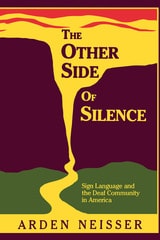
The Other Side of Silence
Sign Language and the Deaf Community in AmericaArden Neisser
Gallaudet University Press, 1983
Arden Neisser’s classic book on American Sign Language (ASL) and the Deaf community is again available, with a new prologue. The Other Side of Silence explores the Deaf community through telling interviews and research from across the country.
In widely varying encounters, Neisser heard Deaf individuals recall how their teachers suppressed ASL, how linguists foster conflicting theories, and how various institutions of the deaf dilute ASL to suit hearing patrons. This seminal book reveals the warmth, creativity, and resilience of Deaf people, and offers an update of the community today.
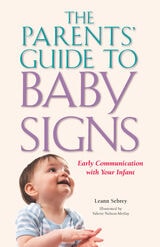
The Parents’ Guide to Baby Signs
Early Communication with Your InfantLeann Sebrey
Gallaudet University Press, 2009
Experienced ASL instructor Leann Sebrey champions two-way sign communication between parents and their infants who are just months old as a way to bond more closely and reduce frustration, while also maximizing the children’s intelligence and emotional quotients.
Sebrey’s book The Parents’ Guide to Baby Signs: Early Communication with Your Infant lays out an easy, step-by-step process that will instill confidence in parents who have never signed before. She begins by explaining why ASL is best for all children, both deaf and hearing. Sebrey also recognizes the different ways young children learn, encouraging parents and caregivers to sign with infants at all times as a natural part of their interaction. She reveals the first indications of when a baby is ready to communicate, and includes a list of signs to provide parents with a good starting point. Sebrey discusses the moments when infants are most receptive to learn signs and outlines numerous practical techniques with plenty of helpful hints to speed the process. She describes the pleasure of seeing a baby’s first sign, and tells parents how to interpret baby signs, including what to do when a baby uses the wrong signs. Full of easy-to-grasp illustrations of child and family-oriented signs, The Parents’ Guide to Baby Signs is the best how-to book for parents, caregivers, and educators to teach early communication to infants.

The Study of Signed Languages
Essays in Honor of William C. StokoeDavid F. Armstrong
Gallaudet University Press, 2002
In 1999, many of today’s notable researchers assembled at a special conference in honor of William C. Stokoe to explore the remarkable research that grew out of his original insights on American Sign Language. The Study of Signed Languages presents the fascinating findings from that conference.
Part 1, Historical Perspectives, begins with a description of the decline of sign language studies in the 1800s. Past research on signed languages and its relationship to language origins theory follows, along with a consideration of modality and conflicting agendas for its study.
In Part 2, Language Origins, the first entry intrigues with the possibility that sign language could answer conundrums posed by Noam Chomsky’s linguistic theories. The next essay considers how to build a better language model by citing continuity, ethology, and Stokoe’s work as key elements. Stokoe’s own research on the gestural theory of language origins is examined in the section’s closing chapter.
Part 3, Diverse Populations, delineates the impact of sign language research on black deaf communities in America, on deaf education, on research into variation in sign language, and even on sign communication and the motor functioning of autistic children and others. In its wide-ranging, brilliant scholarship, The Study of Signed Languages serves as a fitting tribute to William C. Stokoe and his work.