Results by title
3258 books match the query 'Art' and 634 start with t

T-Squared
Theories and Tactics in Architecture and DesignEdited by Samantha Krukowski
Intellect Books, 2021
T-Squared has three primary aims. First, it illuminates the extensive and explicit relationship between the research that shapes art, architecture, and design practices and the studio prompts and assignments that are developed by faculty for students engaging the creative disciplines. Second, it demonstrates that pedagogical inquiry and invention can be a (radical) research endeavor that can also become an evolutionary agent for faculty, students, institutions, and communities. Third, it makes available to a larger audience a set of innovative ideas and exercises that have until now been known to limited numbers of students and faculty, hidden behind the walls of studio courses and institutions.
An interdisciplinary collection with its origins in the 2018 National Conference on the Beginning Design Student, this book will appeal to anyone interested in design thinking and process.
TEXT
Transactions of the Society for Textual Scholarship, Volume 7D. C. Greetham and W. Speed Hill, Editors
University of Michigan Press, 1994
TOUCH
Caterina Nirta, Danilo Mandic, Andrea Pavoni and Andreas Philippopoulos-Mihalopoulos
University of Westminster Press, 2020
Described by Aristotle as the most vital of senses, touch contains both the physical and the metaphysical in its ability to express the determination of being. To manifest itself, touch makes a movement outwards, beyond the body, and relies on a specific physical involvement other senses do not require: to touch is already to be active and to activate. This fundamental ontology makes touch the most essential of all senses.
This volume of ‘Law and the Senses’ attempts to illuminate and reconsider the complex and interflowing relations and contradictions between the tactful intrusion of the law and the untactful movement of touch. Compelling contributors from arts, literature and social science disciplines alongside artist presentations explore touch’s boundaries and formal and informal ‘laws’ of the senses. Each contribution unveils a multi-faceted new dimension to the force of touch, its ability to form, deform and reform what it touches. In unique ways, each of the several contributions to this volume recognises the trans-corporeality of touch to traverse the boundaries on the body and entangle other bodies and spaces, thus challenging the very notion of corporeal integrity and human being.
TV by Design
Modern Art and the Rise of Network TelevisionLynn Spigel
University of Chicago Press, 2008
Whereas most histories of television focus on the way older forms of entertainment were recycled for the new medium, Lynn Spigel shows how TV was instrumental in introducing the public to the latest trends in art and design. Abstract expressionism, pop art, art cinema, modern architecture, and cutting-edge graphic design were all mined for staging techniques, scenic designs, and an ever-growing number of commercials. As a result, TV helped fuel the public craze for trendy modern products, such as tailfin cars and boomerang coffee tables, that was vital to the burgeoning postwar economy. And along with influencing the look of television, many artists—including Eero Saarinen, Ben Shahn, Saul Bass, William Golden, and Richard Avedon—also participated in its creation as the networks put them to work designing everything from their corporate headquarters to their company cufflinks.
Tactical Media
Rita Raley
University of Minnesota Press, 2009
In Tactical Media, Rita Raley provides a critical exploration of the new media art activism that has emerged out of, and in direct response to, postindustrialism and neoliberal globalization. Through close readings of projects by the DoEAT group, the Critical Art Ensemble, Electronic Civil Disobedience, and other tactical media groups, she articulates their divergent methods and goals and locates a virtuosity that is also boldly political. Contemporary models of resistance and dissent, she finds, mimic the decentralized and virtual operations of global capital and the post-9/11 security state to exploit and undermine the system from within.
Emphasizing the profound shift from strategy to tactics that informs new media art-activism, Raley assesses the efficacy of its symbolic performances, gamings, visualizations, and hacks. With its cogent analyses of new media art and their social impact, Tactical Media makes a timely and much needed contribution to wider debates about political activism, contemporary art, and digital technology.

Tactile Sensibilities
Seeing Through Print in American ArtJuliet Sperling
University of Chicago Press, 0
A print-driven history of American art in the long nineteenth century.
Juliet Sperling’s Tactile Sensibilities uses interactive printed objects to uncover culturally instilled ideas about touch’s role in perception and shows how these frameworks were integral to ways of making and appreciating even seemingly untouchable works of painting and sculpture. Crucial to Sperling’s argument is a genre of paper constructions designed to engage the hand and eye in tandem: multilayered and lift-the-flap book plates, pull-tab engravings, foldable playbills, and spinning paper wheels that built expectations of touch as a trained, focused process into their structure and material. Intimately scaled and portable, tactile prints cut across multiple spheres of experience, including spaces in which people learned to view, understand, and create art.
Sperling reverses standard procedures for integrating prints into art history. Rather than working her way outward from canonical artworks toward ephemeral sources within the artist’s orbit, she uses previously unstudied printed materials to open period discourses of tactile sensibility that ultimately lead to art objects, unlocking new meanings behind works of painting and sculpture by artists including Raphaelle Peale, Hiram Powers, William Sidney Mount, and Winslow Homer. In treating sidelined materials as dedicated objects of study in their own right, Tactile Sensibilities reveals that in the long nineteenth century, print was an intellectually dense and powerfully connective medium, vital in mediating the tactile sensibilities that shaped ways of making and appreciating art.

Take Heart
Encouragement for Earth’s Weary LoversKathleen Dean Moore
Oregon State University Press, 2022
To this question, environmental philosopher Kathleen Dean Moore and Canadian artist Bob Haverluck bring twenty-two life-affirming essays and drawings. Their entwined art offers pluck, stubborn resolve, and even some laughter to those who have for years been working for environmental sanity, social justice, and ecological thriving.
What Moore and Haverluck offer is encouragement to join or keep on with Earth’s work—not distractions, but deep and honest reasons to remember that the struggle matters. Rather than another to-do list or an empty promise of hope, Take Heart is a thank-you gift to the multitudes of Earth’s defenders. Inside its pages, they will find reason to take heart.
Taking heart is not hope exactly, but maybe it’s courage. Not solutions to the planetary crisis, but some modest advice for the inevitable crisis of the heart. A rueful grin, and gratitude to be part of this strange and necessary work for the endangered Earth.
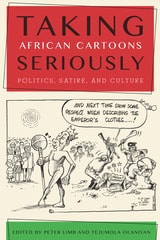
Taking African Cartoons Seriously
Politics, Satire, and CulturePeter Limb
Michigan State University Press, 2018
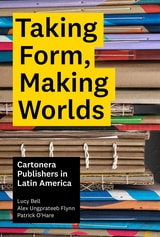
Taking Form, Making Worlds
Cartonera Publishers in Latin AmericaLucy Bell, Alex Ungprateeb Flynn, Patrick O’Hare
University of Texas Press, 2022
2023 LASA Visual Culture Studies Section Book Prize, Latin American Studies Association (LASA)
The first comprehensive study of cartonera, a vibrant publishing phenomenon born in Latin America.
A publishing phenomenon and artistic project, cartonera was born in the wake of Argentina’s 2001 economic crisis. Infused with a rebellious spirit, it has exploded in popularity, with hundreds of publishers across Latin America and Europe making colorful, low-cost books out of cardboard salvaged from the street. Taking Form, Making Worlds is the first comprehensive study of cartonera. Drawing on interdisciplinary research conducted across Mexico, Brazil, and Argentina, the authors show how this hands-on practice has fostered a politically engaged network of writers, artists, and readers. More than a social movement, cartonera uses texts, workshops, encounters, and exhibitions to foster community and engagement through open-ended forms that are at once artistic and social. For various groups including waste-pickers, Indigenous communities, rural children, and imprisoned women, cartonera provides a platform for unique stories and sparks collaborations that bring the walls of the “lettered city” tumbling down. In contexts of stigma and exclusion, cartonera collectives give form to a decolonial aesthetics of resistance, making possible a space of creative experimentation through which plural worlds can be brought to life.
Taking Leave
Deborah Kapchan
Duke University Press, 2025

Taking Place
Location and the Moving ImageJohn David Rhodes
University of Minnesota Press, 2011
Taking Place argues that the relation between geographical location and the moving image is fundamental and that place grounds our experience of film and media. Its original essays analyze film, television, video, and installation art from diverse national and transnational contexts to rethink both the study of moving images and the theorization of place. Through its unprecedented—and at times even obsessive— attention to actual places, this volume traces the tensions between the global and the local, the universal and the particular, that inhere in contemporary debates on global cinema, television, art, and media.
Contributors: Rosalind Galt, U of Sussex; Frances Guerin, U of Kent; Ji-hoon Kim; Hugh S. Manon, Clark U; Ara Osterweil, McGill U; Brian Price, U of Toronto; Linda Robinson, U of Wisconsin–Whitewater; Michael Siegel; Noa Steimatsky, U of Chicago; Meghan Sutherland, U of Toronto; Mark W. Turner, Kings College London; Aurora Wallace, New York U; Charles Wolfe, U of California, Santa Barbara.
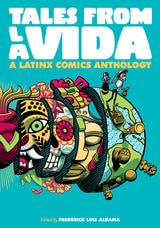
Tales from la Vida
A Latinx Comics AnthologyEdited by Frederick Luis Aldama
The Ohio State University Press, 2018
In the Latinx comics community, there is much to celebrate today, with more Latinx comic book artists than ever before. The resplendent visual-verbal storyworlds of these artists reach into and radically transform so many visual and storytelling genres. Tales from la Vida celebrates this space by bringing together more than eighty contributions by extraordinary Latinx creators. Their short visual-verbal narratives spring from autobiographical experience as situated within the language, culture, and history that inform Latinx identity and life. Tales from la Vida showcases the huge variety of styles and worldviews of today’s Latinx comic book and visual creators.
Whether it’s detailing the complexities of growing up—mono- or multilingual, bicultural, straight, queer, or feminist Latinx—or focusing on aspects of pop culture, these graphic vignettes demonstrate the expansive complexity of Latinx identities. Taken individually and together, these creators—including such legendary artists as Jaime and Gilbert Hernandez, Roberta Gregory, and Kat Fajardo, to name a few—and their works show the world that when it comes to Latinx comics, there are no limits to matters of content and form. As we travel from one story to the next and experience the unique ways that each creator chooses to craft his or her story, our hearts and minds wake to the complex ways that Latinxs live within and actively transform the world.

Talkin' With Your Mouth Full
Conversations with the Videos of Steve FaginSteve Fagin, ed.
Duke University Press, 1998
Combining elements of criticism with various modes of artistic expression, these responses take the form of reviews, letters, interviews, and in one case an imaginary TV programming schedule. Interspersed with—and sometimes literally interrupting—the video scripts, these contributions interact with one another on multiple levels and complement Fagin’s scripts. Historical, political, and theoretical issues dovetail, ricochet, and interplay in this book, revealing a multiplicity of voices, concerns, and cultural revelations.
Unique in its structure and intellectual approach, Talkin’ with Your Mouth Full will appeal equally to those who have seen Fagin’s videos and those who have not. Students of art history and cultural critique, and anyone interested in the ongoing dialogue between artists and theorists, will find particular value in this book.
Contributors. Gregg Bordowitz, Constance DeJong, Leslie Dick, Steve Fagin, Barry Gifford, Victoria Gill, Bill Horrigan, Bertha Jottar, Ivone Margulies, Patricia Mellencamp, Margaret Morse, Constance Penley, Vicente L. Rafael, Mark Rappaport, Andrew Ross, Vivian Sobchack, Trinh T. Minh-ha, John Welchman, Peter Wollen
Talking Art
The Culture of Practice and the Practice of Culture in MFA EducationGary Alan Fine
University of Chicago Press, 2018
Talking to Action
Art, Pedagogy, and Activism in the AmericasBill Kelley, Jr. with Rebecca Zamora
School of the Art Institute of Chicago, 2017

Talking to Action
Spanish Language EditionBill Kelley, Jr. with Rebecca Zamora
School of the Art Institute of Chicago, 2017
This is the Spanish language edition.
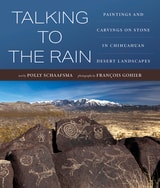
Talking to the Rain
Paintings and Carvings on Stone in Chihuahuan Desert LandscapesPolly Schaafsma, photographs by François Gohier
University of Utah Press, 2025
In this visually stunning volume, Polly Schaafsma, leading authority on pre-Hispanic Indian rock imagery and kiva murals of the greater American Southwest, provides an insightful journey into the petroglyphs and rock paintings of the Jornada Mogollon farmers in southern New Mexico's lower Chihuahuan Desert.
Talking to the Rain defines the Rio Grande Tradition, emphasizing the foundational Jornada Style as exemplified by its Mimbres-like imagery as well as its diverse and complex rain-making symbolism. By examining visual metaphors of cosmology and place-making, the book reveals an ancient dialogue between farmers and the cosmos that places rain for crops as its central concern. Exceptional color photographs by François Gohier invite readers to experience the landscapes and locations selected for creating these images. Both scholarly and accessible, Talking to the Rain offers a fresh perspective on cultural landscapes and the profound connections between people, art, and environment, making it essential for understanding Southwest cultural history.
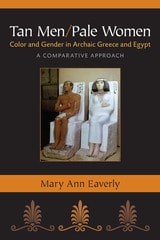
Tan Men/Pale Women
Color and Gender in Archaic Greece and Egypt, a Comparative ApproachMary Ann Eaverly
University of Michigan Press, 2013
One of the most obvious stylistic features of Athenian black-figure vase painting is the use of color to differentiate women from men. By comparing ancient art in Egypt and Greece, Tan Men/Pale Women uncovers the complex history behind the use of color to distinguish between genders, without focusing on race. Author Mary Ann Eaverly considers the significance of this overlooked aspect of ancient art as an indicator of underlying societal ideals about the role and status of women. Such a commonplace method of gender differentiation proved to be a complex and multivalent method for expressing ideas about the relationship between men and women, a method flexible enough to encompass differing worldviews of Pharaonic Egypt and Archaic Greece. Does the standard indoor/outdoor explanation—women are light because they stay indoors—hold true everywhere, or even, in fact, in Greece? How “natural” is color-based gender differentiation, and, more critically, what relationship does color-based gender differentiation have to views about women and the construction of gender identity in the ancient societies that use it?
The depiction of dark men and light women can, as in Egypt, symbolize reconcilable opposites and, as in Greece, seemingly irreconcilable opposites where women are regarded as a distinct species from men. Eaverly challenges traditional ideas about color and gender in ancient Greek painting, reveals an important strategy used by Egyptian artists to support pharaonic ideology and the role of women as complementary opposites to men, and demonstrates that rather than representing an actual difference, skin color marks a society’s ideological view of the varied roles of male and female.
Tania El Khoury's Live Art
Collaborative Knowledge ProductionLaurel V. McLaughlin
Amherst College Press, 2023
Taste
Giorgio Agamben
Seagull Books, 2017
Taste, Agamben argues, is a category that has much to reveal to the contemporary world. Taking a step into the history of philosophy and reaching to the very origins of aesthetics, Agamben critically recovers the roots of one of Western culture’s cardinal concepts. Agamben is the rare writer whose ideas and works have a broad appeal across many fields, and with Taste he turns his critical eye to the realm of Western art and aesthetic practice. This volume will not only engage the author’s devoted fans in philosophy, sociology, and literary criticism but also his growing audience among art theorists and historians.
Tattoo
Bodies, Art, and Exchange in the Pacific and the WestNicholas Thomas, Anna Cole, and Bronwen Douglas, eds.
Duke University Press, 2005
The contributors examine the contexts in which Pacific tattoos were “discovered” by Europeans, track the history of the tattooing of Europeans visiting the region, and look at how Pacific tattooing was absorbed, revalued, and often suppressed by agents of European colonization. They consider how European art has incorporated tattooing, and they explore contemporary manifestations of Pacific tattoo art, paying particular attention to the different trajectories of Samoan, Tahitian, and Maori tattooing and to the meaning of present-day appropriations of tribal tattoos. New research has uncovered a fascinating visual archive of centuries-old tattoo images, and this richly illustrated volume includes a number of those—many published here for the first time—alongside images of contemporary tattooing in Polynesia and Europe. Tattoo offers a tantalizing glimpse into the plethora of stories and cross-cultural encounters that lie between the blood on a sailor’s backside in the eighteenth century and the hammering of a Samoan tattoo tool in the twenty-first.
Contributors. Peter Brunt, Anna Cole, Anne D’Alleva, Bronwen Douglas, Elena Govor, Makiko Kuwahara, Sean Mallon, Linda Waimarie Nikora, Mohi Rua, Cyril Siorat, Ngahuia Te Awekotuku, Nicholas Thomas, Joanna White
Teaching Art
(Re)Imagining IdentityLaura Hetrick
University of Illinois Press, 2018
Teaching Artist Handbook, Volume One
Tools, Techniques, and Ideas to Help Any Artist TeachNick Jaffe, Becca Barniskis, and Barbara Hackett Cox
University of Chicago Press, 2015
This book is a collection of essays, stories, lists, examples, dialogues, and ideas, all offered with the aim of helping artists create and implement effective teaching based on their own expertise and strengths. The Handbook addresses three core questions: “What will I teach?” “How will I teach it?” and “How will I know if my teaching is working?” It also recognizes that teaching is a dynamic process that requires critical reflection and thoughtful adjustment in order to foster a supportive artistic environment.
Instead of offering rigid formulas, this book is centered on practice—the actual doing and making of teaching artist work. Experience-based and full of heart, the Teaching Artist Handbook will encourage artists of every experience level to create an original and innovative practice that inspires students and the artist.
Teaching the Eighteenth Century Now
Pedagogy as Ethical EngagementKate Parker
Bucknell University Press, 2024
Published by Bucknell University Press. Distributed worldwide by Rutgers University Press.
Team 10 East
Revisionist Architecture in Real Existing ModernismEdited by Lukasz Stanek
Museum of Modern Art in Warsaw, 2014
Tech-Noir Film
A Theory of the Development of Popular GenresEmily E. Auger
Intellect Books, 2011
From the postapocalyptic world of Blade Runner to theJames Cameron mega-hit Terminator, tech-noir has emerged as a distinct genre, with roots in both the Promethean myth and the earlier popular traditions of gothic, detective, and science fiction. In this new volume, many well-known film and literary works—including The Matrix, RoboCop, and Mary Shelley’s Frankenstein—are discussed with reference to their relationship to tech-noir and one another. Featuring an extensive, clearly indexed filmography, Tech-Noir Film will be of great interest to anyone wishing to learn more about the development of this new and highly innovative genre.
Technics Improvised
Activating Touch in Global Media ArtTimothy Murray
University of Minnesota Press, 2022
Seeing new media art as an entry point for better understanding of technology and worldmaking futures
In this challenging work, a leading authority on new media art examines that curatorial and aesthetic landscape to explore how art resists and rewires the political and economic structures that govern technology. How do inventive combinations of artistic and theoretical improvisation counter the extent to which media art remains at risk, not just from the quarantines of a global pandemic but also from the very viral and material conditions of technology? How does global media art speak back to the corporate closures of digital euphoria as clothed in strategies of digital surveillance, ecological deprivation, and planned obsolescence? In Technics Improvised, Timothy Murray asks these questions and more.
At the intersection of global media art, curatorial practice, tactical media, and philosophy, Murray reads a wide range of creative performances and critical texts that envelop artistic and digital materials in unstable, political relations of touch, body, archive, exhibition, and technology. From video to net art and interactive performance, he considers both canonical and unheralded examples of activist technics that disturb the hegemony of biopolitical/digital networks by staging the very touch of the unsettling discourse erupting from within. In the process, critical dialogues emerge between a wide range of artists and theorists, from Hito Steyerl, Ricardo Dominguez, Joan Jonas, Isaac Julien, Ryoji Ikeda, and Shadi Nazarian to Gilles Deleuze, Jean-Luc Nancy, Elizabeth Povinelli, Jean-François Lyotard, Erin Manning, Achille Mbembe, and Samuel Weber.
Brilliantly conceived and argued and eloquently written, Technics Improvised points the way to how artistic and theoretical practice can seize on the improvisational accidents of technics to activate creativity, thought, and politics anew.
Technocrats of the Imagination
Art, Technology, and the Military-Industrial Avant-GardeJohn Beck and Ryan Bishop
Duke University Press, 2020
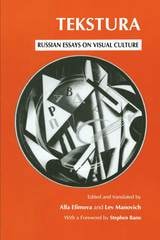
Tekstura
Russian Essays on Visual CultureEdited by Alla Efimova and Lev Manovich
University of Chicago Press, 1993
Taking its title from a Russian word that can refer to the 'texture" of life, painting, or writing, this anthology assembles thirteen key essays in art history and cultural theory by Russian-language writers. The essays erase boundaries between high and low, official and dissident, avant-garde and socialist realism, art and everyday life. Everything visual is deemed worthy of analysis, whether painting or propaganda banners, architecture or candy wrappers, mass celebrations or urban refuse.
Most of the essays appear here in English for the first time. The editors have selected works of the past twenty years by philosophers, literary critics, film scholars, and art historians. Also included are influential earlier essays by Mikhail Bakhtin, V. N. Voloshinov, and Sergei Eisenstein. Compiled for general readers and specialists alike, Tekstura is a valuable resource for anyone interested in Russian and Soviet cultural history or in new theoretical approaches to the visual.
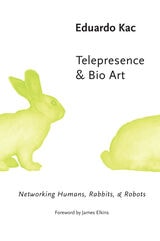
Telepresence and Bio Art
Networking Humans, Rabbits and RobotsEduardo Kac
University of Michigan Press, 2005
-Edward Lucie-Smith, author of Visual Arts in the 20th Century
"His works introduce a vital new meaning into what had been known as the creative process while at the same time investing the notion of the artist-inventor with an original social and ethical responsibility."
-Frank Popper, author of Origins and Development of Kinetic Art
"Kac's radical approach to the creation and presentation of the body as a wet host for artificial memory and 'site-specific' work raises a variety of important questions that range from the status of memory in digital culture to the ethical dilemmas we are facing in the age of bioengineering and tracking technology."
-Christiane Paul, Whitney Museum of Art
For nearly two decades Eduardo Kac has been at the cutting edge of media art, first inventing early online artworks for the web and continuously developing new art forms that involve telecommunications and robotics as a new platform for art. Interest in telepresence, also known as telerobotics, exploded in the 1990s, and remains an important development in media art. Since that time, Kac has increasingly moved into the fields of biology and biotechnology.
Telepresence and Bio Art is the first book to document the evolution of bio art and the aesthetic development of Kac, the creator of the "artist's gene" as well as the controversial glow-in-the-dark, genetically engineered rabbit Alba. Kac covers a broad range of topics within media art, including telecommunications media, interactive systems and the Internet, telematics and robotics, and the contact between electronic art and biotechnology. Addressing emerging and complex topics, this book will be essential reading for anyone interested in contemporary art.

Televising Taste
Performing Classical Music on American ScreensBy Evelyn Kreutzer
Lever Press, 2027
Televising Taste: Performing Classical Music on American Screens explores how American television portrayed canonical European classical music in the Cold War era. Situating mid-century TV culture within a history of music visualization efforts, it complicates narratives about the postwar decades as a peak moment of polarity between “high” and “low” cultures, and between ideologies of consensus and rebellion. Drawing on discourse analysis, archival research, and the medium of videographic analysis, Evelyn Kreutzer suggests that the legacies of European classical music played an important part in the formation of an American national identity and that they were interwoven with and negotiated through popular media. Conjunctions of classical music and television occurred in dialogue with aspirations for cultural capital, which were attached to European classical music and inscribed into visions of American cultural literacy and citizenship. Simultaneously, these conjunctions responded to anxieties that popular culture and mass media would diminish “serious” music appreciation and turn audiences into passive consumers.
Through musical mediations on television, Televising Taste addresses larger ideological and historical implications of taste and canon politics, contributing a new interdisciplinary perspective on the interdependence of music and media cultures.
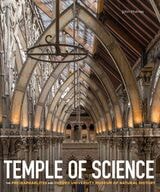
Temple of Science
The Pre-Raphaelites and Oxford University Museum of Natural HistoryJohn Holmes
Bodleian Library Publishing, 2020
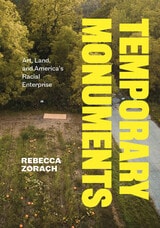
Temporary Monuments
Art, Land, and America's Racial EnterpriseRebecca Zorach
University of Chicago Press, 2024
Art has long played a key role in constructing how people understand and imagine America. Starting with contemporary controversies over public monuments in the United States, Rebecca Zorach carefully examines the place of art in the occupation of land and the upholding of White power in the US, arguing that it has been central to the design of America’s racial enterprise. Confronting closely held assumptions of art history, Zorach looks to the intersections of art, nature, race, and place, working through a series of symbolic spaces—the museum, the wild, islands, gardens, home, and walls and borders—to open and extend conversations on the political implications of art and design.
Against the backdrop of central moments in American art, from the founding of early museums to the ascendancy of abstract expressionism, Zorach shows how contemporary artists—including Dawoud Bey, Theaster Gates, Maria Gaspar, Kerry James Marshall, Alan Michelson, Dylan Miner, Postcommodity, Cauleen Smith, and Amanda Williams—have mined the relationship between environment and social justice, creating works that investigate and interrupt White supremacist, carceral, and environmentally toxic worlds. The book also draws on poetry, creative nonfiction, hip-hop videos, and Disney films to illuminate crucial topics in art history, from the racial politics of abstraction to the origins of museums and the formation of canons.
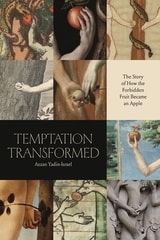
Temptation Transformed
The Story of How the Forbidden Fruit Became an AppleAzzan Yadin-Israel
University of Chicago Press, 2022
How did the apple, unmentioned by the Bible, become the dominant symbol of temptation, sin, and the Fall? Temptation Transformed pursues this mystery across art and religious history, uncovering where, when, and why the forbidden fruit became an apple.
Azzan Yadin-Israel reveals that Eden’s fruit, once thought to be a fig or a grape, first appears as an apple in twelfth-century French art. He then traces this image back to its source in medieval storytelling. Though scholars often blame theologians for the apple, accounts of the Fall written in commonly spoken languages—French, German, and English—influenced a broader audience than cloistered Latin commentators. Azzan Yadin-Israel shows that, over time, the words for “fruit” in these languages narrowed until an apple in the Garden became self-evident. A wide-ranging study of early Christian thought, Renaissance art, and medieval languages, Temptation Transformed offers an eye-opening revisionist history of a central religious icon.
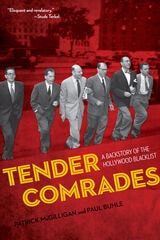
Tender Comrades
A Backstory of the Hollywood BlacklistPatrick McGilligan
University of Minnesota Press, 2012
More than sixty years ago, McCarthyism silenced Hollywood. In the pages of Tender Comrades, those who were suppressed, whose lives and careers were ruined, finally have their say. A unique collection of profiles in cinematic courage, this extraordinary oral history brings to light the voices of thirty-six blacklist survivors (including two members of the Hollywood Ten), seminal directors of film noir and other genres, starring actresses and memorable supporting players, top screenwriters, and many less known to the public, who are rescued from obscurity by the stories they offer here that, beyond politics, open a rich window into moviemaking during the Golden Age of Hollywood.
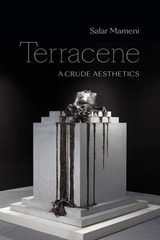
Terracene
A Crude AestheticsSalar Mameni
Duke University Press, 2023
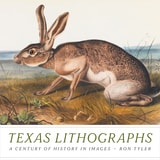
Texas Lithographs
A Century of History in ImagesRon Tyler
University of Texas Press, 2023
2024 Ewell L. Newman Book Award, American Historical Print Collectors Society
2024 Kate Broocks Bates Award for Historical Research, Texas State Historical Association
2024 TCU Texas Book Prize, Friends of the TCU Library and the TCU Press
2024 Kempner Family Book Prize—Nonfiction,The Philosophical Society of Texas
A stunning and comprehensive collection of lithographs from 1818 to 1900 Texas.
Westward expansion in the United States was deeply intertwined with the technological revolutions of the nineteenth century, from telegraphy to railroads. Among the most important of these, if often forgotten, was the lithograph. Before photography became a dominant medium, lithography—and later, chromolithography—enabled inexpensive reproduction of color illustrations, transforming journalism and marketing and nurturing, for the first time, a global visual culture. One of the great subjects of the lithography boom was an emerging Euro-American colony in the Americas: Texas.
The most complete collection of its kind—and quite possibly the most complete visual record of nineteenth-century Texas, period—Texas Lithographs is a gateway to the history of the Lone Star State in its most formative period. Ron Tyler assembles works from 1818 to 1900, many created by outsiders and newcomers promoting investment and settlement in Texas. Whether they depict the early French colony of Champ d’Asile, the Republic of Texas, and the war with Mexico, or urban growth, frontier exploration, and the key figures of a nascent Euro-American empire, the images collected here reflect an Eden of opportunity—a fairy-tale dream that remains foundational to Texans’ sense of self and to the world’s sense of Texas.
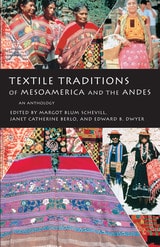
Textile Traditions of Mesoamerica and the Andes
An AnthologyEdited by Margot Blum Schevill, Janet Catherine Berlo, and Edward B. Dwyer
University of Texas Press, 1996
In this volume, anthropologists, art historians, fiber artists, and technologists come together to explore the meanings, uses, and fabrication of textiles in Mexico, Guatemala, Ecuador, Peru, and Bolivia from Precolumbian times to the present. Originally published in 1991 by Garland Publishing, the book grew out of a 1987 symposium held in conjunction with the exhibit "Costume as Communication: Ethnographic Costumes and Textiles from Middle America and the Central Andes of South America" at the Haffenreffer Museum of Anthropology, Brown University.
The "Legend of Zelda
Ocarina of Time": A Game Music CompanionTim Summers
Intellect Books, 2022
More than twenty years after its creation, The Legend of Zelda: Ocarina of Time is still held in high critical regard as one of the finest examples of the video game medium. The same is true of the game’s music, whose superlative reception continues to be evident, whether in the context of the game or in orchestral concerts and recordings of the game’s music.
Given music’s well-established significance for the video game form, it is no coincidence that music is placed at the forefront of this most lauded and loved of games. In Ocarina of Time, music connects and unifies all aspects of the game, from the narrative conceit to the interactive mechanics, from the characters to the virtual worlds, and even into the activity of legions of fans and gamers, who play, replay, and reconfigure the music in an enduring cultural site that has Ocarina of Time at its center. As video game music studies begins to mature into a coherent field, it is now possible to take the theoretical apparatus and critical approaches that have been developed in antecedent scholarship and put these into practice in the context of an extended concrete game example.
The most extensive investigation into the music of a single game yet undertaken, this book serves three important primary purposes: first, it provides a historical-critical account of the music of an important video game text; second, it uses this investigation to explore wider issues in music and media studies (including interactivity, fan cultures, and music and technology); and third, it serves as a model for future in-depth studies of video game music.
The Absent Stone
Mexican Patrimony and the Aftershocks of State TheftSandra Rozental
Duke University Press, 2026
The Accidental Archives of the Royal Chicano Air Force
By Stephanie Sauer
University of Texas Press, 2016
How do you write a history of a group that has been written out of history? In The Accidental Archives of the Royal Chicano Air Force, world-famous archaeologist La Stef and the clandestine Con Sapos Archaeological Collective track down the “facts” about the elusive RCAF, the Rebel Chicano Art Front that, through an understandable mix-up with the Royal Canadian Air Force, became the Royal Chicano Air Force.
La Stef and her fellow archaeologists document the plight and locura que cura of the RCAF, a group renowned for its fleet of adobe airplanes, ongoing subversive performance stance, and key role as poster makers for the United Farm Workers Union during the height of the Chicano civil rights movement. As the Con Sapos team uncovers tensions between fact and fiction in historical consciousness and public memory, they abandon didactic instruction and strive instead to offer a historiography in which various cultural paradigms already intersect seamlessly and on equal ground. That they often fail to navigate the blurred lines between “objective” Western archival sciences and Indigenous/Chicana/o cosmologies reflects the very human predicament of documenting the histories of complicated New Worlds everywhere. Uniquely blending art history, oral history, cultural studies, and anthropology, The Accidental Archives of the Royal Chicano Air Force suspends historical realities and leaps through epochs and between conversations with various historical figures, both dead and alive, to offer readers an intimate experience of RCAF history.
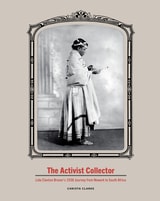
The Activist Collector
Lida Clanton Broner’s 1938 Journey from Newark to South AfricaChrista Clarke
Rutgers University Press, 2023
Published by the Newark Museum. Distributed worldwide by Rutgers University Press.
“After twenty-eight years of desire and determination, I have visited Africa, the land of my forefathers.” So wrote Lida Clanton Broner (1895–1982), an African American housekeeper and hairstylist from Newark, New Jersey, upon her return from an extraordinary nine-month journey to South Africa in 1938. This epic trip was motivated not only by Broner’s sense of ancestral heritage, but also a grassroots resolve to connect the socio-political concerns of African Americans with those of black South Africans under the segregationist policies of the time. During her travels, this woman of modest means circulated among South Africa’s Black intellectual elite, including many leaders of South Africa’s freedom struggle. Her lectures at Black schools on “race consciousness and race pride” had a decidedly political bent, even as she was presented as an “American beauty specialist.”
How did Broner—a working class mother—come to be a globally connected activist? What were her experiences as an African American woman in segregated South Africa and how did she further her work after her return? Broner’s remarkable story is the subject of this book, which draws upon a deep visual and documentary record now held in the collection of the Newark Museum of Art. This extraordinary archive includes more than one hundred and fifty objects, ranging from beadwork and pottery to mission school crafts, acquired by Broner in South Africa, along with her diary, correspondence, scrapbooks, and hundreds of photographs with handwritten notations.
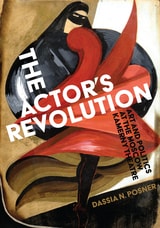
The Actor’s Revolution
Art and Politics at the Moscow Kamerny TheatreDassia N. Posner
Northwestern University Press, 2027
Reclaims the lost history of one of the twentieth century’s most innovative theaters
The Moscow Kamerny Theatre created stage worlds of movement, color, and light. Cofounded in 1914 by Alexander Tairov, a Jewish director from Ukraine, and Alisa Koonen, a Moscow-born actress from an immigrant family, the company celebrated the actor’s virtuosic inventiveness during an era when most theaters imitated daily life or prioritized the autocratic director’s vision. By the 1920s, it had become the most famous Soviet theater in the world, renowned for its actors’ acrobatic grace, its bold collaborations with avant-garde artists, and its revolutionary redefinition of what theater can be. But the accusations of Soviet disloyalty that were used to destroy the Kamerny during Stalin’s post–World War II antisemitic purge have rendered it little known outside Russia today and frequently misunderstood even there.
The Actor’s Revolution vividly reclaims this lost history by reconstructing the theater’s most illustrious premieres, analyzing them within the turbulent artistic and political context of the early Soviet era. Drawing on a decade of archival research, Dassia N. Posner restores Tairov’s legacy as one of history’s most significant directors and celebrates Koonen’s liberatory creative expressiveness as a vital alternative to Konstantin Stanislavsky’s better-known acting system. Building on rich archival sources, from unpublished memoirs to vibrant scenic and costume designs, this timely volume grapples with the entangled histories of art, politics, and erasure and celebrates the radical power of human creativity under—and in spite of—totalitarianism.
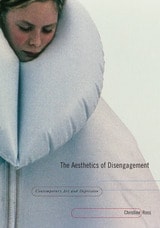
The Aesthetics of Disengagement
Contemporary Art and DepressionChristine Ross
University of Minnesota Press, 2006
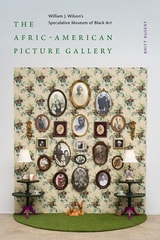
The Afric-American Picture Gallery
William J. Wilson's Speculative Museum of Black ArtBritt Rusert
Duke University Press, 2026
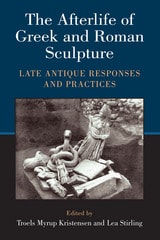
The Afterlife of Greek and Roman Sculpture
Late Antique Responses and PracticesTroels Myrup Kristensen and Lea Stirling, editors
University of Michigan Press, 2016
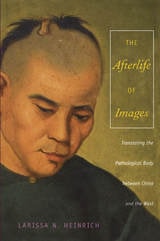
The Afterlife of Images
Translating the Pathological Body between China and the WestAri Larissa Heinrich
Duke University Press, 2008
Combining literary studies, the history of science, and visual culture studies, Heinrich analyzes the rhetoric and iconography through which medical missionaries transmitted to the West an image of China as “sick” or “diseased.” He also examines the absorption of that image back into China through missionary activity, through the earliest translations of Western medical texts into Chinese, and even through the literature of Chinese nationalism. Heinrich argues that over time “scientific” Western representations of the Chinese body and culture accumulated a host of secondary meanings, taking on an afterlife with lasting consequences for conceptions of Chinese identity in China and beyond its borders.
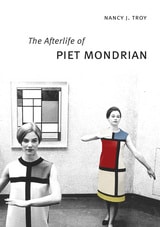
The Afterlife of Piet Mondrian
Nancy J. Troy
University of Chicago Press, 2014
The Age of the Cathedrals
Art and Society, 980-1420Georges Duby
University of Chicago Press, 1981
"If Age of the Cathedrals has a fault, it is that Professor Duby knows too much, has too many new ideas and takes such a delight in setting them out. . . insights whiz to and fro like meteorites."—John Russell, New York Times Book Review
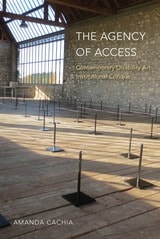
The Agency of Access
Contemporary Disability Art & Institutional CritiqueAmanda Cachia
Temple University Press, 2025
Showcasing artwork by contemporary disabled artists Corban Walker, Christine Sun Kim, and Carmen Papalia, among others, The Agency of Access inscribes contemporary disability art in the broad canon of contemporary art, where the artistic past is regarded differently.
Cachia is an outspoken advocate for artists living with sensory disabilities. She understands disabled artists’ experiences in both the world and the gallery. The artists she has curated make bold, astonishing, and compelling statements about interdependency, care, and the ways in which our environment affects disabled, ill, and immunocompromised bodies.