99 books match the query 'Art, Modern' and 13 start with t
cover of The Aesthetics of Disengagement: Contemporary Art and Depression

The Aesthetics of Disengagement

Contemporary Art and Depression

Christine Ross

University of Minnesota Press, 2006
According to the National Institute of Mental Health, more than half of the world's population will have a depressive disorder at some point in their lifetimes. In The Aesthetics of Disengagement Christine Ross shows how contemporary art is a powerful yet largely unacknowledged player in the articulation of depression in Western culture, both adopting and challenging scientific definitions of the condition. Ross explores the ways in which contemporary art performs the detached aesthetics of depression, exposing the viewer's loss of connection and ultimately redefining the function of the image. Ross examines the works of Ugo Rondinone, Rosemarie Trockel, Ken Lum, John Pilson, Liza May Post, Vanessa Beecroft, and Douglas Gordon, articulating how their art conveys depression's subjectivity and addresses a depressed spectator whose memory and perceptual faculties are impaired. Drawing from the fields of psychoanalysis as well as psychiatry, Ross demonstrates the ways in which a body of art appropriates a symptomatic language of depression to enact disengagement - marked by withdrawl, radical protection of the self from the other, distancing signals, isolation, communication ruptures, and perceptual insufficiency. Most important, Ross reveals the ways in which art transforms disengagement into a visual strategy of disclosure, a means of reaching the viewer, and how in this way contemporary art puts forth a new understanding of depression.
[more]
cover of The Casual: Downplaying Art Since California Conceptualism

The Casual

Downplaying Art Since California Conceptualism

Jacob Stewart-Halevy

University of Chicago Press, 2026

Considers the enduring legacy of California Conceptualism, known for its lax approaches to creating, writing about, and exhibiting art.
 
Moving away from making objects, and turning instead to staging scenes, the artists associated with California Conceptualism—including Eleanor Antin, John Baldessari, David Lamelas, Tony Ramos, Ilene Segalove, and William Wegman—behaved indifferently toward their art, denied making it and knowing what it was about, and displayed a lack of concern for its future. Their casual attitude and aesthetic transformed relationships between artists, critics, and viewers, separating those who could recognize these practices from those who could not.
 
Contemporary artists have continued this trajectory, finding new ways to act casually through their “stance.” In the humanities, this term is often taken to mean the beliefs, values, and intentions of authors, and it has offered a useful way to think about how artists position themselves toward their work and audiences. Jacob Stewart-Halevy builds on recent social theory to show how artists, critics, and other members of the art world wield stance to make sense of artworks and their social circumstances, arguing that, through the rise of conceptual art, stance has come to supplement—and in some cases replace—the aesthetic quality of artworks.  
 
[more]
cover of The Cone Sisters of Baltimore: Collecting at Full Tilt

The Cone Sisters of Baltimore

Collecting at Full Tilt

Ellen B. Hirschland

Northwestern University Press, 2008

Over a period of fifty years, sisters Claribel and Etta Cone amassed one of the most acclaimed collections of late-nineteenth and twentieth-century art in America. Dr. Claribel and Miss Etta were two halves of an idiosyncratic team—Claribel bold and assertive and Etta reflective and sensitive—who used the fortunes of their German Jewish immigrant family to seek out works that inspired and pleased them, regardless of public opinion and with only self-taught expertise.

This richly illustrated biography documents their lives from a unique perspective: that of their great-niece, who wrote this book with her daughter. Ellen B. Hirschland and Nancy Hirschland Ramage delve into Claribel’s and Etta’s world, following the sisters through letters and personal stories as they travel to meet some of the artists whose works would turn their adjoining apartments into a gallery. They bought art by Manet, Gauguin, and Cézanne, as well as of Picasso and Matisse, whom they came to know well. The sisters’ experiences in Paris from 1901 through the 1920s provide an exceptional view of the bright artistic ferment in the city at that time. They were two Victorian women from Baltimore buying avant-garde masterpieces, attending salons with friends Gertrude and Leo Stein, and building a collection that would initially enrage the conservative people around them. Only with time would their keen eyes and unwavering taste prove them right.
[more]
cover of The Difference Aesthetics Makes: On the Humanities “After Man”

The Difference Aesthetics Makes

On the Humanities “After Man”

Kandice Chuh

Duke University Press, 2019
In The Difference Aesthetics Makes cultural critic Kandice Chuh asks what the humanities might be and do if organized around what she calls “illiberal humanism” instead of around the Western European tradition of liberal humanism that undergirds the humanities in their received form. Recognizing that the liberal humanities contribute to the reproduction of the subjugation that accompanies liberalism's definition of the human, Chuh argues that instead of defending the humanities, as has been widely called for in recent years, we should radically remake them. Chuh proposes that the work of artists and writers like Lan Samantha Chang, Carrie Mae Weems, Langston Hughes, Leslie Marmon Silko, Allan deSouza, Monique Truong, and others brings to bear ways of being and knowing that delegitimize liberal humanism in favor of more robust, capacious, and worldly senses of the human and the humanities. Chuh presents the aesthetics of illiberal humanism as vital to the creation of sensibilities and worlds capable of making life and lives flourish.
[more]
cover of The Essential Paul Laffoley: Works from the Boston Visionary Cell

The Essential Paul Laffoley

Works from the Boston Visionary Cell

Paul Laffoley

University of Chicago Press, 2016

A stunning collection of works by a uniquely visionary contemporary artist
 
Paul Laffoley, who once worked for Frederick Kiesler and Andy Warhol, emerged in recent years as one of the leading visionary artists of our time. Lavishly illustrated, The Essential Paul Laffoley documents the evolution of his unique intellectual, spiritual, and artistic approaches.

Living and working in a tiny space in Boston he called the “Boston Visionary Cell,” Laffoley became best known for his large mandala-like paintings filled with symbols and texts. Their titles range from the paranormal and arcane, such as The Ectoplasmic Man and The Sexuality of Robots, to the organic, as with Das Urpflanze Haus, to the erudite, including De Rerum Natura, a reference to the Roman poet Lucretius. Whether focused on working with plants to create living architecture or centered on the process of alchemy, these detailed, brilliantly colored works reflect Laffoley’s utopian hopes and transdisciplinary interests: throughout, he aimed to unite the boundless freedom of human imagination with the mathematical precision of the physical world.

Nearly one hundred of Laffoley’s works are showcased here along with his accompanying “thought-forms,” texts specific to each painting that comment on its particular content. Together with an introduction by editor and gallerist Douglas Walla, a biography by fellow artist Steven Moskowitz, and essays by scholars Linda Dalrymple Henderson and Arielle Saiber, this book is a long-awaited celebration of the theories, writings, and artworks of an extraordinary mind.
[more]
cover of The Frame and the Mirror: On Collage and the Postmodern

The Frame and the Mirror

On Collage and the Postmodern

Thomas P. Brockelman

Northwestern University Press, 2001

If the postmodern is a collage—as some critics have suggested—or if collage is itself a kernel of the postmodern, what does this mean for our way of understanding the world? The Frame and the Mirror uses this question to probe the distinctive character of the postmodern situation and the philosophical problem of representation. Brockelman’s work is itself a collage of sorts, using juxtapositions of critics and art historical figures to conduct a debate between such figures as Karsten Harries, Gianni Vattimo, Rosalind Krauss, Immanuel Kant, Jean-Francois Lyotard, Slavo Žižek, and Le Corbusier about issues such as truth in art, perspectivism, theatricality, the sublime, psychoanalytic theory, politics, and urbanism.

More than an introduction to the postmodern, The Frame and the Mirror advances our understanding of the contemporary world by relating its features to the peculiar characteristics of collage. Ultimately, Brockelman shows how collage demands that we reinterpret modernity, conceiving of it as suspended between a loss of certainty and a new kind of knowledge about the human condition. In doing so, his work challenges many of the claims made in the name of postmodernism—and offers in their place a new and ironic view of the cultural space in which contemporary and historical events occur.
[more]
cover of The Human in Bits: Graphical Computers, Black Abstractions

The Human in Bits

Graphical Computers, Black Abstractions

Kris Cohen

Duke University Press, 2025

In The Human in Bits, Kris Cohen examines black abstractionist painting to demonstrate how race and computation are intimately entangled with the personal computer’s graphic user interface. He shows how the personal computer and the graphical field of its screen meant to transform the human by transforming what environments humans were to labor in. It also provided the means for whiteness to tie itself to notions of colorblind meritocracy. Cohen focuses on the post-1960s experiments of black abstractionists Alma Thomas, Jack Whitten, Charles Gaines, and Julie Mehretu, who developed a nonrepresentational approach to blackness that was oriented more toward constraint than human expression. From Gaines’s use of grids to Mehretu’s layering of paint, these artists—in their knowledge that black life had always been conflated with numbers and bits of information—flirted with repetition, systems, and formulas to test other ways of being human. By demonstrating how these artists bypassed the white fear that the human would become interchangeable with data, Cohen reframes modernism and modernist art to account for racialization in computational cultures.
[more]
cover of The Idea of Spatial Form

The Idea of Spatial Form

Frank, Joseph

Rutgers University Press, 1991

The Idea of Spatial Form contains the classic essay that introduced the concept of "spatial form" into literary discussion in 1945, and has since been accepted as one of the foundations for a theory of modern literature. It is here reprinted along with two later reconsiderations, one of which answers its major critics, while the second places the theory in relation to Russian Formalism and French Structuralism. Originally conceived to clarify the formal experiments of avant-garde literature, the idea of spatial form, when placed in this wider context, also contributes importantly to the foundations of a general poetics of the literary text. Also included are related discussions of André Malraux, Heinrich Wölfflin, Herbert Read, and E. H. Gombrich.

New material has been added to the essays in the form of footnotes and postscripts to two of them. These either illustrate the continuing relevance of the questions raised, or offer Frank's more recent opinions on the topic.

[more]
cover of The Old Guard and the Avant-Garde: Modernism in Chicago, 1910-1940

The Old Guard and the Avant-Garde

Modernism in Chicago, 1910-1940

Edited by Sue Ann Prince

University of Chicago Press, 1990

"The Old Guard and the Avant-Garde: Modernism in Chicago, 1910-1940 brings together the history and the critical reaction to the new developments in art and design, places them in the context of conservative yet innovative Chicago at the turn of the century, and explores the tensions between tradition and innovation. The individual essays present the best in specialized current research, yet one can clearly understand the impact of modernism on the broader intellectual and cultural life of the city. I eagerly await as cohesive and thorough an analysis of the subject for New York."—David Sokol, University of Chicago

"This is fresh and fascinating research about the ups and downs of modernism in Chicago, a city where art students reportedly once hung Matisse in effigy. Regional studies like this one broaden our understanding of how the art world has worked outside of New York and gives depth to a story we know too narrowly. Applause all the way around."—Wanda M. Corn, Stanford University
[more]
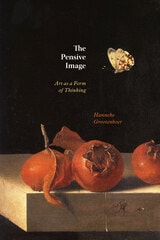
cover of The Pensive Image: Art as a Form of Thinking

The Pensive Image

Art as a Form of Thinking

Hanneke Grootenboer

University of Chicago Press, 2020

Grootenboer considers painting as a form of thinking in itself, rather than a subject of philosophical and interpretive thought.
 
While the philosophical dimension of painting has long been discussed, a clear case for painting as a form of visual thinking has yet to be made. Traditionally, vanitas still life paintings are considered to raise ontological issues while landscapes direct the mind toward introspection. Grootenboer moves beyond these considerations to focus on what remains unspoken in painting, the implicit and inexpressible that manifests in a quality she calls pensiveness. Different from self-aware or actively desiring images, pensive images are speculative, pointing beyond interpretation. An alternative pictorial category, pensive images stir us away from interpretation and toward a state of suspension where thinking through and with the image can start.

In fluid prose, Grootenboer explores various modalities of visual thinking— as the location where thought should be found, as a refuge enabling reflection, and as an encounter that provokes thought. Through these considerations, she demonstrates that artworks serve as models for thought as much as they act as instruments through which thinking can take place. Starting from the premise that painting is itself a type of thinking, The Pensive Image argues that art is capable of forming thoughts and shaping concepts in visual terms.
 
[more]
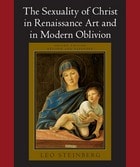
cover of The Sexuality of Christ in Renaissance Art and in Modern Oblivion

The Sexuality of Christ in Renaissance Art and in Modern Oblivion

Leo Steinberg

University of Chicago Press, 1996

Originally published in 1983, Leo Steinberg's classic work has changed the viewing habits of a generation. After centuries of repression and censorship, the sexual component in thousands of revered icons of Christ is restored to visibility. Steinberg's evidence resides in the imagery of the overtly sexed Christ, in Infancy and again after death. Steinberg argues that the artists regarded the deliberate exposure of Christ's genitalia as an affirmation of kinship with the human condition. Christ's lifelong virginity, understood as potency under check, and the first offer of blood in the circumcision, both required acknowledgment of the genital organ. More than exercises in realism, these unabashed images underscore the crucial theological import of the Incarnation. 

This revised and greatly expanded edition not only adduces new visual evidence, but deepens the theological argument and engages the controversy aroused by the book's first publication.
[more]
cover of The Sovereign Self: Aesthetic Autonomy from the Enlightenment to the Avant-Garde

The Sovereign Self

Aesthetic Autonomy from the Enlightenment to the Avant-Garde

Grant H. Kester

Duke University Press, 2023
In The Sovereign Self, Grant H. Kester examines the evolving discourse of aesthetic autonomy from its origins in the Enlightenment through avant-garde projects and movements in the nineteenth and twentieth centuries. Kester traces the idea of aesthetic autonomy—the sense that art should be autonomous from social forces while retaining the ability to reflect back critically on society—through Kant, Schiller, Hegel, Marx, and Adorno. Kester critiques the use of aesthetic autonomy as the basis for understanding the nature of art and the shifting relationship between art and revolutionary praxis. He shows that dominant discourses of aesthetic autonomy reproduce the very forms of bourgeois liberalism that autonomy discourse itself claims to challenge. Analyzing avant-garde art and political movements in Russia, India, Latin America, and elsewhere, Kester retheorizes the aesthetic beyond autonomy. Ultimately, Kester demonstrates that the question of aesthetic autonomy has ramifications that extend beyond art to encompass the nature of political transformation and forms of anticolonial resistance that challenge the Eurocentric concept of “Man,” upon which the aesthetic itself often depends.
[more]
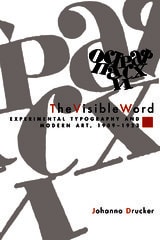
cover of The Visible Word: Experimental Typography and Modern Art, 1909-1923

The Visible Word

Experimental Typography and Modern Art, 1909-1923

Johanna Drucker

University of Chicago Press, 1994

Early in this century, Futurist and Dada artists developed brilliantly innovative uses of typography that blurred the boundaries between visual art and literature. In The Visible Word, Johanna Drucker shows how later art criticism has distorted our understanding of such works. She argues that Futurist, Dadaist, and Cubist artists emphasized materiality as the heart of their experimental approach to both visual and poetic forms of representation; by mid-century, however, the tenets of New Criticism and High Modernism had polarized the visual and the literary.

Drucker suggests a methodology closer to the actual practices of the early avant-garde artists, based on a rereading of their critical and theoretical writings. After reviewing theories of signification, the production of meaning, and materiality, she analyzes the work of four poets active in the typographic experimentation of the 1910s and 1920s: Ilia Zdanevich, Filippo Marinetti, Guillaume Apollinaire, and Tristan Tzara.

Few studies of avant-garde art and literature in the early twentieth century have acknowledged the degree to which typographic activity furthered debates about the very nature and function of the avant-garde. The Visible Word enriches our understanding of the processes of change in artistic production and reception in the twentieth century.
[more]